“The Woman in White” (1948) is an example of how Hollywood can “borrow” a classic novel, change things around, slap together “locations” on a soundstage and back lot, even alter the ending, and still, sometimes, get it right. This movie is a winner because of its engaging cast, and a director who employs film noir techniques on a Victorian mystery.

How the movie succeeds is probably because this is one of the few times where that old bemused studio system arrogance that altered the plots of classic novels as often as it changed the names of its contract players actually came up with a plot that works for this movie. This is not to say that the movie is the ultimate version of this story, written by Wilkie Collins in 1859—it does not strictly adhere to the plot—but I will say that no filmed version of this story I have seen, including two BBC miniseries (and nobody dramatizes their literature like the British), are better. All take liberties with plot and characterization. This movie, I think more closely follows the spirit, certainly energy, of the book.
Long post. I hope you brought an overnight bag.
The film, directed by Peter Godfrey, employs an economy of script and cinematography to capture the essence of the story. If there was one thing Old Hollywood did well, it was atmosphere.
The novel was a smash in its day. It was at the forefront of the rise of the sensation novel, and one of the first to use a character, or in this case, two characters, to follow logical detection to solve the mystery. Or mysteries. There are several. According to Matthew Sweet, who wrote the introduction to the Penguin Classic version published in 2009,
“The progress of the plot became a dinner-table topic and bets were struck on the outcome of this or that situation. Collins received letters from single men demanding to know the identity of the original for his heroine Marian Halcombe, and if she would accept their hand in marriage…The future Prime Minister William Gladstone cancelled a theatre engagement in order to continue reading it...Prince Albert was a great admirer, and sent a copy to the royal family’s most trusted adviser, Baron Stockmar.” (p. xv)

The book is very long and the subplots are intricately entwined. A modern reader might be surprised to discover that a book written in 1859 could have such a “modern” feel in pacing, but it really is a quick read if only because you can’t put it down. A charming approach the author uses to create intimacy with the reader is to break up the book into separate first-person narratives with many different characters each taking a turn at bat and giving their perspective on what is happening.
We know that Marian Halcombe is intelligent, loyal, and forthright, speaks her mind, because of her impressions as she relates them. We know others regard her with admiration because they say so. We know Walter Hartright is the hero because he tells us he suspects the ladies are in danger and he wants to help them. We don’t entirely know who the villains are at first, but slowly we begin to realize from the testimony of others that some people are not to be trusted.
The movie similarly sets us up right away on the characters of Marian, played by Alexis Smith; and Walter, played by Gig Young. We know right off the bat they are to be trusted, because both director and novelist know we have to come to the table trusting somebody. We experience the mystery through them. I like Gig Young in the role. He’s stalwart and transparent, and we need to see him as the Rock of Gibraltar.
In the book, Marian is described as tall and graceful, but with an unattractive face. Some critics may fault the film or at least smile at it because Alexis Smith was not unattractive. However, the previously mentioned BBC offerings featured actresses in the role who were also attractive, so it seems a moot point among directors to regard that bit of information on Marian as unimportant. And so it is.
Miss Smith is warm and natural in her role, speaks her accent with a greater ease than the other Americans, enjoyed good reviews, but this was one of the last films she made for Warner Brothers, having finally worked her way to star billing.
Walter Hartright is called to the mansion of Frederick Fairlie to teach his nieces to draw. In the book, the young women are half-sisters, who share a mother. Their parents are all deceased and Laura, the younger, is Fairlie’s ward. Laura, through her father, is the heiress of a great fortune. Marian, who is a few years older, has only a small income. They are inseparable and devoted to each other. Marian tells Walter at the beginning that neither she nor Laura can do without the other, so he must please both of them. In the end, he does.
In the movie, Marian and Laura are cousins. I’m not sure what necessitated this particular change in script, but the novel deals with Laura’s father having an illegitimate child, and maybe this was too close a relationship to make the censors happy. Beats me. That child is Anne, who in this movie becomes yet another cousin. She is a near lookalike to Laura. So, in this movie both Anne and Laura are played by Eleanor Parker.
I won’t go play-by-play from here on in, but what the movie does change from the novel is a skillful paring down of a very long story to under two hours of film. The movie should be taken separately from the novel as its own creation, and will be best appreciated as such.

For instance, and here is a big fat spoiler—in the movie, Walter falls in love with Laura, but later circumstances change and he falls in love with Marian. In the novel, Walter falls in love with Laura and marries her. In this case, I prefer the movie version. Laura is a weaker character and by the end of the novel, quite emotionally and physically dependent on Marian and Walter to take care of her. She draws our sympathy, but does not seem like she should be an object of passion. Marian, however, has been at Walter’s side through thick and thin, helping him and facing danger. He tells us how much he admires her, and other characters in the story do, too. One villain in particular is infatuated with her. It seems more logical that Walter would be, too. The author’s only reason for Walter’s romantic disinterest in Marian seems to be that she’s ugly.

Eleanor Parker, one of Hollywood's most gifted actresses, is quite good in the dual roles of Laura and Anne. Laura is charming, lighthearted, and unaffected. Anne, who has just escaped from an asylum, is tense, with a wandering mind and an overly emotional response to others. There may be a bit of scenery chewing here, but Anne’s at the edge and sometimes all an actress can do is go to the edge with her.
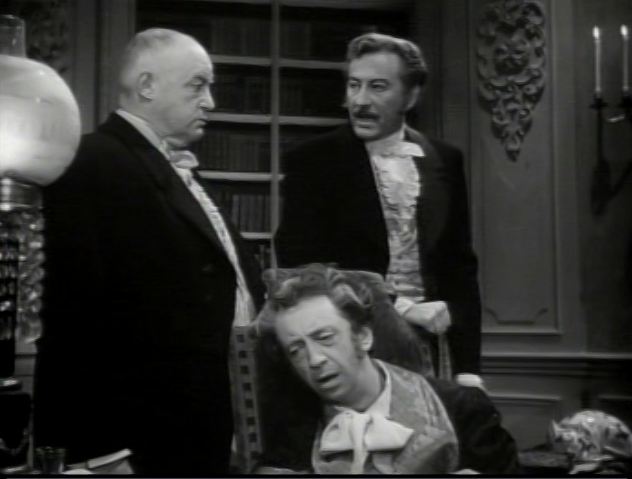
John Abbott plays Frederick Fairlie, plays him so well you wonder why he didn’t star in films instead of just play bit parts or uncredited walk-ons. Frederick is a self-absorbed fop, dramatically fussing about his nerves and comically displaying a disinterest in everything but himself. Mr. Abbott is spot-on and terrific in this role. He’s hysterical. It’s like this guy knew he was given the role of his life. He takes the baton and runs with it.
Poor Curt Bois, who I think gets one line in the film, is his bullied servant. With a slackened stance and hangdog look, he seems to be channeling Buster Keaton in a couple scenes, and makes the most of his part.

John Emery is Sir Percival, who is engaged to marry Laura. He’s charming one minute, and a villain the next. He’s out for her money.
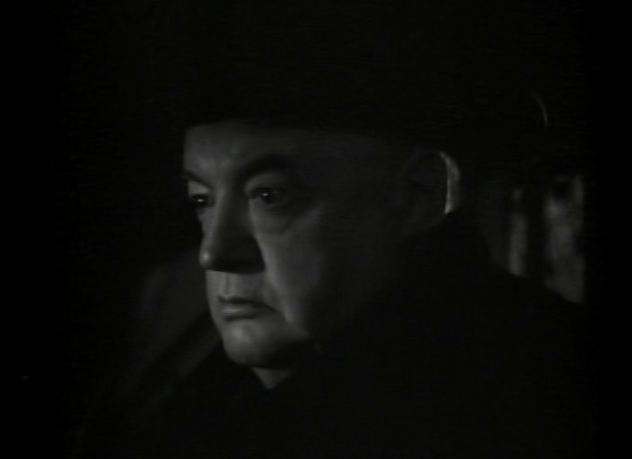
The best for last. Sydney Greenstreet. It’s as if Wilkie Collins had Sydney Greenstreet in mind when he wrote the complicated character Count Fosco. A brilliant man of self indulgence, who plays human beings like chess pieces, and is so wicked that writes his own rules. And usually gets away with it.
We know early on Mr. Greenstreet must be wicked, because the director gives us a hint at the very beginning of the movie. Gig Young is walking in the twilight mist of the English countryside of the back lot. He meets Anne, learns a bit of her story, learns she is running away, and then she bolts as a carriage approaches. A man asks if Young has seen an escapee from the asylum. Inside the carriage where Gig Young can’t see him, is Sydney Greenstreet with a scowl on his face. He looks mean.
We next see Greenstreet when he pops through the French windows from the terrace as Mr. Young is welcomed to the mansion by Alexis Smith. She is delighted to see Mr. Greenstreet, and treats him like a fond and funny uncle. It's as if he is a different person. So, we see from the start his character is duplicitous.
We are quickly fed the plot in bite-size chunks—about asylums (there will be more than one escape before the movie is through), about inheritance, and getting robbed of one’s inheritance, and how to foil the bad guys.
Alexis, by virtue of her being the older girl and because John Abbott can’t be bothered, takes responsibility for the younger Laura. When she senses Gig Young falling for Laura, she warns him that Laura’s already engaged and he has to knock it off. We see, though he does not, that Alexis is falling in love with him. A few nice very light touches by the director indicate her desire. In one scene, he questions Mr. Greenstreet's motives, and she tells him not to overstep his bounds.
The camera is on her as she turns her back to him and proceeds to leave the room, but she thinks the better of it, softens, and turns to address him again.

The camera shows us he has already turned his back to her and is walking out to the terrace to be with Laura. Camera cuts back to Alexis, who looks like a despondent wallflower at a country dance. We can imagine she has been in this situation before.
In another scene he plans to leave the estate because Laura is going to marry John Emery. He kisses Alexis’ hand and she leans over him slightly as his head is bowed. She lingers as if she will touch him or say something, but doesn’t. These are great clues that will make their union logical at the end, except we get no clues from Gig Young. The director doesn’t set up any scenes with his reactions to her. His later declaration of love for her seems a surprise, to us as well as her.

The director gives us some other shots though, that are splendid, uniting the 1940s with the 1850s in a neat way. Lots of ground-to-ceiling film noir shots that show menacing figures, a few shadows on the wall.
There’s a spiffy scene shot from the ceiling to the floor through the crystal jungle of a chandelier. It is morning, and a few characters leave the room through a door, closing it behind them.

Then, instantly it is night, the chandelier is lit, the door opens, and another character walks through. It is a seamless showing of the passage of time.
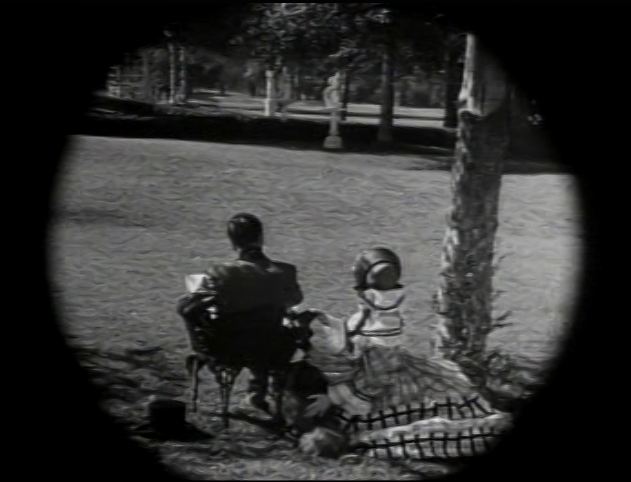
On another occasion, Gig Young and Eleanor Parker are spied on through a telescope, and the camera takes a view of them through the telescope that looks like an iris shot from a silent movie. Then it opens up, and we are no longer watching them from a distance; we are right behind them. We could touch them.
I also really like the score of this movie. Max Steiner is credited, but some of the English country ballad flourishes sound authentic to me, and I wonder if he adapted some traditional music?
Laura, who has now married Sir Percival, may be in great danger.
We suspect this when Alexis, who has spent a few months with relatives in the country while Laura and Sir Percival are in Europe on their honeymoon, returns to silly John Abbott’s mansion to wait for them.
Hey, none of the servants are familiar!
They’re all new!
Including marvelous
Anita Sharp-Bolster, who we discussed here in this previous post. That woman, with her stupendous profile, could play scary/funny like nobody.
Alexis is given a different room on the other side of the mansion! Away from Laura!
Alexis confronts John Abbott about this. He attempts a tantrum, but his blood sugar level is too low.
Alexis discovers that Sydney Greenstreet is living here now with his wife, played by Agnes Moorehead. She is an enigma, and takes the character from the novel to a different, more intense, level. We may puzzle at Greenstreet’s hold over her, that allows him to taunt and manipulate her, but still waters run deep. There’s a lot more going on here. We will soon see she’s not just a wax figure under her husband’s thumb. Miss Moorehead does so much with a small role, it's like she conducting a master class in acting.
When the honeymooners return, Laura is a changed person—haughty, gaudily bejeweled and attempting to smoke at the dinner table. (GAD!) She has not replied to Alexis’ letters to her during their separation.
Back in her room that night, Alexis writes her fears in her diary that Laura is lost to her. This is about the only scene, except for some beginning narration by Gig Young, that tries to imitate the novel in first-person perspective, but that’s hard to keep up in a movie.
Later Laura sneaks into Alexis’ room, tells her she has to act out a part because she’s in danger. Alexis gets to do some girl power stunts when she climbs out on a ledge in a storm to eavesdrop (quite literally under the eaves) on the plans of the bad guys.
She returns to her room and we see her figure in a shadow on the wall as she is changing from a rain-soaked nightgown to a dry one. Then the curtains part, and it’s Sydney Greenstreet! He thinks she knows too much. He’s also attracted to her.
There’s a nifty exchange between them when she asks, “Was it necessary to hide there and shame me as well?”
He responds with that gravely-voiced huff, “I was only too happy to discover at last something as flawless in form as it is in spirit.” It took me several viewings of this movie to realize that meant he’d been watching her undress. Yes, I am that obtuse.
There’s nothing quite so charming as Victorian lechery.
And, funny enough, just before this a scene where we hear John Emery muttering his frustration and he appears, if I’ve heard right, to use the word “bugger”. Obviously, to us in the US this is just a funny sounding oath, but in British English it’s a vulgarity. It may have lost quite a bit of its punch through the decades and no longer so offensive, but at the time story is set, it was quite vulgar and author Wilkie Collins never used it. I guess those minding the store didn’t know that.
Actor and screenwriter 1, Production Code 0.

Because Anne and Laura are played by the same actress, we do have one Patty Duke Show scene where they’re together, but it’s not overdone. I don’t think we ever mistake one for the other because they behave differently, and Anne’s makeup, with her dark circles under her hollow eyes indicates she is sickly. But others mistake them, and I won’t tell you what happens because of it. So there.
Mr. Greenstreet gloats over Alexis when she refuses his offer to be his mistress, predicting she will return of her own accord. She does, when she thinks Laura’s in too big a jam and Walter unable to help. She offers herself to the big guy if he lets Laura go.
Alexis Smith appeared with Sydney Greenstreet in
“Conflict”(1945) discussed here, and she enjoyed working with him.
On “The Woman in White”, her husband in real life, Craig Stevens, was quoted in
The Women of Warner Brothers by David Bubbeo (McFarland and Co., Inc.: Jefferson, NC, 2002) “Alexis was mesmerized by Sydney Greenstreet…He memorized the entire script.
He knew everyone else’s role.
She just thought he was fascinating to be around.”
In the novel, Marian describes Fosco as a man, “who devours pastry as I have never yet seen it devoured by any human beings but girls at boarding-schools…” In a nutshell we have Fosco’s love of food, and Marian’s witty sense of humor.
In another passage, she tries to get Laura to leave her cruel husband, “Are you to break your heart to set his mind at ease? No man under heaven deserves these sacrifices from us women. Men! They are the enemies of our innocence and our peace—they drag us away from our parents’ love and our sisters’ friendship—they take us body and soul to themselves and fasten our helpless lives to theirs as they chain up a dog to his kennel. And what does the best of them give us in return? Let me go, Laura—I’m mad when I think of it!”
Doesn’t sound very Victorian, does it? The book also has an astounding subplot of murder by a 19th century style Italian Mafia.
Watch the movie and enjoy it for all it is, which is plenty. But treat yourself to the book as well. Hollywood exploited popular literature and classic literature, but also introduced a fair number of its audience to these books for the first time. A lovely co-dependence. Like Marian and Laura.