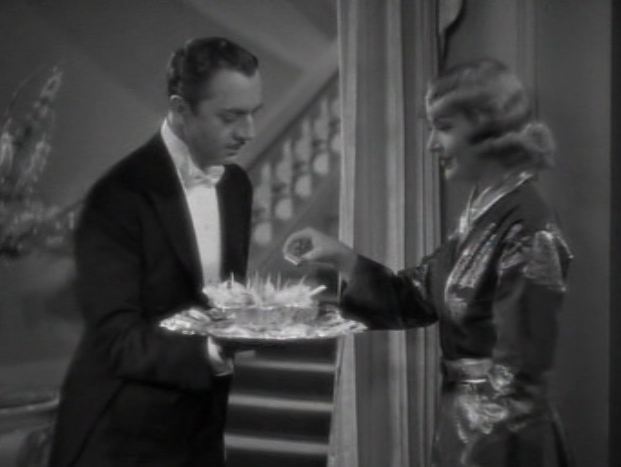
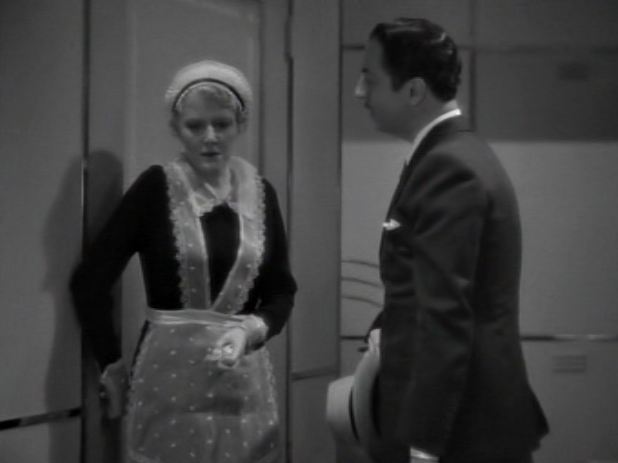
“In Old Chicago” (1937) re-ignites the Great Chicago Fire of 1871, and illustrates American History as part legend, part wish fulfillment, and mainly the extraordinary ability to cope.
It is easy enough to run down a checklist of all the “facts” in the telling of this story and mark which are true and which are not. The most obvious of which is, of course, that the cause of the Great Chicago Fire was probably not Mrs. O’Leary’s cow. The story of Daisy the cow kicking over a lantern in the barn and setting the monumental blaze that killed perhaps as many as 300 people and left some estimated 100,000 homeless over the course of a single night has been refuted by alternate theories.
The first news of Mrs. O’Leary and her cow was reported in the Chicago Tribute at the time of the fire, and later was found to have been completely made up to sell papers. Such a tragedy needed a scapegoat, and in those days of anti-Catholic, anti-immigrant sentiment, what better scapegoat than a poor, ignorant, slovenly, comic old Irish crone and her stupid, silly cow?
Except that Mrs. O’Leary was not ignorant, slovenly, nor a crone. She was in her late ‘40s when the incident occurred, hardworking, married, a mother (with a son and a daughter, not three sons), and had the great misfortunate to be only two of the accusations against her: poor, and Irish.
Recent historical investigations have shifted suspicion on the fellow who actually noticed the fire in her barn first, and called out for help. You’ll see him in the film -- a man with a wooden leg hollering, “Mrs. O’Leary! Oh, Mrs. O’Leary!” His character is unnamed in the movie, but he is meant to be Daniel “Peg Leg” Sullivan, whose inconsistent testimony at the original investigation has since come under scrutiny. He may have caused the fire in the O’Leary barn by accident. Have a look here at this
website for more information.
John Wallace is the actor who plays this man in the movie “In Old Chicago”, and I would assume wore a prosthetic leg in real life, because he played so-called “peg-leg” characters in at least six other films.
The truth about the cause of the fire aside, “In Old Chicago”, has a charm and vigor that is perhaps due to this leaning on American legend rather than fact. It tells the story with a wink and a smile. It attempts to entertain with a tale we think we already know, rather than enlighten us on what we do not know.
I wonder, though, if younger, modern, audiences are even aware of the Mrs. O’Leary legend? To 1937 audiences, this tale was familiar, homespun, and as part of Americana as Paul Bunyan or Pecos Bill. They may have accepted it as legend and not truth, but the legend was like a souvenir of an era. A snow globe you bring home from the fair. It’s not real either, but you like to shake it once in a while and watch it “storm”.
Going down our checklist, most of the characters in the movie: the three sons, the rival politician, the saloon singer, are all fictional. In the movie, Patrick O’Leary dies in the first few minutes. In real life, he was still alive at the time of the fire. In the movie, Mrs. O’Leary’s first name is Molly. In real life, it was Catherine. Come to think of it, the only factual character was Daisy the cow.
She had a small, but pivotal role.
What the movie lacks in historical accuracy (at least as far as characters are concerned; the sets, costumes, and the fire special effects are pretty good), it makes up for in some stunning visual images.
One of my favorites comes at the very beginning of the movie, a shot of the prairie when Patrick O’Leary meets his Maker. We see Mr. and Mrs. O’Leary, Irish immigrants with brogues, wit, and guts, travel across the prairie with their three small boys in a covered wagon. They are on their way to Chicago, the new boomtown of the great American Midwest. It is 1854. Mr. O’Leary, at his sons’ urging, playfully whips the horses and races a nearby locomotive. He has an accident when the horses become unhitched. He is pulled off the wagon and dragged on the ground.
![]()
Mrs. O’Leary leaps from the wagon and runs toward her husband’s prone body. We see her running across a very great distance, a wide, rolling, empty grassland. All is silent, but in your imagination you might hear the wind sifting over the grass; you certainly get a sense of solitude, of her helplessness in such a big place. In that long shot of the woman running, you also see a hint of strength and courage. The image of the small figure on the huge prairie is stunning.
Patrick O’Leary, played by J. Anthony Hughes says his dying speech, and his widow and sons go on to Chicago.
Mrs. O’Leary is played by Alice Brady, theatre and movie veteran. Her spirited, feisty characterization earned her a Best Supporting Actress Oscar for this movie. Unfortunately, she was never to receive it. On the night of the ceremony, she was home with an injury and her award was accepted by an unknown man who came up from the audience, and promptly walked away with it. Sadly, she succumbed to cancer two years after this movie was made and died at 46 years old.
Her grown sons in this movie are played by Tyrone Power as the charming scamp and ne’er do well; Don Ameche as the good son who battles poverty (his own) and injustice (other people’s) as a lawyer; and Tom Brown as the baby of the family who marries the Swedish hired girl and helps Ma with her laundry deliveries.
Another great image in the movie is when they first arrive in the boomtown of Chicago, and we are plunked down with them in a maze of wooden hovels, saloons, and shops all nestled in a spectacular sea of mud. Pedestrians are knee-deep in mud, horses get stuck in it.
In such a dirty place, Widow O’Leary starts a laundry business. Another great visual is a panning shot of Alice Brady wrestling clothes from a network of lines in her backyard into a basket.
Tyrone Power dirties his own hands with saloons and political graft in this shanty neighborhood called The Patch (in this movie The Patch is meant to refer to a particular shabby sort of red light district, but in the 19th century many Irish immigrant neighborhoods in American cities were often referred to as The Patch).
Tyrone’s rival is a ruffian saloon owner played by Brian Donlevy, who made a career out of playing essentially the same scoundrel from film to film. They both admire Donlevy’s new stage act, the lovely Miss Alice Faye. There are several musical numbers in the movie.
One gets the sense of something really special happening with Tyrone Power, Don Ameche, and Alice Faye all seeming to get their big break in this movie. They are all young and beautiful, and on the rise.
However, the minor players make a distinct impression, from Joe Twerp’s stuttering scene, to the unforgettable visage of Rondo Hatton, whose tragic facial disfigurement from acromegaly was exploited in monster or monster-as-human type roles the studio. Here, he’s one of Donlevy’s goons.
Most impressive is Madame Sul-Te-Wan, who plays Alice Faye’s maid. Like most African-American actors of the period, her role is marginalized, but she manages, I think, to escape stereotype with a wonderful quality of razor wit. With her rapid delivery of lines, and her physical slapstick timing, she reminds me of a modern day stand-up comedian. Despite that fact that one of her earliest roles was in D. W. Griffith’s “Birth of a Nation” (1915) (she stayed in contact with Mr. Griffith for years and attended his memorial service), she really comes off as more 21st century savvy comic than 19th century servant or 20th century exploited actress.
We meet her first singing a bluesy tune, admiring herself in the mirror wearing one of Alice Faye’s wraps. She comically covets her employer’s things and helps herself to them. When Alice Faye wants her to keep out admirers or manage her affairs, Madame Sul-Te-Wan replies, “I done told him that ‘til I’m black in the face.” She says it lighting quick, under her breath, as if we are not supposed to hear it. She’s a scene stealer.
When Tyrone Power forces his way into Miss Faye’s boudoir (which happens a couple of times), Madame Sul-Te-Wan shrieks, chases Power chasing Faye, and attempts to beat him with one of her gowns, and hangs onto his coattail trying to pull him away, shouting, “Get out of here, white man!” I have to wonder how much she made up as they went along, because she’s hysterical and seems to know it. You don’t even notice Alice Faye when Madame Sul-Te-Wan enters the scene.
When she’s off to drag a cop back, Power has wrestled Faye to the floor for a kiss, another great visual. Here Faye’s furious, arms pined back, panting from exertion and frustration. Director Henry King just leaves them wordless for a moment and all we hear is Alice Faye’s heavy breathing. Erotic slapstick.
This is world of gaslight and handlebar moustaches, of barbershop quartets, and political rallies that feature quantities of beer.
Another good scene is when Alice Brady, her boys, and daughter-in-law dance a jig in the parlor and finishing off a bucket of beer.
Don Ameche runs for mayor against Brian Donlevy, and Tyrone Power pulls a few switcheroos to get him elected. But, Mr. Ameche is honest, won’t dance for political favors, and vows to wipe out The Patch and all the unstable “mushroom growth” of Chicago. He points out the wooden shanties are a fire hazard. He wants to eliminate crime, even if it means destroying his brother.
Well, then Daisy kicks over the lantern and you know what happened next. The special effects guys take over.
Round about this time, with mobs of terrified people running from the fire that spreads rapidly, loved ones separated (we entirely lose Madame Sul-Te-Wan somewhere) and Tyrone Power staggering around a dynamited firebreak with blood on his face -- you might notice a similarity to the goings on in “San Francisco” (1936). They could have used that movie as a template.
Except “In Old Chicago” has Sidney Blackmer as General Philip Sheridan to help fight the fire. This part was true.
And “San Francisco” didn’t have a cattle stampede.
The impressive amount of mud gives way to an impressive amount of extras all running as fast as they can to get to Lake Michigan to escape the flames.
Alice Brady, standing up in a cart half-submerged in the Lake, looks back on the flaming city and remarks, “It was a city of wood, and now it’s ashes.” But, she tells us that Chicago will be reborn and gives us hope for the future.
The Water Tower - one of the few structures to have survived the fire. J. T. Lynch photo.
Chicago was reborn, and that story perhaps is the one that should really be told, for in a generation it became the city of stone and steel that Don Ameche wanted, once again the Queen of the Middle West. City of the Broad Shoulders, Hog Butcher to the World…you know.
No such resurrection came to the real Mrs. O’Leary, however, who was vilified in the press, and on the anniversary of the fire for the rest of her life, came reporters who wanted her to remember. She didn’t. No matter how many times she moved, they still found her. She refused even to accept the offers of promoters and hucksters to capitalize on her fame. She just wanted to be left alone. Her husband Patrick died in 1894. She died the following year.
In 1997, Chicago passed a resolution exonerating Mrs. O’Leary, and Daisy, from any blame for the Great Chicago Fire. The Mayor offered an apology to her great-grandchildren.
J.T.Lynch photo
Here is a plaque that stands on the spot on De Koven Street where the O’Leary home stood.
J.T.Lynch photo
Back up a bit, and you see the memorial to the Great Chicago Fire, a bronze sculpture, “Pillar of Fire” by sculptor Egon Weiner, which was placed here in 1961.
Behind it, is the Chicago Fire Academy, where firefighters are trained.
J.T.Lynch photo
For more on the
Great Chicago Fire, have a look at this website.