Showing posts with label Bill Hayes. Show all posts

Thursday, November 6, 2014

Ann Blyth's Concert Career


Where has Ann Blyth been all these years?

This was the lead to Stephen Holden’s New York Times review of Ann Blyth’s concert with Bill Hayes at the famed and elite Rainbow and Stars atop Rockefeller Center in November 1992.

…she seemed so physically unchanged from her 1950s self that it was possible to imagine she had been frozen for the last 30 years and had thawed herself out for the occasion.

Their act was called “An Elegant Evening of Beautiful Music,” a collection of theatre and movie songs.

The kind of show that rarely plays in Manhattan nowadays.  Suburban dinner-theater entertainment aimed at audiences over 60, it trades heavily in nostalgia toward these show-business veterans who have aged well and seek only to spread sugarcoated cheer….Miss Blyth’s lyric soprano is still in good condition.

Today we discuss Ann Blyth’s “third act” career as a singer.  I use the term “third act,” though the more common dictum “second act” refers to a career adopted, or revived, late in life.  It stems from F. Scott Fitzgerald’s hard luck observation, “There are no second acts in American life.”  Well, there weren’t for him, poor man, but for others…a second act, a second chance at life, a revival is sometimes possible.

Ann Blyth had more than a second act, she had a “third act,” her singing, which took her beyond both her screen and stage career, in her resilient soprano that is like a metaphor for her resilient career: surprisingly strong, stunning it its loveliness, and carefully controlled.  Her “third act” was not so much a new venture as a reprise.  She always was a singer—before she became a movie star, before she even became an actress, she was a singer.  At six years old, she auditioned for a children’s radio program in New York City, and stood upon a box to reach the microphone, and sang the late hit “Lazy Bones” by Johnny Mercer and Hoagy Carmichael.

Years later she would be required to stand on a box to kiss Gregory Peck.  Some of the best things in life are just out of reach.

Unless one perseveres.

She sang, and acted, on many radio programs as child, before her life-changing audition for Lillian Hellman’s Broadway play, Watch on the Rhine.  When her film career was launched in her early teens, she continued to perform as a singer for charity venues on her own time.  Donating her talent to needy causes had a secondary effect: it gave her experience singing live in front of an audience, even if it was just 50 people in a church hall. Gradually, those audiences became larger.  She traveled many miles to perform for them.

Syndicated columnist Sheilah Graham wrote of one such benefit: 

 Ann Blyth is one of the reasons why people like Hollywood.  She is just back from doing a swell show for the Loretto Heights College in Denver.  

Perhaps her largest audience in these years was the combined theater and radio audience who heard her at the 1949 Academy Awards, held March 23, 1950 at the RKO Pantages Theatre, where she sang one of the nominated songs, “My Foolish Heart” in a low-cut red gown.  In one respect, she was announcing her availability as a singer in the industry for those who had forgotten, or else never knew of, her talent, and throughout the 1950s took advantage of other opportunities to sing.  

She sang on Louella Parson’s radio show in September 1951.  After suffering the obligatory and heavily scripted “interview” on whom she was, or was not, dating, Ann soars in a song called “My Golden Harp” to the tune of “Danny Boy” or “The Londonderry Air.”  One imagines it was a payoff for the indignity.

Other radio shows gave her chances to sing, and television would give her a few more, including another Oscar® program in 1954, which we discussed in this previous post.  The fifties was a great era for musical variety on TV.  Among the shows on which she sang were The Perry Como Show, The Dinah Shore Show, The Fisher-Gobel Show, The Ed Sullivan Show, The Tennessee Ernie Ford Show, and The Jack Parr Show.  

It was also during this decade that Ann Blyth took an unusual (for a movie star) and brave plunge into nightclub performing.  In the late summer of 1954, still a new mother, her first baby only a few months old, she tested a new singing act for a few nights at the Tops Nightclub, a Streamline Moderne popular spot on the Pacific Coast Highway in San Diego.  

She wowed the crowd, and then brought the act up to Sacramento for a weekend at the state fair in September, all preparatory to opening at the Sahara in Las Vegas in late September for a month’s run.  The Los Angeles Times reported:

Ann Blyth proved that night-club entertainment can be something utterly new and different when she made her debut here tonight.  She received thunderous applause when she wound up her headline singing and intimate conversation with her audience at the Sahara.


Ann came down with laryngitis during that engagement, and though these comic press photos indicate her brother-in-law Dennis Day came to minister to her sore throat, he really helped out by filling in for her on stage.


There was to have been another appearance at the Sahara two years later in 1956, but MGM, her home studio at the time, called her back for the film Slander (1957), which we’ll discuss next week. 

But it was back to the nightclub circuit in 1958, when after The Helen Morgan Story (1957), which we’ll discuss in a future post, turned out to be her last film.  In September 1958 she opened a new act the Coconut Grove in Los Angeles.  Louella Parsons was in the audience.

Ann Blyth, so refreshingly sweet and beautiful at the Coconut Grove joined us after her show.  She said every night she sings a song about her husband, Dr. Jim McNulty, and that night he was sitting ringside when suddenly she looked and he was gone.  You guessed it—a call from the hospital sent him scurrying there to deliver a baby.

She had broken in the act the previous weekend in Phoenix, Arizona, where again, her obstetrician husband couldn’t make it to opening night because the stork interfered.  The entertainment press at this time conjectured how a two-career marriage and a growing family would work.  

The Los Angeles Timesran a brief blurb to announce the debut of the act that read more like a dossier than a feature story:

Subject: Ann Blyth, singer-film star, female.
Makes local nightclub debut at Coconut Grove, Ambassador Hotel on Wednesday.  Only other such appearance at Sahara in Las Vegas three years ago.  Plans to make club dates another facet of her career.

Sounds like Sgt. Joe Friday wrote that one.


Her planning to make club dates another facet of her career stemmed, in the wake of no upcoming films after The Helen Morgan Story, from practicality as well as her desire to sing.  From a syndicated column in September by James Bacon, which teases Ann as Hollywood’s “little lady” becoming a “saloon singer,” he quotes Ann:

“All the movie scripts offered wanted me to go to Europe and for such long times.  I just felt that I couldn’t be separated from my family that long.”

After the Coconut Grove, Ann would take this act to the Sahara in Las Vegas, and then to New York and Miami Beach, Florida.

In the early sixties, Ann re-joined the theatre world in what would be three decades of touring musical theatre performances, which we covered in this previous post.  Her re-emergence on the concert scene came in the mid-1980s.

In 1985 she teamed up with her brother-in-law, Dennis Day, for a show in Downey, California, that was so well received, they did an encore performance at El Camino College in Torrance, California.  Perhaps there might have been more concerts with Dennis Day, beloved longtime radio sidekick of Jack Benny, but sadly, Mr. Day became ill and was diagnosed with Lou Gehrig’s Disease.  He died in 1988.

Ann called upon Bill Hayes to be her singing partner in a series of concerts that would continue for another decade.  Mr. Hayes had appeared with her in Brigadoon on stage in the late 1960s, and most recently had starred opposite Ann in Song of Norway in March 1985.  Many will remember Bill Hayes from his long run on the daytime drama Days of Our Lives.

Together, they joined Ann’s first screen partner, Donald O’Connor, for a two-week stint at The Dunes in Las Vegas in June 1992, then Hayes and Ann continued to take their show to several spots across the country, culminated by a four-week engagement at the exclusive Rainbow and Stars in New York City in late October through November 1992.  At the time she was 64 years old.  For a really stunning publicity photo of Bill Hayes and Ann Blyth together, have a look at Mr. Hayes’ website here.

And here:

Courtesy Bill Hayes, used by permission.

To promote their concert, Ann and Bill Hayes appeared as guests on Casper Citron’s radio talk show on New York’s WOR on November 14, 1992.  The studio was in the same building where Ann started in radio as a six-year-old child singer.  The poignancy of her bringing her career full circle in this very place seemed lost on Mr. Citron, who was a former politician, former theatre critic, and longtime radio host in New York.  He had interviewed many famous people, and yet one is struck by his lack of preparation and frank ignorance in this interview.  One is also struck by Bill Hayes’ gallant explanations to their host on Ann’s accomplishments, when she would not toot her own horn.  Both Bill and Ann were quite patient with their host who wandered off track many times.  Below are a few brief excerpts of a transcript of the interview:

AB:     We do a variety of music from Broadway and Hollywood.  I think a lovely potpourri, songs that everyone can certainly remember, songs that everyone has hummed or sung or whistled.
CC:      Your career in films was not as a singer?
AB:     Well, it didn’t start out that way, that’s correct.  And really, when I did my test, they said, “What else do you do?” and, of course, I said, “Well, I also sing.”  But it wasn’t until…
CC:      Did you sing in The Helen Morgan Story?
AB:     No, they used someone else’s voice, Gogi Grant, who has a completely different sound, a marvelous voice, to be sure, but a very pop sound and for some reason the studio at that time felt that that would be an added, an added dimension for some reason to that movie.
……………..
BH:     But Casper, Ann really did sing in a lot films.  It was just The Helen Morgan Story that…
CC:      What was your biggest singing role?
AB:     Well, I…
CC:      Pardon my stupidity on this.
AB:     I think I would have to say The Student Prince, and…
CC:      Oh, that’s a big singing role.
…………………….
CC:      Do any of these people that you have worked with through the years come up to Rainbow and Stars?
AB:     Oh, indeed, and that’s half of the pleasure of what we do, is, of course, seeing people that perhaps you haven’t had a chance to see in many, many years—the nature of our business being such that you find yourself on one coast and so many of your friends are someplace else.
………..
BH:     We do two different shows.  We do a dinner show and an after-theatre show.  The dinner show is at 9:00.  People come at 7:00 or 7:30 and have dinner, and we work from 9:00 to 10:00.  And then they come after the theatre, we do an 11:00, excuse me, 11:15 show.
CC:      How many times a week?
BH:     We do that five nights a week, so we’re off Sundays and Mondays, and we play Tuesday through Saturday.  And it’s a thrill.  It’s a breathtaking view.
CC:      That’s 10 times a week.  That’s even more than Broadway.
AB:     But it’s such lovely music.  We really do have a good time.  It is a lot of singing, but we do have a good time.  And the view is spectacular.
CC:      It always has been.
AB:     Here I am back in the very same building that I started in.
CC:      A number of years later.  We don’t ask…
AB:     Yes.
CC:      …how many.
AB:     Well, I’m just glad that I’m here.

Some of those old friends mentioned above who turned up in the audience were Claire Trevor; Arlene Dahl; Imogene Coca, with whom Bill Hayes appeared on the wonderful classic TV Your Show of Shows; Ruth Warrick, with whom Ann appeared in Swell Guy (1946); which we discussed here, and her old pal, Roddy McDowall.

Syndicated columnist Liz Smith was also in the audience:

Ann Blyth, who was a movie star when the words really meant something, looks incredible.  Time seems literally to have stood still for her—and not only physically.  The star’s soprano is as lilting and steady as when she was knocking out those MGM musicals…

Blyth, expertly partnered with Bill Hayes, even perched on a piano a la Helen Morgan and belted out “Why Was I Born?”

The room was awash with nostalgia.

Ann and Bill Hayes continued sporadic touring with their show, popping up Florida, Illinois, and a cruise ship from Acapulco to San Francisco.

More gigs in the mid-1990s partnered her with John Raitt, with whom she performed in Los Angeles.  In October 1994, they appeared at the Academy Plaza Theatre for two hour-long concerts, along with Ann’s longtime music director and accompanist, Harper MacKay, on piano.  They performed solos and duets from many musicals, including teaming up on “If I Loved You” from Carousel.

What has become known as The Great American Songbook has achieved a certain degree of “cool” these days, but twenty and thirty years ago was still in a nadir patch of being termed “old people music.”  Some of the articles about their performances have a slightly condescending tone to them. 

Ann Blyth, as on many occasions and in many circumstances of her life, seemed above it all, and serenely took the path, and musical form, that was right for her.

From the Los Angeles Times article by Libby Slate promoting her concert with Mr. Raitt in October, 2004:

Although they have sung many of Sunday’s selections numerous times, both say the songs remain fresh.  “In almost every phrase, there’s such emotion that it would be difficult not to feel it when you sing it, and hopefully, pass it on to the audience,” Blyth says.  “It’s the best way to communicate to those who are perfect strangers; suddenly, they’re not strangers any more.”

Ann Blyth continued into the twenty-first century with an act she performed with her accompanist, singing and telling stories of her film career on the woman’s club circuit in support of charities, once again bringing a facet of her career full circle.  In May 2000 she performed for an audience of 500 at a Holiday Inn in Hanover Township, Pennsylvania, to raise funds for the Visiting Nurse Service of Sacred Heart Hospital, opening with “With a Song in My Heart.”

From the Express-Timesof Easton, Pennsylvania: 

Her voice, after nearly six decades of professional activity, was a little rough around the edges, but pleasant, warm and surprisingly powerful for such a tiny person; she wears a size four.  Her upper range is clear and easy, and she holds each phrase for its full value.

She was 71 at the time, and mimicked herself as a small child singing “Lazy Bones” for her very first audition, and playfully following the trajectory of her early career, sang “Peg O’ My Heart,” which was the song she sang for her audition prior to being signed by Universal.

We’ve noted previously that Ann sang at the 2009 Thalians Ball, along with other Hollywood stars, in Los Angeles in support of that charitable organization’s raising funds for children with mental health issues.  These types of charitable venues not only serve the community, but they seem to be, these days, the most receptive to aging singers.  It’s one thing for The Great American Songbook to be accepted by a young person in the form of a young entertainer, like Michael Bublé, or even someone older but tolerated as sufficiently hip, like Tony Bennett, but a roster of old tunes sung by old singers for more than a good cause is still more than the apparently hipper-than-thou can take.  In October 2005, Stephen Holden of the New York Times panned a concert of songs from the movies at Lincoln Center, an over-long event (some three-and-a-half hours)…

– which featured mostly second-and-third-tier performers along with reminiscences by semi-and-semi-semi legends like Ann Blyth, Arlene Dahl, Sally Ann Howes, Jane Powell and Margaret Whiting, strove to connect old-time Hollywood glamor with the New York cabaret world.  

The master of ceremonies was Turner Classic Movies’ own Robert Osborne.  

With the exception of Ms. Powell’s, and to a lesser extent, Ms. Blyth’s, the reminisces of the semi-legends consisted of dull, over long mixtures of trivia, sentimentality, and self-glorification. 

Bad reviews come and go, and so do bad reviewers, as much as bad performances.  The music lingers, at least for those who like it, and for one lady who has sung it all her life.

“I’ve always enjoyed the joy, the excitement, the pure pleasure of singing this music.  It’s so easy to listen to, it stays with you.  Isn’t any art supposed to do that—to climb inside you and give you a wonderful feeling?”

Come back next Thursday when we return to Ann Blyth’s movie career and discuss the power of the press to do more than critique in Slander (1957).


PASS THE WORD!!!!!   Looking for photos and shared memories of the recent TCM Cruise regarding Ann Blyth's talks.  This material will be used for my upcoming book on Ann Blyth's career.  Please contact me at: JacquelineTLynch@gmail.com.

*******************************************
Bill and Susan Hayes.com - http://www.billandsusanhayes.com

Chicago Tribune, October 28, 1990, special article to the Tribuneby Bill Hayes.

Daily Breeze,(Torrance, California), March 1, 1985, article by Sandra Kreiswirth; October 19, 1922, article by Sandra Kreiswirth, p. C1.

Daily News of Los Angeles, June 21, 1992, “Hayes of ‘Days’ Fame Hits the Road in Song-Filled Gala, by Lynda Hirsch, p. L25.

The Express-Times(Easton, Pennsylvania), May 4, 2000, “Actress Ann Blyth captures memorable career in songs – She is most known for ‘Mildred Pierce’ by Cynthia Gordon, p. B4.

The Los Angeles Times, September 22, 1954, “Ann Blyth Wins Ovation at Sahara in Las Vegas” by Edwin Schallert, p. B6; August 31, 1958, p. D1; June 23, 1988, article by Edward J. Boyner; October 14, 1994, “Playing Their Songs: Concert by John Raitt and Ann Blyth will target a crowd that craves ‘hummable’ music,” by Libby Slate.

Milwaukee Sentinel, September 10, 1958, syndicated article by Louella Parson, p. 6, part 3.

The Morning Call(Allentown, Pennsylvania), May 4, 2000, “Ann Blyth Appears at an Annual Benefit That Raises Money for Children’s Causes in the Lehigh Valley,” by Christian D. Berg, p. B02.

New York Times, November 3, 1992, review by Stephen Holden; October 22, 2005, by Stephen Holden.  

Ocala Star-Banner(Florida), September 2, 1958, syndicated article by James Bacon, p. 3.

The Spokesman Review(Spokane, WA), syndicated article by Sheilah Graham.

St. Petersburg Times(Florida), September 18, 1994, “Onetime Oscar Nominee Picks Stage Over Screen” by Jay Horning, p. 12A.

Toldeo Blade, November 13, 1992, syndicated column by Liz Smith, p. P-1.

****************************
 THANK YOU....to the following folks whose aid in gathering material for this series has been invaluable:  EBH; Kevin Deany of Kevin's Movie Corner; Gerry Szymski of Westmont Movie Classics, Westmont, Illinois; and Ivan G. Shreve, Jr. of Thrilling Days of Yesteryear.  And thanks to all those who signed on as backers to my recent Kickstarter campaign.  The effort failed to raise the funding needed, but I'll always remember your kind support.
***************************
TRIVIA QUESTION:  I've recently been contacted by someone who wants to know if the piano player in Dillinger (1945-see post here) is the boogie-woogie artist Albert Ammons. Please leave comment or drop me a line if you know.


mel said...
I consulted David Meeker's authoritative and exhaustive book "Jazz On The Screen - a Jazz And Blues Filmography" (2008) and Albert Ammons is not mentioned as performing in Dillinger (1945).

So my educated guess is a negative.
November 7, 2014


Thanks, Mel.
Delete
****************************
 HELP!!!!!!!!!!
Now that I've got your attention: I'm still on the lookout for a movie called Katie Did It (1951) for this year-long series on the career of Ann Blyth.  It seems to be a rare one.  Please contact me on this blog or at my email: JacquelineTLynch@gmail.com if you know where I can lay my hands on this film.  Am willing to buy or trade, or wash windows in exchange.  Maybe not the windows part.  But you know what I mean.

Also, if anybody has any of Ann's TV appearances, there's a few I'm missing from The Dennis Day Show (TV), The DuPont Show with June Allyson, This is Your Life, Lux Video Theatre.  Also any video clips of her Oscar appearances.  Release the hounds.  And let me know, please. 

***************************
A new collection of essays, some old, some new, from this blog titled Movies in Our Time: Hollywood Mimics and Mirrors the 20th Century is now out in eBook, and in paperback here.

I’ll provide a free copy, either paperback or eBook or both if you wish, to bloggers in exchange for an honest review.  Just email me at JacquelineTLynch@gmail.com with your preference of format, your email address, and an address to mail the paperback (if that’s your preference).  Thanks.


Thursday, July 31, 2014

Life Upon the Wicked Stage - Ann Blyth Plays Summer Theatre


author collection

Ann Blyth spent more than three decades in summer theatre.  Despite the minor footnote this may appear in Internet bios, if included at all, it was a huge part of her résumé and her life, and the world where a great number of fans came to enjoy her work.

Summer theatre is a special world, to be savored while it is experienced, and the memory of which to be treasured most especially because it is a world of the moment.  Once the curtain comes down, it’s gone forever, leaving the longing ache to see it again ever unfulfilled.  Summer theatre, however, rarely ends with the drawing of an actual curtain, for these productions are usually in a barn, or tent, or some ramshackle building where we trod well-worn wooden floors, or climb up temporarily constructed seating in-the-round style that will be disassembled come September.  We walk to our cars in the loveliness of a warm summer night, or perhaps step carefully through a mud-sodden field in the rain.  The slap of the wooden screen door at the theater entrance, a moth or two flying around inside, caught in the pale blue beam of a Fresnel, or the sound of raindrops on the tent are all part of the experience and the memory.

The stars are quite close to us in summer theatre.  We don’t go to big cities to see them.  They come to our towns.  The stage may be only a few feet away, or if in-the-round, the star may brush our shoulder with her sleeve as she trots down the aisle to make her entrance.  They leave the same way we do, through the same doors.  The next morning, we may see them at the coffee shop or grocery store, as for a week or two, our town becomes theirs.  Summer theatre is intimate, and heartfelt.  There is very little Hollywood gloss.  Summer stock can’t afford gloss.

Today we visit that special world and some of Ann Blyth’s performances from the 1960s through the 1980s.  We’ll explore these musical shows through newspaper reviews and interviews, which are all we have left to prove they existed. 

This is going to be a long post.  Pour yourself a root beer, hitch up your shorts, pull your lawn chair up close to the bug zapper and relax.

One of her very first summer theatre experiences, perhaps her first, was Carnival in July 1963.  She had given birth to her fifth and last child in April, and according to a syndicated column by Joseph Finnegan in the News-Texan, was already preparing for this new stage, literally a new stage, in her career.

During her recent hospital stay after having the baby, Ann was the most entertaining patient on the maternity ward floor as she rehearsed her singing role in Carnival…Any nurse with spare time could always drop by Ann’s room to hear a few songs.

Ray Danton played the male lead, and John Smolko and Helon Blount were also in the cast.

That summer she would also be filming her last appearance on the TV show Wagon Train, “The Fort Pierce Story,” which we discussed here.

We might well understand Ann chomping at the bit to perform in a musical again; it had been nine years since she did Kismet on film, which we discussed here, and there were fewer opportunities for big screen musicals anymore.  Her career always seemed to flip-flop between periods of dramatic films, and shorter periods of musicals, with the need to remind producers that she was available for both.  Just before her string of 1950s musical films, she was quoted in Erskine Johnson’s syndicated column in 1951:

I’m grateful for my wonderful dramatic chances.  But I keep hinting for musicals.  I’ve kept up with my vocal lessons and I could brush up on my dancing with a little practice.

There was another reason for approaching stage musicals: by the early 1960s films were changing, Hollywood was a different place after the collapse of the studio system, but on stage, an actress in her mid-thirties could still, in the tradition of theatre, play ingénue roles.  On screen, there were fewer meaty roles left for “older women” (and women in their thirties were, indeed, considered “older women”).  On stage, Ann played leads, not character roles, through her fifties.

Perhaps the best reason for turning to summer stock was that Ann originally came from the world of theatre herself, having played on Broadway in Watch on the Rhine as a child, which we covered here.

She explained to Jack Hawn for the Los Angeles Times in February 1985:

"Most actors who have done theater dearly love getting back to it," she said.  "It's exciting. . . . Once you start, that's it.  Nobody's going to say, 'Cut; let's try it again.'  You must continue, but that's part of the excitement.  I love it a lot."

It was the heyday of summer theatre, when many Hollywood stars toured the country in popular plays.  Carnival was a production of the Kenley Players, which was performed at the Packard Music Hall in Warren, Ohio, and then played the Veteran’s Memorial Auditorium in Columbus.  The very end of Kenley’s season that year featured Ann’s old movie co-star Howard Keel in Man of La Mancha.  Colleagues and friends from the movie business regularly crisscrossed the country on the heels of each other’s performances.  Sometimes a star would perform in several productions of a summer.  Ann did Carnivalagain in subsequent seasons, and in 1967, her performance in this play at the Valley Music Hall in Salt Lake City was followed immediately after a two-week run of The King and I in St. Louis.

A year after Carnivalin 1963, she played her first production of The Sound of Music in August 1964 at the Tenthouse Theatre in Highland Park, Chicago.  The show also played in Texas as a Dallas Summer Musicals tour, where the eldest daughter, Liesl was played by a teenaged Sandy Duncan.


She performed in The Sound of Music in several other productions through the 1970s, in Miami Beach, Florida; at the Colonie Coliseum in Latham, New York, among other places.  In 1972, she performed it at Milwaukee’s Melody Top Music Tent, a venue where she remained a huge audience draw for many years.  A review by Jay Joslyn of the Milwaukee Sentinel lauded the opening of the summer season with:

…what every summer theater should have: glorious weather, a spectacular star, a well polished company and a vehicle of supreme charm.

To combine an appearance of Ann Blyth with a performance of The Sound of Music has to be the equivalent of box office overkill…each generates success.

The show broke audience attendance records.

Miss Blyth, her voice as lovely and true as ever, gives the role of Maria von Trap a wonderful gamin turn that provides great strength and sympathy.  She’s superb.

Mitchell Gregg played the Captain in this production, where each of the fourteen performances was sold out.

Ann Blyth took a brief detour from the world of musical theatre back to drama in May 1967 when she starred in the suspense thriller Wait Until Dark in Chicago, which we discussed here.


Then in August, it was back to musicals in The King and I, which she performed again in the following year, 1968.  Her first time as Anna occurred in June 1965 at Highland Park, Chicago, at the Tenthouse.  The King was played by James Mitchell.  A review of “T.W” in the Chicago Tribune:

Ann Blyth’s gracious, well-sung Anna and James Mitchell’s skillfully played king gave Tenthouse theater…professional stature, tho both performers were of somewhat limited range.  Miss Blyth projected Victorian elegance but had no spitfire spark.

The show also played New England in June in Framingham, Massachusetts; and in Wallingford, Connecticut at the Oakdale Musical Theater in August.  A blurb in The Hartford Courant noted her reputation for versatility:

Miss Blyth, who as built an enviable record of versatility in all entertainment media, will be Anna.


William Chapman of the New York City Center Opera played the King.  The production was directed by James Hammerstein, son of Oscar Hammerstein II, and the children of the palace were played by local kids from Connecticut.  From a review by Allen M. Widem in The Hartford Times, who remarked on the…

…delight at Oakdale Music Theater of seeing one of Hollywood’s most talented thespians bring Mrs. Anna to life.

That star is Ann Blyth.  A mere wisp of a thing, with boundless charm, she is an impressive addition…Miss Blyth is a delightful Anna.


A reader named Ellen, who provided these images of the Oakdale Musical Theatre's production of The King and I, which was theatre-in-the-round, recalled of the performance she attended:

When she started her entrance & on the way to the stage, part of her costume became entangled on a theater chair, but was quickly separated...neither Ann or the orchestra missed a beat.  Her performance on Aug. 16, prompted by the orchestra, had the sold-out audience singing "Happy Birthday."

Ann would have turned thirty-seven.

Howard Keel, who had performed here in this tent himself, in his autobiography Only Make Believe, recalled:

There isn’t a hotter place on earth than inside the Wallingford tent on a matinee day with all the lights on.

This is, I confess, another reason for my admiration for summer stock.  For the actors and techies, it’s rather like going through Marine boot camp.  Howard Keel, unlike many actors who write books about their film careers and give short shrift to summer stock, spends a lot of time covering his years in summer theatre, mentioning not only on-stage problems, but the mishaps of everyday life that are magnified for an actor about to go on any minute: emergency root canal, various injuries and illnesses that he must pretend are not hurting, the discipline it takes not only to learn one’s craft, but the discipline it takes to stifle a flu or allergic reaction-prompted need to vomit until one can make it to the wings after the next scene.  Howard Keel affirmed:

I believe summer stock people are some of the bravest people I know. 

This was proven in an horrific incident in a production of Kiss Me Kate in which Ann appeared in July 1968 in Pittsburgh.  Lew Herbert, who played one of the gangsters in the show felt ill during a performance, but he soldiered on.  After the performance, he collapsed in his dressing room.  He was taken to the hospital with an apparent heart ailment.  He died the next day.  The understudy went on that night.  The most courageous and yet most brutal aspect of live theatre is that the show goes on.

Walter Winchell, who scavenged stories like this for his column, wrote his take on the event two months later in September:

Lew Herbert…was stricken in his dressing room, Ann Blyth, the star, kissed his cheek to comfort him.  “Now I can die happily,” he whispered…which he did soon after.

The review of Kiss Me Kate at the Civic Light Opera was cheerier:

Miss Ann Blyth is a sight for sore eyes in the role of Lilli Vanessi…she gives a pleasant performance, somewhere in the middle ground, effective and likeable, but not striking or distinctive…Her voice is agreeable and natural, but lacks an emotional range.

The reviewer, Carl Apone’s remarks on male lead Robert Wright and the director were also tepid.  Along with his review, he interviewed Ann on the state of the film world that seemingly drove her to the stage.  If things were changing in 1963, it had become an unrecognizable world for many classic film stars by 1968.  “Filth” was the topic of their conversation, and Ann remarked that the treatment of explicit sex in films…

“…has a bad effect on young people.  They get quite a distorted sense of something quite beautiful.  All the wondrous and beautiful aspects of sex are gone.  For the ideas they see of sex on the screen tend to drag it into the gutter…I dearly love to perform, but there is no need to bring myself down to that level.”

Miss Blythe [her name is misspelled throughout the article],the mother of five children, looking as beautiful and youthful as she did in her early movie days, doesn’t mind admitting her age.  She will be 40 on August 16.”

This was echoed in 1976 in a syndicated column by Vernon Scott: 

She makes no attempt to convert anyone to her own lifestyle.  But neither does she compromise on her own strong convictions.  She won’t, for instance, appear in movies or television shows of dubious moral content…

“That’s why I prefer summer theater. The quality and tone of the shows I do are proved and have high standards…For the past 13 years, I’ve done almost all of them,” she said. “Last summer it was Bittersweet, Show Boat and Kiss Me, Kate.

“It’s six weeks of hard work but a wonderful break from the routine.  I enjoy it.  But my children and husband come first.”

We discussed other classic film stars’ opinions on the changing attitudes of sex and violence in films in this post here.

When she played in Kiss Me Kate in August 1984 in Flint, Michigan, The Argus Press marveled that she was turning 56 the following week, and took the opportunity to laud the breadth of her career:

…is one of the few stars who not only conquered all five mediums of the entertainment world, but who has scored resounding success in each.

From radio to legitimate theatre to motion pictures, television and supper clubs, the singer-actress has traveled back and forth with ease.  In doing so, she has built a reputation for versatility and talent equaled by few.

She returned to Milwaukee’s Melody Top Theatre, one of her most popular venues, for South Pacificin 1973 and was presented with their Showstopper Award for helping the show to earn more money than any in this tent theater’s history.  Have a look here at this fan page Melody Top Memories for now defunct Melody Top Theatre for production photos of Ann Blyth in South Pacific.

Peter Filichia noted in his post at the Theater Mania blog here:

Ann Blyth! My buddy Craig Jacobs, production stage manager for The Phantom of the Opera, worked with her on a summer stock production in Milwaukee. After watching her perform and dance in rehearsals, he told her how he marveled that she never perspired no matter how hard she worked. Days later, after one particularly grueling rehearsal, she came up to him, pointed to her forehead, and said, "Look!" to show him that a single bead of sweat had formed.

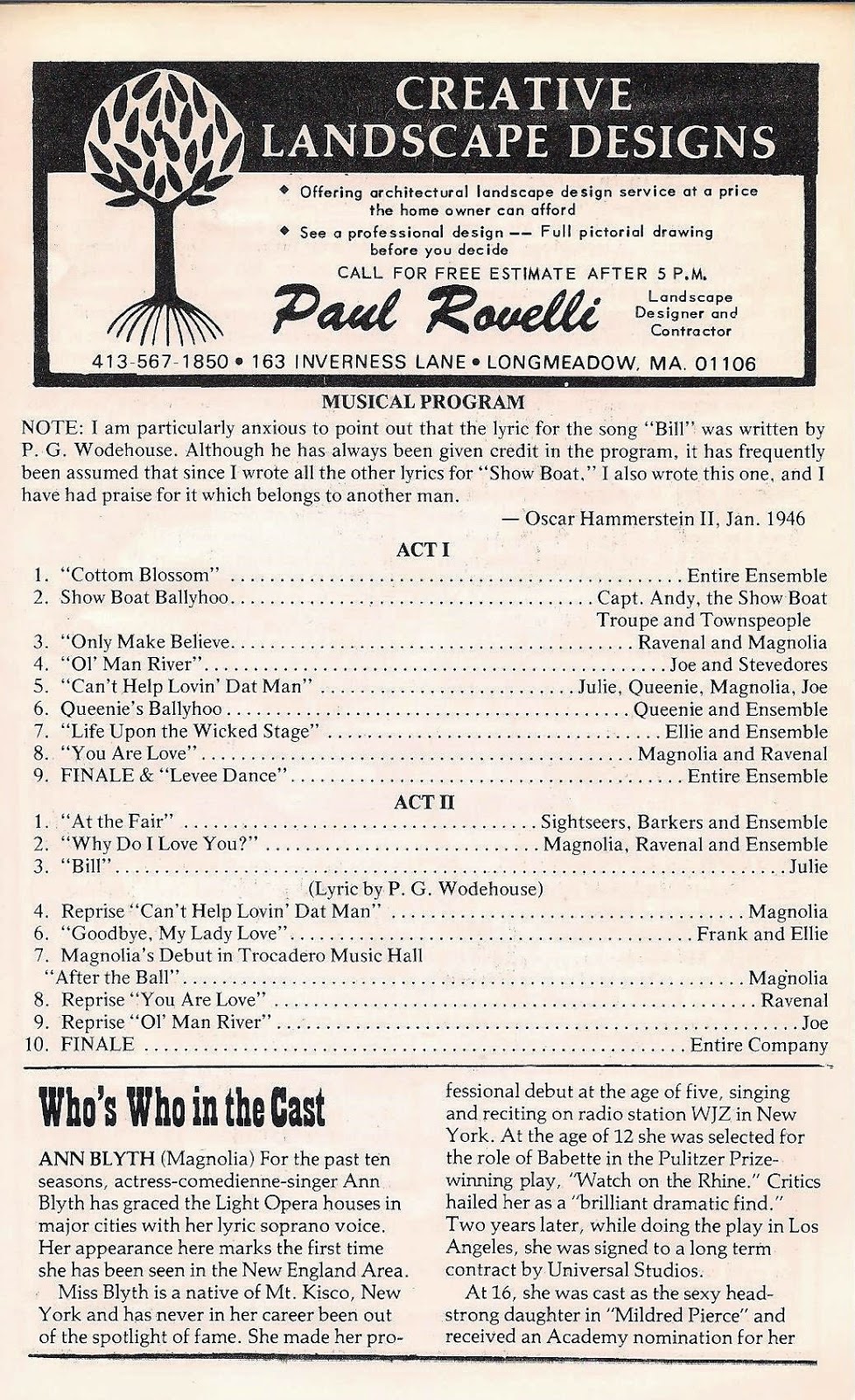
Perhaps her biggest and most performed show of the 1970s was Show Boat, which she first performed in 1970.  (“Life Upon the Wicked Stage,” the title of this post, as many of you probably know, is the title of a song in Show Boat.) Andy Devine, who appeared with her in one of her early Universal musicals, Babes on Swing Street (1944), which we’ll cover later in the year, played her father, Cap’n Andy.  She would play Magnolia again several times through the decade.

author collection

author collection

In September that year, Edwin Steffe was her father for two weeks in Milwaukee that closed the Melody Top season.  From Michael H. Drew of the Milwaukee Journal:

Miss Blyth is lithe and lovely as film fans remember her.  And, praise be, she brings us a Real Voice –not one of those sound stage concoctions that—in person—side step the high notes and undersell the big ones…when that dastardly Gaylord Ravenal (Lowell Harris) abandons her, tears flood her comely cheeks.  The World Almanac claims she’s 42.  It surely lies.

The rival paper, the Sentinel, agreed, calling Ann…

…a leading lady of truly stellar stature and charm…Ann Blyth, the show’s captivating Magnolia, is a superlative actress, whose winning ways are bolstered by one of the sweetest voices around. She demonstrates why the show’s Jerome Kern music has never died.

In a 1975 performance at the Music Circus in Sacramento, California, Jesse White, who played with her in Katie Did It (1951) –a film which I am still looking for – played Cap’n Andy, and the wonderful Kathleen Freeman was her mother, Parthy.


Show Boat closed the 1976 summer season at the Storrowton Theatre in West Springfield, Massachusetts.  Sam Hoffman of the Springfield Daily News reviewed the play:

Miss Blyth has lost none of her beautiful lyric soprano voice or any of her beauty.  She is a delight to see and to hear…Miss Blyth not only sings [the songs] for all their worth, she is capable of giving each a dramatic touch.

Magnolia just never looked as beautiful or was in finer voice than Miss Blyth.

Here Jay Garner filled in for an ill Andy Devine as Cap’n Andy, and Ed Evanko played Gaylord Ravenal.

In a follow-up article, Mr. Hoffman confessed his admiration for Ann Blyth was a torch he’d been carrying for some time.

…I remember her lovely lyric soprano voice that seemed to float right out of the screen in my direction.  I always managed to blot out the male star to make sure it was me she was singing to and not someone else. 

I was even a bit jealous when she upped and married a doctor for Ann Blyth has always been one of my favorite screen stars, someone I didn’t particularly care to share with another person.

He also noted in his interview with her, that she hoped to get in some tennis before the Thursday evening show.

One of the treats of summer theatre at this time was getting to see up close those Hollywood stars who before this era were rarely seen except on screen. That they appeared in town as flesh and blood people was a bit of a shock for many, such that even star-struck interviewers sometimes paid a bit too much attention to the star’s private lives and not enough on their performances.  Have a look here at this1970 television interview of Ann Blyth by Bette Rogge of local TV station WHIO-TV in Dayton, Ohio.  Ann was in town for Show Boat, which you can hear rehearsing in the background, but despite the excitement, Miss Rogge is more interested in Ann’s dress size and vacation plans in Hawaii.

In 1969, Ann returned to operetta in The Merry Widow, at the Starlight Theatre in Swope Park, Kansas City, Kansas, which she recalled for columnist Jay Horning in 1994 was one of her favorite shows.

“The music is so beautiful, so singable, and for audiences, so hummable,” she said, “So walking out of the theater they’re able to whistle a happy tune.  You want to leave an audience feeling good.”

Toward the end of her stage career in the later 1970s and 1980s she would turn more to operetta, in a way bringing her career full circle.

In 1975 she played in Noel Coward’s Bittersweet at Milwaukee’s Melody Top.  Columnist Jack O’Brian referred to it as an “even-when-first-produced nostalgia trip,” denoting operetta as something quaint and too artificial to be taken seriously.

From the Milwaukee Journal:

Veteran star of Hollywood, and currently, Hostess TV commercials, was satisfactory in a show so musically demanding that her third act was almost a recital.  While pretty rather than prodigious, her soprano glittered brightly. 

One audience member saw Ann the next day at the local mall, as recounted in this Memories of Melody Top website:

BITTER SWEET, an operetta by Noel Coward, was charming, as was Ann Blyth when I encountered her over a table of sale items in Marshall Field's at Mayfair Mall the day after I saw her performance…I couldn't resist telling her I didn't want to bother her when she was shopping, but I had to say how much I enjoyed her performance the previous evening. I immediately took off, only to hear her yelling after me, "That's no bother!"

There was Sigmund Romberg’s The Desert Song in August 1979 at the Starlight Theatre, and at the MUNY, famous for its outdoor productions in St. Louis. 

Song of Norway in 1985 with the Long Beach Civic Light Opera in Long Beach, California, a show which seemed to carry enough of a reputation for being clunky that few reviewers seemed kindly toward it, was reviewed by Don Shirley for the Los Angeles Times:

Any production of Song of Norway had better be well sung. The dramaturgy in this slab of aging shmaltz [sic] is primitive, and the spectacle—at least as designed for the Long Beach Civic Light Opera—is dull.

Only one of the Long Beach voices, Ann Blyth’s comes close to justifying the experience.  Her dark-hued solo of “North Star—Soveig’s Song” in the second act is the show’s only scene that casts any sort of spell.  Perhaps she also deserves some credit for the fact that her character, ostensibly the villain, is marginally less tiresome than the others.

Her male lead in this production was Bill Hayes, who first starred with in a 1967 production of Brigadoonat the St. Louis MUNY, which Mr. Hayes called in an interview with the Daily Breeze of Torrance, California, “the Brigadoon to end all Brigadoons.”  Bill Hayes would, in the next decade, become Ann’s singing partner in yet another phase of her career – singing in concert.  We’ll get to that in a future post.

The Daily Breezecalled Song of Norway, “pleasant fare"…

That’s largely because its stars, Ann Blyth and Bill Hayes, don’t take themselves too seriously and play with enough camp to liven up the stilted tale.  And the orchestration is delightful…Blyth is amazing in that she is one of Hollywood’s most successful stars and still looks good more than 30 years after reaching the top.

Lowell Harris, who played opposite Ann in Show Boat in 1970, here played the friend of Bill Hayes, Susan Watson played the lovely Nina, and the trio of friends is broken up by “the lusty Countess Louisa” played by Ann and her lothario husband played in a comic role by Ray Stewart.


We conclude with New Moon in 1987, when Ann performed the lead, at 58 years old, for the Long Beach Civic Light Opera.  Neither of these Long Beach shows were actually "summer" theatre, but I include them for convenience.  Sandra Kreiswirth of the Daily Breeze of Torrance, California interviewed her on the second day of the two-week rehearsal.

…although it’s a dark, rainy afternoon, Blyth enters a Long Beach tearoom looking as if she stepped out of a fashion layout—casual, but definitely chic.

She’s in terrific shape thanks to her three-times-a-week workout regime.

The article was a biography of her life and career, events and circumstances Ann rehashed many times over many decades with patient cooperation in order to sell tickets.

From a review by Lewis Segal in the Los Angeles Times:

Ripples of excited recognition spread through the house at the first hint of “Stout-hearted Men” in the overture.  And if they became ripples of giggles by the time Ann Blyth sang the very, very, very last solo reprise of this 1928 Sigmund Romberg anthem, no matter: The Long Beach Civic Light Opera had incontestably delivered a generous sampling of the vocal overkill and off-the-wall character comedy endemic to Broadway operetta…

This was all pure hokum, of course, most of the time utterly unrelated to human behavior as we know it on this planet.

Operetta, as we’ve mentioned in this series this month, is an acquired taste. 

Blyth made a spunky, likeable Marianne…All but obliterated in the ball scene by a gown exploding with ruffles, polka dots, ribbons, bows and lamè, Blyth nevertheless radiated great poise and style.  

But at 58, her voice must be carefully husbanded and, even so, frequently sounded pinched or hooded on Saturday.

In 2002 when Opera News writer Brian Kellow interviewed her, Ann Blyth was still singing in supper clubs and concert venues. 

She still takes her singing quite seriously and works to keep the voice in shape.  “It’s the old story,” she says, “You’ve got to find out if it’s there every day.”

She was seventy-three.

If anyone has any memories to share of attending one of Ann's musical theatre productions, I'd love to hear from you.  See, I've got this here book to write.

This concludes our month of Ann Blyth's musicals.  Come back next Thursday when we start a month of Ann's historical costume dramas.  We'll take a second look at her time-travel romance, I’ll Never Forget You (1951) 


Posted by Jacqueline T. Lynch at Another Old Movie Blog.
********************
The Argus Press(Owoss, Michigan), August 10, 1984, p. 19.

Daily Breeze(Torrance, California), March 8, 1985, review by James Bronson, p. E24; February 24, 1987, article by Sandra Kreiswirth,  p. C1; October 19, 1992, article by Sandra Kreiswirth, p. C1.

The Hartford Courant, August 18, 1965.

The Hartford Times, August 18 1965, review by Allen M. Widem, “Ann Blyth Able Anna in “The King and I.”

Lawrence (Kansas) Journal-World, May 29, 1969, p. 14.

Lodi News (Lodi, California), July 24, 1975, p. 7 “Show Boat Docks at Music Circus.”

Los Angeles Times, February 28, 1984, articled by Jack Hawn, “A Blyth Spirit from an Earlier Era”; March 8, 1985, review by Don Shirley, p. 16

Milwaukee Journal, September 2, 1970, review by Michael H. Drew, part 2, p. 13; July 9, 1975, Part 2; January 27, 1976, syndicated by Vernon Scott.

Milwaukee Sentinel, September 2, 1970, “Showboat’s Here and Wow!”; June 7, 1972, part 1, page 9, review by Jay Joslyn; September 29, 1972; July 2, 1973, p. 12, part 1

The News-Texan, May 22, 1963, p.2, syndicated column by Joseph Finnegan.

The Northeast Missourian, October 24, 1951, syndicated column by Erskine Johnson.

Opera News, August 2002, article by Brian Kellow.

The Pittsburgh Press, July 28, 1968, “Filth in Movies Saddens Ann Blyth” by Carl Apone, p. 13, section 5; July 29, 1968, p. 14, review by Carl Apone; article by Kaspar Monahan.

Bette Rogge, 1970 interview, WHIO-TV, University of Dayton collection:

Sarasota (Florida) Journal, April 15, 1975, syndicated column by Jack O’Brian, p. 5B.

The Spartanburg Herald-Journal, September 1, 1968, syndicated column by Walter Winchell, p. B-10.

Springfield Daily News(Springfield, Mass.), August 31, 1976, review by Sam Hoffman, p. 8; September 1, 1976, article by Sam Hoffman, p.25.

St. Joseph News-Press(Missouri) p. 11.

St. Petersburg Times, September 18, 1994, column by Jay Horning, p. 12A.

Theater Mania blog, post by Peter Filichia, August 10, 2003. (http://www.theatermania.com/new-york-city-theater/news/08-2003/taking-stock_3796.html).

Toledo Blade, June 2, 1963, section 7, p. 1, article by Ray Oviatt.

 *************************************************
I've started a Kickstarter campaign - looking for backers to raise funds for upcoming Ann Blyth biography - principally to offset costs of fees to obtain never or rarely seen photos in libraries, museums, and newspaper files. It will run for the next three weeks. Thanks to all who can help. 


****************************
 THANK YOU....to the following folks whose aid in gathering material for this series has been invaluable:  EBH; Kevin Deany of Kevin's Movie Corner; Gerry Szymski of Westmont Movie Classics, Westmont, Illinois; and Ivan G. Shreve, Jr. of Thrilling Days of Yesteryear.

***************************
TRIVIA QUESTION:  I've recently been contacted by someone who wants to know if the piano player in Dillinger (1945-see post here) is the boogie-woogie artist Albert Ammons. Please leave comment or drop me a line if you know.
****************************
 HELP!!!!!!!!!!

Now that I've got your attention: I'm still on the lookout for a movie called Katie Did It (1951) for this year-long series on the career of Ann Blyth.  It seems to be a rare one.  Please contact me on this blog or at my email: JacquelineTLynch@gmail.com if you know where I can lay my hands on this film.  Am willing to buy or trade, or wash windows in exchange.  Maybe not the windows part.  But you know what I mean.

Also, if anybody has any of Ann's TV appearances, there's a few I'm missing from Switch, The Dick Powell Show, the Dennis Day Show (TV), the DuPont Show with June Allyson, This is Your Life, Lux Video Theatre.  Also any video clips of her Oscar appearances.  Release the hounds.  And let me know, please. 

***************************

A new collection of essays, some old, some new, from this blog titled Movies in Our Time: Hollywood Mimics and Mirrors the 20th Century is now out in eBook, and in paperback here.

I’ll provide a free copy, either paperback or eBook or both if you wish, to bloggers in exchange for an honest review.  Just email me at JacquelineTLynch@gmail.com with your preference of format, your email address, and an address to mail the paperback (if that’s your preference).  Thanks.