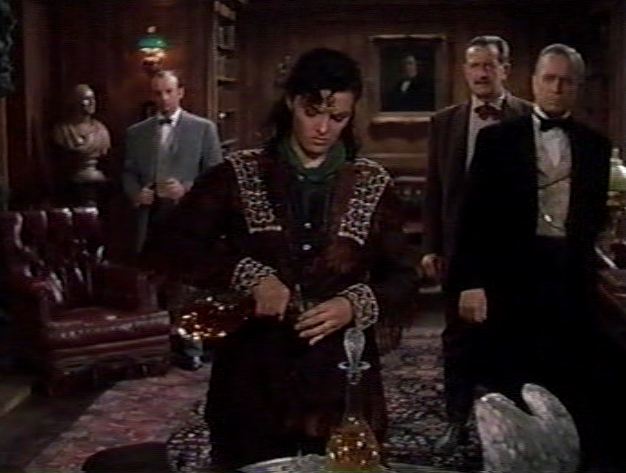
One of the most fascinating aspects to Ann Blyth’s film career is how her reputation flipped from powerful actress doing moody parts to nice girl playing nice girl roles in which she was invariably taken less seriously. A lot of that transformation in the eyes of the press and the public had to do with the fact they found out that in real life—she was a nice girl. In terms of press copy, her natural and intuitive versatility as an actress seemed to be outshone by her real-life pleasant, even spotless, reputation.
The utterly silly phenomenon began as How Could a Nasty Screen Character be Played by Such a Nice Person in Real Life...and morphed to Such a Nice Person in Real Life Cannot Play a Nasty Screen Character.
The utterly silly phenomenon began as How Could a Nasty Screen Character be Played by Such a Nice Person in Real Life...and morphed to Such a Nice Person in Real Life Cannot Play a Nasty Screen Character.
Mildred Pierce, in which she ferociously played a budding young conniving sociopath (see last post here), established her at the age of 16 as a serious actress—so much so, that some in the press, including Los Angeles Times drama editor Edwin Schallert, were excitedly calling her a young Bette Davis.
For the first few films after Mildred Pierce, she played other troubled young women with chips on their shoulders, axes to grind, or evil plots to hatch. But she didn’t want to be typecast, and worried at first that “mean” roles were the only kind she would be offered. Mr. Schallert interviewed her when she was making Swell Guy (1946), her first movie after the long recovery from her back injury, discussed in this intro post. We’ll talk about Swell Guy later in the year. “Miss Blyth is reputed to give her most sensational performance in this.”
Ann described her character in the film: “I’m not a mean girl…but I don’t change completely for the good…She is wild at the beginning, but her wildness results in unhappiness for her. So I naturally am not against that part. However, I do want to do a nice role now, and I want to sing in a picture. You see, I am hoping, as perhaps many people do in Hollywood, for a variety of opportunities.”
Mr. Schallert notes in his November 1946 article that Ann “is essentially shy,” but he kindly does not call her naïve for wanting or expecting not to be typecast in Hollywood. It was the bane of many, if not most actors, that the studio’s bottom line and the public’s perception would roll over like a steamroller an actor’s usual hope of playing something different than his last movie. Mr. Schallert also kindly notes the catastrophes suffered in the past two years with her spinal injury, and the death of her mother, and that “The emotion associated with that bereavement is too close as yet for Ann to discuss.
“Ann’s fortitude is nothing light in the film world. Her experiences have undoubtedly given her an unusual maturity in her work. She has no formula for playing the roles that are so much at variance with herself. She indicated that she does them intuitively as much as anything else.”
A simple answer to a question that trailed Ann through her early career. How could a nice girl play such less-than-virtuous people so convincingly? She’s an actress, that’s why.

The very question seems to lead us to the astounding conclusion that actors who play murderers, thieves, and pickpockets must actually be murderers, thieves, and pickpockets.
Another article that November of 1946 notes her latest role in Swell Guy: “Her part…is that of an ornery little brat grown up, and Ann is quite aware of the danger she will be typecast as a ‘meanie.’ Result: she is studying vocal music, with every intention of snagging a part in the next big musical show filmed at her studio.”
That next big musical at Universal never happened, but after a few more ‘meanies’, her roles began to change towards nice girls in less demanding parts. How much of this was due to her seeking new material, and how much was due to a personal life that the press was touting more and more as laudatory is an interesting question.

The notice of her as a young woman living an exemplary life may have gained more steam in April 1949, when she was slated to play the lead in a film called Abandoned, which she refused and was put on unpaid suspension. The movie, (judging by this swell lurid poster, was a crime noir with a great cast) deals with unwed mothers and a black market baby adoption racket.
Many actors risked studio wrath by rejecting scripts because the scripts were lousy. However, though I don’t know the reason she rejected the movie and have never read an interview with her opinion on the subject, some columnists seemed to infer that taking the suspension was an exercising of her moral conscience. One would assume that none of the greedy, conniving, promiscuous characters she had heretofore played, performing unsavory deeds including shooting Zachary Scott dead, would fall in line with how a proper young lady should behave, but the columnists took the shortcut and wrote her up—and wrote her off—as a nice girl.
It was also regarded as somewhat quaint, if admirable, that she preferred not to do any cheesecake photos.
Sheilah Graham noted in August 1949, that Ann didn’t smoke, or drink, and went to church regularly and attended church socials, but also gave Ann credit for spunk. “She seems happy and easy going, but she has a mind of her own. Not too long ago she took a suspension from her studio for refusing to play a role she didn’t like. In spite of her lack of experience in real life, on the screen Ann is able to portray hardened, willful, sinful characters.”

By 1954, syndicated columnist Sue Chambers echoed the, by now, cemented public view of Ann, that she was deeply religious, and there has “…never been a whispered breath of scandal about her….she has never been temperamental; she has never kept anyone waiting for an appointment…She leaves a good impression with everyone. Her working associates have never known Ann to raise her voice in anger or turn down a request for a benefit appearance, no matter how ‘small’ the group.”
Not keeping anyone waiting for an appointment may be really fishing for nice things to say, but the press was also apparently intrigued that she could be a homebody who was equally interested in a career, the antithesis of the 1950s nice girl. Ms. Chambers noted that Ann, married the previous year and expecting her first child at the time the article was published, wanted a family “but she has no intention of giving up her career; she’s intensely ambitious, too.”
Her reputation more than preceded her; it wrapped around her like a cocoon. From a syndicated article in 1952: “Can a nice girl make the grade in the movies?"

Nice girls get paper dolls made in their image.
“Ann Blyth, a girl any fellow could proudly take home to meet mother, is proof that virtue is its own reward—even in Hollywood. The young and beautiful actress is one of the most talented and successful in the business. Yet, paradoxically, her name is seldom, if ever, mentioned in the gossip columns…Ann, it seems, spends most of her leisure time at church bazaars, a most unlikely hangout for gossip columnists.
“She has three major motion pictures either just released or about to be. All of them accent her versatility…somehow, in between, she manages to make countless benefit appearances at church suppers or hospital wing dedications.”
One of Hollywood’s most famous gossip columnists, Louella Parsons, early on noted the amazing paradox of the young girl who was career-ambitious and yet still seemed like a nice person. By 1951, Louella, who had this backyard fence familiarity/condescension in her prose, was still ruminating on the problem child who was so frustratingly not a problem: “Ann’s aunt and uncle are her family, and she lives with them. She has been brought up as if she had never been in Hollywood or motion pictures.

“Her aunt waits up for her until she gets home at night…likewise, Ann’s escorts are always carefully scrutinized by both her aunt and uncle. She might have been brought up in some small town and then not had the protection she had with these two loving people. And, withal, she is a fine girl and a versatile actress.
“Her first success was ‘Mildred Pierce’ when she played the horrid daughter…and was everything a young girl should not be.
“How could you happen to play that girl so well when she is just the antithesis of you?’ I asked her.”
Did Ann’s reply shock her?
“I like to vary my roles, and it would be very tiresome if I played only sweet young things…I’d really rather have a part I can get my teeth into—one with character rather than a milk and water girl.”

Louella wasn’t listening. She had decided, as did other members of the press, that the nice girl should only play nice girls. A movie to be tentatively titled White Sheep was proposed for Ann in April 1951 (though never made with Ann), and Louella Parsons announced, “This is the story of a small town minister who helps regenerate a rather wayward family. Ann, of course, is the white sheep of the family. You could not believe her in any other role.”
You could not believe her in any other role? What happened to Another Part of the Forest, or A Woman’s Vengeance, or Mildred Pierce and the scheming, sultry, promiscuous, greedy, backstabbing, murderess roles for which she had earlier been called a young Bette Davis?

On her film, The Golden Horde – columnist Harold V. Cohen also scoffed at the notion of the nice girl playing anything but: “Nobody in his right mind could possibly visualize sweet, wholesome Miss Ann Blyth in the role of a seductive Persian princess, dressed in scanties and flimsies, who uses the wiles of her sex to stop the ruthless march of the terrible Genghis Kahn…Now Miss Blyth can take off those veils and go back to her cashmeres and dirndls, where she belongs. In ‘The Golden Horde’ they’ve sent an innocent child to do a woman’s work.”
You can seduce Zachary Scott and then blast him to smithereens, but how quickly they forget.

Another aspect of Ann’s personal life which may have influenced press opinion may have been her resplendent Roman Catholic wedding ceremony in June 1953 celebrated by several clergy including a cardinal—James Francis Cardinal McIntyre, who also delivered a blessing from Pope Pius XII.
In the company of several priests and monsignori was an old friend from back east, the Rt. Rev. Charles E. Hagearty, a monsignor at that time located in Hartford, Connecticut. Msgr. Hagearty had been a curate at St. John's Church in Stamford, Connecticut when Ann visited her uncle and aunt there in the summers as a child. It was this same uncle and aunt, Mr. and Mrs. Patrick Tobin, who gave up their Stamford home and moved out to Los Angeles to care for Ann after the death of her mother, which we discussed in the intro post here. According to an article in the Hartford Courant at the time, she was ten years old when she and Fr. Hagearty first met. He played the organ. She liked to sing.
The church was packed with some 500 people, but according to a newspaper description of the event, "set workers and crewmembers...far outnumbered the celebrities." The press lumped the nameless techies together as "friends of the bride." To most of them she was Annie.
More about her bridesmaids in a future post.
In a town that loved spectacle, it was a spectacular beginning to a long and happy marriage. Dr. James McNulty, a Los Angeles area obstetrician, was invariably referred to in articles as Dennis Day’s brother (who acted as best man at the wedding) more than I think he ever was referred to as Ann Blyth’s husband. Dr. and Mrs. McNulty had five children over the next ten years, further cementing Ann’s confounding respectability.
Her respectability, itself, became a problem for television producers of the 1953 Oscars, when she had been asked to perform the song “Secret Love” from Calamity Jane (a movie we discussed in this previous post). Doris Day had been slated to reprise the song she made famous, but according to the authors of Inside Oscar – The Unofficial History of the Academy Awards, Miss Day turned down the opportunity due to being afraid to sing before the live audience (made bigger still by television). The program was telecast March 25, 1954. Ann was pregnant with her first child (her baby son was born in June). Having a pregnant woman on television at all was still considered a dicey subject in this buttoned-up era, but one who stood there and sang the lyric “and my secret love’s no secret anymore” seemed to fill the NBC network powers that be with considerable trepidation.

It was the second time that the Oscars were broadcast on TV, called by columnist Bob Thomas, “The biggest star splurge in television history,” to an expected 60 million viewers. The ceremony was held at the RKO Pantages Theater with Donald O’Connor as host in Hollywood, and Fredric March handling the live TV-hook-up from New York.
Ann, who the newspapers were a little more brave about acknowledging her pregnancy, still referred to it delicately as her “soon-to-be-mother-condition” wore an emerald green chiffon gown (“naturally,” commented columnist Buck Herzog with a nod to her Irish ancestry) with a big skirt and off-shouldered neckline. She also wore emeralds. Too bad TV was still black and white then.
Ann, who evidently felt no reason to wear a scarlet letter on her green gown, and seemed to see no reason why the sight of a pregnant woman should engender sophomoric double entendres about love not being a secret, performed without incident or apparent damage to her career. Unfortunately, her old pal and former co-star Donald O’Connor, did suffer the wrath of pundits, including the disgust of Ed Sullivan, when he made the unpardonable faux pas of publicly acknowledging that Ann was with child. He playfully introduced her before her number as “Ann Blyth and family.”
He was berated for his poor taste. Ann thought his remark was cute.

Over two years later, the press was starting to crow with its typically short memory how mature the public was in accepting pregnant women in society. “Women entertainers used to retire temporarily when they became expectant mothers, but in this day of the working wife, females everywhere go on working as usual.” The columnist, Aline Mosby, cites for her examples as Lucille Ball, Rosemary Clooney, and “Ann Blyth sang at the Academy Awards show shortly before she had a baby.”
And the world didn’t end.
Not too long after the birth of her son, she took her nice girl act on the road and really showed them.
That September, Ann performed a night club act at the Sahara Hotel in Las Vegas, and brought the house down. Los Angeles Times writer Edwin Schallert, who we quoted at the beginning of this piece when he interviewed her some eight years earlier, marveled at how well the nice girl blossomed.

Nice girls also do Lux Soap ads. With Peter Gunn.
“Miss Blyth won completely and without sensationalism the cosmopolitan public that had previously been intrigued by Dietrichs, Mae Wests, Gabors…it was a simple, sincere victory gained by a fragile-looking young girl in a modest shell-pink lace gown who confessed her knees were shaking.”
She sang such hits as “April in Paris,” “September Song,” excerpts from The Student Prince and Rose Marie(movies which we’ll discuss in future posts this year), an Irish song, and in a series of songs labeled as a “Calendar Hit Parade”, she belted out “Yankee Doodle Dandy”, and “Silent Night.” She closed the segment with “Auld Lang Syne.”
“With her eyes misty with tears as she held a huge armful of flowers, she thanked the audience again and again for their tribute…There were also many misty eyes among the people present.”
Louella Parsons crowed that Ann, “…brings down the house, she’s so good.”
Syndicated columnist Bob Thomas wrote, “The gamblers and dealers in this hard-boiled town never saw anything like it. Everyone in the night club was standing and cheering a demure beauty whose act was pure enough for a Sunday school picnic.”

Good girl makes good.
He reported on her closing performance after a three-week stint in Vegas, “With tears streaming down her cheeks, she sang, ‘Auld Lang Syne’ and bowed off with a thundering ovation. Most of those in the Congo Room were misty-eyed too.”
He compared her to other more ribald acts such as the striptease by Marlene Dietrich and Mae West’s racy humor. “But along came little Miss Ann Blyth to prove that purity pays.”

She had tried out the act first in San Diego, and then sang to the crowds at the California state fair in Sacramento. Ann acknowledged, “It is the first time I played night clubs or any singing dates, and it has opened up a whole new world to me.”
However, the old world of Hollywood was increasingly reticent to accept Ann’s versatility as easily as she had. A big role was coming up that would, unknown to anyone at the time, be her last film, The Helen Morgan Story. The down-and-out, troubled, hard-living alcoholic 1920s saloon singer was considered by everyone who voiced an opinion about it to be beyond Ann’s abilities.
Some still recalled her earlier career of sultry gals. According to Armand Archerd, “She is truly a paradox, having been described as ‘sweet Victorian’ to ‘sexy and sultry’…by nature, of course, Ann is probably the sweetest person in the film colony.”
She was required to test for the role in competition with something like 300 other actresses.
“Ann, by virtue of her own reputation, was the least likely candidate of all.”
By virtue of her own reputation.
By virtue of her own reputation.
“Of course, no one in Hollywood believed she would get the role of the sexy Miss Morgan.”
So how did she get the part?
According to Mr. Archerd, “…her test out-sizzled any of the so-called sexy stars of Hollywood.”
The headline in the Daytona Beach Sunday News Journal reflected a shocked public.
Good Girl
In Movie
Gutter
Hollywood reassured a nervous public, “Ann Blyth is still a good girl, despite what some of her fans think…who fear that Hollywood’s ‘little lady’ compromised her own moral principles in taking the part.”
Ann responded, “There are always people who can’t disassociate an actress’ personal life from her screen life…An actress, to keep going, must portray life, and life is not all sweetness and light…there was great conflict between good and evil in Helen’s life. Unfortunately, she had weaknesses and the evil in her life often won over the good. I personally think that such movies, when done in taste, do more good than ones that gloss over the brutal facts.”

We come full circle then to a description of Ann by Ida Jean Kain earlier in her career from 1949: “I thought you might be interested in knowing what she is like is real life, this girl who plays the hateful, spoiled darling roles so realistically.
She is poised and genuinely unaffected—completely unspoiled. And in a quiet, confident way, she knows where she is going, and she is neither deviating nor taking short cuts.”
The quiet, confident woman replied to Mr. Archerd at the time of The Helen Moran Story as to how she could possibly make the transformation to such a wayward woman?
“Well,” she blushed, “I guess I just try to be the person I’m playing.”
Because she’s an actress, that's why.
Come back next Thursday when we jump several decades ahead to 1985, a time when even the wholesomeness of Hostess cupcake television commercials could not keep her from turning wayward again as a woman haunted by the death of her first husband, who stabs her second husband with scissors in a fit of hysteria, and who may be a murderer. That's up for her friend, the intrepid Jessica Fletcher, to decide in Murder She Wrote.

****************
Beaver Valley Times, syndicated article by Aline Mosby, December 28, 1956, p.11.
The Deseret (Utah) News, November 8, 1946; also syndicated column by Louella Parsons, April 5, 1951, articled by Ben Cook, April 21, 1952.
The Florida Flambeau (Florida State University, Tallahassee, Florida), article by David Dreis, January 18, 1955, p. 2.
The Free Lance Star (Fredericksburg, Virginia), syndicated article by Bob Thomas, October 21, 1954, p. 14.
The Hartford Courant Magazine, July 19, 1953, p.7.
The Hartford Courant Magazine, July 19, 1953, p.7.
The Kentucky New Era, syndicated column by Armand Archerd, June 22, 1957, p. 9.
The Lewiston Evening Journal, July 17, 1952, p. 22.
Los Angeles Times, article by drama editor Edwin Schallert, November 17, 1946, p. A1; also by Schallert, September 22, 1954, p. B6.
The Milwaukee Sentinel, syndicated column by Sheilah Graham, August 22, 1949; syndicated article by Sue Chambers, May 1, 1954, p. 3; also syndicated article by Buck Herzog, March 28, 1954, p. 19; also syndicated article by Louella Parsons, September 27, 1954, p. 6.
Pittsburgh Post-Gazette article by Harold V. Cohen, November 12, 1951.
Portsmouth Times, (Ohio), article by Ida Jean Kain, July 15, 1949 p. 15
Sarasota Herald-Tribune, June 28, 1953, p. 6; also syndicated article by Bob Thomas, March 24, 1954, p. 16.
The St. Joseph (Missouri) News-Press, syndicated column by Louella Parsons, December 16, 1951.
The Sunday News Journal (Daytona Beach, Florida), September 15, 1957, p. 12A.
Wiley, Mason and Damien Bona. Inside Oscar – The Unofficial History of the Academy Awards (NY: Ballantine Books, 1986), p. 238.
***********************************HELP!!!!!!!!!!
Now that I've got your attention: I'm still on the lookout for a movie called Katie Did It (1951) for this year-long series on the career of Ann Blyth. It seems to be a rare one. Please contact me on this blog or at my email: JacquelineTLynch@gmail.com if you know where I can lay my hands on this film. Am willing to buy or trade, or wash windows in exchange. Maybe not the windows part. But you know what I mean.
Also, if anybody has any of Ann's TV appearances, there's a few I'm missing from Burke's Law, Switch, The Name of the Game, The Dick Powell show, the Dennis Day Show (TV), the DuPont Show with June Allyson, This is Your Life, Lux Video Theatre. Also any video clips of her Oscar appearances. Release the hounds. And let me know, please.