Showing posts with label Ian Wolfe. Show all posts

Thursday, February 12, 2015

Abe Lincoln in Illinois - 1940


Abe Lincoln in Illinois(1940) carries both historical insight while at the same time being remarkably and most startlingly current in its message.  Surely writer Robert E. Sherwood made no attempt to be prescient, in the same way Abraham Lincoln seemed to foresee his own doomed future, but we may take as a sad state of fact that all life is a cycle and we must continually fight the same battles every couple generations. 

We celebrate Lincoln’s Birthday today with probably the best movie ever made depicting Abraham Lincoln, both in script, and in characterization by Raymond Massey, who played this role on Broadway before Sherwood adapted his own script for the screen.  John Cromwell directs, and we are treated to a nineteenth century fairy tale land of innocence and danger, but always familiar because it is part of our American consciousness—the log cabin, the reading by firelight, the lusty backwoodsmen who “wrassle” and drink, the hoop skirts, the stovepipe hat, but stringing everything along is the message of a gentle, reluctant man, sometimes self-admitted blunderer, who is idealistic enough to expect better from his country, and pragmatic enough to know “a more perfect union” wasn’t going to happen without an awful lot of trouble, and that some in the dysfunctional family of states would have to be dragged kicking and screaming to the table.  Behind all, shaping his journey and shouldering it, are his periods of depression that threaten his nimble mind, sap his courage, and crush his soul.

We covered another Lincoln biography here when Walter Huston took the role in 1930.

Raymond Massey’s Abe Lincoln is not a schoolroom saint.  He is flawed, human, and beset by troubles that include a nagging wife, certainly the most homespun and prosaic of incidents that ride the coattails of his more Herculean crisis—that of publically standing against slavery, and of trying to keep the union together when so many preferred it to be dissolved.  He makes compromises, he allows himself to be shepherded into the political process by backroom dealers.  Our American democracy is on display here for all that is good about it and all that is shady.

Election night, with vote tabulations cast by magic lantern onto a screen, and crowds cheering everything by torchlight, with relentless tinny tapping of Morse code relaying results from across the country—which is presented by a crude map of states and territories and pins—is no less accurate and no less exciting than were it covered ad nauseam between commercials on CNN.

That Raymond Massey, for whom Abe Lincoln was his signature role, was, and probably remains the best actor to have played him, was able to convey Lincoln’s self-deprecating humor, his cleverness, his anxiety, his good nature all at once is a splendid feat of acting.  His manner of speech is a marvel and mesmerizing.  However, he was helped along by the very legacy we have of Lincoln’s personality in context of the opinions of his countrymen.  There are fewer films in which George Washington is depicted, largely because we still, I think, don’t know how to approach the father of our country.  He remains a schoolroom saint in many respects, as least for the non-historian. 

We know more about Lincoln, and he has become a flesh and blood, more down-to-earth person to us in large part probably because so much was written about him in his own day that was extremely critical.  The Confederacy, of course, considered him an enemy, up to and including the nutcase who murdered him.  John Wilkes Booth’s act was borne of cold, deep-seated hatred, political resentment, and vengeance.  Such an action is not an anomaly; it is the end result of resentment carried to the extreme.  Then—and today.

But there were many in the North who felt just as much antagonism for Lincoln, even if they did not carry their anger to such extremes.  Lincoln was dogged by critics every step of his years as President, in his own party, in his own cabinet, by some of his own generals. 

All Presidents are met with criticism while in office, especially from the opposing political party; that is normal and the sign of a healthy democracy.  But few Presidents are reviled and mocked and vilified to the extent Lincoln was.  We may add Franklin Delano Roosevelt in this category, for his programs to lift the nation out of the Great Depression were all hated by those who considered them communistic.  FDR, just as Lincoln, was considered by those who felt they had a great deal personally to lose under his administration, as dangerous anti-American radicals.

And they were two of our greatest Presidents, who brought us through two of this nation's great periods of crisis, and we know them for their flaws as well as for their great deeds.  It’s a funny kind of paradox that those who hate to the extreme shine an accusatory light not only on their intended enemy, but on themselves.  Lincoln’s detractors, including those who mocked the Gettysburg Address, are regarded as fools today, standing on the wrong side of history.  So are the factions into the early twentieth century who felt that child labor was necessary and that without it, our economy would collapse; that if women were allowed the right to vote family values would collapse; etc. and we could go on about those who fear equality for others because it might mean they would lose their own enviable position in society, or their own imagined moral superiority.

Massey delivers, in a depiction of a Lincoln-Douglas debate on a wooden platform under torchlight:
“All men are created equal except Negroes.  If we are to accept this doctrine of race or class discrimination, what is to stop us in time of decreeing all men are created equal except Negroes, foreigners, Catholics, Jews, or just poor people?”

Stephen Douglas, played here by Gene Lockhart, upholds slavery as it is decreed lawful by the Supreme Court.  We could certainly draw similarities to a Supreme Court bought by special interests today, could we not?

Lincoln further warns that we are sliding into a morass where “there is no right principle of action but self-interest.”

It is a literate script that carries us from Abe’s adventures, and misadventures, as a young man, his doomed love for Ann Rutledge, his business failures, his start as a lawyer, his troubled courtship of Mary Todd.  John Cromwell’s direction is artistic and full of feeling. We look down over the shoulders of these historical figures, we look up at them, we stand in the doorway and watch their turmoil.

A few high points:  Mr. Massey’s singing of the old campaign song for William Henry Harrison and John Tyler: “Tippecanoe and Tyler Too” and the crowd later singing the campaign song for Lincoln, “Lincoln and Liberty Too.

Stage actress Ruth Gordon gives a strong performance as Mary Todd Lincoln.  

Howard Da Silva (who originated the role on Broadway) is the town bully and eventual loyal supporter of Lincoln. 

Louis Jean Heydt as Mentor Graham, who tutors Abe in the law.  Look for Ian Wolfe as newspaper editor Horace Greeley.

Alan Baxter is Billy, the young law clerk Abe takes under his wing, who, almost like Mary Todd, nags him to take up the torch of politics and defeat slavery.  An interesting minor character, he is not fawning and idealistic; he is tortured, angry, and a kind of Greek chorus.  All the minor characters who stay in Abe’s life through the film visibly age with him, and it is a poignant thing to see.

The scene where Lincoln has just won the election and Billy explains the new President’s grim attitude by reminding us that the South has threatened to secede if he won.  Now, war is inevitable, and Lincoln is walking straight into it.  Literally.  As Massey is about to leave to the room, suddenly the double doors open and a there is a uniformed guard detail: at once a sign that he is the President, that he will need security because there are already threats against his life, and also as a portent of Civil War and the soldiers over whom he will have authority as Commander in Chief.


The final scene is Cromwell’s dramatic touch, as Lincoln stands on the train platform offering a curiously ominous farewell to Illinois as he is about to leave for Washington.  He won the election, but seems somehow the loser.  The train slowly pulls away, he manages a weak half-wave, and he slips into the darkness of the night, as we finally imagine, as he has done already, his doom.  It is not a moment of triumph; it is an eerie moment of foreboding as the train chugs away into the blackness.

Abe Lincoln in Illinoisis such a fine achievement both as drama and as history, and works so well partly because of the skill of the writer, the director, and the actors, but also because we have the unique legacy of knowing all about Abe Lincoln and all about those who hated him.  Neither can hide from us, even this far away from 1860.

©Jacqueline T. Lynch, 2007-2015. All rights reserved. If you're reading this on a site other than Another Old Movie Blog, please be aware that this post has been stolen and is used without permission. 


********************************

My book on Ann Blyth's career--Ann Blyth: Actress. Singer. Star. will be published on June 18th. To that end, I’ll be looking for some help in the pre-launch phase, so I’d like to invite any blogger—film blogger or book blogger—to participate in a blog tour. I’ll be looking for blogs to schedule publicity-oriented posts beginning Monday, June 1st. The last day will be June 17th. If anyone wants to pick a day, please let me know so I can coordinate with others. Think of it as a kind of blogathon. On your day, you can post a review of the book (I’ll have ARCs – advanced reading copies - available in PDF form which I’ll email to you that you can read on your computer), or you can do a Q&A with me, or I can just send you a 250-word excerpt of the book, or you can just post the cover and a link to the Amazon page, if you will. Just a little something to spread the word. I will be posting here every day from June 1st through the 18th and I’ll be linking to your blogs, pushing traffic to you.

Among those 17 bloggers who participate, I’ll throw your names in a hat and pick five winners who will receive a print book of Ann Blyth: Actress. Singer. Star. when it is published on the 18th. The rest will receive an eBook file in whichever format you choose: ePub, Mobi, or PDF (Note, the ARC copies will not have the index).


Thursday, August 28, 2014

The King's Thief - 1955


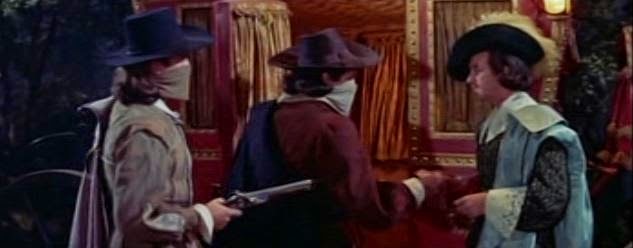
The King’s Thief(1955) is a colorful swashbuckler movie, entertaining and continuing in the vein of last week’s discussion of The Golden Horde (1951) as another Saturday matinee adventure story.  The King’s Thief might be easier for us to relate to simply because it is less foreign and exotic.  We don’t really know how the Mongol tribes of Genghis Khan’s gang spoke or interacted with each other, and our uncomfortable ignorance is what makes us guess it’s all pretty phoney.  But The King’s Thief is set in the restored reign of England’s Charles II, which, being that much closer in time to our own, we stand on firmer ground when it comes to accepting Walter Plunkett’s elaborate costumes, the crisp speech, the elegant salons, and the grimy prison as coin of the realm, so to speak.


Both films are quite short, just over an hour, which lends a fast-paced adventure.  No over-burdened Cecile B. DeMille epics here, just grab your sword, tell the story, and get out.  It's filmed in CinemaScope, and looks well in this process.


Ann Blyth is reunited with Edmund Purdom, who starred with her in her previous film, The Student Prince (1954), which we discussed here.  He infamously lip-synched to tenor Mario Lanza in that film, but here Mr. Purdom happily climbs out from the shadow of that star and shines on his own.  He is quite capable, quite handsome in his Van Dyke beard, and seems to be a worthy successor to Errol Flynn.  His career never reached those heights, however.


His best buddy in this movie, Roger Moore, would climb to greater heights, and Mr. Moore is one of the pleasures of this film.  It’s a small role, but he demonstrates the dashing presence that will one day lead him to fame as James Bond.


Two Hollywood greats liven things up considerably, even if this little movie might not seem much in their careers: David Niven, who plays the villain, and George Sanders, so delightfully foppish as King Charles II (he had played this role as well in Forever Amber (1947).


I love Mr. Sanders’ teasing, “Brr-r-rampton!” when he spies a small black notebook Niven has dropped, thinking it is a bachelor’s “little black book.”  “Some tasty names, I’ll wager?”

That little notebook is the real star of the show.  Niven is the king’s trusted advisor, a nobleman who has, unknown to the king, skimmed off quite a bit of spoils from the recent English Civil War.  I confess, my own interest in this historical time period is because the ultimate losers of the war – those stuffy, self-righteous, stubborn Puritans—came to settle my neck of the woods in the 1630s and 1640s.  Had they remained in power in England, the settlement, governance, and culture of New England might have been rather different.

We might not be so stuffy, self-righteous, and stubborn.  (Bah-ha-ha-ha.)  No, we probably would be.  It’s the climate. 


David Niven, in the aftermath of the restoration of Charles II, that hedonistic, “Merry Monarch,” has taken to discrediting noblemen who fought on the king’s behalf, accusing them of treason, putting them on trial and hanging them, and then skimming a good part of their fortunes for himself.  Boo!  Hiss!


Ann Blyth plays the daughter of one such discredited nobleman, who has lived in exile in France.  Now that the war is done, she’s eager to return to England, but is shocked and heartbroken when her father’s friend comes to tell her the news that David Niven has put her father to death.  Though told she must never return to England now, nevertheless, Ann is a feisty gentlewoman.  She’s heading back to find out what happened to her father, and confront this David Niven fellow.


The black book, mentioned above, has the names of other noblemen on Niven’s blacklist, as well as an accounting of all their fortunes and land he hopes to take.  Edmund Purdom, one of the soldiers of the king who, after the war, was not paid for his services, has become a highwayman.  He robs Niven, and takes the book, not really knowing what it is, but he soon learns that it is worth far more than the all the jewels he’s taken so far.


That book will change hands a lot in a lusty game of keep-away that involves elegant gambling salons, fast chases on horseback through the MGM backlot, assumed identities, subterfuge, sword fighting, and not a little flirting.


A few favorite scenes:  Ann makes another one of those walking down a grand staircase entrances, so effective for establishing credibility in society, making a statement, and building suspense.  And it's just pretty.  Ooh!  Ahhh!

Edmund Purdom escorting her home at night by walking beside her sedan chair, which is carried by stone-faced servants.


John Dehner as Niven’s captain of the guard.  He gets thrown out of a coach, and roundly tricked by Ann in a cute scene where she, being taken into custody, fakes heart trouble.  She has set up a plan where Dehner must take her to an apothecary shop, that happens to be run by the son-in-law and daughter of her faithful servant played by Tudor Owen.  His daughter, played by Queenie Leonard, refuses to let Dehner into the room where they are putting Ann to lie down during her "illness", “Please sir, I’ll have to remove her bodice,” she admonishes him.  Then, door closed, she allows Ann and her father to tie her up, and reminds them to gag her so it will look like Ann had no help in her escape.


By the way, favorite go-to man Ian Wolfe is among the familiar faces.

Ann and Purdom are a handsome pair, but there is little lovemaking when the plot is a constant chase for escape.  Ann wants to use the book as evidence against Niven, but Mr. Purdom wants to sell the information.


There are swordfights, and when Purdom and Moore are imprisoned, Ann is forced by Niven to visit them to get information on the whereabouts of their gang.  If she does not agree work for Niven as a double agent, he will ship her off in indentured servitude to the New World.  “A grim and so far unsuccessful effort to populate the colonies.”  America, ewww!  Who wants to go there?  She’d probably end up in Massachusetts, currently overrun with those stuffy, self-righteous, and stubborn sore loser Puritans, scrubbing floors for a humorless magistrate until, a few decades hence, she is hanged for a witch.

Instead, in a brave attempt to avoid all that, she slips Purdom a stiletto to pick the lock on his iron chains.  There is a painstaking and nail-biting escape from the prison.


The final hat trick is using Niven’s own coach, which Purdom had previously stolen, to gain entrance to the castle where the crown jewels are kept.  Purdom and Ann, pretending to be relatives of Niven’s, are allowed a private tour to see the crown jewels, which Purdom will attempt to steal and ransom back to the king, thereby demanding an audience with him so they can rat on David Niven.


But…ZOUNDS!  The king arrives unexpectedly just as Edmund Purdom is pummeling a Beefeater over the crown jewels!  Ann is desperately trying to stall Sir Isaac Newton in the next room by pretending to know more about astronomy than he does!  How will it end?!!

Our pal Bosley Crowther of The New York Times called it “…one of the most thorough banalities of the year.”


I think it deserves better, as a fun and rollicking adventure, a sumptuous costume drama with a lot to look at, not the least of which lovely Ann Blyth in her period clothes.  I would suggest the movie could have been made more memorable by a scene with her singing at a pianoforte.  No such luck.  The King's Thief has been shown on TCM, and is available on DVD.

Ann would sing in her next movie, her last movie musical, Kismet (1955), which we covered here.

By the end of 1955, Ann would be expecting her second child, a baby daughter born in December.  In October, Modern Screen, gushing over the news of her latest pregnancy, ran a rather long article recounting the major events of her life: her career start in radio as a child, her terrible spine injury as a teen, the loss of her mother, and a look back at her dating years that must have been with a certain degree of self-serving nostalgia for a magazine that must now satisfy itself with the less juicy news of her steady marriage and respectable motherhood.

Since her marriage, her babies, and her 30thbirthday only a few years away, Ann’s place in the hearts of the movie-going public may not have changed, but the magazines, after having rabidly pursued her since her teen years, were beginning to turn their voracious attention to younger, single stars where there was a greater opportunity for them to write about scandal.  It was attention Ann apparently was happy to do without.

Speaking of the period when she was being tagged, her soft voice takes on an edge of firmness.  “This is a phase of your life—even if you’re in pictures—that’s quite private and special.  Not that you’re unwilling to share a certain amount, but only so much.”

Come back next Thursday when we discuss Ann’s teen years as a Hollywood actress during World War II, during years that were personally challenging, heartbreaking, anxious, and uplifting.  She made friends she kept for life, and films that would live forever.


 *************************
Modern Screen, October 1955, article by Ida Zeitlin.


The New York Times, August 13, 1955, review by Bosley Crowther, p. 7.
****************************
 THANK YOU....to the following folks whose aid in gathering material for this series has been invaluable:  EBH; Kevin Deany of Kevin's Movie Corner; Gerry Szymski of Westmont Movie Classics, Westmont, Illinois; and Ivan G. Shreve, Jr. of Thrilling Days of Yesteryear.  And thanks to all those who signed on as backers to my recent Kickstarter campaign.  The effort failed to raise the funding needed, but I'll always remember your kind support.

***************************
TRIVIA QUESTION:  I've recently been contacted by someone who wants to know if the piano player in Dillinger (1945-see post here) is the boogie-woogie artist Albert Ammons. Please leave comment or drop me a line if you know.
****************************
 HELP!!!!!!!!!!

Now that I've got your attention: I'm still on the lookout for a movie called Katie Did It (1951) for this year-long series on the career of Ann Blyth.  It seems to be a rare one.  Please contact me on this blog or at my email: JacquelineTLynch@gmail.com if you know where I can lay my hands on this film.  Am willing to buy or trade, or wash windows in exchange.  Maybe not the windows part.  But you know what I mean.

Also, if anybody has any of Ann's TV appearances, there's a few I'm missing from Switch, The Dick Powell Show, the Dennis Day Show (TV), the DuPont Show with June Allyson, This is Your Life, Lux Video Theatre.  Also any video clips of her Oscar appearances.  Release the hounds.  And let me know, please. 

***************************

A new collection of essays, some old, some new, from this blog titled Movies in Our Time: Hollywood Mimics and Mirrors the 20th Century is now out in eBook, and in paperback here.

I’ll provide a free copy, either paperback or eBook or both if you wish, to bloggers in exchange for an honest review.  Just email me at JacquelineTLynch@gmail.com with your preference of format, your email address, and an address to mail the paperback (if that’s your preference).  Thanks.

Thursday, July 3, 2014

Chip off the Old Block and The Merry Monahans - 1944


Chip off the Old Blockand The Merry Monahans, both released in 1944, were Ann Blyth’s first two films.  They are an intriguing view of a very young, still developing talent, but we can recognize the composure and maturity that carried her through her career and her life.  The camera loves her.  She seems, with ladylike reticence, to be waiting for a proper introduction to us, but with Donald O’Connor bringing her to the party, she’s in good hands.
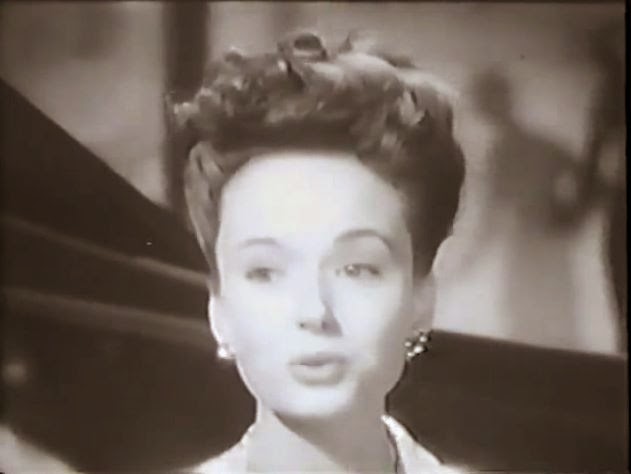
B-movies to be sure, they are the tentative beginning of her thirteen-year film career that reaped a quick rise to stardom—but not just yet.  How much she took with her from her radio and stage training and applied it to her new screen career, and what she might have had to jettison to adapt makes interesting speculation—for this fresh-faced newcomer had been working since the age of six.  If she had learned anything by the age of fourteen-going-on-fifteen, when these films were made, it was that every new experience brought new wisdom, and a revelation, perhaps, that though one could not always create opportunity, one could still carve out a space on which to build the future.

She recalled this period for Modern Screen in 1955:

I guess everyone dreams about being in pictures.  I was no different.  I loved the stage.  But children’s parts, especially good ones, don’t come along too often, and pictures promised at least the chance of steady income.

A pragmatic approach for a young person, but perhaps entirely in character for a woman who would become known in Hollywood as much for her discretion, sense, and serenity as for her talent and beauty.

She and her mother had been several months touring with the road production of Watch On the Rhine(after having played Broadway for a year—see our intro post to this series here), and her seven-year movie contract with Universal meant she could unpack her suitcase for good, though far away from New York and Connecticut where family lived.  There would still be plenty of travel in her future, but from this point forward, California would be home.

The irony was that she came to Universal a dramatic actress—they discovered only in their interview with her that she could also sing.  Sufficiently impressed with this ability, they started her off in musicals.  The ink on the contract was still wet in December 1942 when an article by Harold V. Cohen in the Pittsburgh Post-Gazette crowed, “Pretty little Ann Blyth…may be Universal’s new Deanna Durbin.”

After four B-musicals, Ann was loaned to Warner Bros. for Mildred Pierce (1945), see our post here, and when she returned to the Universal lot, never did another musical for them again.  She wanted to do musicals, but it would take a new studio—MGM—to give her that chance.

The first four movies, all musicals, that Ann made for Universal were Chip off the Old Block, The Merry Monahans, Babes on Swing Street, and Bowery to Broadway, and were all released in 1944.  We’ll discuss the other two films later in the year.  It’s difficult to say if they were made in order of their release, as Donald O’Connor was in most of them and the studio was in a race to crank out as many films with him as possible before he entered the Army Air Corps late in 1943.

Donald O’Connor is quoted in Dick Moore’s book Twinkle, Twinkle, Little Star—But Don’t Have Sex or Take the Car:

They tried to finish all those pictures before I went into the service.  We worked three pictures at one time: the one coming up, the one we were doing, and we dubbed the one we’d just finished.  That’s all we did: work.  It’s amazing we had as much fun as we did, grinding them out like that.

Despite MGM’s glossier and more famous “Andy Hardy” series, according to author Bernard F. Dick in City of Dreams-The Making and Remaking of Universal Pictures:

Universal movies featured more teenagers and young adults than any other studio—Deanna Durbin, Donald O’Connor, Peggy Ryan, Susanna Foster, Grace MacDonald, Ann Blyth…Gloria Jean…

Hedda Hopper noted in her column in February 1943:

Children on the upbeat at Universal.  Since Deanna Durbin and Gloria Jean made so much money for them, Henry Koster has little Ann Blyth…who was so good in Watch on the Rhine…while talking to her, he discovered she could sing.

Universal already had its youth unit, The Jivin’ Jacks and Jills, and the young dramatic stage actress, who it was discovered could also sing, was plunked into this energetic world of home front teens just shy of draft age.  Ann would recall these films as “good learning experiences.”

Later on in the year, we’re going to talk a little about Ann’s teen years in Hollywood.

Chip off the Old Block, released February 1944, in her very first film, gives her third billing after Donald O’Connor and Peggy Ryan--above the title.  This also, along with the uneven quality of the first four films, makes it difficult to really understand what might have been in the can first.  At some point in the frenetic assembly line, the studio decided she was worth featuring.

She is, not for the first time, playing older, a young woman of college age who, having been raised by an uncle and aunt in Hawaii, is now coming to New York City to live with her mother. (Played by Helen Vinson.  Her grandmother is Helen Broderick.)  “My mother and grandmother are famous actresses, and I guess you can’t be that and raise children too.”

She’d have a chance to prove that one wrong some years later.

Donald O’Connor is a campus cut-up at a military academy who performs in the school show.  His father is a career naval officer.  We don’t know what kind of career Donald has mapped out for himself—he laments that he’d be in the war already if his eyesight were better, but he’s so good at performing that his pal, young theater hoofer Peggy Ryan, enlists his help to get an audition.  

She is the comedienne of the piece, no real rival for Ann Blyth for Donald’s affections, though there are some misunderstandings that push the plot along like kids playing kick-the-can until the final number, where all three are on stage performing for war relief.


Our introduction to Ann Blyth is, serendipitously for us train fans, on a train.  Donald sits apart from her, doing eye exercises for his lousy vision, and she misinterprets it as somewhat grotesque flirting.  After a spat and reconciliation, they are cozily ensconced on the rear train platform (which, sadly, nobody can do anymore), and sing a duet.  Her voice is a pleasing soprano, but nowhere near the range, control and richness of what it would become with more training in the next decade. 

Like Donald, she is also a teen with a conscience and wants to do her bit for the war effort, and intends to divide her time between China Relief, the Red Cross, and the canteen, but is dragged into the theater because she sings so swell, and she agrees to do it if the producers give all the money to the war effort.

There is a subplot about Donald mistakenly thinking his naval father is selling plans to a Nazi spy, and a back story that his father and Ann’s mother were once engaged, and where his grandfather and Ann’s grandmother also had a broken-off relationship.  At first, mom and grandma don’t want Ann to have anything to do with Donald, fearing she will be hurt as they were, and they try to scuttle the friendship.  That’s all probably too much for one movie, but Ann shares her first screen kiss with Donald—she goes after him—so this little lightweight movie manages to accomplish a lot for her debut. 

There’s also Joel Kupperman, the seven-year-old math genius from the Quiz Kids radio program.  I’m not sure how he wandered in, but he’s cute as a bug, even if his recitation of math equations makes my head hurt.

Some favorite moments:

Arthur Treacher and Minna Gombell as the former vaudevillians, now turned butler and maid of Ann’s mother and grandmother.  He liked playing a butler so much on stage, he decided to become one.  He still dances up stairs.

The drugstore reconciliation scene (see our previous post on romance in drugstores here) and the endearing soda jerk listening to their tiff as if engrossed in a soap opera.

The sarcastic line, when Ann is fighting with Donald, “What train did you take this morning, the subway from Times Square to 49thStreet?”  It’s only one stop, and Ann lived on East 49th Street before she came to Hollywood.

The way nobody makes a joke out of the lady cabdriver.  She’s doing war work.

Peggy Ryan.  My gosh, that girl was talented.  More on that below.  But though Donald O’Connor and Peggy Ryan eclipsed the other “Jacks and Jills” in popularity and became a team, the addition of Ann Blyth made them a triangle, with Ryan relegated to the pal or sister parts.  From a review in The Windsor (Ontario) Daily Star, May 1944:

The studio seems to have decided that Miss Ryan is a comedienne, and not glamorous enough for the junior romancing required.

So to share feminine honors opposite O’Connor, Universal has introduced Ann Blyth.  She’s a very junior miss who was in the stage version of Watch on the Rhine and looks 14 if she’s a day.

Trying to keep both Miss Blyth and Miss Ryan sympathetic cuts down conflict there, so they drag in the family rivalry.

O’Connor is his bright and brashful self and Miss Ryan again the angular dynamo, matching her partner in mugging. Miss Blyth is a shrinking violet in comparison and so put in the shade.

I get a kick out of the “looks 14 if she’s a day” line, but I have to disagree.  With the regulation upsweep hairdo, she’s quite grown up here, and looks the same age as Peggy Ryan, who in real life was actually some four years older.  It’s funny, and a little sickening, that aging was such a dark cloud over the heads of young performers.  Our old obtuse friend Bosley Crowther of The New York Times deigned to discuss the shenanigans:

The juvenile precocity of Donald O’Connor is wearing off as age is creeping up—the young man is now all of 18 and looks it…

He describes the film as “lackluster” and singles out Ann as only “a pretty newcomer.”  Peggy Ryan gets the mud slung: “Peggy Ryan is a clowning annoyance.”

According to Ann’s interview in the above-mentioned Modern Screen article, the preview for Chip off the Old Block took place out in Glendale.  “It took forever to get there by streetcar and bus.”

Ann’s mother accompanied her, and Ann recalled:

She probably realized that I had a lot to learn, but there for the first time on the screen was her daughter.  Her daughter made little impression on anyone else.  Nobody recognized me outside.  Nobody asked me for an autograph.

The next movie, The Merry Monahans was released seven months later, in September 1944, followed immediately by the third, Babes on Swing Street in October, and the last, Bowery to Broadway in November.

In December, Mildred Pierce went into production.  Nothing would be the same after that.


The Merry Monahansis one of those fun “passing parade of years” movies, where a decade and more fans through our eyes in a flurry of newspaper headlines and the ups and downs of a vaudeville family.  Jack Oakie teams with lovely Rosemary DeCamp at the turn of the twentieth century on stage, and proposes marriage, but his problems with alcohol have him helplessly entangled with another woman, who drags him to the altar first.  Oakie is likeable in the role, and poignant when he nobly faces heartbreak. 

It is a loveless marriage, and his wife leaves him.  Nobody misses her.  Oakie continues the act with their two kids: Donald O’Connor and Peggy Ryan.  Catch the scene where the kids are shown much younger using some sort of camera perspective trickery to make them appear much shorter than Oakie.

We’re taken up to the World War I era, where the act is traveling by train, and we have another train meet cute between Donald and Ann Blyth.  He is bored, wanders around the train, eventually decides to climb onto the train roof and stroll around up there.  Shades of his later role as Buster Keaton (see our post on Donald and Ann’s matchup in The Buster Keaton Story 1957, here).  In a later scene, he takes her up there with him.

When he climbs down, covered in soot, he lands on the rear train platform, and who is sitting there?  Ann Blyth, of course.  She thinks he is a hobo, feels sorry for him, and gives him a dollar.

Ann is also in vaudeville, traveling with her mother and the lead in the act, a distinguished dramatic actor played by John Miljan, who has eyes for her mother, and who takes a Svengali-type interest in Ann’s career. 

Here, Ann is not the breezy and self-confident sophisticate she was in Chip off the Old Block.  She’s playing closer to her own age, looks younger with the World War I-era long ringlets and old-fashioned clothing, and she immediately draws our sympathy for her anxiety over performing, of not being good enough and not pleasing her mother and Mr. Miljan, who coaches her.  She has to make good because they have to eat, otherwise, she’s not sure she belongs in this world of theatre.  A sad, sweet girl, doing her best to keep up, though she is overwhelmed.

We see at once that Ann Blyth has, in her second film, already established her ability to appear completely different to her previous movie role.  Her versatility, as we’ve seen in this year-long series on Ann Blyth, was the most striking and notable feature of her acting career, and is a quality she came in with from day one. Also, as we’ve seen, this very talent of simply being versatile could be useful in exploiting new opportunities; but it could also hold one back in an industry that seemed always to hire based on type.

Consider Donald O’Connor and Peggy Ryan, a very successful team as teens and both enormously talented.  They are the same in every film, because that was what clicked with the audiences.  Miss Ryan’s film career would not last much longer, and Mr. O’Connor would have a struggle to re-establish himself after his military service.  Francis the Talking Mule came to his rescue, and eventually, of course, there would be his exceptional performance in Singin’ In the Rain (1952) and a few other big musicals in the 1950s, and his own TV show.  Peggy Ryan and Donald O’Connor were seen as a sort of B-movie Mickey and Judy.  As a team, they were equally talented to the better known, more glossily produced Mickey and Judy team.  As individual performers—I would suggest they were even better.

O’Connor and Ryan were impressive dancers.  There are comic numbers that include amazing acrobatics and athleticism.  There are explosive tap numbers, and there are sweeping, elegant ballroom dances that surpass anything done by Mickey and Judy, and are the equal to any performance of Gene Kelly or Fred Astaire and their partners. 


In a lavish solo number, Peggy Ryan, who though she may have not been allowed to display a great acting range in her teaming with Donald O’Connor, and whose singing was only fair, here displays remarkable versatility as a dancer.  She is exquisite in ballet, ballroom, elegantly dropping the mugging comic persona for an enchanting presence as one of the great screen dancers.  I think this is too little acknowledged today, and maybe she has become forgotten by all but her fans, but we need to rectify that.  I hope to discuss more of her work in the future.  The Ryan-O’Connor dance team couldn’t be beat.

The Merry Monahansis mostly music, and some of the numbers staged as theatre shows are fantastic, especially the quite long “Manhattan Follies” sequence at the end, which leaves not a lot of time for plot.  Just as in Chip off the Old Block, there’s a lot happening here and it could almost be divided up into two or three movies.  First, there is the surprise when Ann’s mother comes to fetch her off the back train platform and…gasp!  It’s Rosemary DeCamp!  Jack Oakie’s former love!  And Jack Oakie is Donald O’Connor’s dad!  The coincidence is all too remarkable!

You can see where this is going.  However, there’s a whole lot to wade through before we get one big happy family.  John Miljan’s controlling influence over Ann and her mother is sinister, and where Ann is concerned, really quite creepy.  That could have been a whole movie by itself.

Then there is the recurrence of Jack Oakie’s drinking problem and how he messes up the act and Donald and Peggy have to go it alone.

Ann gets a nice variety of scenes in this movie that showcase her abilities.  Her first solo is sweet rendition of “If You Wore a Tulip” performed as part of a vaudeville act rehearsal.  Her dramatic abilities shine in the tension over John Miljan’s harsh influence over her, especially when she is moved to tears under his criticism, and her final standoff with him.  She even gets a nice comic scene when she has run away (“I can’t stand him anymore.”) and she and Donald are mulling over their problems on a park bench where an Irish cop played by Robert Homans (Hollywood Stereotype #412), on the lookout for the reported runaway, has discovered them. 

Ann, innocent as you please, launches into her Irish accent (possibly borrowed from her Irish-born mother, but I’m sure she put it back when she done using it), and berates “my fine policeman” for thinking she was anything but the proud daughter of another Irish cop.

They attempt to be married at a town hall, but the clerk rats on them.  He’s played by Ian Wolfe, who years later showed up as Ann’s butler in Wagon Train’s “The Jenny Tannen Story” (see this previous post here).

Gavin Muir, who we’ll later see as the dogged inspector plaguing Ann’s life in Thunder on the Hill (1951-which we discussed here) is the Broadway impresario who gives them all their big break.

Problems get resolved a little too quickly at the end, but then, we have to move fast because we’re running out of film.  The Merry Monahans is, for all its weaknesses, a really delightful movie with an unassuming cast so incredibly talented that we need to dismiss the sum total of the movie parts and just focus on the individuals who rise above the movie-making assembly line and prove themselves to be real troupers.

Before the movie was released to the general public, it was previewed at Camp Pendleton, whose proximity to Hollywood made it the lucky beneficiary of many visits from Hollywood stars donating their time to entertain.  A newspaper article from July 1944, probably a not a little beefed up by the studio publicity department, quote one “rugged Marine” back from battle on Tarawa and the Marshalls as admiring newcomer Ann Blyth, “She not only sings like an angel—she looks like one.”  Ann the “young singing and acting sensation of Universal’s The Merry Monahans had been made sweetheart of the regiment.”

She sang at the camp, and was lauded by other marines as “another Deanna Durbin.”  The article also mentions the “as yet unreleased” Bowery to Broadway, so here again, we don’t really know if these first four films were actually made all at the same time. 

Now she is on the threshold of film greatness while only in her middle teens.

This, despite the crackling sound of hyperbole, proved to be true, but not yet for her singing.  She was unexpectedly loaned to Warner Bros. for Mildred Pierce and her searing performance as the evil Veda broke the cycle of light teen musicals and would earn her a reputation as a promising dramatic actress.  Though she kept hoping for another musical from her home studio, it was not until she was loaned to MGM for The Great Caruso (1951) that Ann appeared in another screen musical.  It took some campaigning to get that role, and that role finally launched her string of big 1950s musicals, to the point where some may have forgotten what a tremendous dramatic actress she was.
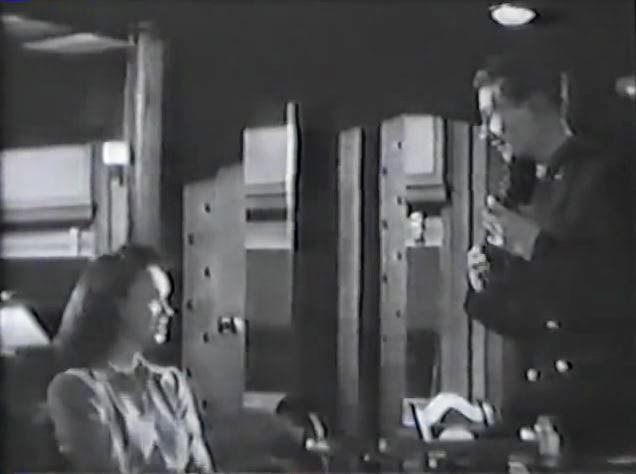
If that meant she did not enjoy the firmly cemented screen persona that made Peggy Ryan and Donald O’Connor so easily identifiable to the public and so easily marketable by Universal, nevertheless it made for a longer lasting career with what must have been a satisfying degree of variety.

For the rest of this month, we’re going to cover that progression of screen musicals in the 1950s.  Come back next Thursday, when we start off with The Great Caruso with Mario Lanza.

To my knowledge, neither Chip off the Old Block or The Merry Monahans has been released in VHS or DVD (please correct me if I'm wrong), but bits can be found on YouTube.

To American readers: Wishing you a very happy Independence Day tomorrow.

*******************************
Classic Images, February 1995, “Ann Blyth: Ann of a thousand Smiles” by Lance Erickson Ghulam, p.18.

Deseret News (Salt Lake City), July 19, 1944, p. 7 “Ann Sings, Looks Like Angel.”

Dick, Bernard F.  City of Dreams-The Making and Remaking of Universal Pictures (University of Kentucky Press, 1997), p. x

Modern Screen, October 1955, “High Road to Happiness” by Ida Zeitlin, p. 82.

Moore, Dick. Twinkle, Twinkle, Little Star—But Don’t Have Sex or Take the Car (NY: Harper & Row Publishers, c. 1984), p. 124.

The New York Times, March 17, 1944, review by Bosley Crowther.

Pittsburgh Post-Gazette, December 3, 1942, article by Harold V. Cohen, p. 22.

St. Petersburg (Florida) Times, February 18, 1943, syndicated column by Hedda Hopper, p. 15.


The Windsor(Ontario) Daily Star – article by Annie Oakley, May 8, 1944.
******************************
THANK YOU....to the following folks whose aid in gathering material for this series has been invaluable:  EBH; Kevin Deany of Kevin's Movie Corner; Gerry Szymski of Westmont Movie Classics, Westmont, Illinois; and Ivan G. Shreve, Jr. of Thrilling Days of Yesteryear.

***************************
TRIVIA QUESTION:  I've recently been contacted by someone who wants to know if the piano player in Dillinger (1945-see post here) is the boogie-woogie artist Albert Ammons. Please leave comment or drop me a line if you know.
****************************
 HELP!!!!!!!!!!

Now that I've got your attention: I'm still on the lookout for a movie called Katie Did It (1951) for this year-long series on the career of Ann Blyth.  It seems to be a rare one.  Please contact me on this blog or at my email: JacquelineTLynch@gmail.com if you know where I can lay my hands on this film.  Am willing to buy or trade, or wash windows in exchange.  Maybe not the windows part.  But you know what I mean.

Also, if anybody has any of Ann's TV appearances, there's a few I'm missing from Switch, The Dick Powell Show, the Dennis Day Show (TV), the DuPont Show with June Allyson, This is Your Life, Lux Video Theatre.  Also any video clips of her Oscar appearances.  Release the hounds.  And let me know, please. 

***************************

A new collection of essays, some old, some new, from this blog titled Movies in Our Time: Hollywood Mimics and Mirrors the 20th Century is now out eBook, and will soon be issued in paperback.


I’ll provide a free copy, either paperback or eBook or both if you wish, to bloggers in exchange for an honest review.  Just email me at JacquelineTLynch@gmail.com with your preference of format, your email address, and an address to mail the paperback (if that’s your preference).  Thanks.