Showing posts with label James Stewart. Show all posts

Thursday, July 24, 2014

Rose Marie - 1954

Rose Marie (1954) is a delightful surprise.  It stands on the shoulders of its 1936 predecessor, whose stars Nelson Eddy and Jeannette MacDonald became icons in their roles, and soars beyond that famous cliché, ironically, by joyously and most unselfconsciously wrapping itself in the old-time conventions of operetta and melodrama.  New technology, however—CinemaScope and Technicolor—gave this version a twist and a punch in a most convenient and happy marriage of the old and the new.

Ann Blyth was 24 going on 25 when she played the title role in this musical, and one is impressed by her ability to appear so young, so naturally and effortlessly a teenager when in her teen years she often played characters who were older, or least more poised and sophisticated.  Very light, natural-looking makeup, and her loose woodsman’s buckskins covering her shape help to create this illusion, but two things she does herself complete the picture—her animated expressions which, with the innocence of youth, do not mask her emotions, but let us see every flickering thought passing through her mind, and also the way she moves.  With an animal-like ease and strength, she lives the outdoor life like someone completely at home in the woods, not stomping about in her buckskin with exaggerated mannishness like Doris Day in Calamity Jane, but hiking, climbing on rocks, and running with the grace of an athlete. 
The picture of her seeming physical change was overshadowed in the press of the day, which took greater notice, with greater surprise, at her singing voice.  This was her first big singing role after her one song in The Great Caruso, which we covered here. 

A review in the St. Petersburg (Florida) Times:

The surprise in Rose Marie is Ann Blyth’s singing voice, which is gloriously pitched, full, and strong.
The “new Ann Blyth” of the headline “New Ann Blyth Emerges in Classical Rose Marie,” (in pretty much every film she did she was always “new”), emphatically declares herself with her first song, the exhilarating “Free to Be Free".  Just like the character Rose Marie, who wants to live life in the wild without being forced into a “ladylike” life of restricted freedom in town, Ann Blyth is declaring her freedom in a way that says, “Look at me.  I can really sing.  This is my movie.”  Her range is quite demonstrably large in this song, even drifting down into the mezzo area, and her control is stunning, bang-on notes with no vibrato or trilling.  It’s a magnificent delivery and a great song to come charging out of the gate in this movie, as if to make the audience take notice—this is Rose Marie, the old chestnut you thought you knew, but didn’t.

The old chestnut, as it happens, was never produced the same way twice.  We think we know it as the template of all parodies involving a man in a Mountie’s uniform, from Dudley Do-Right to Monty Python’s male chorus in “The Lumberjack Song.”   It started as the second-longest running play of the 1920s, just behind The Student Prince, (we discussed that 1954 film last week here.)

As far as the popular parodies go, I confess, Dudley Do-Right was my first crush.  I know, he wasn’t very bright, but he exemplified honor, attention to duty, and all things respectably Canadian.  And he had that red coat.  Chick magnet.

He didn’t sing operetta, though.  Not like Mighty Mouse, who was a magnificent tenor.

I’m sorry, where was I going with this?

Court Square Theatre, Springfield, Mass., author's collection.

The Broadway play, an operetta that took its melodrama seriously, featured a boatload of songs, only a few of which survived in film versions.  The story was of Rose Marie, who loved Jim, a miner, who was accused of murdering an Indian named Black Eagle, whose girlfriend, Wanda, is the real killer.  Rose Marie is brokered off in marriage by her brother for money to marry city slicker Etienne Darcy.  Behind all this menagerie, is the stalwart Mountie, Sgt. Malone, who is on the trail of the murderer.  At one point, in a suspenseful moment to help Jim escape, Rose Marie signals him by singing the “Indian Love Call.”  Note: the love story is not between her and Sgt. Malone; it’s between her and Jim the Miner.  The Mountie sees that justice prevails, and Rose Marie is free to marry Jim and go off into the wilderness. 

Court Square Theatre, Springfield, Mass., author's collection.

The play wowed them at the Imperial Theatre from September 1924 through June 1926, and then brought back quickly by popular demand at the Century Theatre in a revival in 1927.  Hollywood, now poised to pounce on any Broadway hit, took over the property and promptly made the first of three movie versions of Rose-Marie in 1928.

A silent movie, obviously, it was released in February, six months before Ann Blyth was born, and starred an actress whom she would come to know years later—Joan Crawford.

Miss Crawford was something like 23 when she played Rose-Marie, with James Murray (so terrific in The Crowd, which we discussed here) as her lover Jim the Miner, and House Peters as the Mountie, Sgt. Malone.  There’s a nice still from the movie here at this website, Nitrateville.

Publicity photo, Joan Crawford with co-star House Peters.

Joan is quoted as having said, “I felt very uneasy as a French Canadian.”  An odd remark, considering she did not have to speak with an accent in this silent film, and considering her real name was Lucille Le Sueur.  The film is considered lost, but we can imagine the melodrama probably went over well as a favorite genre in the heyday of silents.

The second go-round for Rose Marie came in 1936, the famous matchup with Nelson Eddy and Jeannette MacDonald.  Because these two stars already walked into the story with their own strong talents and screen personalities, and because MGM wanted to build up the team, the original story was scrapped.  Rose Marie 1936 bears little resemblance to the operetta, though a few songs remain, including the now famous “Indian Love Call,” which cemented the duo’s iconic place in film because it was sung in this movie an amazing four times.  Just in case we weren’t paying attention.

In this film, there is no Jim the Miner.  Rose Marie is an opera singer, going by her stage name, Marie de Flor.  We see Jeannette performing scenes from Roméo et Julietteand Tosca just to show she can do it.  

Her brother, John, is in trouble, on the lam in the Canadian wilderness, from murdering a cop.  He is strikingly played by a young James Stewart, who conveys the young man’s restlessness and pitiable scamp’s charm, and his ultimate hopeless future with great sympathy. 

Jeannette leaves the glittering opera house of Montreal, heads for the big woods, and hires a guide to take her to her brother.  She does not even attempt a French accent; she leaves that to her maid, played by the wonderful Una O’Connor.

Instead of a turn-of-the-century melodrama, we get a modern 1930s romantic comedy, admirable for the magnetism of its stars and its fast-paced plot.  Nelson Eddy is the Mountie, here called Sgt. Bruce, hunting her brother, and the race is on as to who will get to him first, Jeannette or Nelson.  From the moment they meet, Nelson is after her, too, and we know they will end up a romantic couple. 

Jeannette, playing a spoiled diva, has a great comedic scene when she tries to emulate a saloon torch singer, competing with her, unsuccessfully, to earn coins thrown at her from an inattentive audience. 

Nelson sings the title song “Rose Marie” to her in a canoe, while she slowly unbends her opinion that she hates all men.  The climax occurs when she finds her brother, but so does Nelson, and takes him in. 

The film is well done, with plenty of natural scenery (not filmed in Canada), but uses its share of rear-screen projection as well—particularly noticeable when Nelson Eddy rides in front of a troop of Mounties singing in his heroic baritone, “The Mounties.”  But it’s just him.
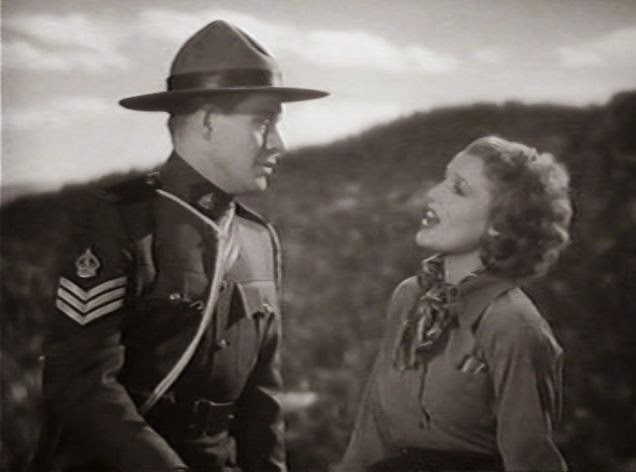
This movie, because it cemented the Eddy-MacDonald team and because of those four separate unrepentant blasts of “Indian Love Call,” rose above the quaint operetta on which it was based and took on a life of its own.

The Rose Marie of 1954, playfully, and with equal dash, revisits the old operetta with unabashed admiration and humor.  It is more leisurely-paced, and with its magnificent scenery (including location shooting in Alberta), glorious singing, CinemaScope and Technicolor, invites us to enjoy the marvels of technology on this very old-fashioned story.
Ann Blyth is Rose Marie Lemaitre, all alone in the world after the death of her trapper father.  Miss Blyth apparently had no qualms about playing a French Canadian, as her delightful accent is spot-on.  She has no qualms, either, about being alone in the world, for when the Mountie first encounters her, she is placidly fishing from a canoe, contentedly doing for herself, and wants no outside help.

The Mountie, Sgt. Malone, is Howard Keel, resplendent in that red coat enough to make me almost desert Dudley Do-Right.  He sings "The Mounties" while riding ahead of his troop of men, not rear screen projection.  He has the job of taking her out of the wilderness, (which as he tells in song is no place for girl) and bring her into protective custody. 
She is unwilling, even frightened to go with him, like an animal panicked at the sight of a cage.  She gets away, and he tracks her down, finding her cuddled up like a bear cub in sleep, but when he disturbs her, she attacks him with a knife.  At the first opportunity, she bites him.

Someday I'm going to have to tell you my coonskin cap story.  When I feel I know you better.

We may note that she runs like an athlete, not like Jeannette MacDonald, who runs through the woods like a sissy. 

Sgt. Howard Keel catches her again.  Have a look at this image of him holding her, one-armed, from his horse, dangling her like a rag doll.  An indignant, frustrated rag doll.  Do you see any bit of the slick sociopath Veda Pierce here?  Any bit of haughty, conniving fashion plate Regina Hubbard, the graceful elegance of the Countess Marina?  The poised, demure high school graduate Gail Macaulay?
Few of Ann Blyth’s contemporaries were as versatile.  I love her little groan, equal parts despair and discomfort, when he hoists her into the saddle after she capitulates.

Howard Keel at first was not happy with the Mountie’s role in this film, finding him too weak and ineffectual…perhaps like Dudley Do-Right…but his requested changes to the script were made and he signed on, noting in his autobiography, Only Make Believe, that it was a fun shoot.

I didn’t sing with Ann Blyth, but she was a delightful cutie and sang beautifully.
They did not sing “Indian Love Call” together because in the original story, that song was for Rose Marie and Jim the Miner.  Here, he’s Jim the Trapper Who Wants to Also Pan for Gold, played by Fernando Lamas.  One of the film’s particular pleasures is giving us not one, but two baritones, who are rivals for the hand of Rose Marie, adding a bit more tension to the plot. 
Mr. Lamas, in deference to his impossible-to-disguise Argentine accent, is also supposed to be French Canadian.  Only to a Hollywood producer would this be logical.  He sounds about as French as the Mountie, but if you can overlook the Spanish accent coming out of his mouth, Fernando presents as a brooding, handsome mystery, who fascinates Rose Marie from the moment she meets him.  It will be a coming of age story as she struggles with her feelings for the two men.

You might stumble on some spoilers as we go. 

Bert Lahr is the comedy relief as the bumbling corporal.  When she is first brought into custody at the fort, Ann pleas with Bert, “You let go me, yes?”

“If I let go you, they let go me, and on a clear day I can see my pension.”  She bites him.
Ray Collins, one of my favorite stuffed shirts, here plays the inspector in charge.  By the time he visits, Ann has become docile, changed from her buckskin to a cut-down and tailored Mountie’s uniform as the post mascot.  Inspector Collins inspects the troops, berates the men for not shaving properly, and is pleased with the little Mountie who has no five o’clock shadow.  After a beat, the penny drops and he realizes it’s because she has a hormonal advantage.
“She’s a woman!” he blasts Howard Keel, who suddenly realizes that fact as well, now that it’s been pointed out to him.  He thinks of her as just a kid.  Collins wants to send her away, to his cousin, Marjorie Main, in town.  If the wilderness is no place for a woman, neither is the police constabulary.  Poor Rose Marie, just when she begins to adapt, she’s got no right to be here either.
There are several laugh-out-loud moments in the film, as everyone, not just Bert Lahr, gets to play for laughs.  One of the particular charms of Ann Blyth’s character is her quality of being quite innocently unselfconscious.  Mountie Howard tells her she is interesting to men, and she agrees, "You're right.  I am interesting."  He tells her she is beautiful, she beams at the coincidence, "I think so too."  She greets the inspector with enthusiasm, telling him about the horse Howard Keel taught her to ride.

“A fine horse, Monsieur.  Old, but still alive.  Like you, Monsieur.”  She deals with the ups and downs of life with a Gallic shrug of the shoulders. 

But she does not want to go to town and leave the post, so she runs away.  Howard catches up, and instead of handcuffing her, explains that she will enjoy growing up and being attractive to men in the song “Rose Marie.”  By the song’s end, she is intrigued and wants to give it a try, and he is astonished to realize his own attraction for her.
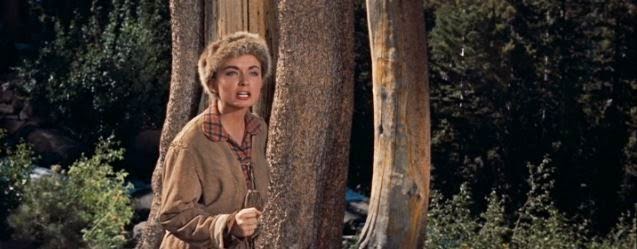
Interesting how this scene is filmed.  First, it is an outdoor shot.  Rose Marie is furious that the inspector, “the man with the face” wants to send her away.  Her rant is hysterical.

“…the man with the face.  Oh, Mike, I hate this man most happily.”

“Well, what do you aim to do about it?”

“Kill him.”

“Kill him?”

“Sure.  It’s easy.  I show him how I shoot the hat at fifty paces, but I do not shoot the hat, I shoot the face.  Voilà.”
She leans against the trunk of a tree.  When she pushes herself off of it, she steps into what is a studio soundstage wilderness, but it is so imperceptible you don’t notice it unless you obsess over frames like me.  Howard sings his song, Ann steps back to the tree, leans her bottom against it, and we are back outside again.
This was the first musical ever to be filmed in CinemaScope, and it’s amazing how fluid the scenes are and how the shots vary.  In later musicals, including The Student Prince, Kismet, really most of the late 1950s musicals that were filmed in CinemaScope, the shots seem almost static.  In some cases, you see the characters wrenched into a kind of kick-line to fill up the horizontal space, and often the glaring far left and far right are empty.
Rose Marie has a vibrancy to its set-ups that makes use not only of the grandeur of the scenery just made for widescreen, but is used most effectively in indoor shots as well.  Over the shoulder shots, composition that makes use of the widescreen qualities, but does not scream CinemaScope gimmick.

In town, Ann is taken under the wing of Marjorie Main, a blustering saloon keeper who’s sweet on Bert Lahr.  She’s got a motherly streak, and she teaches Ann to be a lady.  Ann recalled for Classic Images in 1995:

I think a lot of people don’t remember that Marjorie was really a marvelous dramatic actress.  She did some marvelous stage work, and, of course, a few roles like that in pictures as well…As funny as she could be, she could break your heart as well.
In these shots of Ann’s bedroom above the saloon the director makes use of the mirrors on either side and the window to open the space up for CinemaScope.  You can see Jim riding up through the open window.
In this series of shots, Jim sings of his love to her from the half-door of a trapper’s bunkhouse behind the stable.  The camera pulls back, reveals the top of a pine tree, and then embraces the second-story balcony where Rose Marie sings in response.
Before this, they have sung the famous “Indian Love Call” with a frank loveliness that seems to dare the audience, and snarky reviewers, to compare them with Nelson Eddy and Jeannette MacDonald.  Ann holds the last note for around nine or ten seconds, but that’s not her record. She could hold the end of “Baubles, Bangles and Beads” from Kismet for a full nineteen.

“I can still do it,” she told interviewer Brian Kellow for Opera News in 2002.

Here is the “Indian Love Call.”


Love with devil-may-care Jim does not run smooth, however.  He is, by his own admission, “not the marrying kind.”  This is what he tells Wanda, the Indian maid whose jealousy will drive her to attempt to murder Jim/Fernando, fail, and then kill the Indian chief when he beats her for chasing after Jim.  Jim gets stuck with the rap, and, just as in the play, Rose Marie, tearing up, sings the “Indian Love Call” in reprise to signal to him that she does not love him, to make him leave and not wait for her so Howard Keel will not catch him.
In the middle of all this is a typically garish Busby Berkeley-choreographed number that is mesmerizing for its bizarre sexuality and plot pointlessness.  Wanda, played by Joan Taylor, who appears to be the only woman in the Indian village, takes part in some sort of fertility dance with a zillion braves.  Wanda sees Ann and Fernando watching, perceives they love each other, and you can’t help but be heartbroken for Wanda.

The 1936 Rose Marieincludes the play’s original “Totem Tom-Tom” number in a much more natural style and setting, looking for all like a real tribal celebration, and it is more dramatic and moving for being so.  I’m not sure why the Busby Berkeley number, except that there is no big musical dance scene in this movie, apart from the charity dance at the saloon.  Maybe producer and director Mervyn LeRoy, whose work in this movie is otherwise very effective, fell back on the Big MGM Musical template and decided this weirdness was needed.  It is colorful, certainly, and eye catching, if a little stupefying.
The Mountie does catch his man, and Fernando is going to be hung, but Howard, stunned at Ann’s confession that she loves Fernando (Howard had earlier proposed to her), decides to sift through the evidence one more time and saves the day.  When Fernando is released, Ann, in gratitude, tells Howard she will marry him and do whatever he wants.  Howard wants her to put her buckskin clothes back on, and take a ride with him out of town.  When they are out in the woods, despite his earlier position that girls do not belong in the wild, he tells her that she was meant to be free and to live in the wilderness.  He sends her off with Fernando.  It is just the noble thing you’d expect a Mountie to do.
We could also marvel that not only is he telling her she is no less feminine for wearing buckskin and living a rugged life, but there is no suggestion that she and Fernando are going to rouse a justice of the peace in the middle of the night to marry them.  They’re just going off together in the wilderness in a bittersweet ending.  We cannot help but wonder how they will fare.  Will Jim be faithful to Rose Marie?  Will the Mountie ever find another girl to love him?  This is what happens when you stop thinking about the stars, when the stars are skillful enough to allow you to do that.
The principal players generally received good reviews, though most reviewers dismissed the story as an antique.

There would be few opportunities ever again to present operetta on screen, and even popular musicals were on the wane.  Ann Blyth was newly married when Rose Marie was being filmed.  We can imagine it was a period of both personal and professional happiness.  Her wedding was, like many celebrity weddings, called The Wedding of the Year when it occurred in 1953, which we mentioned in this previous post, but except for that occasion, she managed to live so quietly that few took notice.

Hedda Hopper noted of Rose Marie in June 1954:

Ann just goes her own sweet way, making little fuss and fewer headlines.  Then, when you least expect it, she comes through with a Sunday punch and you find yourself blinking and asking, “Was that Ann Blyth?”
Come back next Thursday, when we have a chance to say, “Was that Ann Blyth?” again, and again, in three decades of musical theatre performances from the 1960s to the 1980s.  Until then, here’s the trailer for Rose Marie:


*******************************
Classic Images, February 1995, “Ann of a Thousand Smiles” by Lance Erickson Ghulam, p. 20.

Hartford Courant Magazine, June 6, 1954, article by Hedda Hopper, p. 10.

Keel, Howard, with Joyce Spizer.  Only Make Believe – My Life in Show Business (Fort Lee, NJ: Barricade Books, 2005) pp. 156-157.

Opera News, August 2002, article by Brian Kellow.

St. Petersburg(Florida) Times, March 22, 1954, “New Ann Blyth Emerges in Classical Rose Marie,” review by L.B., p. 34.
 ******************************
THANK YOU....to the following folks whose aid in gathering material for this series has been invaluable:  EBH; Kevin Deany of Kevin's Movie Corner; Gerry Szymski of Westmont Movie Classics, Westmont, Illinois; and Ivan G. Shreve, Jr. of Thrilling Days of Yesteryear.

***************************
TRIVIA QUESTION:  I've recently been contacted by someone who wants to know if the piano player in Dillinger (1945-see post here) is the boogie-woogie artist Albert Ammons. Please leave comment or drop me a line if you know.
****************************
 HELP!!!!!!!!!!

Now that I've got your attention: I'm still on the lookout for a movie called Katie Did It (1951) for this year-long series on the career of Ann Blyth.  It seems to be a rare one.  Please contact me on this blog or at my email: JacquelineTLynch@gmail.com if you know where I can lay my hands on this film.  Am willing to buy or trade, or wash windows in exchange.  Maybe not the windows part.  But you know what I mean.

Also, if anybody has any of Ann's TV appearances, there's a few I'm missing from Switch, The Dick Powell Show, the Dennis Day Show (TV), the DuPont Show with June Allyson, This is Your Life, Lux Video Theatre.  Also any video clips of her Oscar appearances.  Release the hounds.  And let me know, please. 

***************************

A new collection of essays, some old, some new, from this blog titled Movies in Our Time: Hollywood Mimics and Mirrors the 20th Century is now out in eBook, and in paperback here.
I’ll provide a free copy, either paperback or eBook or both if you wish, to bloggers in exchange for an honest review.  Just email me at JacquelineTLynch@gmail.com with your preference of format, your email address, and an address to mail the paperback (if that’s your preference).  Thanks.

Thursday, February 6, 2014

Mildred Pierce - 1945...Revisiting Veda


Mildred Pierce (1945) gave Ann Blyth a film career.  The loan-out to Warner Bros. to make the film proved a serendipitous event, handing her an astounding opportunity.  She responded, astoundingly, with a remarkably intense and mature performance. 

I know I keep warning you about long posts.  They won't all be long.  But enough will be so that you should always bring a snack to this blog.

Ann was only sixteen, with four minor musicals to her credit at Universal (which we’ll discuss in a later post), and all of these films were ensemble pieces.  She never had a starring role in any of them, and in the last film she made before Mildred Pierce, a bit of vaudeville fluff called Bowery to Broadway (1944), she was in the film as the daughter of ex-vaudevillians Frank McHugh and Rosemary DeCamp for all of about three minutes, singing a song at the finale.  How the lightweight, chirping, innocent teens she played in these movies ever paved the way to creating the role of Veda Pierce—a manipulative sociopath—is a phenomenon often mused over by classic film fans, but probably will never be fathomed by anyone looking for a logical explanation.  The ability for an actress to shed her skin and crawl into another person’s psyche is what’s supposed to happen—but it shocks us when it’s done so well.

Fifth billing here, not only did the film really launch Miss Blyth’s career—certainly more than the Universal musicals did—but it sustained her career over that horrific period when she was out of work for more than a year during the recovery from her severe spinal injury (which we discussed in our intro post to this series here).  A year is a long time in the film industry, and once momentum is lost in one’s career, it is often gone for good.  Many film careers have gotten derailed and never recovered from circumstances far less serious than Ann’s.  But her splendid work in Mildred Pierce, which earned her a Best Supporting Actress nomination, kept her in the industry’s focus and in the favor of the fickle and forgetful public during her convalescence.

According to gossip columnist Hedda Hopper, who reported in December 1947, “…Of all the promising youngsters in our town, I predict the brightest future for Ann.  She’s got it.  In Mildred Pierce, she stole many scenes from the star.”

The star of the film, Joan Crawford, in her way helped to get Ann the role by pairing up with her for Ann's screen test.

Joan Crawford was at a crossroads in her career, having left MGM with her star power draining away in predictable roles and the inevitable crisis of maintaining screen glamour for an actress entering her forties.  Miss Crawford was not ready for character parts yet (and never would be), and headed for Warner Bros. in the hope of reviving her brand with meatier roles.  Mildred Pierce was just the ticket for her, but in what must have been a very canny and savvy act, she read with Ann Blyth during Ann’s screen test.  This is not something stars usually did—that was a chore for an underling, but Joan Crawford had a lot riding on this movie, and she wanted to be sure that the actress playing her daughter Veda, who was the linchpin of the movie, was the best she could get.

Miss Crawford, despite her stardom at the biggest studio in town before she came to Warner’s, had to jump through some hoops herself to get her role as Mildred.  Director Michael Curtiz had not wanted her, and it wasn’t until other established Warner’s stars like Bette Davis had turned down the role that Joan was considered.  She was even required to test for it first, which had to have been an insult, but Joan Crawford was nothing if not a fighter, and she wanted this movie.  She knew with impressive clarity that it could be her making—or re-making, as if were—and that the actress playing Veda was key.

Ann Blyth was one of the last to test of many, many young actresses who badly wanted this role of the spoiled, troublesome and, at times, downright evil Veda.  Ann recalled in interviews that her agent at the time pushed for a chance for her to test for the role, sensing some as yet untried ability in his young client to meet the challenge.

Warner’s, however, was not really keen on having Ann do the role, even if she were really good in the part.  Why make a star of a young actress who belonged to another studio?  They had plenty of young women in their own stable to groom.  But Ann was good in the tests, and Joan wanted her. 

Ann Blyth never forgot it, and in the distant decades ahead when Joan’s name and reputation after her death became a scandal and a joke, Miss Blyth remained one of her biggest fans and defenders.  You can have a look at her TCM tribute to Joan Crawford here.

In the final days of shooting the film in February 1945, curiosity in the press buzzing around the studio presaged the huge hit this film was going to be.  Columnist Sheliah Graham: “Joan Crawford is taking a big chance with her following in Mildred Pierce.  In the matter of her glamour girl status, I mean…Joan has a grownup daughter…in this case, it’s pretty Ann Blyth…In Mildred she wears no makeup in some of the scenes and looks bedraggled and drab.  To further emphasize the change in Joan: she plays many of the scenes with her back to the camera, facing Ann’s pretty, youthful face.  Miss Crawford certainly has changed—and for the better.”

 
We’ve discussed Mildred Pierce before in this post here, but that was to concentrate on Ernest Haller’s gorgeous cinematography.  Today we focus on Ann Blyth’s Veda character.  The movie is so rich in performances and imagery, that I suppose you could pick out different aspects of the film and never run out of things to talk about—there may be somebody out there right now working on their Master’s Degree thesis on Mildred Pierce.

For this post, I’d like to explore the idea that Kay Pierce, Veda’s younger sister played by Jo Ann Marlowe, was a steadying influence on Veda and that had she lived, the course of Veda’s life and her downfall might have been very different.  Veda had two negative and ultimately destructive influences in her life—Monty, played by Zachary Scott, was one.  The other was her own mother.

Kay, the rough and tumble little sister Veda lorded over, was actually the most positive influence in her life, and had more subtle power over Veda than anybody.

Of course, neither the movie nor the original novel play with this notion, but this is my blog and it’s my football. 
 
In the striking opening shots Zachary Scott is gunned down by an unseen murderer and the movie, completely unlike the novel, begins with a murder mystery.  We see Joan Crawford pondering a suicidal leap off a dark wharf in desperation, and then try to ensnare Jack Carson in a murder rap.

Veda, who will figure so prominently in the movie, first appears like a minor character, skirting nervously across the room to her mother, Mildred, played by Joan Crawford, who comes home to find the police there already waiting to question her.

Veda runs to her for comfort, explanation, protection, “Mother, where have you been?  What’s happened?”  She is a pretty young woman covered in a long bathrobe.  She seems genuinely frightened by the police and genuinely mystified by what could possibly have brought them here at this late hour.  She seems like any innocent teen.  Director Michael Curtiz has set the scene beautifully, with his showman’s artistry. 

One of the problems, if it is a problem, of making a movie on what was then a currently popular novel is that a good part of the audience knows what happened in the story.  Mr. Curtiz and the team of writers, by adding the murder mystery, turned the story on its ear and made it something new.  That murder mystery also carried to greater depths the darker mood of the story than to the novel, and the darker places in the souls of the mother and daughter.

We have only one clue in our introduction to Veda that there’s more to this girl than meets the eye.  She wears that, now iconic, enormous gardenia in her dark hair.  Her hair is fashionably coiffed, set off by the gardenia and she's wearing earrings.  If we notice that much, then we might assume she’s been out this evening, perhaps she hasn’t been home for very long.  But we don’t have too much time to dwell on it at this stage in the movie.

Joan Crawford comforts her and tells her to go to bed, that she will handle everything.  It is the theme of the movie.  Veda dutifully goes upstairs and Joan is taken by the police to the station.  We might note also, if we are observant, that Veda actually runs up the stairs to her bedroom looking anxiously over the banister once or twice as the police leave the house.  We may take that as an indication that she can hardly wait for them to leave so she can attend to something.  At the very final moments, we will learn that she has tried to take it on the lam. 

Then of course the movie goes into its famous flashback and we get all the background on Mildred’s life of drudgery, the weak and ineffectual husband, the marriage that falls apart and her new career as a successful businesswoman.  We go back in what is something like four years and meet her children Veda and Kay. 

Like that opening scene where we meet Veda, we learn a great deal about Veda and Kay’s relationship by what subtle clues director Michael Curtiz gives us about their appearance, their body language and reactions to each other.

They come home from school on the day their father and their mother separate.  First, we see Kay, wonderfully played by Jo Ann Marlowe, a much younger girl, probably about nine years old playing football in the street with her friends.  She’s wearing overalls and her hair is in pigtails.  She's just a happy, carefree kid.

Veda comes along, probably a freshman or sophomore in high school, dressed smartly. Veda takes Kay by the hand and drags her home with the pseudo-sophistication of an older sister, someone who criticizes her and condescends, who nags at her for not behaving like a little lady, but Kay, with sublime self-confidence and extraordinary good humor, lets it all roll off her back.  She skips, she hops, and she doesn’t mind Veda’s big sisterly criticism because she is so wonderfully contented her own little world that she finds happiness easily.  For all the possessions Veda aspires to, she is the one who will never find happiness because she will never be content with anything.  Nothing will be enough.  She’s a tragic figure in that way and maybe Kay sees that Veda is the one who needs to be humored because she’s not the strong one.  Kay is.

An interesting scene occurs when they get closer to home and they see their father putting his belongings in the family car.  They stop on the sidewalk and watch him, and there is a moment when Veda turns to look at Kay, but it is not the protective look of an older sister.  Rather, it appears almost as if Veda is looking at Kay to understand the scene through Kay’s eyes.  She’s looking for Kay’s reaction because in some way, even though the child is much younger, Veda relies on her opinion.  Veda, not in the course of the whole movie, ever displays a sense of caring about another person’s feelings.  Later when Joan Crawford comes to see that the girls are asleep and finds Veda reading a magazine, Veda will tell her that Kay has cried herself to sleep over their father and says it in such an unconcerned tone that we know she really doesn’t care about Kay’s sadness.  She has never been wrapped up in anybody but herself.

And yet there are keys, such as those seen on the sidewalk, where she looks for Kay’s reaction that would almost suggest to us that Veda is the needy one in the relationship and that Kay, simply by being impervious to Veda’s nonsense, is the only one whose reaction Veda trusts.  Her father pulls away from her.  Her mother goes overboard trying to please her, so much so that Veda has a great sense of power over her mother.  She lost respect for Mildred because her mother is always so obviously under her thumb. 

But Kay is amused by Veda, has her own strong sense of self and does not feel threatened by Veda.  She doesn’t give in, she doesn’t ignore.  She takes Veda for who she is with a grin.

They go into the house and we have the scene where Veda sits at the piano to play the new tune she has learned, Chopin’s “Valse (or Waltz) Brillante” (I love Joan Crawford’s bemused, “Does it really?” when Ann Blyth tells her what the word means.)  Kay immediately starts dancing to it quite unselfconsciously, as freely as if she had been in the room alone.  Veda provides accompaniment. 

When her mother tells Veda that a dress she ordered for her has arrived, Veda is thrilled, forgets all about the trouble between her father and her mother.  She runs upstairs to see her new dress—but she grabs Kay’s hand and pulls her upstairs with her because she wants Kay to see the dress too.

We never see Veda with other girlfriends and we never hear her talk about them.  With such a conceited and bullying personality as hers, we may imagine she probably doesn’t have too many friends.  It may be that Kay is her whole world.  The one person who she can feel superior to by virtue of her age and yet feel equal to because Kay takes none of her guff.

When they are up in their room and Veda tries on her new dress, Kay gathers the wrapping paper in the box and puts it to the side because she is responsible and she is neat and she looks after Veda.  But she also tells Veda, “You ought to do something about your sit down.”

“What’s wrong with it?”

“It sticks out.”

Kay is the only person in the world who probably ever told Veda that she’s got a big butt.  Veda, rather than be affronted, blames it on the dress and then continues to criticize the dress as if she’s talking to someone her own age instead of someone much younger, sitting there on the bed, fondling a ragdoll. 

Kay throws it back at her, unconcerned and funny, when Veda complains about the quality of the dress and Kay responds, “What did you expect?  Want it inlaid with gold?”  And when Veda continues to find fault with the dress, Kay remarks, “You’re breaking my heart.”

They speak as equals, and there is no one else in this movie who speaks to Veda as an equal.  She is kowtowed to, she is avoided.  She is threatened.  She is flirted with, but nobody ever looks her in the eye and tells her what’s what, except for little sensible Kay.

We very soon learn how big a problem Veda is going to be to her mother in the scene where Joan Crawford comes up to the girls’ room at night and Veda tells her that she overheard her conversation with Jack Carson and wishes that her mother would marry him because he has money.  Mildred tries to explain that she can’t marry a man she doesn’t love just for the money and Veda wants to know why.

Veda wants more than a new dress.  She wants a life of luxury, now.  Her mother is surprised and shocked, and Veda sensing she has said something wrong, but doesn’t really know why, cuddles up to her mother and lies just a bit, affirming that everything is all right as long as mother and daughters stay together.  But we know she doesn’t mean it.  Veda is a budding sociopath.

One of the most interesting scenes in the movie begins quite deceptively with a funny moment where Kay is dressed up like a mini Carmen Miranda and sings the hit song “South American Way.”  Veda is at the piano in their living room playing the tune and singing along.  She sings a light high harmony to Jo Ann Marlowe’s exuberant faux-Brazilian lead. 

Their mother walks in and ends up hustling Kay away, telling her to wash her face.  The thing that’s so remarkable about this scene is that, here again, we have a brief but telling look at Veda’s relationship with her younger sister.  Veda’s not playing “Valse Brillante”, or any of her high-tone music.  She singing a popular song of the day with her little sister dressed up as Carmen Miranda clowning around.  Veda is playing,as in pretending. This is the only point in the movie were we see Veda with her hair down and the person she can do that with is her little sister, nobody else.

She’s playing at a musical act.  Much later on in the movie will see that when Joan Crawford kicks Veda out of the house and Veda has to find work, she ends up in Jack Carson’s waterfront dive singing the ragtime saloon song “The Oceana Roll” and we may wonder if she got her training for that unlikely career by playing with Kay in the living room singing a song like “South American Way”.  She has a little of Kay’s flamboyance if not her unselfconscious joy, as she is leered at by sailors in the dismal dive.

Joan Crawford’s sickened expression in the saloon watching her daughter is priceless.

When Mildred arrives home, complaining about all messy makeup on Kay’s face.  It is Veda who speaks up in a very irritated tone and says, “It’s just a little lipstick, Mother.”  Perhaps she’s the one who put it on Kay.

Then, of course, the tone of the scene changes radically with Kay out of the room and Veda is left alone with her mother.  Still at the piano, Veda switches to a classical piece.  She is stony faced.  She is a different person with her mother than she is with Kay.  This is the first confrontation scene between them when Veda reveals that she has discovered that her mother is working as a waitress.  She is embarrassed by this, and when she insults her mother, Joan Crawford slaps Ann Blyth across the face with a resounding forehand and backhand.

Before we get to the famous return slap by Ann, a bit more on her relationship with Kay.

Another companionable scene between Kay and Veda occurs just as the girls are packing to go on a weekend trip with their father.  Veda wonders aloud if there will be any boys there, and Kay, who has retrieved Veda’s bathing suit and tosses it to her, responds with matronly wisdom, “If there are any, they’ll be sure to find you,” and the sisters smile briefly at each other.  Kay is the reassuring constant in her life.


How their relationship might have developed into adulthood makes interesting speculation, but we never get the chance, for Kay dies of pneumonia, and we are given one last scene to decipher.  We have some tragic, and artfully framed shots of the child in an oxygen tent with doctor, nurse, and family at the bedside.

Joan Crawford and the children’s father, played by Bruce Bennett, are stoic bystanders.  The most emotion, the most worry and horror displayed is on the face of Veda.  Again, we do not imagine she feels compassion for the suffering little sister.  Rather, she is shaken for herself.

She snuggles up to Joan Crawford, clutches her almost as if she’s trying to climb into her pocket, like a small child who is afraid of standing in line to see Santa Claus.  She’s clinging to her mother for protection.  Perhaps somewhere deep inside she realizes she is losing the one person who just by her easy, no-nonsense personality has created a comfort zone for Veda. 

When Kay is pronounced dead, Joan Crawford sits down in shock and Veda rests her head in Mama’s lap, still in tears.  Mama, meantime, more in the novel than in the book, acknowledges that she’s relieved it was Kay who died and not Veda, her favorite. 

Later on in the movie when Joan marries Zachary Scott and moves into his beautiful mansion, purely as bait to get her estranged daughter to come back to her, Mr. Curtiz sets up a tantalizingly poignant shot of Joan looking out the window at Veda in the driveway.  In the foreground is a piano on which perhaps no one plays “Valse Brillante” or “South American Way”, and on top of the piano is a framed photograph of Kay.  So many pianos, so much subtext.  
 
Here we see in this quiet moment when Bruce Bennett brings his daughter to be reunited with her mother, and Veda appears repentant and contrite that we see Kay still has influence in the scene. 

“I’ll change, Mother.  I’ll never say mean things to you.”

But then in the next moment, Zachary Scott enters the room offers Veda a cigarette and Veda’s final downfall has begun.

That is Veda’s relationship with Kay, for anyone who wants to do their Masters Degree thesis on it.  Good luck.

Michael Curtiz is largely responsible for the construction of these scenes, but they would never come off without the intuitive interpretation by Ann Blyth, who steps up to the plate and handles everything so well in this movie, taking whatever baton Mr. Curtiz and Miss Crawford hand to her and running with it.  With Kay gone, we have more close-ups and more emotional involvement with the evil teenager. 

The scene where she entraps the rich boy, marries him for his money, and casts a knowing, purposeful glance over the rim of her champagne glass at Jack Carson, who helps her set the trap.


Her sexually charged chuckle in the dark in the arms of Zachary Scott, one of my favorite scenes where Joan Crawford discovers them embracing, Ann’s back arched over the bar. 

I love the blocking on this scene where Ann says a formal goodnight to Zachary Scott, and Jack Carson mimics her, saying an equally ridiculous formal goodnight to an amused Joan.
 
The famous scene where she tells Joan off and slaps her in the face, a scene so full of rage it must have left them both exhausted.  I cannot help but wonder at the direction given this 16-year-old girl by Mr. Curtiz.  "Okay, now you haul off and belt one of Hollywood's biggest stars."

The scene where she is dancing with Zachary Scott after first meeting him, with Jack Carson tipsily singing a song to accompany them, and Ann hums along.  Mr. Scott says, “You have a very nice voice, you know that?”  I always wondered whether that was ad libbed.

Veda smoking for the first time because Zachary Scott has given her a cigarette case, and she peppers her conversation with French phrases like Miss Piggy trying to impress.

Her stealing her mother’s husband, “I’m glad you know.  He never loved you.  It’s always been me.  I’ve got what I wanted and there’s nothing you can do about it.”  Her triumph, searing through narrowed eyes and the gloss of a long-aspired to sophistication hangs in the air just for a moment, until the catastrophe happens, by her own guilty hand.  Hysterical and sobbing, begs her mother, “Help me!”

This is no ploy, she is genuinely at the end of the rope.  Her, by now, truly tragic emotional collapse and her mother’s leaden inability to take any more--is topped only by more flip-flopping by both until the movie’s last few moments.

It’s quite a ride.  Ann Blyth is consistently believable in Veda's mercurial psyche.

My only bone of contention is having Mildred walk off into the rosy dawn with Bruce Bennett.  After all, she did throw Jack Carson under the bus by trying to pin a murder on him.  If she was so willing in her desperation to send an innocent man to the gas chamber, (comforting herself that he could talk his way out of it) maybe Veda’s frank and open avarice is at least honest compared to her mother's sneaky if desperate manipulation?

The movie was a hit, and changed the fortunes of both Miss Crawford and Miss Blyth.  A critic for the Hollywood Review wrote, “This Blyth child is exquisite in her understanding of one of the most difficult roles ever written.  Only the undeniable genius that has made Joan Crawford the great popular star she long since became enables her to keep Ann Blyth from running off with the film.”
 
We still marvel, as the critics did then, that she was only sixteen when she played this complicated young woman, especially since Veda's character really does not change in the film.  We go to deeper levels of nastiness and ability to wound, but that's all.  The character, played by a less intuitive actress, could have come off as just shrill.

Syndicated columnist Dorothy Manners crowed, “This Blyth girl is real star stuff—young, tempestuous and definitely a screen personality.  If you saw her as Mildred Pierce’s daughter—you know what I mean.”

Shortly after wrapping the movie, Ann Blyth was seriously injured with a fractured spine that kept her not only out of movies, but in doubt as to whether she would even walk again.  This is covered in our intro post to the series here. 

When she was able to be taken out of a body cast, she was allowed to swim as part of her physical therapy.  She and her mother lived in an apartment at the time with no pool available.  She took many swimming sessions in Joan Crawford’s pool.

While she was on the mend, two things happened which proved to be hopeful portents on her shelved career.  First: though the character she played in Mildred Pierce was hardly likeable, she received enough fan mail to keep her publicity afloat.

As The Coaticook Observer noted: “While under the care of doctors, Miss Blyth’s fan mail took a rise from solicitous servicemen and school-going fans.”

And the second thing was the most stunning.  She received a Best Supporting Actress nomination for her work, the youngest up to that time ever to have been nominated.  The nominations were announced January 27, 1945.

Her fellow nominees in this category were Anne Revere for National Velvet, Joan Lorring for The Corn is Green, Angela Lansbury for The Picture of Dorian Gray, and her fellow Mildred Pierce cast mate, Eve Arden.

Joan Crawford, of course, was nominated in the Best Actress category.

The ceremonies were held at Grauman’s Chinese Theater on March 7, 1946 at 8:00 p.m., hosted by Bob Hope and James Stewart.  The supporting awards were given out by actor Van Heflin. You can see a newsreel of part of the festivities here on YouTube.

Joan Crawford, as I would guess everybody knows by now, did not attend the awards due to illness, or what she said was illness, but received the press at home when director Michael Curtiz brought her Oscar to her bedside.  Other friends and colleagues dropped by the impromptu house party to congratulate the very happy winner.

Anne Revere won Best Supporting that year, though Ann Blyth was reportedly a sentimental favorite, in part due to the injuries she suffered, as The Deseret News reported, “…it is both unusual and heartwarming to find a…girl, her body still in braces as a result of an almost fatal accident, selected for a finalist’s nomination as best supporting actress of the year.  Ann Blyth is this girl, a gifted and lovely lass…”


Ann was one of the well-wishers at Joan Crawford’s house on the night Joan won the Oscar.  They remained friends over the years, and had occasion to drop by each other’s sets in future days.  Here Joan visits Ann on the set of All the Brothers Were Valiant (1953), which we'll discuss later this year, and next Joan displays her famous leggy pose when Ann visits her on the set of her movie Torch Song (1953).

Here’s a candid of Joan showing Ann some knitting tricks on the set of Mildred Pierce.

But I think my favorite photo of them together is this one:

 
The night Joan clutched the Oscar in her hand.  Ann, despite her pretty dress the studio made especially for her to fit over the steel back brace she was wearing, and despite the importance of the occasion, looks nothing like the ultra chic Veda here.  She’s just a happy kid sharing a warm moment with the Big Hollywood Star and acting mentor; a kid who, at least in part, helped Joan get that Oscar.  Judging by Joan’s affectionate kiss, we might say even Joan knew that.

The role of Veda Pierce went a long way in cementing Ann Blyth’s future in Hollywood, but not necessarily of playing a bad girl.  Come back next Thursday when we discuss how the press and the public and the studio painted a good girl image on Ann that was hard to shake—even when she wanted to play the baddies.


************************

The Coaticook Observer(Sherbrooke, Quebec, Canada), May 25, 1945, p. 9

The Deseret News, February 23, 1946, p. 8.

Hollywood Reporter, as quoted in Hansberry, Karen Burroughs. Femme Noir – Bad Girls of Film (Jefferson, NC & London: McFarland & Co., Inc. Publishers, 1998), p. 35.

The Milwaukee Sentinel, syndicated article by Dorothy Manners, May 31, 1946, p. 4.

The Ottawa Citizen, syndicated article by Sheilah Graham, February 1, 1945, p. 5.

The Spokesman Review, January 29, 1946, p. 11.

Toledo Blade, syndicated article by Hedda Hopper, December 16, 1947.

Wiley, Mason and Damien Bona.  Inside Oscar – The Unofficial History of the Academy Awards.  (NY: Ballantine Books, 1986), p.154.