Dead Reckoning(1947) is Easter noir. The incongruity of Easter and noir melded together might be why the movie has such an offbeat, almost comic touch to it, more than one usually sees in noir, which is usually humorless. Noir is despair, it’s fate clutching at the throat, dragging down an already doomed soul into depths of accepting that life is hopeless. It’s more than just shadows from window blinds; there’s a psychological reason for the shadows.
Easter noir?
Yeah, it can be done, and Dead Reckoning does it, bold as brass and a little cheeky.
Since the story is a mystery, I’ll try not to spell it all out, but just hit the high spots with a few observations.

There’s the image of an Easter lily and a Medal of Honor on the title credit, but Easter is not thrown right at us like Judy and Fred in their Easter bonnets strolling down Fifth Avenue. It’s only hinted at, and we have to connect the dots. The action starts with Bogart darting through darkened, rain-soaked streets, obviously on the lam, and as he stops by a florist’s shop to mix with a small crowd observing the display of lilies, a newsstand guy’s voice hollers for us to get our Sunday paper. Then Bogie ducks into a Roman Catholic church before early Mass. It’s Easter Sunday, but we won’t know that until the inevitable noir flashback plunks us a few days earlier when he registers in a hotel on April 17th, and remarks in a later scene when interrogated by cops inspecting his room that if they’re looking for Easter bunnies, it’s a day early. (Easter fell on the 21st in 1946.) His flippant remark is the only time Easter is mentioned.
But these touches are only add-ons; the real Easter reference is in the flirtation with an afterlife, if not exactly resurrection, with a few poetic symbols of parachutes for a soft landing into whatever awaits.
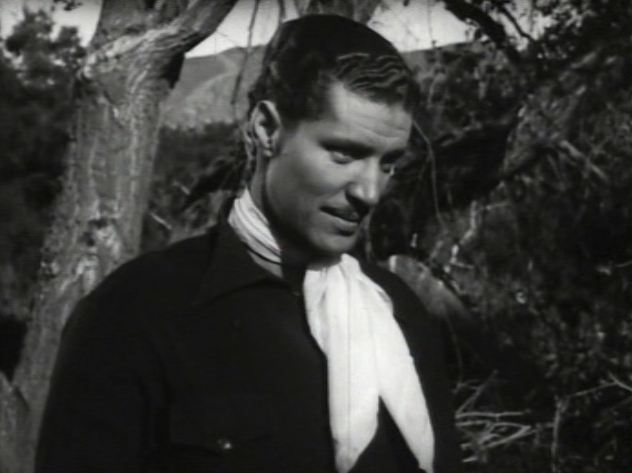
Parachutes, silken, billowing, harrowing are the image and emblem of the film, more than the lilies and the Medal. Bogart returns from the war, a captain in the paratroops, getting the VIP treatment with his pal and sergeant, played by William Prince. Prince did not have a long film career, but did TV work for decades, including many soap operas. He’s a handsome, likeable guy, with enough personality to hold his own with Bogart, which is impressive. His role is short in this movie, but he makes such a strong impression I’m surprised it didn’t launch him on a longer film career.

Bogart used to own a fleet of taxicabs in St. Louis—love his line that they got sunk at Pearl Harbor—and the young sarge was a college professor, but the working class officer and the enlisted man professor, as well as their close friendship despite a rule against fraternization, is only one of many instances of flaunting the norms we’re supposed to expect. Perhaps the biggest one occurs at the end when Bogart won’t stand by his new dame, Lizabeth Scott because, though he loves her, he says of Prince, “I loved him more.” Sidekicks are not pushed aside for women in this movie, especially when she’s nobody he can trust. His sidekick is not a comic foil, but a man to put on a pedestal even at the price of his own life.
From John, Chapter 15: Greater love than this no man hath, that a man lay down his life for his friends.
Okay, so this is from the Douay-Rheims, but Bogie did stumble into a Catholicchurch, after all.
He and his sergeant are bound for a special appointment in Washington, D.C., because he recommended Prince for the Medal of Honor. (One note here, it’s commonly known as the Congressional Medal of Honor, but that’s not really its official title. It’s the Medal of Honor, and even if the Hollywood screenwriters didn’t know that, Bogart and the military brass escorting them to D.C., should have. Calling it "the Congressional" is just wrong.)

But sarge jumps off the train and runs away and leaves Bogie with a mystery. Sarge has something to hide, and Bogie spends the rest of the movie figuring out what it is. Bogie gets drugged, beaten up, but nothing deters him from finding out the truth, and the search takes him to a newspaper morgue (one of my favorite places for research), a real morgue (I’ll pass), and a streamline moderne nightclub where he meets noir queen Lizabeth Scott, “Cinderella with a husky voice,” as he says.
She’s in Gulf City, a steamy burg in the South where he has trailed his buddy. (Funny that while pausing in Philadelphia, he talks on the phone in his hotel room and we see Independence Hall out the window. Must be like if you get a room in Paris, you always see the Eiffel Tower.)
Morris Carnovsky is the club owner, who’s got Lizabeth Scott, and everybody, under his thumb. He plays the erudite mobster with the pretense of culture wonderfully. Unfortunately, Mr. Carnovsky would have his film career cut off at the knees by the Blacklist in 1950, but Broadway became for him, like so many other actors and writers, a refuge in those dark, disgusting days.
Charles Cane plays a detective, sarcastic and perhaps not so bright, who spends the movie tailing Bogie, and even being held hostage by Ruby Dandridge, Lizabeth Scott’s African American maid when Miss Dandridge is told to hold the gun on the cop tied up in the closet so Scott and Bogie can escape. Black woman gets to hold a gun on a white cop—even if it’s through a door and meant to be comic, it’s still a bold stunt.

Marvin Miller plays Carnovsky’s hired goon, a cruel gorilla in a white dinner jacket. We last saw Mr. Miller playing Genghis Khan here in The Golden Horde (1951). Casting directors evidently never saw him as the cuddly type.
Our old, dear friend Wallace Ford is an ex-safe cracker who provides Bogie with some helpful gadgets, and it’s a pleasure to see him in any movie. Got to write a post about him sometime.
Lest we forget:

For a guy on a chase with no time to lose, Bogart changes from uniform to civilian clothes and a Fedora mighty quickly. Though he and his sergeant briefly bask on the train about houses with roofs, kids who can eat, and all the pleasures of peace in a country not destroyed by war, there is no sense of homecoming to the U.S., no period of adjustment. This is not The Best Years of Our Lives.
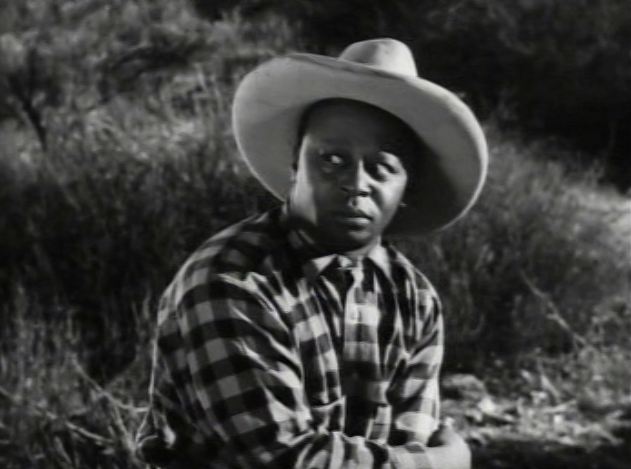
Blink and you miss ‘em: Ray Teal as the motorcycle cop, partygoer Bess Flowers in the nightclub, and according to IMDb, Matthew “Stymie” Beard, too grown for Our Gang, as the bellhop who brings Bogie’s prank note to the detective tailing him.
Bogie kills time by practice pitching into a chair in his hotel room, and being from St. Louis, ruminates on pitching in the World Series and downing the Red Sox for his team, the Cardinals. The Cardinals, did, indeed, win over the Sox in October of ’46, but the movie takes place in April, so it’s as if Bogie is predicting what will happen. As a Red Sox fan, I must admit the pain this caused, since the Sox had not won the Series since 1918. However, in the spirit of good sportsmanship, let me offer my belated congratulations to the St. Louis Cardinals. Well done.
The Cardinals also beat the Red Sox in the 1967 World Series, which I’m afraid we still haven’t quite gotten over yet.
Oh, all right. Congratulations on that one too.
Bogart is not his usual grim anti-hero in this one; he doesn’t play it with the bitterness and dissatisfaction of his returning vet in Key Largo, or Rick in Casablanca. His quips are less sarcastic than they are simply funny. He’s got some great lines in this movie, and his character is less haunted than his other roles.

He plays well with Lizabeth Scott. She had a really fine way of appearing both vulnerable and yet as inscrutable as noir dames were supposed to be, so that we don’t know whose side she’s on. Unfortunately, her singing is dubbed in this movie, and I’m not sure why, as she was certainly able to sing. She had a limited range, but it was a pleasant singing voice, very suitable to jazz and blues numbers. Here’s her album on YouTube.
And she wears a black beret. Can a woman be more perfect? I think not. I refer you to our previous post on black berets in the movies here.
For all the gloss of her glamorized scenes in the nightclub, I really think one of the most beautiful shots of Lizabeth Scott is at the end when she’s sitting in the car with Bogie, her hair stringy from the rain. The camera view is from the back seat as she turns sharply to Bogie, her eyes bright and intense, and her expression taut, fire in her soul and murder in her heart. I don’t have a screen cap of it, but here’s a publicity shot with a similar appearance:

Bogart tells his troubles to a Catholic priest in church at the beginning of the movie, jump starting the flashback. The priest, played by James Bell, is in uniform. He, like, Bogie, is just returned from overseas and is also a paratrooper, so Bogart feels a kinship with him. Bogie hides in the shadows as one making Confession. At the end of the movie, Father will return, softly intoning a Latin prayer for the dying, and one last image of a billowing parachute in the blackness is seen, carrying the weird juxtaposed themes of afterlife, parachuting, guilt and punishment, but oddly without of any suggestion of redemption, which would be all we need to tie up the Easter message. But this is where the noir finally kicks in: there is no redemption, just settling scores.
May I wish all who celebrate, a Happy Easter. If you like noir, remember, jelly beans also come in black.