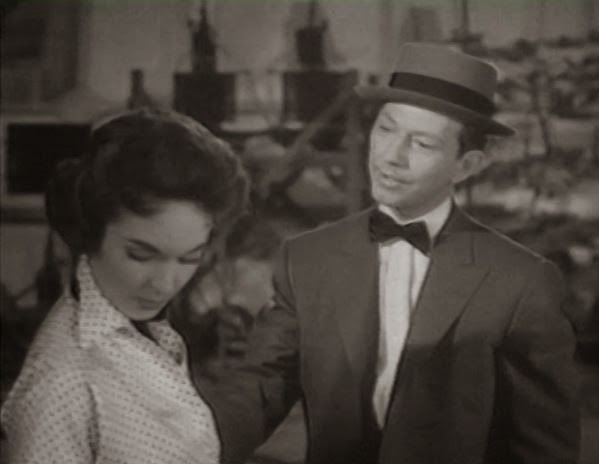
The Student Prince(1954) began production in an atmosphere of controversy, and its reputation remains mired in an ironic history. Today we may recall the film as the one Mario Lanza walked out on, that his voice was used for the musical numbers and lip-synched by his newbie replacement, Edmund Purdom. There’s a lot more to this prim operetta—the one that happened off-stage, I mean, and it is the story of a dying studio system clutching at its waning power, a suicidal career move, and most especially, a perceived museum piece of old-fashioned entertainment that didn’t belong in the 1950s.
What most people seem to forget is that the Broadway musical on which the movie is based, which came to the Jolson’s 59th Street theater in 1924, was the smash hit of the 1920s, playing a then record 608 performances, running over a year and a half. The turn-of-the twentieth century fairy tale of the prince and the barmaid may not have belonged in the Jazz Age, either, its quaint Gemütilichkeit a contradiction to the Roaring Twenties, yet it still packed them in and was wildly successful.
We may wonder with a smile if it was just because the Prohibition-era audiences got a charge out of the rollicking “Drink! Drink! Drink!” number.

And it was revived on Broadway in 1931, and in 1943.
The story was based on a play and novel written around the turn of the twentieth century, which made it current events at the time, but by 1924 on Broadway, and then in 1927 when Hollywood took the property and turned it into a silent operetta (no smirking) with Norma Shearer and Ramon Novarro, it was a slice of zeitgeist that charmed a faster-paced society.
What happened to all the excitement and goodwill by 1954?
It seemed to walk out the door with Mario.

Last week we discussed The Great Caruso (1951) that made a star out of Mario Lanza, and gave Ann Blyth her first crack at a big screen musical for MGM. Carusoenjoyed great financial success, which the studio hoped to repeat in The Student Prince, whose score by Sigmund Romberg, lyrics by Dorothy Donnelly, were well known and, at least in the 1920s, considered a sure hit.
Ann Blyth was not the first choice for Kathie the barmaid,who hoists steins of beer at her uncle’s inn.

According to author Armando Cesari in Mario Lanza: An American Tragedy, Jane Powell was originally considered for the role, but her pregnancy would have been too far along by the time of shooting and was replaced by Miss Blyth, who, in 1952 when the film was slated to be made, was still unmarried. By the time the movie actually went into production, toward the end of 1953 and beginning of 1954, Ann was married and expecting her first child, such that now the studio needed to push forward the shooting to accommodate her. (MGM had also tried to get Deanna Durbin out of retirement, but you couldn’t have pried Miss Durbin out of her comfy shell with a crowbar.)
Ann Blyth, by the way, for the only time in her screen career appears as a blonde in this movie. I don’t know why. It’s not distracting; she looks fine, but it’s just something of an affectation that doesn’t seem necessary.
In between all this was when the fireworks happened that affected the production of this musical and stamped its troubled legacy ever after.
In June 1952, Mario Lanza clashed with director Curtis Bernhardt on the first day of rehearsals and walked out. Other actors who had worked with Bernhardt in the past had expressed a dislike of his brusque manner, but Lanza’s request that the studio replace him with Richard Thorpe, who directed Caruso, was rejected by MGM head Dore Schary and producer Joe Pasternak. A compromise was reached on Mario’s various artistic complaints, including a few new songs, and in the next month, July, Mario came back and did the pre-production musical recordings. According to author Mr. Cesari:
…to the amazement of everyone he recorded most of the numbers from the score in single takes.
Then Mr. Lanza, whose mercurial temperament and thin skin made him unable to accept criticism and was vulnerable to stress, suffered a personal trauma when unexpected financial troubles came down hard on him. According to the author, he suffered from nervous tension and accordingly, did not use good judgment when it came to his artistic differences with the director, and in his stubborn noncompliance with studio orders. Unable to take frustration, he just walked out again. There have always been rumors about Lanza’s having gained too much weight and was dismissed from The Student Prince for that, but he was fit at the time of rehearsals and his real troubles with weight gain and dangerous crash dieting happened afterwards, at least in part as a reaction to the stress of his troubles with MGM. His troubles compounded when the studio sued him for walking out.
Movie production was canceled in September 1952. The studio sued Lanza, and the lawsuit took over the news, and lives of many. In October, Ann was interviewed by William Brownell for the New York Times:
“We were all disappointed to miss making this picture,” she commented. “Mr. Lanza and I had so much fun making The Great Caruso, and I’m sure nobody thought anything would go wrong with this one. He seemed to be in good spirits and satisfied with everything. We had already finished all the pre-production musical recordings and were all set to film the story portion.
“I feel so sorry for all the others connected with the picture—the technicians, the supporting players, the musicians and dancers. We waited around on the set for over a week, but Mr. Lanza didn’t appear. Finally they told us that the picture wouldn’t be made and everyone was thrown out of work. But I actually feel most sorry for Mr. Lanza. If only we could help him some way…”
Her strikingly sympathetic words might almost be taken for a portent on the eventual end of Mario Lanza’s career and his life—which happened sooner than anyone could have imagined. He died in 1959 at 38 years old of a heart attack and other health issues. He was born in 1921, the same year Caruso died, and was considered to be his heir as the world’s greatest tenor, or would have been, according to varied opinions, if he had lived longer, or lived a more disciplined life, trained harder, had forsaken Hollywood for the opera world...or just not walked out on The Student Prince.
The last was apparently his own opinion. According to author Mr. Cesari:
During the last period of his life, Lanza would confess, “I now admit the biggest mistake I ever made was to walk out of Metro.”
But he left behind his voice.
We’ll get to that in a minute.

Ann Blyth was still contracted to Universal-International at this time, and neither they, nor she, were willing to just let the grass grow under her feet in the meantime. Buoyed by the success of The Great Caruso, she continued her voice training and performed at local venues whenever possible. Syndicated columnist Gene Handsaker noted in June 1952:
Little Ann Blyth has more singing volume than I thought. Annie recently sang five songs before the Greater Los Angeles Press Club. When she turned away from the mike, to face part of her audience, she proved that her voice is as strong as it is beautiful.
But apparently, Universal still had no intention of casting her in musicals, for the remainder of her time with them was spent in the drama The World in His Arms (1952), which we covered here, and the comedy Sally and Saint Anne (1952), which we covered here. Two more dramas, One Minute to Zero and All the Brothers Were Valiant, which we’ll cover down the road, were made before the clock ran out on her Universal contract and she moseyed over to MGM and her next musical, Rose Marie (1954), which we’ll talk about next week.
With Rose Marieand The Student Prince, as well as a biopic of their composer, Sigmund Romberg, Deep in My Heart starring José Ferrer, 1954 must have been The Year of Sigmund Romberg. We’ll have to cover Deep in My Heart sometime.
In May 1953, MGM offered a compromise that would let them proceed with making the musical—without Lanza, that would also end their lawsuit against him. Their proposal: for Mario to let them use the vocal soundtrack he already recorded in return for their dropping the suit. Lanza, still stunned that the studio did not seem to want him back, and under mounting debt, could not withstand a prolonged court case, agreed.
Film production finally continued (ironically under director Richard Thorpe, whom Lanza wanted from the beginning). Lanza was replaced by English newcomer Edmund Purdom, as The Student Prince became one of Hollywood’s most infamous voice-dubbing controversies. Another would be Ann’s singing being dubbed by Gogi Grant in The Helen Morgan Story(1957). We’ll get to that down the road.
Here’s the trailer:
Ann’s singing here is lovely, and she continues to display a vocal agility (even more pronounced in Rose Marie, which was filmed before this) that had not been evident through the songs offered her in any movie in which she had ever sung. While it’s true she continued to train and develop her voice such that she was a much better singer in 1954 than she was in 1944 when she started in her first Universal B-musical (see our previous post on Chip off the Old Block here), but it is also true that operetta, this supposedly antiquated (by pop 1954 standards) allowed us to experience the depth and fullness of her singing ability in a way a popular musical would not. Ann Blyth could sing popular musicals and pop songs, even saloon songs (I’m looking at you “Oceania Roll”), but banging out the crisp high notes on the rousing “Come Boys” number, or facing off toe-to-toe with the great tenor Mario Lanza (and cheek-to-cheek on screen with Edmund Purdom) in “Deep in My Heart” are marvelous demonstrations of her vocal range and agility, and moments of musical bliss.
Here’s a look at “Deep in My Heart”:
As Brian Kellow in his 2002 Opera News article remarks:
One of the best things about her singing is its no-frills emotional directness.
I would suggest this is also one of the best things about her acting.
However, our old friend Bosley Crowther of the New York Times (it seems one of my great pleasures in life is disagreeing with Bosley Crowther) reported in his review:
…natty little Ann Blyth does her own singing, they tell us—and does it quite nicely, too. Of course, is a bit fragile for a barmaid and a bit on the prim and proper site.
Here I have to once again, disagree about the “fragile.” Have a look at the way Ann hoists three full liter-size beer steins in each hand as she sings “Come Boys,” serving them to thirsty, singing male students and picking up more by the handful from passing trays, all the while climbing over benches, tables, and patrons. It’s like an Olympic event. That little woman must have had a vise-like grip. I’ll bet if she shook hands with Arnold Schwarzenegger, she’d make him cry like a little girl.

We have a very charming account of what it was like to perform in this scene from one of those students, by the name of Ralph:
I was in constant awe working so closely with this charming, beautiful, friendly actress. She treated all of us as equals, joking, talking and enjoying our company as we enjoyed hers. To this day I can recall the good feelings on that set just because Ann Blyth made it that way.
Please head over to Ralph’s blog here for more on his experience as an extra in The Student Prince.
The movie features Louis Calhern as the king, who must marry off his grandson, played by Edmund Purdom, in an arranged marriage to a wealthy princess (played by Betta St. John) to save his kingdom because they’re broke. Mr. Purdom, handsome, haughty, but lacking in personality, is something of a jerk. Who wants to marry a poor jerk? A rich jerk, maybe, but not a poor one. He has only his charms to recommend him, and he’s low on charm.
Edmund Gwenn, who played Ann’s grandpa in Sally and Saint Anne, is the kindly old professor and mentor to Purdom, who suggests that the lad be sent off to college with the commoners so he can learn about life and how not to be a jerk. With his mustache and muttonchops, Mr. Gwenn looks a little like Emperor Franz Josef. It’s a good look on him.

John Williams, a favorite and whom we last saw with Ann here as the prosecuting attorney in A Woman’sVengeance (1948) has a comic role as the disapproving, snippy chamberlain who goes with Mr. Purdom to college and acts like his babysitter. His dignity is assaulted in practically every scene.
Richard Anderson, another favorite, and who we last saw as Ann’s beau in The Buster Keaton Story(1957) here, plays one of the students who befriends Purdom and encourages him to binge drink as a form of social interaction.

Edmund Purdom drinks copiously, meets Ann, and through the course of a rocky courtship, falls in love and learns not to be quite such a jerk. He also learns, to his regret, what it means to be king.
I like the scene where a disgruntled chef chases him out of his kitchen with a meat cleaver. I don’t know who plays the chef, but I love his rolling R’s German accent. Since the cartoon-watching days of my early childhood, I've always had a love of scenes where somebody chases somebody else with a meat cleaver. That's not something I would tell everybody, so don't let that get around. It sounds worse than it is.
S. Z. "Cuddles" Sakall plays Ann's uncle, the innkeeper with his customary middle European loving fretfulness.

Purdom performs well in his “singing” scenes, having prepared diligently for several weeks for the role. He may not have had the screen magnetism of Mario Lanza—and one cannot hear Lanza’s voice without wondering how he might have appeared in the film—but Purdom is handsome and if this were really his singing voice we’d be talking about a major new star.

But it wasn’t his singing voice, and that, for perhaps the first time in the history of Hollywood, where dubbing went on all the time since the advent of sound pictures but nobody made a big deal out of it, was what dragged down this movie and possibly Purdom’s start in Hollywood. He went on to other films, in fact, his next was a rematch with Ann in the historical drama The King’s Thief (1955), which we’ll get to down the road. He was a talented actor, a beautiful speaker, but having lip-synched to one of the most famous voices of the era, despite that role seeming, as it should have been, a tremendous career opportunity, only tarnished his image as a second-string weak imitation. Purdom deserved better, and so did the movie.

The film also carried the image of a poor substitute, inferior goods. The reviews were mixed, with some positive, such as this one from Howard Pearson in his syndicated column from May 1954:
Before the song is half-way through, audiences will not be conscious that Purdom is not singing. The work of blending his lip movements to the Lanza’s voice has been well-nigh perfect…Also, Purdom is so handsome and personable, it’s a certainty audiences won’t care that he isn’t singing…”
 With Mario Lanza’s great big, fat screen credit, nobody was allowed to forget it was him singing.
That first song is “Summertime in Heidelberg,” a sweet tune he sings in a duet with Ann Blyth, which she starts, seated at a piano, with shy and hesitant wistfulness. No “opera singing” here, it’s as gentle as a lullaby. He picks up the tune and takes it over. The image is like a metaphor for the movie: her guiding the newcomer Purdom into the spotlight with his first song on screen, and Lanza’s voice, the ghost that wouldn’t go away, taking over not only Purdom’s credibility, but the taking over the rest of the song from Ann while she sits in the foreground in silence. For my part, though Mr. Lanza’s voice is always a pleasure, I would prefer to have less Lanza and more Blyth. He again has the lion’s share of the music.
Here’s a look at “Summertime in Heidelberg”:
Other reviews were more dismissive, suggesting the genre of operetta had had its day. Perhaps, in the new era of filming on location, the studio soundstage “village” seemed artificial, but is totally in keeping with the theatrical mode of operetta. To have made it more “realistic” would have been to cut its artistry off at the knees.
In an interview with Lance Erikson Ghulam for Classic Images in 1995, Ann recalled:
In some ways, I thought it was photographed beautifully and had some great character actors. I still feel that Edmund Purdom did a marvelous job…Certainly, if [Mario] had been in the movie, things would have been quite different. So much had been written about his problems with the studio that I think everyone was waiting to pounce on the movie.

If Mario Lanza’s arrogance was punished by his cutting off his nose to spite his face, then MGM’s arrogance in cherry picking the voice of one major star and assigning it to a newcomer—quite publically as if to prove a point that stars were replaceable—had an effect as well. The film did middling at the box office, but the record album of Lanza’s recordings was a smash. It became Mario Lanza’s best selling LP, his first gold album.
That LP, just as the movie, also leaves a legacy of contractual misfortune. Ann Blyth’s vocals were done by Gale Sherwood, because Ann did not have a contract with RCA, the producer of the album.
Two weeks before The Student Prince premiered, Ann's first child was born, beginning a new and very happy chapter in her personal life. Professionally, with the coming autumn, she would continue her career in what would come to be one of its most satisfying facets: singing in concert on stage. Her Las Vegas act is described in this previous post.
Two weeks before The Student Prince premiered, Ann's first child was born, beginning a new and very happy chapter in her personal life. Professionally, with the coming autumn, she would continue her career in what would come to be one of its most satisfying facets: singing in concert on stage. Her Las Vegas act is described in this previous post.
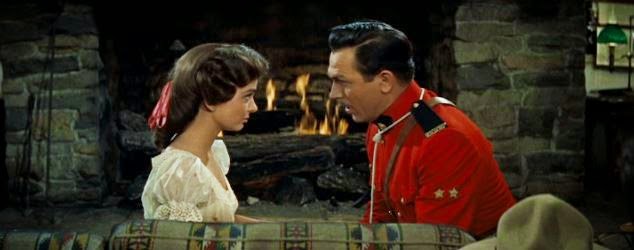
Come back next Thursday when we discuss Rose Marie, a lavish production featuring Ann as the feisty backwoods waif, Howard Keel as her Mountie guardian, and Fernando Lamas as the wily trapper in a tuneful, and heartbreaking, romantic triangle. The triangle was haunted, however, by another duo.
Posted by Jacqueline T. Lynch at Another Old Movie Blog.
Posted by Jacqueline T. Lynch at Another Old Movie Blog.
*****************************
Cesari, Armando. Mario Lanza: An American Tragedy(Baskerville Publishers, Inc.) pp.164, 166, p. 173
Classic Images, February 1995, “Ann Blyth: Ann of a Thousand Smiles” by Lance Erickson Ghulam, p.20.
Daytona Beach Morning Journal, June 3, 1952, p. 4 “Hollywood Report” syndicated column by Gene Handsaker.
Deseret News (Salt Lake City), May 8, 1954, syndicated by Howard Pearson, p. B 3.
Milwaukee Journal, May 2, 1954, “It Pays to Be Good” by Sue Chambers.
New York Times, October 12, 1952, article by William Brownell, p. x5; June 16, 1954, review by Bosley Crowther, p. 18
Opera News, August 2002, article by Brian Kellow, pp. 38-44.
******************************
THANK YOU....to the following folks whose aid in gathering material for this series has been invaluable: EBH; Kevin Deany of Kevin's Movie Corner; Gerry Szymski of Westmont Movie Classics, Westmont, Illinois; and Ivan G. Shreve, Jr. of Thrilling Days of Yesteryear.
***************************
***************************
TRIVIA QUESTION: I've recently been contacted by someone who wants to know if the piano player in Dillinger (1945-see post here) is the boogie-woogie artist Albert Ammons. Please leave comment or drop me a line if you know.
****************************
HELP!!!!!!!!!!
Now that I've got your attention: I'm still on the lookout for a movie called Katie Did It (1951) for this year-long series on the career of Ann Blyth. It seems to be a rare one. Please contact me on this blog or at my email: JacquelineTLynch@gmail.com if you know where I can lay my hands on this film. Am willing to buy or trade, or wash windows in exchange. Maybe not the windows part. But you know what I mean.
Also, if anybody has any of Ann's TV appearances, there's a few I'm missing from Switch, The Dick Powell Show, the Dennis Day Show (TV), the DuPont Show with June Allyson, This is Your Life, Lux Video Theatre. Also any video clips of her Oscar appearances. Release the hounds. And let me know, please.
HELP!!!!!!!!!!
Now that I've got your attention: I'm still on the lookout for a movie called Katie Did It (1951) for this year-long series on the career of Ann Blyth. It seems to be a rare one. Please contact me on this blog or at my email: JacquelineTLynch@gmail.com if you know where I can lay my hands on this film. Am willing to buy or trade, or wash windows in exchange. Maybe not the windows part. But you know what I mean.
Also, if anybody has any of Ann's TV appearances, there's a few I'm missing from Switch, The Dick Powell Show, the Dennis Day Show (TV), the DuPont Show with June Allyson, This is Your Life, Lux Video Theatre. Also any video clips of her Oscar appearances. Release the hounds. And let me know, please.
***************************

A new collection of essays, some old, some new, from this blog titled Movies in Our Time: Hollywood Mimics and Mirrors the 20th Century is now out eBook, and in paperback here.
I’ll provide a free copy, either paperback or eBook or both if you wish, to bloggers in exchange for an honest review. Just email me at JacquelineTLynch@gmail.com with your preference of format, your email address, and an address to mail the paperback (if that’s your preference). Thanks.