Monday, January 16, 2012

Two-Gun Man from Harlem - 1938


“Two-Gun Man from Harlem” (1938) creates a world for us that is both strange and familiar, an image placed over another image. We see a separate world, but it is our world and we are at home here, even if we are not cowboys, even if we are not black, even if we are not white.

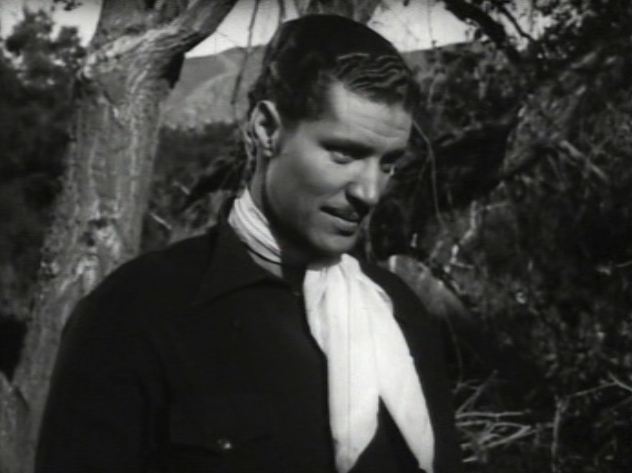
This movie is one of a handful of B-westerns starring Herb Jeffries, and the first of a series of three featuring him playing the cowboy called Bob Blake. We discussed Mr. Jeffries in this previous post, how his stature as The Bronze Buckaroo, the Singing Cowboy of the Black Cinema in the 1930s put him on par with the likes of Gene Autry and a posse of others who were all white and all more famous.


The Bronze Buckaroo traveled in somewhat different circles. He rode the range in movie houses that played to African-American audiences. General audiences, i.e. theaters where patrons were either mostly white, or, as in the South, all white, were not shown these films.

They missed out on something big, those white patrons. A simple message a lot of them would have to wait another 20 or 30 years to hear, and under much more turbulent circumstances. If they had only seen Herb Jeffries riding into town on his white horse to save the day, heard him sing “I’m a Happy Cowboy”, one wonders if the battles for social justice fought in the streets and on the back of the bus, and at the lunch counter would have been necessary.

Not that “Two-Gun Man from Harlem” was the greatest movie in the world. It wasn’t even the greatest movie in the small neighborhood movie houses where it played. It was typical B-western.

That is its charm, and the very magic of its power.

Herb Jeffries is the hero. We know that because he’s jaw-droppingly handsome, he’s taller than everybody else, and he wears a white hat. He’s no great actor - none of the singing cowboys were, although in this movie he gets to play a dual role. As the gunfighter “The Deacon” he looks like he’s having a blast.

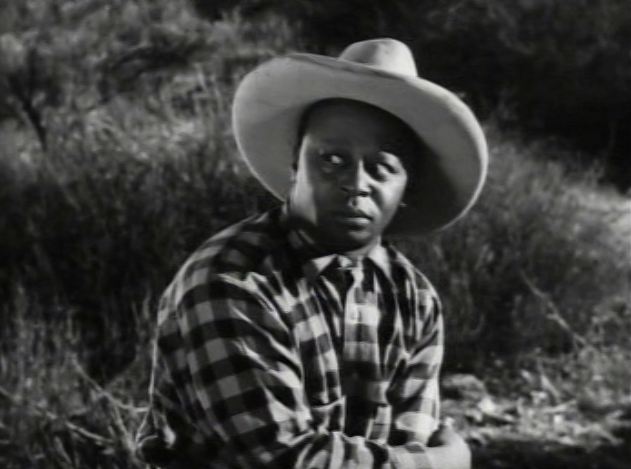
Manton Moreland is his shorter, funnier brother. He is sly and loyal, and a lot smarter than most cowboy sidekicks. He tells a story to divert the bad guys, about Lot’s wife. Only in his rambling version, Salt Lake City is the result of the biblical curse.

Mae Turner is the ranch owner’s wife, who is unfaithful and tries to lure our Herb. Failing that, she frames him for murder. Unlike most of the other awkward and wooden performances here, Miss Turner had stage training at the University of California, and played Lady Macbeth among her professional roles. She knew how to do evil ladies.

Spencer Williams, who would go on to write and produce in Black Cinema, played Butch, the bad guy who did the bidding, for a hefty fee, of Clarence Brooks. He gives a quite natural performance and has great screen presence.

Mr. Brooks played the head bad guy, a man of means and just plain mean. He tries to buy the love of the beautiful young ingénue, played by Marguerite Whitten. He is as oily as Snidely Whiplash.

Miss Whitten is the guardian of her younger brother, Matthew “Stymie” Beard, who you’ll recognize as one of the Little Rascals. Here, he’s a funny, talkative, know-it-all kid who hero-worships Herb Jeffries.

And who wouldn’t?

That’s all pretty standard for a B-western. The writing is stilted and corny. The acting isn’t the best. The production values are distinctly low budget. Even the fight scenes are funny because they lack proper choreography, and the sound effect of the punching sounds a lot somebody slapping a tennis ball against a garage wall.

But look again. Jess “Jesse” Lee Brooks, one of the finest actors and singers of his generation (see this previous post with a clip of his “Let My People Go” in “Sullivan’s Travels”), plays the sheriff.

He is a man of authority, no-nonsense, steely-eyed, but fair. You can put your life in his hands. He always gets his man.

Films exhibited for “general” audiences did not show dark-skinned sheriffs. Nor dark-skinned rapacious landowners paying off henchmen. Nor dark-skinned cowboy heroes.

Which is why when offered a chance to “pass” in the movies, light-skinned Herb Jeffries, who was of mixed African and European heritage on his father’s side, and Irish on his mother’s side, refused. He did one better and wore darker makeup on screen. Mr. Jeffries reasoning was:

"In those days, my driving force was being a hero to children who didn't have any heroes to identify with," Jeffries says in a quote from his website. "I felt that dark-skinned children could identify with me and, in The Bronze Buckaroo they could have a hero. Many people don't realize (to this very day) that in the Old West, one out of every three cowboys was a Black... and there were many Mexican cowboys, too."

The familiar image of the B-western types: the hero, the villain, the pretty girl, the hero-worshiping little boy, and the loyal sidekick, they are all played out here by black people. African-American audiences could enjoy the same storybook sagebrush fare as the “general” audiences without fear of being demeaned or stereotyped, this time.

White audiences, however, missed out on a revelation. The hero, the villain, the pretty girl, the hero-worshiping little boy were all people they knew very well. They saw them all the time at the movies.  The only difference -- the only difference -- was skin color.

About ten minutes into the movie, one sees that is no difference at all.

Powerful stuff, and not what some people wanted to hear.

For more on Herb Jeffries, have a look at his website.

Wishing you a meaningful Martin Luther King, Jr. Day.

Thursday, January 12, 2012

California Conquest - 1952


“California Conquest” (1952) features Teresa Wright as a pants-wearing, deadeye shot in the days before California’s annexation to the U.S. This may be the movie’s chief delight as the delicately feminine heroine of 1940s Hollywood took that precarious turn into 1950s longsuffering wife/neurotic spinster roles. Here, as an interlude between those eras in her career, she rides, shoots, and saves Cornel Wilde from whipping by shooting dead the bad guy.

This is nothing if not refreshing.

Most of the movie, however, belongs to Cornel Wilde as the dashing nobleman of Mexican heritage who runs guns and organizes a movement for California to become part of the U.S. The people of Mexican ancestry are all called Californians here, to distinguish them from Mexicans who live below the Rio Grande, the part of Mexico we didn’t snatch in the Mexican War. Teresa Wright is called an American here. She is not a Californian, though she lives here with her gunsmith father, who sells guns to Cornel Wilde’s political movement.

The “good” Californians want to be Americans. The “bad” ones want to stay part of Mexico, or, failing that, to become part of the territorial designs of Imperial Russia, which also has settlements here. Got that, class?


John Dehner plays the head bad guy, a bad Californian who wants his brother to be Governor. Graft is so much easier when you’ve got a relative in power.


The two lead “Californians” then are played by Wilde and Dehner, neither of which in real life are of Spanish/Mexican heritage. A large cast of Spanish-speaking actors play minor, mostly nameless characters, with the exception of Alfonso Bedoya, who plays Jose Martinez, the head goon of John Dehner.

Hollywood casted movies by its own caste system. We’ve seen it before. In one scene, Teresa Wright watches a street fight, standing behind two stoic Indians, also watching. Were they Modocs or Washoes? Shoshonis or Yokuts? Who knows, they are not considered Californians, either.


The movie attempts to be a lot of things: a swashbuckling adventure, an historical picture, and to be sure, gets off on the right foot with the title exposed by a man’s hand swiping a glittering blanket of gold coins off the table. A vivid storybook-ish image. In parts, the movie has all the panache of a Saturday kiddie matinee adventure flick.


But we’ve got a lead actress of Teresa Wright’s caliber, so she can’t just sit around twisting a hanky in her hands. This film, to its credit, give her lots of action, too. When her gunsmith father is murdered, she joins Wilde to go after the killer. Wilde is distressed at her men’s attire, which he calls “horrible”, but seems to be unruffled by her gun fighting skills, which seem to be better than his.

The villains are one-dimensional, and the interesting story of the rivalry of three powers - US, Russian, and Mexican all converging in this rich land is pretty much lost in characters spitting out simplistic facts as plot exposition at convenient moments. Maybe the movie attempts too much, or maybe not enough.

Teresa Wright says to Wilde, “I wonder if we Americans will ever understand you people.” To which Wilde replies, “You don’t have to. It’s more important that we understand you.”

Placards of official dogma make for an easy, and lazy, explanation of why the characters are going from point A to point B, but they do nothing to flesh out even the characters’ motivations, let alone the complexities of political reality.


It is easier to focus on the beautiful rugged terrain, which we see much of behind swarms of hard-riding Californians chasing each other on horseback. We see the elaborate Spanish dress of the nobles at the ball, where a specialty act performs a beautiful, passionate dance.


Mantillas and ruffled shirts, and sword fighting out on the red-tiled patio among the potted yucca plants. The guy in tight burgundy pants slays the guy in tight purple pants. No blood. Basil Rathbone and Errol Flynn did it better.


The ball brings Mr. Wilde and Miss Wright together again, and he marvels with relief that she looks more like a girl in her virginal white ball dress. There’s no romance yet; that doesn’t happen until they’ve been on the trail a few days, looking for the bad guys, and stop to rest in a hayloft. She’s back to a skirt for this scene, and well, there’s just something about haylofts. Instantly they are in love and planning a future life together.

But first, they trick the gang of bandits into leading them to the stolen guns, and John Dehner, and a Russian Count and Princess who are agents of the Czar. When the Princess balks at this pants-wearing female pointing a gun at her, Miss Wright, with absolutely no vestige of Peggy Stephenson left in her, remarks: “Lady, this gun will shoot anybody. It’s not particular.”

I love that line and her world-weary delivery.

Wilde is an almost too-cheerful hero, as if he is Robin Hood instead of a revolutionary, but since this movie drifts along on the mood of a kiddie matinee, his happy bravado is suitable, and the stereotype villains are serviceable, and the action is all we need to kill time.


It’s Teresa Wright who doesn’t quite fit, and not because she wears pants and a gun holster (which was probably a selling point for her to take this role). She’s too troubled for these shallow types around her, on a higher plane (and not the hayloft), where the deeper issues of California’s annexation await her consideration, figuring out what all this really means for her. She’s far too intelligent an actress to be stuck in this pop-up book.

Explorer John Fremont, the only real historical figure, shows up at the ball, despite the bandits that overturn his stagecoach, and tells the “good” Californians that the US will not annex California because Mexico is a neighbor and friend.

The Mexican War, from which we snagged a good chunk of Mexico, including California, would seem to contradict his assertion. Did anybody at the kiddie matinee catch that? Or did the kids in their red felt cowboy hats just knock back another handful of jujubes and cheer for the hard riding “good” Californians who, like they in school, pledged allegiance to the flag of the United States of America, and dreamed of cementing their heroism by pointing a gun in a haughty Russian’s face? Ah, 1952. Gotta love it.

Monday, January 9, 2012

The Chicago Theatre


The Chicago Theatre, so grand and magnificent a building it was dubbed “the Wonder Theatre of the World” at its opening in 1921. The first of its kind, it became a prototype for a generation of “movie palace” theater construction. It stands today as a reminder of that era of remarkably beautiful buildings.

French Baroque, the theater features murals, a replica of the Arc de Triomphe sculpted on its State Street side. The grand lobby, five stories high, is modeled after the Royal Chapel at Versailles. The grand staircase is reminiscent of the Paris Opera House. One wonders if anything on stage could be half so diverting as the venue?

Movies were the order of the day, and “The Sign on the Door” was the debut flicker with Norma Talmadge on October 26, 1921, accompanied by a 50-piece orchestra in the pit, and a thundering Wurlitzer pipe organ.

A showcase not just for movies, live entertainment shared the auditorium with bands such as Duke Ellington’s and Benny Goodman’s.

Then, as we have noted with so many of these theater histories, the 1970s came. Then the 1980s. They brought disuse, decay, but this theater managed to escape the third D - demolition. The Chicago Theatre was restored and reopened in 1986. Frank Sinatra performed at the gala reopening, and the future for this theater finally seemed as bright as its past.

For more on the Chicago Theatre, including detail and photos on its spectacular interior, have a look at this website.

Thursday, January 5, 2012

Meet Me in Las Vegas - 1956


“Meet Me in Las Vegas” (1956) is a fun and frothy pastiche uniting the two themes upon which the reputation of that town is built: gambling, and nightclub acts. We get a little of the first, and a lot of the second.

Today we wrap up a two-post trip to Las Vegas. Have a look here at Monday’s post on “Las Vegas Story” (1952). From that black and white crime story we move on to color, lots and lots of colors.

Dan Dailey is a happy-go-lucky rancher who drives his coral convertible, with the matching horse trailer, to visit the casinos. Where he is not lucky at all. He is well known and well liked for being a good loser, and only a loser. But a swell guy.


His career in big movie musicals of the 1940s and 1950s puts Dan Dailey somewhere in the same universe, though in a lesser orbit, as Fred Astaire and Gene Kelly. I don’t know where his dancing puts him against those gentlemen; I think he’s a swell hoofer, and I particularly like the “Gal with the Yaller Shoes” number in this movie where he performs with Cyd Charisse and the male ensemble to Hermes Pan’s vigorous and playful choreography.  

But what sets Mr. Dailey apart is not his dancing; it’s his screen personality. Astaire and Kelly were both famous for playing confident wise guys who turned out to be nice underneath the wisecracking. Dan Dailey always seemed more sensitive, even troubled, a guy who really wasn’t that confident, but whose tenderness was never hidden.  He is never a card sharp or gamester on the make in this movie. He’s a frequently obtuse stumblebum, something Astaire and Kelly never played.

Cyd Charisse is a ballerina appearing at the casino where Mr. Dailey is losing his money. She’s a fish out of water here, just trying to make some dough herself in a world about which she knows nothing. She has several opportunities to dance in this movie, ballet, a jazzy “Frankie and Johnny” routine (narrated and sung by Sammy Davis, Jr.), and a very funny impromptu venture into burlesque. Having had too much to drink, she invades a parade of lady hoofers dressed in gaudy costumes representing “lucky charms”.


The plot is about as simple as they get. Dan Dailey, who believes in luck even though he doesn’t have any, grabs the hands of passing ladies, in lieu of a rabbit’s foot, while the roulette wheel spins. The only time it works is when he lunges for the hand of a passing Cyd Charisse. He insists she is his lucky charm.

She thinks he’s loony and angrily tries to discourage him, but when she relents to give the experiment a try, they discover that, yes, every time at any game he plays, if he’s holding her hand, he wins.

They start winning all over the place, up and down The Strip. Miss Charisse, at first attracted by the money, is secondly attracted by this new world she’s discovering outside the rehearsal hall. Her life thus far has been very disciplined, with no time for play. Now she sees how the other half lives, and she likes it. I like her line when, seated in a restaurant with him, a couple of huge steaks in front of them, she’s too excited to eat, even though as a dancer on a perpetual diet, she marvels, “I’ve been hungry for ten years.”

She is thirdly attracted by Dan Dailey, and it is to get his attention that she joins the burlesque kick line. His drooling over Cara Williams makes her jealous. Miss Williams belts out “I Refuse to Rock and Roll” (which was just beginning to beat down the drawbridge of popular music and storm the castle).


Sultry Lena Horne also sings, as does Frankie Laine. One of the fun things about the movie is the shameless name dropping. The Four Aces start the movie. We have cameos by Frank Sinatra, Debbie Reynolds, Vic Damone, Peter Lorre, Tony Martin (Cyd Charisse’s husband).


 Paul Henried also has a minor role, and Jim Backus as the hotel manager gets to briefly bluster, and Jerry Colonna rips his otherworldly tenor on "Lucky Charm".

The marquees on the casinos -- many of the same ones we mentioned in Monday’s post on “Las Vegas Story”, give us a snapshot of the big names of the 1950s: Louis Prima and Keely Smith, Marge and Gower Champion, Danny Thomas, the Mills Brothers, Johnnie Ray, Donald O’Connor.


Dan Dailey finally notices more than just Cyd’s hand, particularly after a brief ballet (which features a game of volleyball in the middle of it), “That was the most beautiful thing I’ve ever seen.”


He takes her home to his ranch to meet Mother, who is played by Agnes Moorehead. It’s always good see her in any movie, though there’s not much for her to do here.  She’s feisty, opinionated, and likes the cut of Cyd’s jib because Cyd is a career woman with no intention of giving up her career.


I found myself distracted by Miss Moorehead’s hair color, a cross between tomato soup and the fires of hell. I guess when you use Technicolor, you have to shoot the works. Might explain the coral-colored convertible, too. Most of the film is painted in a rainbow of soft, lush colors.

The lucky couple’s luck continues at the ranch, where as they stroll around holding hands, the barren chickens lay eggs, and the cow gives birth, and a new oil well gushes forth black gold.

But we know the old axiom “lucky at cards, unlucky at love”. So, too here. When they fall in love, their luck at gambling leaves them. Will they stay together anyway? You can probably figure that out yourself. It’s  refreshing that they compromise to spend six months in her world of dance and six months on the ranch.

Except for a couple of numbers, most of the songs performed in this movie are staged as nightclub acts, so there isn’t that jolting of reality for people who dislike musicals for that reason.


But I’ve never quite understood that. “People don’t burst into song in real life,” the movie musical curmudgeon might complain.

Sure they do. They’re called entertainers.

Monday, January 2, 2012

Las Vegas Story - 1952


“Las Vegas Story” (1952) is like the seductively slow Mona Lisa smile of its star, Jane Russell: both sly and simple, secretive and open. It’s a noir that loses a lot of its noir shadows in the bleached, unblinking sunshine of the desert. Like the city for which it’s named, this movie does its own thing in its own way.

This week we adventure in Las Vegas -- with Jane Russell and Victor Mature today, and on Thursday we’ll have Dan Dailey and Cyd Charisse in “Meet Me in Las Vegas” (1956). I hope it proves to be a lucky start to a lucky year.  By the way, we once featured publicity for this movie at this previous post.

“Las Vegas Story” is a crime drama. Jane Russell is the wife of Vincent Price, a suave, well-heeled businessman from the east out here on a pleasure trip to try his luck. The couple are followed by a very handsome pest played by Brad Dexter, who though obviously attracted to Miss Russell, is even more attracted to the gaudy diamond necklace she wears.

The necklace will figure prominently in a murder.

There are a few subplots to the story that keep us entertained while we’re waiting for the crime to happen. So entertained that, in fact, the crime story seems almost like an afterthought. First, there is the back story about Jane Russell, who during the War was a singer in one of the casinos here. She’s here not to gamble, but to come to grips with her past.

“I have a feeling I interrupted a conversation between you and the desert,” Vincent Price tells her in what I think might be my favorite line from the movie. Perhaps it’s just his charming, sensitive delivery. He has broken away from the gaming tables briefly to notice she has wandered off by herself, alone outside on the terrace. They appear to have a comfortable, affectionate relationship, but something is nagging each of them that has nothing to do with the other.

Vincent Price, too focused on gambling to pay much attention to her anyway, indulgently allows her to sort out a few old ghosts, and suggests she go off on her own to explore the Strip.

“Go ahead. Get it out of your system,” he tells her.

She heads for her old hangout, a casino called The Last Chance. There’s Hoagy Carmichael at the piano, playing “I Get Along Without You Very Well.” I love when Hoagy’s at the piano when we walk in the door.

This is an exquisite scene. Jane Russell stands some distance away from where Hoagy is seated at his piano. He doesn't know she's there.  At once we see she is remembering days gone by. I don’t think I’ve ever seen a flashback done with such sensitivity and such style. In a close-up on her face, we see her eyes wander around the room and then lock on a small table with an empty chair. From the chair, we go back to a close-up of her face, and her eyes gently move to something beyond the piano. We hear the echo of a woman’s voice singing. In another moment the camera shows us…

…she is watching herself. A younger, happier woman, with longer 1940s style hair. The room is full of GIs, and a large flag hangs on a back wall. Victor Mature is seated at the empty chair, dressed in an Army uniform, adoring her.

We go back to Jane’s expression as she remembers.  Her face registers the wonder of recognition, the co-mingling pleasure and pain of memory.  Usually in a flashback scene, we are dropped into the past, and when the scene is over, we get wrenched back to the present.  Here, the camera keeps shifting from the scene to her face watching it. We never completely enter the flashback; we always have one foot in the present, just as she is firmly rooted in the present but cannot let go of the past. She is stuck between two worlds emotionally, and in this scene, literally. This marvelous tactic makes the memory seem like real-time.

What Jane Russell does just with her eyes, and with the slightest flicker of sublte expression is so impressive. This scene is a skillful union between a starlet who rose to fame on her voluptuous figure but who clearly really could act, and a director, Robert Stevenson, who with admirable delicacy, pays more attention to her face than her chest.

The movie was produced by Howard Hughes, second to none for his famous appreciation and promotion of her décolleté.  While we have the obligatory costuming and camera angles that showcase Miss Russell’s physical attributes (including a gratuitous shower scene, and the demonstration that she wears nothing but heavy makeup to bed), there is still more even more here about her broken heart.

Victor Mature, and his perpetual grimace, is the tough police detective whose beat is the Strip. We gather Jane was supposed to wait for him until he came back from the War, but didn’t. They are equally delighted and distressed to see each other again, and Mature becomes particularly bitter. He also reflects on his former self:

“That guy was a chump. He believed that if he left his hat or his girl at a table they’d be there when he got back.”

A couple of subplots on Mr. Mature’s side include the teenaged would-be bride and groom he has to hold in detention until the parents show up to stop the quickie wedding. There is also the playful antagonism with his boss, the sheriff played as his comic foil by Jay C. Flippen.

The Last Chance, where Jane used to sing during the War also keeps a couple of side stories on the back burner for us: Hoagy and his pal, played by Will Wright. Mr. Wright, the hangdog proprietor/house detective of other movies here plays a floorwalker who used own The Last Chance, but lost it in a bad business move. The stern new owner, played by Robert J. Wilke, comes down hard on his staff. Hoagy hates him, and Wright chokes on his humiliation.

Which is something we have to consider when this same new owner ends up dead.

Vincent Price has the most dramatic reason to kill him. Mr. Price is an embezzler, wanted back east, and takes his wife’s necklace to buy himself credit at the gaming tables. When he loses big at The Last Chance, Mr. Wilke takes no pity on him.

But what of Brad Dexter, perpetually tailing Miss Russell in and out of cocktail lounges and swimming pools? He turns out to be an insurance investigator, and maybe Jane and Vincent have something cooking between them to scam The City of Second Chances?

Lots of suspects, and an unresolved love story in the middle of them.

The movie is capped by a nifty chase scene between an old woody station wagon and a helicopter.


The car is not unlike the old woody rumbling through the Nevada desert in “Split Second” (1953) seen in this post, and another reminder of that film is the abandoned military installation where the final confrontation between helicopter and car occurs. I don’t know if any atomic testing went on here, too, but it’s deadly eerie.

Victor Mature is in the helicopter, which buzzes the car and follows it right through an empty hangar.  The murderer has taken a hostage, and tries to escape in a cat and mouse game with the dogged Mr. Mature, in an abandoned wooden control tower. There is no dialogue in this exciting scene, just the sound of footsteps, gunfire, and the howling wind from the desert. A tumbleweed rudely bounces off the head of a slain figure in the dust.

The crime story may have not a lot of depth to it, but at times this is a visually stunning film. Along with the desert, and miles of footage of Jane Russell, we get the obligatory shots of the neon casino signs embroidering the night sky: The Golden Nugget, The Pioneer Club, a montage of all the old casinos and hotels. The Thunderbird, the Flamingo. The sign at the Union Pacific station where Jane Russell and Vincent Price arrive in town, not to be outdone, tells us Las Vegas is the “streamlined city of the west.”


The movie ends on an upbeat note with another of Hoagy’s songs. Not very noir, but Vegas makes its own rules.


Come back for more Vegas and more songs on Thursday in “Meet Me in Las Vegas” with Dan Dailey as a most unlucky gambler, until he grasps the delicate hand of dancer Cyd Charisse.