Thursday, July 3, 2014

Chip off the Old Block and The Merry Monahans - 1944


Chip off the Old Blockand The Merry Monahans, both released in 1944, were Ann Blyth’s first two films.  They are an intriguing view of a very young, still developing talent, but we can recognize the composure and maturity that carried her through her career and her life.  The camera loves her.  She seems, with ladylike reticence, to be waiting for a proper introduction to us, but with Donald O’Connor bringing her to the party, she’s in good hands.
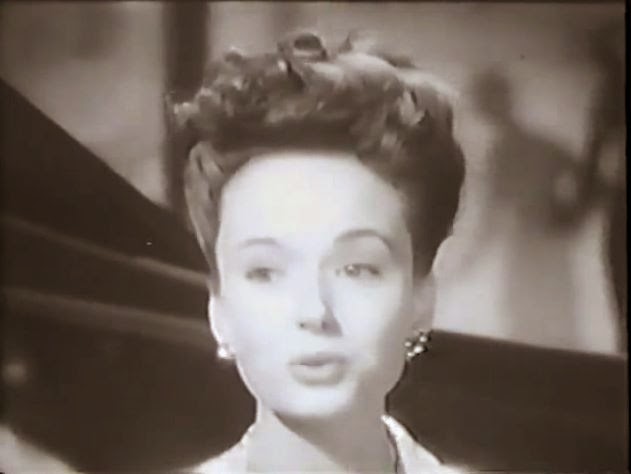
B-movies to be sure, they are the tentative beginning of her thirteen-year film career that reaped a quick rise to stardom—but not just yet.  How much she took with her from her radio and stage training and applied it to her new screen career, and what she might have had to jettison to adapt makes interesting speculation—for this fresh-faced newcomer had been working since the age of six.  If she had learned anything by the age of fourteen-going-on-fifteen, when these films were made, it was that every new experience brought new wisdom, and a revelation, perhaps, that though one could not always create opportunity, one could still carve out a space on which to build the future.

She recalled this period for Modern Screen in 1955:

I guess everyone dreams about being in pictures.  I was no different.  I loved the stage.  But children’s parts, especially good ones, don’t come along too often, and pictures promised at least the chance of steady income.

A pragmatic approach for a young person, but perhaps entirely in character for a woman who would become known in Hollywood as much for her discretion, sense, and serenity as for her talent and beauty.

She and her mother had been several months touring with the road production of Watch On the Rhine(after having played Broadway for a year—see our intro post to this series here), and her seven-year movie contract with Universal meant she could unpack her suitcase for good, though far away from New York and Connecticut where family lived.  There would still be plenty of travel in her future, but from this point forward, California would be home.

The irony was that she came to Universal a dramatic actress—they discovered only in their interview with her that she could also sing.  Sufficiently impressed with this ability, they started her off in musicals.  The ink on the contract was still wet in December 1942 when an article by Harold V. Cohen in the Pittsburgh Post-Gazette crowed, “Pretty little Ann Blyth…may be Universal’s new Deanna Durbin.”

After four B-musicals, Ann was loaned to Warner Bros. for Mildred Pierce (1945), see our post here, and when she returned to the Universal lot, never did another musical for them again.  She wanted to do musicals, but it would take a new studio—MGM—to give her that chance.

The first four movies, all musicals, that Ann made for Universal were Chip off the Old Block, The Merry Monahans, Babes on Swing Street, and Bowery to Broadway, and were all released in 1944.  We’ll discuss the other two films later in the year.  It’s difficult to say if they were made in order of their release, as Donald O’Connor was in most of them and the studio was in a race to crank out as many films with him as possible before he entered the Army Air Corps late in 1943.

Donald O’Connor is quoted in Dick Moore’s book Twinkle, Twinkle, Little Star—But Don’t Have Sex or Take the Car:

They tried to finish all those pictures before I went into the service.  We worked three pictures at one time: the one coming up, the one we were doing, and we dubbed the one we’d just finished.  That’s all we did: work.  It’s amazing we had as much fun as we did, grinding them out like that.

Despite MGM’s glossier and more famous “Andy Hardy” series, according to author Bernard F. Dick in City of Dreams-The Making and Remaking of Universal Pictures:

Universal movies featured more teenagers and young adults than any other studio—Deanna Durbin, Donald O’Connor, Peggy Ryan, Susanna Foster, Grace MacDonald, Ann Blyth…Gloria Jean…

Hedda Hopper noted in her column in February 1943:

Children on the upbeat at Universal.  Since Deanna Durbin and Gloria Jean made so much money for them, Henry Koster has little Ann Blyth…who was so good in Watch on the Rhine…while talking to her, he discovered she could sing.

Universal already had its youth unit, The Jivin’ Jacks and Jills, and the young dramatic stage actress, who it was discovered could also sing, was plunked into this energetic world of home front teens just shy of draft age.  Ann would recall these films as “good learning experiences.”

Later on in the year, we’re going to talk a little about Ann’s teen years in Hollywood.

Chip off the Old Block, released February 1944, in her very first film, gives her third billing after Donald O’Connor and Peggy Ryan--above the title.  This also, along with the uneven quality of the first four films, makes it difficult to really understand what might have been in the can first.  At some point in the frenetic assembly line, the studio decided she was worth featuring.

She is, not for the first time, playing older, a young woman of college age who, having been raised by an uncle and aunt in Hawaii, is now coming to New York City to live with her mother. (Played by Helen Vinson.  Her grandmother is Helen Broderick.)  “My mother and grandmother are famous actresses, and I guess you can’t be that and raise children too.”

She’d have a chance to prove that one wrong some years later.

Donald O’Connor is a campus cut-up at a military academy who performs in the school show.  His father is a career naval officer.  We don’t know what kind of career Donald has mapped out for himself—he laments that he’d be in the war already if his eyesight were better, but he’s so good at performing that his pal, young theater hoofer Peggy Ryan, enlists his help to get an audition.  

She is the comedienne of the piece, no real rival for Ann Blyth for Donald’s affections, though there are some misunderstandings that push the plot along like kids playing kick-the-can until the final number, where all three are on stage performing for war relief.
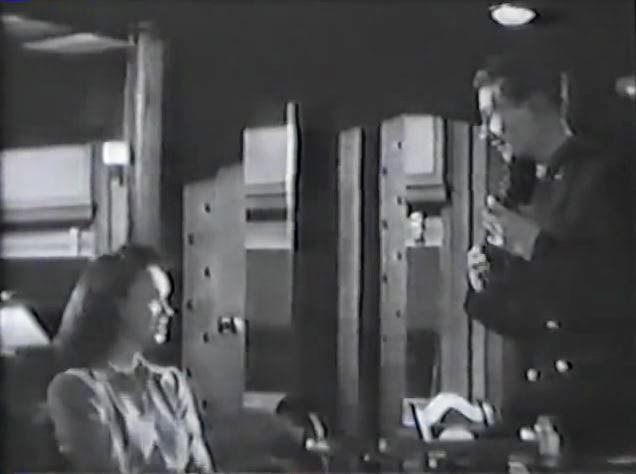

Our introduction to Ann Blyth is, serendipitously for us train fans, on a train.  Donald sits apart from her, doing eye exercises for his lousy vision, and she misinterprets it as somewhat grotesque flirting.  After a spat and reconciliation, they are cozily ensconced on the rear train platform (which, sadly, nobody can do anymore), and sing a duet.  Her voice is a pleasing soprano, but nowhere near the range, control and richness of what it would become with more training in the next decade. 

Like Donald, she is also a teen with a conscience and wants to do her bit for the war effort, and intends to divide her time between China Relief, the Red Cross, and the canteen, but is dragged into the theater because she sings so swell, and she agrees to do it if the producers give all the money to the war effort.

There is a subplot about Donald mistakenly thinking his naval father is selling plans to a Nazi spy, and a back story that his father and Ann’s mother were once engaged, and where his grandfather and Ann’s grandmother also had a broken-off relationship.  At first, mom and grandma don’t want Ann to have anything to do with Donald, fearing she will be hurt as they were, and they try to scuttle the friendship.  That’s all probably too much for one movie, but Ann shares her first screen kiss with Donald—she goes after him—so this little lightweight movie manages to accomplish a lot for her debut. 

There’s also Joel Kupperman, the seven-year-old math genius from the Quiz Kids radio program.  I’m not sure how he wandered in, but he’s cute as a bug, even if his recitation of math equations makes my head hurt.

Some favorite moments:

Arthur Treacher and Minna Gombell as the former vaudevillians, now turned butler and maid of Ann’s mother and grandmother.  He liked playing a butler so much on stage, he decided to become one.  He still dances up stairs.

The drugstore reconciliation scene (see our previous post on romance in drugstores here) and the endearing soda jerk listening to their tiff as if engrossed in a soap opera.

The sarcastic line, when Ann is fighting with Donald, “What train did you take this morning, the subway from Times Square to 49thStreet?”  It’s only one stop, and Ann lived on East 49th Street before she came to Hollywood.

The way nobody makes a joke out of the lady cabdriver.  She’s doing war work.

Peggy Ryan.  My gosh, that girl was talented.  More on that below.  But though Donald O’Connor and Peggy Ryan eclipsed the other “Jacks and Jills” in popularity and became a team, the addition of Ann Blyth made them a triangle, with Ryan relegated to the pal or sister parts.  From a review in The Windsor (Ontario) Daily Star, May 1944:

The studio seems to have decided that Miss Ryan is a comedienne, and not glamorous enough for the junior romancing required.

So to share feminine honors opposite O’Connor, Universal has introduced Ann Blyth.  She’s a very junior miss who was in the stage version of Watch on the Rhine and looks 14 if she’s a day.

Trying to keep both Miss Blyth and Miss Ryan sympathetic cuts down conflict there, so they drag in the family rivalry.

O’Connor is his bright and brashful self and Miss Ryan again the angular dynamo, matching her partner in mugging. Miss Blyth is a shrinking violet in comparison and so put in the shade.

I get a kick out of the “looks 14 if she’s a day” line, but I have to disagree.  With the regulation upsweep hairdo, she’s quite grown up here, and looks the same age as Peggy Ryan, who in real life was actually some four years older.  It’s funny, and a little sickening, that aging was such a dark cloud over the heads of young performers.  Our old obtuse friend Bosley Crowther of The New York Times deigned to discuss the shenanigans:

The juvenile precocity of Donald O’Connor is wearing off as age is creeping up—the young man is now all of 18 and looks it…

He describes the film as “lackluster” and singles out Ann as only “a pretty newcomer.”  Peggy Ryan gets the mud slung: “Peggy Ryan is a clowning annoyance.”

According to Ann’s interview in the above-mentioned Modern Screen article, the preview for Chip off the Old Block took place out in Glendale.  “It took forever to get there by streetcar and bus.”

Ann’s mother accompanied her, and Ann recalled:

She probably realized that I had a lot to learn, but there for the first time on the screen was her daughter.  Her daughter made little impression on anyone else.  Nobody recognized me outside.  Nobody asked me for an autograph.

The next movie, The Merry Monahans was released seven months later, in September 1944, followed immediately by the third, Babes on Swing Street in October, and the last, Bowery to Broadway in November.

In December, Mildred Pierce went into production.  Nothing would be the same after that.


The Merry Monahansis one of those fun “passing parade of years” movies, where a decade and more fans through our eyes in a flurry of newspaper headlines and the ups and downs of a vaudeville family.  Jack Oakie teams with lovely Rosemary DeCamp at the turn of the twentieth century on stage, and proposes marriage, but his problems with alcohol have him helplessly entangled with another woman, who drags him to the altar first.  Oakie is likeable in the role, and poignant when he nobly faces heartbreak. 

It is a loveless marriage, and his wife leaves him.  Nobody misses her.  Oakie continues the act with their two kids: Donald O’Connor and Peggy Ryan.  Catch the scene where the kids are shown much younger using some sort of camera perspective trickery to make them appear much shorter than Oakie.

We’re taken up to the World War I era, where the act is traveling by train, and we have another train meet cute between Donald and Ann Blyth.  He is bored, wanders around the train, eventually decides to climb onto the train roof and stroll around up there.  Shades of his later role as Buster Keaton (see our post on Donald and Ann’s matchup in The Buster Keaton Story 1957, here).  In a later scene, he takes her up there with him.

When he climbs down, covered in soot, he lands on the rear train platform, and who is sitting there?  Ann Blyth, of course.  She thinks he is a hobo, feels sorry for him, and gives him a dollar.

Ann is also in vaudeville, traveling with her mother and the lead in the act, a distinguished dramatic actor played by John Miljan, who has eyes for her mother, and who takes a Svengali-type interest in Ann’s career. 

Here, Ann is not the breezy and self-confident sophisticate she was in Chip off the Old Block.  She’s playing closer to her own age, looks younger with the World War I-era long ringlets and old-fashioned clothing, and she immediately draws our sympathy for her anxiety over performing, of not being good enough and not pleasing her mother and Mr. Miljan, who coaches her.  She has to make good because they have to eat, otherwise, she’s not sure she belongs in this world of theatre.  A sad, sweet girl, doing her best to keep up, though she is overwhelmed.

We see at once that Ann Blyth has, in her second film, already established her ability to appear completely different to her previous movie role.  Her versatility, as we’ve seen in this year-long series on Ann Blyth, was the most striking and notable feature of her acting career, and is a quality she came in with from day one. Also, as we’ve seen, this very talent of simply being versatile could be useful in exploiting new opportunities; but it could also hold one back in an industry that seemed always to hire based on type.

Consider Donald O’Connor and Peggy Ryan, a very successful team as teens and both enormously talented.  They are the same in every film, because that was what clicked with the audiences.  Miss Ryan’s film career would not last much longer, and Mr. O’Connor would have a struggle to re-establish himself after his military service.  Francis the Talking Mule came to his rescue, and eventually, of course, there would be his exceptional performance in Singin’ In the Rain (1952) and a few other big musicals in the 1950s, and his own TV show.  Peggy Ryan and Donald O’Connor were seen as a sort of B-movie Mickey and Judy.  As a team, they were equally talented to the better known, more glossily produced Mickey and Judy team.  As individual performers—I would suggest they were even better.

O’Connor and Ryan were impressive dancers.  There are comic numbers that include amazing acrobatics and athleticism.  There are explosive tap numbers, and there are sweeping, elegant ballroom dances that surpass anything done by Mickey and Judy, and are the equal to any performance of Gene Kelly or Fred Astaire and their partners. 


In a lavish solo number, Peggy Ryan, who though she may have not been allowed to display a great acting range in her teaming with Donald O’Connor, and whose singing was only fair, here displays remarkable versatility as a dancer.  She is exquisite in ballet, ballroom, elegantly dropping the mugging comic persona for an enchanting presence as one of the great screen dancers.  I think this is too little acknowledged today, and maybe she has become forgotten by all but her fans, but we need to rectify that.  I hope to discuss more of her work in the future.  The Ryan-O’Connor dance team couldn’t be beat.

The Merry Monahansis mostly music, and some of the numbers staged as theatre shows are fantastic, especially the quite long “Manhattan Follies” sequence at the end, which leaves not a lot of time for plot.  Just as in Chip off the Old Block, there’s a lot happening here and it could almost be divided up into two or three movies.  First, there is the surprise when Ann’s mother comes to fetch her off the back train platform and…gasp!  It’s Rosemary DeCamp!  Jack Oakie’s former love!  And Jack Oakie is Donald O’Connor’s dad!  The coincidence is all too remarkable!

You can see where this is going.  However, there’s a whole lot to wade through before we get one big happy family.  John Miljan’s controlling influence over Ann and her mother is sinister, and where Ann is concerned, really quite creepy.  That could have been a whole movie by itself.

Then there is the recurrence of Jack Oakie’s drinking problem and how he messes up the act and Donald and Peggy have to go it alone.

Ann gets a nice variety of scenes in this movie that showcase her abilities.  Her first solo is sweet rendition of “If You Wore a Tulip” performed as part of a vaudeville act rehearsal.  Her dramatic abilities shine in the tension over John Miljan’s harsh influence over her, especially when she is moved to tears under his criticism, and her final standoff with him.  She even gets a nice comic scene when she has run away (“I can’t stand him anymore.”) and she and Donald are mulling over their problems on a park bench where an Irish cop played by Robert Homans (Hollywood Stereotype #412), on the lookout for the reported runaway, has discovered them. 

Ann, innocent as you please, launches into her Irish accent (possibly borrowed from her Irish-born mother, but I’m sure she put it back when she done using it), and berates “my fine policeman” for thinking she was anything but the proud daughter of another Irish cop.

They attempt to be married at a town hall, but the clerk rats on them.  He’s played by Ian Wolfe, who years later showed up as Ann’s butler in Wagon Train’s “The Jenny Tannen Story” (see this previous post here).

Gavin Muir, who we’ll later see as the dogged inspector plaguing Ann’s life in Thunder on the Hill (1951-which we discussed here) is the Broadway impresario who gives them all their big break.

Problems get resolved a little too quickly at the end, but then, we have to move fast because we’re running out of film.  The Merry Monahans is, for all its weaknesses, a really delightful movie with an unassuming cast so incredibly talented that we need to dismiss the sum total of the movie parts and just focus on the individuals who rise above the movie-making assembly line and prove themselves to be real troupers.

Before the movie was released to the general public, it was previewed at Camp Pendleton, whose proximity to Hollywood made it the lucky beneficiary of many visits from Hollywood stars donating their time to entertain.  A newspaper article from July 1944, probably a not a little beefed up by the studio publicity department, quote one “rugged Marine” back from battle on Tarawa and the Marshalls as admiring newcomer Ann Blyth, “She not only sings like an angel—she looks like one.”  Ann the “young singing and acting sensation of Universal’s The Merry Monahans had been made sweetheart of the regiment.”

She sang at the camp, and was lauded by other marines as “another Deanna Durbin.”  The article also mentions the “as yet unreleased” Bowery to Broadway, so here again, we don’t really know if these first four films were actually made all at the same time. 

Now she is on the threshold of film greatness while only in her middle teens.

This, despite the crackling sound of hyperbole, proved to be true, but not yet for her singing.  She was unexpectedly loaned to Warner Bros. for Mildred Pierce and her searing performance as the evil Veda broke the cycle of light teen musicals and would earn her a reputation as a promising dramatic actress.  Though she kept hoping for another musical from her home studio, it was not until she was loaned to MGM for The Great Caruso (1951) that Ann appeared in another screen musical.  It took some campaigning to get that role, and that role finally launched her string of big 1950s musicals, to the point where some may have forgotten what a tremendous dramatic actress she was.

If that meant she did not enjoy the firmly cemented screen persona that made Peggy Ryan and Donald O’Connor so easily identifiable to the public and so easily marketable by Universal, nevertheless it made for a longer lasting career with what must have been a satisfying degree of variety.

For the rest of this month, we’re going to cover that progression of screen musicals in the 1950s.  Come back next Thursday, when we start off with The Great Caruso with Mario Lanza.

To my knowledge, neither Chip off the Old Block or The Merry Monahans has been released in VHS or DVD (please correct me if I'm wrong), but bits can be found on YouTube.

To American readers: Wishing you a very happy Independence Day tomorrow.

*******************************
Classic Images, February 1995, “Ann Blyth: Ann of a thousand Smiles” by Lance Erickson Ghulam, p.18.

Deseret News (Salt Lake City), July 19, 1944, p. 7 “Ann Sings, Looks Like Angel.”

Dick, Bernard F.  City of Dreams-The Making and Remaking of Universal Pictures (University of Kentucky Press, 1997), p. x

Modern Screen, October 1955, “High Road to Happiness” by Ida Zeitlin, p. 82.

Moore, Dick. Twinkle, Twinkle, Little Star—But Don’t Have Sex or Take the Car (NY: Harper & Row Publishers, c. 1984), p. 124.

The New York Times, March 17, 1944, review by Bosley Crowther.

Pittsburgh Post-Gazette, December 3, 1942, article by Harold V. Cohen, p. 22.

St. Petersburg (Florida) Times, February 18, 1943, syndicated column by Hedda Hopper, p. 15.


The Windsor(Ontario) Daily Star – article by Annie Oakley, May 8, 1944.
******************************
THANK YOU....to the following folks whose aid in gathering material for this series has been invaluable:  EBH; Kevin Deany of Kevin's Movie Corner; Gerry Szymski of Westmont Movie Classics, Westmont, Illinois; and Ivan G. Shreve, Jr. of Thrilling Days of Yesteryear.

***************************
TRIVIA QUESTION:  I've recently been contacted by someone who wants to know if the piano player in Dillinger (1945-see post here) is the boogie-woogie artist Albert Ammons. Please leave comment or drop me a line if you know.
****************************
 HELP!!!!!!!!!!

Now that I've got your attention: I'm still on the lookout for a movie called Katie Did It (1951) for this year-long series on the career of Ann Blyth.  It seems to be a rare one.  Please contact me on this blog or at my email: JacquelineTLynch@gmail.com if you know where I can lay my hands on this film.  Am willing to buy or trade, or wash windows in exchange.  Maybe not the windows part.  But you know what I mean.

Also, if anybody has any of Ann's TV appearances, there's a few I'm missing from Switch, The Dick Powell Show, the Dennis Day Show (TV), the DuPont Show with June Allyson, This is Your Life, Lux Video Theatre.  Also any video clips of her Oscar appearances.  Release the hounds.  And let me know, please. 

***************************

A new collection of essays, some old, some new, from this blog titled Movies in Our Time: Hollywood Mimics and Mirrors the 20th Century is now out eBook, and will soon be issued in paperback.


I’ll provide a free copy, either paperback or eBook or both if you wish, to bloggers in exchange for an honest review.  Just email me at JacquelineTLynch@gmail.com with your preference of format, your email address, and an address to mail the paperback (if that’s your preference).  Thanks.

Sunday, June 29, 2014

MGM Blogathon - Mrs. Miniver Re-post


I was invited by Constance and Diana Metzinger of Silver Scenes, who are hosting the MGM Blogathon this weekend, to re-post my 2010 essay on Mrs. Miniver.  I'm happy to do so and take part in this great blogathon.  For more on MGM by the other blogs taking part, please have a look here.

It originally ran as a series of World War II home front movies.


“Mrs. Miniver” (1942) has an aura of greatness, or infamy, about it among classic film critics, perhaps rather in the same way its star, Greer Garson, remains a symbol of MGM royalty so long accepted that a second look seems irrelevant. It’s just an item in a curio cabinet of ephemera from a more glossy if naïve era.

This is due largely to the moniker of wartime propaganda pasted on this film, (covered in this earlier post), and partly due to the “glossy” aspect of this film. The movie, based on the series of stories, afterwards published in book form, by Jan Struther, tells of a British upper middle class family coping with the early days of World War II. We mentioned in the intro to this series that war stories that focus on the home front are in some ways more revealing of the greater struggles of mankind than battle films.

“Mrs. Miniver” is a perfect example of this. We are shown a western democracy/constitutional monarchy about to be threatened with invasion by the armed forces of a fascist dictatorship. We see the before, and the during, but we do not know the eventual outcome because that hasn’t happened yet, and that provides the greatest suspense to the film. It is current events.

The problem, as some critics see it, is the “glossy”. The movie was made in the studio and on the back lot. The film depicts an American romantic notion of British decency, honor, and pluck. It is current events, certainly, but it is not documentary. One wonders what the film would have looked like if it were a British production. Less glossy? More true? Closer to the book?

Possibly they would have never dreamed of filming it. Maybe they didn’t need to make a movie of it, but in a funny way from our safe distance across “the pond”, maybe we did.

If the movie seems ersatz in many respects, it was still lauded by Prime Minister Winston Churchill as the greatest motivator of U.S. aid to the British. More on that later, and on how this quite excellent film got hog-tied by its political usefulness.

Though this blog, and repeatedly in this series on “war stories”, you will be reminded that there is historical context to old movies that shouldn’t be discounted, this is a movie that, conversely, transcends needing to know every detail of those days, because the movie’s charm, as well as the formidable Greer Garson’s charm, lies in its winsome grace.

Directed by William Wyler, this is a film that is saved by Wyler’s easy touch. Another director might go for broke in the decent British people vs. Nazi monsters setting, and then the film would really have little left to it but forced propaganda strung along a weak storyline. Mr. Wyler creates images that are magical in their simplicity, and doesn’t lean too heavily on a linear storyline, probably because he did not have an ending to the story. We wouldn’t know the end for some years.

I’ll not go into this movie scene by scene (I’m afraid you’re going to get quite enough of that in our next post in this series about “The More the Merrier”). Instead, just a few highlights.

We see first the quiet orderliness of their lives in this English village on the back lot. Mrs. Miniver shops in town for a hat, and the local train station manager, played by Henry Travers, has named for her a rose he is growing in competition. A leisurely scene (fortunately, they are all leisurely scenes) when he takes her into his office and tells her about it, and I love the way we see his reflection in the mirror seeming to mimic Greer Garson’s enjoyment of the rose’s scent.

She heads home to a cozy Hollywood/British suburban house. Walter Pidgeon buys a new used car, and struggles with the decision. His small daughter Judy hammers on the piano during her lesson. His small son Toby lugs a cat around. Toby was played by Christopher Severn, who had a few uncredited roles after this, but “Mrs. Miniver” was the highlight of his brief career, where he left an indelible impression in a few key scenes.

Oldest boy Vin, played by Richard Ney, arrives home from university, and blathers on about new philosophies. As they drive home from the station in the new used car, I love the way Walter Pidgeon rolls his eyes and nods his head sarcastically in response to his son’s self-centered philosophical rants. Richard Ney is at an age when young men discover the world, but when such immense knowledge is still not quite useful without maturity. He’s a decent kid; he’s just got some growing up to do.

His impatient, “What IS it, Gladys?” to the maid trying to interrupt with a message shows he’s not quite so sensitive to the working class as he likes to believe. It’s a nice touch on Wyler’s part.

When Teresa Wright visits and debates with Mr. Ney about the realities of having a social conscience in the British class system, I love the looks that Greer Garson and Walter Pidgeon exchange. We see they are a well-married couple who are able to telegraph to each other wordlessly their amusement, and fascination, watching their son on that awkward road to manhood.

He will grow up sooner than they realize, with the first flush of romance with the sweet, ultra-decent Teresa Wright. A superior young actress nominated for Academy Awards for each of the first few movies she ever made (she would be nominated this year both for Best Actress in “Pride of the Yankees” and Best Supporting for “Mrs. Miniver”. She won in this latter category), Miss Wright adds a gentle poignancy to the role of the sole heir of Lady Belham, an aristocratic dragon played with her usual indignant aplomb by the Dame May Whitty.


Teresa Wright is also pretty much the only person in the movie who, when paired in a scene with Richard Ney, does not make him look goofy. Mr. Wyler is said to have auditioned a handful of men for the role of Vincent Miniver, and wanted a goofy looking kid. He chose young Mr. Ney as the goofiest of the lot.

So, while Ney stammers and declares his thoughts and feelings to the room, Miss Wright by virtue of her serenity seems to bring his character down to earth and makes you believe this young fellow is a really nice guy who could make something of himself.

The other maturing influence to come his way is the war.

We break into the war with a sudden announcement in church, and the congregation, as well as the audience, needs a moment to figure out what this all means.

A nice moment, and we all know Wyler’s films are full of them, of Richard Ney squishing little Christopher Severn against the pew in front of them as he strains to get a look at Teresa Wright over in her family pew. Poor Toby really gets pushed around in church, including by mother Geer Garson when she plants her hand on his head that has popped up over the head-bowed genuflecting of others. She pushes him down to a more referent posture. He bobs up again like a cork on the water. A couple of other “moments” follow in this church scene, when Christopher Severn as Toby asks loudly, “Are we going to be bombed?” Toby has the comical habit common to little kids of saying the wrong thing at the wrong time in the wrong place.

He is not afraid of the war, only curious. His curiosity also leads him to bang loudly the iron door knocker as his family leaves the church, disrupting conversations and startling everybody. In an interview done I believe in the 1980s (which might still be up on YouTube), Greer Garson mentions that Christopher had whapped this door knocker on the first take. He was not told to do this; he was just fidgety and playing. Director Wyler liked it, and repeated the scene several more takes (as was his habit), hoping the little boy would do it again. However (as also was his habit), he never told the boy to do it. He wanted it to be natural. After many takes of not doing it, finally, the little guy did it again, of his own accord, and that’s the take we see in the film.

Which makes me think that the scene when the Miniver’s maid, Gladys, serving in the dining room and wailing over her boyfriend about to leave for the Army, makes Christopher laugh with her boo-hooing is another of those spontaneous moments. His burst of chuckle is so natural that it does not seem forced or planned. Also, look at Greer Garson’s expression when he does it. For a moment it looks like she’s going to crack up, then quickly she puts on her disapproving mother expression.

Wyler eases us into this family’s war experiences so smoothly and under such “normal” circumstances that we find ourselves sharing their growing anxieties rather than simply observing them. Their grown son announces he will join the RAF, and Greer Garson and Walter Pidgeon exchange another glance, like throwing a dart, that conveys their fear and their equal determination to say nothing. After Ney has left the room, their only commiseration is Greer’s, “Isn’t he very young?”

“Yes. He’s young.” Walter Pidgeon speaks with resignation, finality, and without a trace of comfort.

This sets us up for what is one of the most shocking switcheroos in the movies. We are reminded in different scenes that Richard Ney is young and that time is precious. He may die in the war. He and Teresa Wright marry because the war will soon drive them apart. Miss Wright is grimly prepared, as her grandma, Dame May Whitty was, to live the rest of her life as a widow if only she gets to live life to its fullest in the meantime. Richard Ney’s pilot officer’s uniform is his death sentence.

But Teresa Wright is one with the Nazi tracer bullets in her body. Greer Garson drags her home in the blackout, leaves her sprawled on the floor while she tries to get help, and her young daughter-in-law dies, as Greer holds her and chokes, “Oh, God…oh, God.” It’s a powerful scene because of Garson, and because of its unexpectedness.

So much else in the before this was cute, from the first air raid drill when Toby wanted to know if the war was over when the all-clear siren sounded, and heartily shouts, “Good!” when he is told it is just the first day. Cute with Mr. Foley, the blackout warden and local grocer pushing sardines on everybody. Cute that the village flower show must continue, and that our gentle Henry Travers wins the top prize. Cute that Dame May gets a standing ovation from her villagers for being a good egg and giving it to him despite her immense pride.

Teresa Wright’s death is telling us to grow up. Life isn’t all about flower shows and shopping for new hats, not anymore it isn’t.

But we have a warning before the death of Teresa Wright’s character on all this intrigue with wartime, and how it becomes, as we might say today, “the new normal” when the Minivers and their two youngest children take to the backyard bomb shelter. (Called Anderson shelters.) We get a taste of the Hollywood-cum-British stiff upper lip when Walter Pidgeon admires the barrage in the distance and then asks if his laundry has come back. We get it when Greer Garson reads “Alice in Wonderland” to the kids by lantern light, and knits, and Mr. Pidgeon shows off the toxic gas detector on the roof of the shelter, like a man proud of his new stereo system. It’s a little surreal to us, and nothing’s even happened yet.

In a few moments, a series of bombs that shake the shelter and plunge it into darkness, a breathless scene with very little dialogue terrorizes the Minivers and terrorizes us. It’s capped, beautifully, by Toby’s, now earnestly scared, wail, “They nearly killed us this time, didn’t they?”

By the time the film ends, we are left with half their house bombed to rubble, Teresa Wright’s corpse laid out in an upstairs bedroom, the villagers gathered in the bombed-out church whose roof is exposed to the sky. We are told several villagers were killed in the raid, including our Henry Travers.

We see that Richard Ney, now a morose widower, has lost any chance of ever being young again.

Then the vicar gives us the Wilcoxon Speech. How could we not buy bonds and send aid to Britain after all this?

The Wilcoxon Speech, as mentioned in this previous post, was hammered out at the last minute by Wyler and Henry Wilcoxon, who played the vicar. The speech was praised by President Franklin D. Roosevelt, who ordered it printed in pamphlet form and scattered over Europe. This began the political usefulness of “Mrs. Miniver”, and perhaps locked it forever into a movie called “propaganda”, a message movie to show what William Wyler felt was the urgency of the war in Europe and what it might mean for Americans.

Wyler, as evidenced by this passionate movie, took the Nazis personally. When his movie swept the Academy Awards, he wasn’t there. He had already enlisted. When he returned from war, his next film was “The Best Years of our Lives” (1946). I’ve always felt that “Best Years” was, though certainly not a sequel, nevertheless the ending to the story began in “Mrs. Miniver”. The beginning of the war in 1939, and then the aftermath, and the link between two allied nations.

There are only two scenes which I think Wyler could have done better in this movie, and they overlap. One is the scene about Walter Pidgeon helping out at Dunkirk. At the Battle of Dunkirk, on the coast of France, the Germans had trapped Allied forces. The only hope of escape was by sea, and thousands of British, French, Belgian, Polish, and Dutch troops were rescued under heavy fire by the British Navy, and by civilians who were called upon to volunteer in small craft to scoop up as many men as they could and bring them back across the Channel to England. It took nine days. The evacuation was a remarkable event that could have been given more attention, but perhaps that would not be sticking to the home front parameters of the film.

Sticking to the home front parameters is what made the other weak scene in the film probably something that could have been left out entirely. This is when Greer Garson captures the wounded Nazi pilot. Invasion was a real threat, not an imagined one, but I don’t think this film really needed a Nazi to show us that threat, or to show Mrs. Miniver with her British pluck capturing him.

The only part of this scene I find interesting is that Helmut Dantine, who plays the German flyer, is about the same age as her boy Richard Ney, and when he discovers she has taken his gun, the sick look of hopelessness makes him seem less monstrous and more human. Perhaps Wyler wants us to look in the face of the enemy and see he’s not so tough. But the movie doesn’t really need this scene. It’s like Mrs. Miniver jumped the shark.

One British wartime experience not seen in the film (obviously, it wasn’t in the book, either, but then most of this film wasn’t in the book), was the evacuation of thousands of children from the London area to other parts of Great Britain, and to the U.S. Toby and his sister Judy being sent to America for the duration certainly would have made a dramatic episode.

What we today need to remember about this movie is that all these events, the air raids, Dunkirk, etc., were all familiar tales to the Americans, still safely guarded by two oceans at this time. We had listened to Edward R. Murrow’s impassioned broadcasts from London, where he described these events (with a command of language far greater than most television commentators you will hear today), and so this movie represented a reenactment of what we already knew. It was fascinating to see it dramatized above the radio transmissions and newspaper headlines.

We also need to remember, as far as the accusation of propaganda element goes, that the U.S. was extremely isolationist before our entry into World War II. We tend to remember only the gung-ho, self-sacrificing era after we got into the war. Until December 7th, as a nation we were anything but.

Director William Wyler had to fight MGM studio head Louis B. Mayer even to show a Nazi in this film, as Mayer was reluctant to show Germans as an enemy when we were not yet at war with them. Most studio owners (apart from the always daring Warner Bros.), preferred not to alienate a huge and profitable market in Germany. Studio owners of Jewish heritage were also loathe to appear to be war mongering, and possibly call down the wrath of middle America.

They had reason to fear. Almost immediately after the bombing of Pearl Harbor by the Japanese, conservative Republican congressmen accused President Roosevelt of orchestrating the disaster so that the U.S. would enter the war. If these powerful men, so sick with hatred for FDR, could pull that hideous accusation out of a hat, what could they do to a group of Jewish businessmen, whose religion automatically made them scapegoats?

Even a centrist, or a progressive Republican like Senator Gerald Nye (R-North Dakota), who had supported FDR’s “New Deal” programs, could form the America First Committee. Strongly anti-war, though he did not outright accuse FDR of being responsible for Pearl Harbor, he did insist that our entering the war because of it was a maneuver by Roosevelt to placate British national interests, of being a pawn of Great Britain. Many average citizens of similar viewpoint would agree that “Mrs. Miniver” was a message Hollywood was ramming down our throats.

We finally did enter the war against Germany and Italy, of course, but only after they declared war on us first.

All this was in background, behind the scrim, above the Fresnels, beyond the soundstage while “Mrs. Miniver” was being filmed. No wonder it was labeled with a propaganda badge, since it was created in a tense political environment.

When shooting began in the autumn of 1941, the U.S. was still at peace. By the time the picture was released, peacetime was only a memory, and Greer Garson became not only a symbol of British pluck to Americans, but an example of how brave we could be ourselves, should we ever find Nazis in our kitchen. One wonders would the film have been half so successful were we still at peace?

Along with the propaganda tag, other aftermaths stuck like flypaper to this film. Greer Garson, who really wanted to do comedy, was stuck with being The Queen of MGM for several years in dramatic, patrician roles.

She and Water Pidgeon, in this their second film together, were locked in the public’s mind, and the studio’s filming schedule, as a team for several more movies.

Greer Garson, soon after this movie was filmed, married Richard Ney, who played her son in the movie, which is pretty much all a lot of people can think about today when they see them together in the film. The marriage was short-lived.

In 1992, when unable to attend the opening of the new Greer Garson Theatre in her now home state of Texas, the British Ambassador to the U.S. sent a bouquet of flowers to Miss Garson along with a message from Queen Elizabeth II. Her Majesty wanted Greer’s theater patrons to know, “She is remembered with particular affection for her role in the classic wartime film ‘Mrs. Miniver’” which along with her philanthropy over the years “have made her an outstanding ambassador for Anglo-American friendship.”

To be still called a symbol of US-British friendship at 88 years old, long after the war and that movie is an interesting legacy. Author Michael Troyan noted the above quote in his biography of Greer Garson, A Rose for Mrs. Miniver - The Life of Greer Garson (University Press of Kentucky, Lexington, KY, 1999). He also notes that a year later in July 1993, Queen Elizabeth II made Greer an Honorary (because she had been a US citizen since the early 1950s) Commander of the Order of the British Empire, for “improving relations between England and the United States” as well as for her philanthropic and conservation activities.  Still and forever a symbol of the alliance between two nations.

“Mrs. Miniver” ended up following Greer Garson the rest of her life.

Mr. Troyan also quotes Teresa Wright on the movie “Mrs. Miniver”, and we’ll give her the last word:

“We all felt, and sought to convey, the profound determination that dramatized those days. It was a picture produced in the shadow of headlines, and those of us who appeared in it never forgot it.”


Thursday, June 26, 2014

The World In His Arms - 1952

The World in His Arms(1952) is unabashedly, unexpectedly sensual, often boisterous and sometimes savage, but over all, romantic.  It manages to be all this without really teasing the Production Code, which is the miracle of it.  The movie stands on all familiar conventions of adventure stories and of romance stories--in this case, the romantic triangle.  But in this film, the triangle is made up of two leads with exciting screen chemistry--and their director, whose thumbprint is on every frame, bringing the characters close to us, keeping it intimate.

It is, on its surface, a swashbuckling sea picture—and indeed, its seagoing action scenes, including a race between two schooners, is among the most thrilling and best ever filmed—but director Raoul Walsh’s creative rendering makes this movie appeal to both fans of action/adventure movies and fans of romance stories.  His celebrated skill in framing shots and selective editing-as-you-go filmmaking makes this a fast-paced movie where no sensation lingers too long, but where one experience after another hits us like a fresh and stinging and exhilarating sea spray.  Like any good storyteller, he knew what buttons to push.

Ann Blyth was 23 years old when she appeared in this film as an escaping Russian countess—escape sets the scene for many Walsh movies.  Handsome Gregory Peck is a New England sea captain, a rascal transplanted to the Pacific coast where he runs between Alaska, where he and his crew harvest seal pelts, and San Francisco, where he sells them and spends his money on saloon girls like Andrea King, whom we saw as Ann’s human rival in Mr. Peabody and the Mermaid (1948), discussed here.  Miss King seems to have recovered from being bitten in the leg by Ann in that film, because she walks okay and even dances a little.

But we don’t see too much of the saloon gals, for very soon Ann Blyth invades Mr. Peck’s manly world of fistfights and clubbing seals as a damsel in distress, escaping from a forced marriage to Carl Esmond, whom we saw here as the Nazi head officer in Resisting Enemy Interrogation (1944).  Even though he’s a Russian Prince, he’s still a Nazi here, calculating, viciously cruel, and unable to rid himself of his Prussian bearing and German accent.


Raoul Walsh’s damsels in distress are never really so helpless that they don’t take an active part in their own salvation.  Ann’s Countess Marina has strong survival instincts, brains, courage, and a sense of responsibility to her few faithful retainers.  She goes after Gregory Peck as the best hope for her to get herself and her staff to Sitka, Alaska (which I think was not called Sitka, but New Archangel at this time period) and the Russian colony headed by her uncle, played by Sig Ruman, who we last saw here in Only Angels Have Wings (1939).  Also unable to handle a Russian accent, and cozy enough to resemble a figure from an operetta, Mr. Ruman is not her best choice for refuge, as we will see.  Carl Esmond has everybody in his power. 

Mr. Peck has an adversarial relationship with the Russians.  He is their chief competitor in the sealing business, and they regard him as a pirate encroaching on their territory in Alaska waters.  The movie takes place in 1850, when the Russians had already had a strong foothold in Alaska for more than a century.  Though Peck has no love for the Russians, Miss Blyth, at first pretending to be one of Andrea King’s saloon girls to attract him, soon becomes his whole world as he loses his heart, and nearly loses his ship and his life. 

About the only thing bogging this film down a little is the sporadic brawling that seems to start with little provocation.  Peck and his men become more interesting when their bravado, and their enjoyment of a good fight, is directed to a sense of purpose—the final rescue scene is quite exciting.

John McIntire, who keeps popping up as a favorite in this series on Ann Blyth, is Gregory Peck’s right-hand man, wry, comic, Bible-quoting, with Shakespearian delivery.  At one point he whacks Gregory Peck on the skull with a belaying pin, purely in the name of friendship.  It's a guy thing.

Bill Radovich is Ogeechuck, a barrel-chested native, chief pilot, and a cross between a barroom bouncer and Curly Howard. 

Anthony Quinn plays the captain of a rival schooner, a loud, boisterous thief who steals cargo, shanghais crews, whose playful exchanges with Peck sometimes end up with one or both of them getting hit on the head with a belaying pin.  It is such an obnoxious character, one can imagine Quinn might have had a lot of fun playing him.

Eugenie Leontovich has a small role as Ann’s chaperone and lady in waiting, and has the distinction of speaking with the most authentic Russian accent in this film.  No wonder, this esteemed stage actress grew up in Imperial Russia and escaped the Revolution when she fled to Paris.  Other members of her family, loyal to the Czar, were not so lucky.  She has a cute bit when, appalled by the odor of Bill Radovich, who has a habit of keeping fish in the hood and pockets of his coat, and whom she is constantly shooing away, turns up as her hero at the end of the movie.  He and the rest of Gregory Peck’s men disguise themselves as Russian Orthodox priests during an attempt to rescue Ann Blyth.  Madame Leontovich recognizes Mr. Radovich by his smell, is greatly relieved that help is at hand, and there is a twinkle in her eye when he winks at her.

Gregory Gay is Ann's loyal adviser and trustee, who is terrorized by teasing saloon girls.

Hans Conreid stands out as a harried hotelier who must endure the chaos Gregory Peck’s gang brings to his fancy hotel.

A few favorite scenes:  The schooner race between rivals Peck and Quinn, with fabulous cinematography by Russell Metty.  Rear screen projection is used sparingly, most of this is the real thing and it feels like we’re on board.

Ann Blyth, the well-bred and refined countess, educated in London and Paris, tries to copy the showy dress and common manners of the saloon girls because she thinks that’s the kind of woman Gregory Peck wants.  She never throws herself at him, rather merely dangles herself in his presence.  The throwing goes to Anthony Quinn, who picks her up roughly and smothers her with unwelcome kisses, and when Peck demands her release, Quinn tosses Miss Blyth to him.

Catch her expression when she lands in Peck’s arms.  Her surprise and discomfort has melted into coy pleasure. 

The scene on the hill above San Francisco, after they have spent an evening on the town together, and he loosens her hair from its tight bun.  Hairdo undoing may be an image corresponding to a woman’s undoing, but it’s also one of the most romantic gestures in storytelling.  You may already know she’s standing on a box for their kissing scene.  Ann frequently had to stand on a box for romantic scenes as many of her partners were quite tall.  She might not have had a career without that box.

Another sublimely romantic scene is when Gregory Peck takes her aboard his moored ship to show her around.  The ship is called The Pilgrim of Salem.  He is originally from Salem, Massachusetts, though his friends and enemies alike here on the Barbary Coast call him The Boston Man.

She puts her hands on the ship’s wheel and says, "She's lovely." 

He puts his hands atop hers, “And she always obeys me.”

“Perhaps because she likes the touch of your hand,” she replies, looking down with satisfaction at his hand covering hers. 

“She ought to; I’m in love with her.”

Modern films with love scenes showing two people writhing in bed are not more erotic than this scene under the night stars, so astonishing in its simplicity and effectiveness.

Most especially lending a mood of almost unbearable longing is the theme song, composed by longtime Universal Studio score composer Frank Skinner that sounds like an old Russian folk tune, sweeping and mournful and heartbreakingly beautiful.  It serves as the leitmotif of the film that resurrects the lovers’ passion in pivotal moments, and conjures the pain of hoping against all hope.

In one scene, Mr. Peck takes Miss Blyth to a restaurant run by Russian ex-pats, where she requests the song from a strolling violinist and hums to it, explaining its words.  She gets to speak a little Russian in the movie.  In the Cold War environment in which this film was made (more on that in a bit), there is a romantic nostalgia for the Imperialist Russia, yet equating the harshness of the regime to modern Soviet totalitarianism.  They are the villains, until they join the Americans and become “good Yankees” themselves.  They are all a microcosm of the world on this coast.  The Aleut native, McIntire the Nova Scotian, Peck the New Englander, Quinn is Portuguese, and Irish, Chinese, and Russians abound. 

In this movie, Peck has a business maneuver afoot to buy Russian Alaska for several millions, exploit its riches and boot out Russian control.  That would happen 17 years after this movie takes place, with or without Gregory Peck.  We may muse that when the movie was released in 1952, Alaska was still a territory, it's riches still barely exploited, and was not a state until 1959.

Peck’s seal harvesting business, incidentally, is strangely handled in this movie.  The scenes with the seals on the beach is rear-screen projection, and no clubbing of the seals is actually seen.  John McIntire gives a young seaman a lesson on conservation—the Russians are decimating the seal population by not carefully culling the herds of only the “bachelors” and instead taking all the female seals and cubs.  We see the men of the schooner land on the beach and herd seals, clubs in hand.  Next, we see them back on board, neatly stacking the skinned pelts.  The brutality of the killing is never seen.  I’m not sure if Raoul Walsh pulled a punch here, or if the studio just got squeamish.  It’s as if the seals, like in a cartoon, just unzipped their pelts, relieved to be rid of the hot fur coat, and walked away.

The romance between Peck and Ann Blyth really is a threesome, for we sense the strong presence of director Raoul Walsh in their scenes.  Despite his lusty testosterone-driven fights with belaying pins (I gotta get me one of them, so handy), his scenes with Ann Blyth are delicate and deep.  This shot of her bridal bouquet held at her waist as she, reluctant and heartbroken, is dressing for her marriage to Carl Esmond (she agrees to marry him to save Peck and his crew) is surprising.  A close-up on the flowers at her corseted waist, then pulled back to see the whole dress.  There is a feminine sensibility to this scene that I find touching, though I wonder if Mr. Walsh would balk at that.

In no scenes is she “taken” by Gregory Peck in abrupt embraces or rough kisses as we might see in other films where the damsel in distress is really just a prop, despite Peck's attitude of wild and lusty freedom to do pretty much what he wants.  Their attraction is mutual and they woo each other with patience and determination. There are too many obstacles for them to simply fall in love.  One senses the director’s appreciation not simply for Marina's sensuality, but for the actress playing her, perhaps expressed as well here by columnist Gene Handsaker who was allowed to watch a bit of the filming:

“Lord, what an actress!” the carpenter beside me breathed almost reverently.  We’d just watched Ann Blyth, as a Russian countess of long ago, burst into a dungeon full of chained men.
She rushes up to Gregory Peck, one of the prisoners, and swears that she still loves him.  She embraces him.  Her face is away from the camera, but there are tears, real tears, in her eyes.

Then she gets good news that will free Peck.  Annie rushes back up the dungeon steps, her back to the camera.  But from where the carpenter and I are watching, we can see her grinning excitedly at this wholly imaginary good news.

All of a sudden I remember a definition I once heard: Good acting is not acting at all.  It’s being…

The director often accused by actors of being difficult to work for was remembered more kindly by Ann Blyth in her interview with Eddie Muller (who called her remarks “generous”) on stage at the Castro Theatre in San Francisco in 2006, the transcript of which is quoted at The Evening Class blog (see below).

He was just a wonderful character, a devil-may-care kind of fellow.  He knew what he wanted and he was very short in his direction and if he didn't get it he'd just say, "Cut, let's try that again."  There wasn't too much "do it again."  He just had a wonderful way of getting the work done.  No fuss about it.

This estimation of Walsh may be more than just being “generous” or her customary habit of not badmouthing coworkers, but we could assume reflected her own serious approach to her work before the camera.  In a radio interview with host Casper Citron at WOR in New York City, November 1992, Ann noted:

I think you can work a scene to death.  I really do think that sometimes the first or second take …if you’ve rehearsed well and if the people you’re working with interact well with you, it seems to me that you should be able to do pretty much all that you can do, certainly within four takes—because they’re going to be covered from different angles as well.  So, you really do get other chances…Indeed, if an actor doesn’t come well-prepared, then I think many times it doesn’t matter who the director is.

…You have to know pretty much how you want to approach a role, and certainly to have input from a good director is most important. But you have to be prepared.

…I’ve always felt strongly about the roles that I’ve done and I’ve always felt that when I went to the set that I was going to be so prepared so that whatever the director decided to do, I would certainly have a say in how to approach a role.

There were other elements that might have given Walsh and Ann common ground: they were both Irish Catholics and both native New Yorkers.  Bryan Forbes, who plays the young seaman recalled in Raoul Walsh: the True Adventures of Hollywood’s Legendary Director by Marilyn Ann Moss that Walsh--the buddy of such tough guys as Humphrey Bogart, Errol Flynn, James Cagney, and John Wayne--put a fine box on the set of The World in His Arms.  “Anyone who swore in …the demure Ann Blyth’s presence…had to put money in it.”

One scene which shows Walsh’ judiciousness is when Gregory Peck is captured by Carl Desmond, who orders him to be whipped.  Peck’s shirt is torn open at the back, and the resident torturer (every bad guy has one), starts the job of whipping Peck, but the camera quickly shifts to Ann Blyth’s reaction.  Obviously, Mr. Peck is not really going to be tortured on camera; that is not possible, so the best option to show the cruelty of the moment is to show the reaction of one who is our proxy in the experience.  Ann’s tragic face is enough to make us feel the horror because she feels it.  We don’t really need to see Peck flayed alive.

This is a primary difference in the approach of drama between theatre and film.  Theatre is unselfconscious about using illusion to tell the story, whereas filmmakers are more self conscious about illusion and prefer to straightjacket the audience’s experience in what has come to be accepted as “reality,” though there is nothing real about film reality.  Here Walsh relies with admirable confidence on Ann’s ability to carry the message of the scene without needing to resort to the sadistic and, in the end, unrealistic, image of Peck bleeding, flinching and wincing over an experience that is not really happening.

The last scene in the film is one of its most passionate, where Ann stands at the ship’s wheel, steering the sleek schooner into the twilight while Gregory Peck stands behind her, his hands covering hers.  Anthony Quinn is about to ask for his cut of Alaska, but John McIntire wisely says that Peck is not interested in Alaska at the moment, "not while he has the world in his arms.”  And we see that Ann Blyth is not just a damsel in distress or prop, but a fellow adventurer, and a woman deserving to be his whole world.

Raoul Walsh is in the scene too.  He frames them against the darkening sky, with the wind billowing against the long elaborate skirt of the wedding dress for her aborted wedding to the bad guy.  That heartbreaking, gorgeous Russian theme song swoops down upon us, sad and lovely and ecstatic.  They are more than smiling, they are grinning, all alone in each other’s company despite having a ship full of his crew, Anthony Quinn and his crew, Ann’s faithful servants, and a seal named Louise. 

Ann says something. We can’t hear because that gorgeous music is making us tear up, and Peck leans in close to her, because, apparently, he didn't hear it either.  She repeats, and he laughs, and she laughs.  It is a joyous moment showing their enjoyment of each other, and so much more sensuous than the clichéd fadeout kiss.

It looks quite impromptu and natural.  She could have said, “You’re on my foot,” or “I brought a peanut butter sandwich for lunch.”  We don’t know, and it’s best left to our imagination.

I cannot believe that glorious tune was not released as a single, with lyrics.

In July 1952 The World in His Arms had its premiere at several military bases in Alaska, the outpost where the Cold War brought nuclear adversaries toe to toe.  Ann toured at these bases making personal appearances and performing.

At one base, two shows were scheduled, but not all the servicemen could be accommodated, so a third show, beginning at midnight, was held for them.  According to Kaspar Monahan of the Pittsburgh Post-Gazette, the performers…

…proceeded to put on their best performance of this tour….But the next day, Ann Blyth and her fellow performers were so tired they could hardly walk to the mess hall for their breakfast.

Alice Hughes of the Reading Eagle reported that the press and entertainers traveled by military transport planes from base to base, and that, “We were given instructions on how to put on the harness and the folded parachute in case of a need to jump.”  The group of 75 including 23 entertainers, included Joyce Holden, Jeanne Cooper, Lori Nelson, Claudette Thornton, Audrey Goetz, male crooner Robert Monnet, comic Buddy Hackett, and Palmer Lee and Kathleen Hughes, both of whom we last saw with Ann in Sally and St. Anne, discussed here.

The bases ranged from the far-flung desolate Adak Island to the Arctic Circle.  “Annie, as we came to call Miss Blyth,” reported Howard Pearson for the Deseret News Magazine (Salt Lake City) sang for audiences ranging from 30 men to over 4,000. 

Clyde Gilmour of the Vancouver Sun was disposed to forgive her for not dishing gossip on the folks back in Hollywood. 

…her guileless and sunny honesty and her lack of theatrical razzle-dazzle are almost legendary in a profession that includes more than its share of strutting poseurs and egomaniacs…has been mesmerizing everybody right and left with her radiant smile and her mellow Irish voice.

Ann Blyth had hoped upon her return to Hollywood to begin The Student Prince in a greatly anticipated rematch with Mario Lanza, with whom she had starred in The Great Caruso, but this was not to be—at least not yet, and not with Mario Lanza.  More on that next month.

Have look here for other reviews of The World in His Arms I've enjoyed very much by our friends Laura of Laura’s Miscellaneous Musings and Kevin Deany of Kevin’s Movie Corner.

The movie is fortunately available on DVD, in a transfer really stunning for it's gorgeous colors and sharp cinematography.  Really a beautiful, beautiful-looking film.

The World in His Armswas one of the last films she made under her seven-year contract for Universal-International.  Come back next Thursday when we turn back the clock to 1944, when a 15-year-old Ann Blyth made her first two movies under that contract, Chip off the Old Block and The Merry Monahans.


This year-long series on Ann Blyth’s career has reached the halfway point.  I’ve enjoyed working on these posts more than I can tell you.  Several of you have asked about the possibility of turning this series into a book.  I’ve decided to proceed with that, to be available sometime next year.

Diana and Constance Metzinger over at Silver Scenes are hosting an MGM Blogathon June 26-29, and have graciously asked me to re-post my essay on Mrs. Miniver.  That will be up this Sunday, the 29th.

See you next Thursday for more Ann Blyth.

*********************

Daytona Beach Morning Journal November 9, 1951, syndicated column by Gene Handsaker.

Deseret News Magazine, (Salt Lake City) August 31, 1952, pp. 16-17, article by Howard Pearson.
          

Moss, Marilyn Ann.  Raoul Walsh: The True Adventures of Hollywood’s Legendary Director (University Press of Kentucky, 2011).

Pittsburgh Post-Gazette, July 2, 1952, p. 16, “Time Hangs Heavy for Servicement on Bleak Adak Island.”

Reading (Pennsylvania) Eagle, June 28, 1952, article by Alice Hughes, p. 5.

The Spokesman Review(Idaho), May 30, 1952, p. 3.

St. Joseph(Missouri) News-Press, December 16, 1951, syndicated column by Louella Parsons, p. 4D.


WOR (New York City) radio interview with Ann Blyth, Bill Hayes, and host Casper Citron, November 14, 1992.  
************************
THANK YOU....to the following folks whose aid in gathering material for this series has been invaluable:  EBH; Kevin Deany of Kevin's Movie Corner; Gerry Szymski of Westmont Movie Classics, Westmont, Illinois; and Ivan G. Shreve, Jr. of Thrilling Days of Yesteryear.

***************************
HELP!!!!!!!!!!

Now that I've got your attention: I'm still on the lookout for a movie called Katie Did It (1951) for this year-long series on the career of Ann Blyth.  It seems to be a rare one.  Please contact me on this blog or at my email: JacquelineTLynch@gmail.com if you know where I can lay my hands on this film.  Am willing to buy or trade, or wash windows in exchange.  Maybe not the windows part.  But you know what I mean.

Also, if anybody has any of Ann's TV appearances, there's a few I'm missing from Switch, The Dick Powell Show, the Dennis Day Show (TV), the DuPont Show with June Allyson, This is Your Life, Lux Video Theatre.  Also any video clips of her Oscar appearances.  Release the hounds.  And let me know, please. 

***************************

A new collection of essays, some old, some new, from this blog titled Movies in Our Time: Hollywood Mimics and Mirrors the 20th Century is now out eBook, and will soon be issued in paperback.


I’ll provide a free copy, either paperback or eBook or both if you wish, to bloggers in exchange for an honest review.  Just email me at JacquelineTLynch@gmail.com with your preference of format, your email address, and an address to mail the paperback (if that’s your preference).  Thanks.