Showing posts with label Robert Montgomery. Show all posts

Thursday, November 27, 2014

Red Canyon - 1949


Red Canyon (1949) was Ann Blyth’s first Technicolor picture, first and only big-screen western, first time she received both top billing and name above the title.  She was 19 years old and had hit her stride.

It was a pinnacle of a kind, and the beginning of new trail.  After a string of six heavy dramas that gave her intense roles to prove herself a major up and coming actress, her last film before Red Canyon, Mr. Peabody and the Mermaid, which we covered here, was a complete change that charmed the public and clued-in the studio that Ann was also athletic, and that her beauty was as much an asset to selling a film as her acting skill.  Her trim body, also, could lend itself to more than posing in a crisp Noir wardrobe. 

It also reminded studio that she was young.  In those dramas, from Mildred Pierce through Another Part of the Forest, Ann’s characters were increasingly poised, knowing, sophisticated, and wore a mantle of worldly experience even though in real life she was still some years away from being old enough to vote.  Her characters were restless, mean, sad, tragic.

Mr. Peabody and the Mermaid, because of her fanciful character and its exotic costuming, her silent communication through her expressive face, and the joyful silliness of the plot, actually managed to re-set the clock on her screen sophistication.  She was suddenly much younger again.  For the next several films she would play more innocent ingĂ©nues, most of them in comedies, and this one western.

In Red Canyon, she plays the spirited tomboyish daughter of George Brent on a late nineteenth century homestead in the west.  Brent is a self-made man who runs a stagecoach line and a prosperous ranch, where he breeds and trains bloodstock for racing.  His prize horse is a great white stallion, his hope for winning an upcoming race, and he won’t let Ann near him, which infuriates her.  She wants to ride him.

George Brent has third billing here, and in that inevitable bittersweet Hollywood turnstile, no longer playing the romantic lead.  That job goes to Howard Duff, pulled away from a string of Noirs for his first romantic lead, and also his first western.  There would be many more westerns for him after this.  (Ann would have to wait for TV’s Wagon Train, in which she appeared in five episodes—we’ve discussed them all this year—to appear in more western stories.)

Mr. Duff plays a saddle tramp trying to capture a wild black stallion hereabouts known as Black Velvet (which was the film’s original working title).  Duff travels under an assumed name to distance himself from his no-account relatives.  That would be our old friend John McIntire, who played in so many of Ann’s films, as Duff’s wily outlaw pa.  Lloyd Bridges is his sneering no-account brother.  

Their gang steals horses, and many years ago made a raid on George Brent’s ranch, which resulted in the shooting death of his wife.

Jane Darwell, fussy and bossy as ever, plays George Brent’s sister, who has helped to raise Ann and is determined to make a lady of her, “If I have to break every bone in your ornery body to do it.”

We open on Ann’s birthday, when her pa and auntie present her with a gift of women’s duds.  Ann examines them with a wariness borne of not wanting to be changed by anybody, and a genuine fear of that metal rat-trap-looking thing called a bustle.  One look at the whalebone corset, and she bolts, climbing out the window.

Later, at the barbecue to celebrate her birthday, Ann appears in her feminine finery to the general approval of the crowd, including several would-be suitors.  They present her with an armload of gifts—the kind she likes—lariats, riding crops, saddles, bullwhips.

Bullwhips?

Catch the scene where she enters the outdoor party by walking down a flight of simple wooden stairs from her second-floor veranda, as the hem of her dress ripples down the steps and she gains confidence with every compliment.  By the time she’s reached the bottom step, she’s the belle of the ball.  As we’ve stated before on other films where the lady makes her entrance on a staircase, this is really the way to join a party.  A much-used device for showing off the heroine, but dang, it works every time.

Ladies, if you’re going to try this at home, all you need is an open staircase and a killer dress.  But make sure you don’t trip and take a header down the flight of stairs; it puts a damper the whole effect.

James Seay, another horse breeder and potential suitor for Ann, remarks she is “Prettier than a string of blue-nosed trout.”

This is apparently a compliment, because she is pleased.  One of the fun things about this movie is it is chock-full of euphemisms of the kind our western pioneers were evidently so fond.  Jane Darwell cracks off a string of them, starting with “flapdoodle” to describe the layers of feminine undergarments to which she introduces Ann.

About the only one in the movie who does not use euphemisms is George Brent, probably because, as we are told, he is originally from Massachusetts.  We in Massachusetts are not imaginative enough to compare a pretty young girl to a string of blue-nosed trout. 

We prefer cod, anyway.

The champion user of euphemisms in a particularly cussed manner is Edgar Buchanan, who plays Brent’s stagecoach driver.

The cod is the state fish of Massachusetts.

Mr. Buchanan is as big a teller of tall tales, and vain a man as you can get, trying to cover his nearsightedness, which will prove a danger to him and others. 

Cape Cod is in Massachusetts.  Oh…forget it.
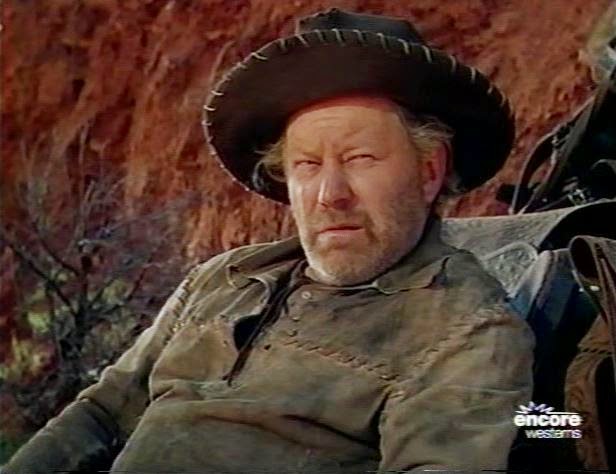
Buchanan’s speech is so tangled up in the most outlandish and complicated blustering euphemisms that I’m surprised he could remember half his lines.  I’d love to see the outtakes; they're real tongue-twisters and he had to have messed up sometimes.

Tired of driving the stagecoach for Mr. Brent, Buchanan invites himself to be Howard Duff’s partner in catching the wild stallion, and voila, we have instant comic sidekick.  He is of no help, as comedy relief seldom is.

Ann’s first meeting with Mr. Duff is contentious, were he leaves her without a horse in the desert, and she catches up to him at a pond, coyly suggests they strip off and go swimming, and then steals his clothes and his horse.  Not a promising start to the romance, but gradually they each find something in the other they can respect. Duff stands up to her father, which she admires.  Ann is a better trainer for Black Velvet than Duff.  His bullying tactics to train the horse, once he’s caught him, only get him thrown off and lying in the dirt with a wrenched back, and the horse escapes from him.  Ann finds Black Velvet on the trail, where he is caught by a rope snagged on a limb.  The sudden jerk brings the poor horse crashing to the ground.

Ann’s gentle manner with Black Velvet goes over big with the horse.  She frees him, and leads him back to Duff, the horse trotting along beside her, happy as a puppy because she’s so purty and talks nice to him.  Duff’s astonishment is a hoot, but, to his credit, he lets her take over the job of training the horse without any ego.  He later tells her, “I would have been whipped.  Black Velvet’s too tough for me.”

Ann has an ulterior motive, she wants to ride Black Velvet in the upcoming horse race and beat the pants off her father, who won’t let her ride his white stallion, and says things, like, “You’d better realize you’re a girl,” as if that were a bad thing. 

Ann looks well on a horse and her confident riding is impressive.  She looks quite skilled and comfortable, even in the exciting shots where she is riding at a speedy gallop, leaning over the horse’s great neck, her hair flying.  I suppose we must credit the Hollywood studio training system for teaching a girl from Manhattan to ride like that. 

Since this is a Technicolor film, her hair has been lightened to a reddish brown.  I guess dark hair is only for black and white films.  For a tomboy, she wears a most vivid shade of red lipstick, similar in hue to the big red first letters in the words of the title.  You can’t waste Technicolor, you’ve got to make the most of it.  Likewise, the title Black Velvet becomes Red Canyon.

Westerns are really meant for color film stock, anyway.  A city scene artfully filmed in black and white can evoke a strong range of powerful emotions, but with an open range of small scrub, a gray palette does not distinguish detail as well as color.  Outside a closed set, there is less ability for the cinematographer to manipulate conditions.  In black and white, the western prairies look as desolate as the moon, but color film brings out depth and warmth to the rugged landscape, stark, challenging to the body and soul, and utterly majestic.

Howard Duff displays a quiet strength in this film, a virile self-confidence with an absence of swagger; he looks comfortable.  A likeable loner; if we never get to know him well it is not because he is complicated, but because he keeps his own counsel.  He faces down his conniving outlaw father and treacherous brother, as well as George Brent, who dismisses him as a saddle tramp.  Though his romance with Ann is tentative; there are no fireworks between them, in part due his reticence about getting involved with the girl who was made motherless by his outlaw family—nevertheless, their scenes together are genuine and reticence is natural to both their characters.  He is living down the burden of his family name; she is discovering her womanhood.  

Duff (in real life some 15 years older than Ann Blyth, but doesn't seem it) looks like he belongs to this landscape, as if he is a part of it.  George Brent does not; he still carries the aura of a transplant.  That, too, is natural.


Possibly the biggest star of the film are the uncredited horse wranglers.  The two great, spirited stallions, and especially the herd of wild horses under the lead of Black Velvet must have taken an extraordinary amount of handling. The camera work, too, is very good, with long and close shots sweeping over the backs of the galloping herd of wild horses.

One scene is a bit unsettling, when Howard Duff captures Black Velvet by forcing him to leave the refuge of a small, narrow canyon by starting a brush fire.  No wonder the horse doesn’t like him. 

By the end of the film, we have a horserace, a showdown, and a shootout.  Most surprisingly, Howard Duff and Ann Blyth decide to return the horse to the wild, and our last shot is not the usual happy couple pressing their cheeks together, but of a magnificent black horse tearing across the open range, rejoining the wild herd of which he is the leader.

The movie was filmed at Kanab, Utah, which was enjoying what was touted in the local press as the birth of a Hollywood-rival in location shooting.  (Howard Duff’s film with Yvonne DeCarlo Calamity Jane and Sam Bass (1949), which we covered here, with the same director and producer: George Sherman and Leonard Goldstein, would use the same racecourse and scenery the following year.).  Locals appeared as extras.  The Deseret News noted in October 1948:

During the past summer, southern Utah hotels, eating houses, stores and workmen reaped a rich harvest from the movie people on location around Kanab and Cedar City.  At the former site, Ann Blyth, Jane Darnell [sic] and George Brent captivated the citizens during their stay while filming Black Velvet.

The excitement of seeing Hollywood stars in their midst was accompanied by the thrill of knowing their part of world was getting attention, as the Deseret News recorded at the time of the film’s premiere in March 1949:

Red Canyon is a picture that’s worth thousands to Utah in the form of publicity.  Many who see the film when it is shown in theaters across the country will want to visit the region in which it was made…

Whether tourists thereafter clamored to get to the Kanab region, or only occasional film companies looking for sagebrush and scenery, but for one afternoon and evening in March 1949, Salt Lake City held the spotlight for the premiere of Red Canyon.


On the morning of Wednesday, March 16th, stars Ann Blyth, Howard Duff, Edgar Buchanan and Chill Wills, along with producer Leonard Goldstein, arrived at the train station on the Union Pacific Streamliner.  The mayor welcomed them, and they appeared on a live radio broadcast right there on the depot platform for the Breakfast in Hollywood program.  Among their personal appearances was to ride in parade through town the next afternoon along with the Downtown Days Queen—part of the Downtown Days festival run by the Retail Merchants Bureau of the Salt Lake Chamber of Commerce.

The evening of the 17th was capped by the premiere showing of Red Canyon at the Utah Theater, with an overflow crowd going to the Capital Theater.  After the movie, the stars appeared on stage, with Chill Wills acting as emcee.  Ann sang.  The Deseret News commented:

The little Blyth girl especially won the plaudits with three songs which showed she is versatile in several fields of entertainment.  She left little doubt of her singing ability after she sang “Galway Bay” as her final selection.

Well, it was St. Patrick’s Day, after all.

If any of our readers attended that event, or know someone who was an extra, I'd love to hear from you.

The next day, the afternoon of Friday, the 18th, it was the train back to Hollywood for the actors, leaving Salt Lake City with only its Downtown Days queen to maintain the magic of celebrity.

For Ann, the following week brought another celebrity experience when she attended the Academy Awards as a presenter, handing out the Sound Recording award.  The host was Robert Montgomery, with whom she was now working in Once More, My Darling, which we covered here.

It was her second appearance at the Academy Awards; you’ll remember her first was three years earlier as a Best Supporting Actress nominee for Mildred Pierce.  She had been a newcomer then; and if presenting the Sound Recording award was less exciting than being nominated, it signaled that she was part of the Hollywood establishment now. 

As you can see by the screen caps, this was recorded off the Encore Westerns channel.  I don't believe Red Canyon was ever released in VHS or DVD, but you can probably find a gray market copy. Please correct me if I'm wrong.

Come back next Thursday when we return to Ann Blyth’s first year of filmmaking, before any thought of Oscars, and the 1944 release of her final two teen musicals from Universal: Babes on Swing Street and Bowery to Broadway.


To all our American readers:  Happy Thanksgiving.

©Jacqueline T. Lynch, 2007-2014.  All rights reserved.  If you're reading this on a site other than Another Old Movie Blog, please be aware that this post has been stolen and is used without permission.
 
***************************
Bonham Daily Favorite(Bonham, Texas) – November 18, 1951-  “Tiny Ann Blyth Proves Durable in Film Roles,” p. 2.

Deseret News, October 1, 1948 – “Movie Makers Turn Eyes to Utah” by Olive W. Burt, p. M1; March 18, 1949, “Red Canyon and Stars Win Plaudits at Premiere,” p. F-3; March 2, 1949, p. B1; March 17, 1949, p. B1; March 15, 1949, p. A8; November 11, 1948, “Kanab Runs Hollywood Close Second of Movies,” p. F-3.

Wiley, Mason and Damien Bona. Inside Oscar - The Unofficial History of the Academy Awards. (NY: Ballantine Books, 1986), p. 187.
************************

THANK YOU....to the following folks whose aid in gathering material for this series has been invaluable:  EBH; Kevin Deany of Kevin's Movie Corner; Gerry Szymski of Westmont Movie Classics, Westmont, Illinois; and Ivan G. Shreve, Jr. of Thrilling Days of Yesteryear.  And thanks to all those who signed on as backers to my recent Kickstarter campaign.  The effort failed to raise the funding needed, but I'll always remember your kind support.
Delete
****************************
 HELP!!!!!!!!!!
Now that I've got your attention: I'm still on the lookout for a movie called Katie Did It (1951) for this year-long series on the career of Ann Blyth.  It seems to be a rare one.  Please contact me on this blog or at my email: JacquelineTLynch@gmail.com if you know where I can lay my hands on this film.  Am willing to buy or trade, or wash windows in exchange.  Maybe not the windows part.  But you know what I mean.


Also, if anybody has any of Ann's TV appearances, there's a few I'm missing from The Dennis Day Show (TV), The DuPont Show with June Allyson, This is Your Life, Lux Video Theatre.  Also any video clips of her Oscar appearances.  Release the hounds.  And let me know, please. 

***************************
A new collection of essays, some old, some new, from this blog titled Movies in Our Time: Hollywood Mimics and Mirrors the 20th Century is now out in eBook, and in paperback here.

I’ll provide a free copy, either paperback or eBook or both if you wish, to bloggers in exchange for an honest review.  Just email me at JacquelineTLynch@gmail.com with your preference of format, your email address, and an address to mail the paperback (if that’s your preference).  Thanks.

Thursday, April 3, 2014

Once More, My Darling - 1949

 
Once More, My Darling (1949) is one of the funniest comedies of the era, and one of the most charming ever made.  I’m not sure why it’s not more well known because it deserves to be lumped with the greats, especially in the madcap heiress genre.  Perhaps because it is so deliciously offbeat, it requires, just as Robert Montgomery discovers, you have to accept certain things at face value.  Its humor is more gentle and subtle than broad, a kind of hybrid between the screwball comedies of the 1930s and a more wry, introspective humor.
The title comes from the speech star (and director) Robert Montgomery delivers on set as a struggling movie actor. 
It’s a funny scene, where he has trouble proclaiming his love to thin air, so the director gets him a body to talk to—a bored and uncomfortable movie grip played by Jack Overman.  Mr. Montgomery looks equally uncomfortable with this situation, but he plods ahead proclaiming his love to Mr. Overman, who is deeply affected.
 
 
Montgomery is actually a lawyer, from a noted family of lawyers, but is bored with the work and, now that the war is over (where he served in the Army in Europe as an investigations officer in the military police), he wants to pursue a fanciful dream of acting.  He is smart, savvy, a bit of a ladies’ man who doesn’t want to be tied down to anything—not a wife, not his family’s law practice, and not the Army.  Unfortunately for him, he’s still considered Reserve status, and is called back to uniform to help in the investigation of a jewel theft that happened late in the war.
When he is called into the colonel’s office, he firmly responds, “I will not go in without my mother.”
He immediately attracts the attention of everyone in the office.  His mother, standing with dignity beside him, is played by theatre great Jane Cowl.  She is an even better lawyer than Montgomery is, and he wants her there as his attorney to get him out of the army.  She doesn’t do it though, because she really wants him to give up this silly acting hobby, get married, and join the law firm.
The case to which Mr. Montgomery is assigned involves Ann Blyth, who plays the daughter of a wealthy American industrialist who spends his time between the US and South America.  The jewel thief, like a lot of shady characters in the post-war years, left Europe for South America, met Ann and attempted to woo her with the stolen jewels.  She is innocent about the heist, but she has publically worn the jewels, notably in a magazine advertisement for perfume she did as a lark.  The government wants Robert Montgomery to woo Miss Blyth himself to flush the jealous bad guy out of hiding so they can nab him.
It’s a simple plot that is carried along with effervescent silliness and beguiling charm.  Robert Montgomery smoothly straddles the savvy and in-control aspects of his character—and helplessly rides the crest of the completely goofy and out-of-control situations in which he finds himself.  He is not entirely a calculating straight man, like, say, Gregory Peck in Roman Holiday (1953), but not entirely a vulnerable and befuddled guy like Cary Grant in Bringing Up Baby (1938) who sometimes seems like a sap Katharine Hepburn culled from the herd for amusement.  Montgomery is more mature and adapts to the moment like the kind of good improvisational actor his character yearns to be.
Here Mr. Montgomery plays out the split personality of his character—a capable man able to think on his feet, but also a “romantic dreamer” as Ann Blyth calls him, who prefers dressing in costumes and acting, to a dull law practice.
Ann Blyth, in the role of the heiress he pursues, also has a duality about her character.  She is sure of herself, bursting with a courageous curiosity about the world, and yet utterly naĂŻve.  I love how she plays this socially dysfunctional character, how she speaks and how she moves.  She leans into people, someone who has no concept of “personal space,” and has a slightly nearsighted squint as she navigates conversations, studying the faces of people to whom she speaks like someone who cannot read expressions 
Unlike Hepburn’s rapid-fire take-charge prattle in Bringing Up Baby, Ann enunciates her words carefully in a manner which illustrates perfectly the kind of young woman this is: someone who, having spent many years bouncing between North and South America probably learned English and Spanish together so that neither is her first language or her second language.  Her speech is formal, sounding as if she’s gleaned much of it from 19th century novels, sprinkled with bits of odd-sounding modern slang she’s probably picked up in off moments from the radio.  She’s likely spent the bulk of her lonely life in the charge of tutors.
She is socially awkward, but lacking shyness, charges into social situations like an excited child discovering new friends at kindergarten, and is completely oblivious to what an oddball she seems to others.  This is consistently hysterical, but also I think rather poignant.  She has no siblings, no friends, and has been sheltered in the care of a dismissive father.
He is played by Taylor Holmes, a veteran movie character actor since the silents of the ‘teens, when he wasn’t on Broadway.  Somewhat of an eccentric himself, her father has lately taken to dressing like his hero, Winston Churchill, and has taken up painting to emulate him.  When Robert Montgomery approaches Mr. Holmes for permission to get to know Ann, and accidently knocks over his easel, Holmes launches into a furious tirade in Spanish.  Ann and her father speak Spanish back and forth, she trying to appease him, flinching at his rage.  When Mr. Montgomery requests a translation, Ann replies, “My father wants to beat you up.”
Catch the reference to the pollsters’ recent infamous mistake on the Truman-Dewey election.
Their chauffer, played by my favorite gravely-voiced guy, Charles McGraw, is an ex-boxer, also very protective of Ann, whom he calls by her nickname: “Killer.”  She is an excellent tennis player, and proudly wears a short-sleeved sweatshirt with the name Killer on the front some vanquished opponents gave her because she has a killer forehand.
In her tennis duds is where she first meets Robert Montgomery, and with her hair tucked under her cap, sunglasses, and Killer across her chest, and he at first doesn’t realize this is his quarry.   She doesn’t look at all like the glamorous debutante photo in the perfume advertisement he was given back in the Colonel’s office, in which she wore an evening gown, with a jeweled pendant—one of the stolen jewels—glinting on her cleavage, and on which Montgomery blissfully concentrates when he is shown the ad. 
She was given gallons of the perfume for doing the ad, which she uses liberally ("I practically swim in the stuff") and there is a running gag about the strong scent.
So Montgomery does not recognize her when he first meets her in this tennis getup, but she is drawn to him immediately.  When she remarks, “I’m sorry there isn’t a puddle so I could take something off and spread it for you to walk on,” we might first think she is being sarcastic, as he does.  Very soon, however, it becomes apparent that this is the love-talk of somebody who doesn’t know how strange she sounds.
Some favorite moments in the film:  When Robert Montgomery, unwillingly, brings Ann home to meet his mother on the night his mother is hosting a party at home for some influential friends. 
Ann is clearly the oddball in this scene, and sweetly, and painfully, doesn’t know it.  She eagerly pounces on Jane Cowl, expressing her love for Mother Cowl’s boy Robert.  She announces that she intends to do "the right thing" by Robert and marry him, pleading that Jane be a mother to her, too, since she never had a mother.  Jane Cowl looks at her like she's got two heads.

I love when Ann, kneeling on the ottoman before Jane Cowl, sits back on her heels a moment and considers the company in the room, momentarily breathless, with a slight, self-satisfied wiggle, like kids do when they’re pleased.
The well-heeled society ladies and gents are astounded and don’t know what to make of her, but are clearly entertained, and all react comically to her strong perfume.  I love when the wallflower daughter of one them, a brainiac, played by Dee J. Thompson, Mother Cowl has been trying to set Robert up with, stands upon being introduced to Ann, and she towers over her, booming a basso profundo “How do you?”
Ann, the daughter of a wealthy and influential industrialist, is socially equal to everybody in the room, and probably wealthier than all of them put together, but her ignorance on how to fit in puts her at a disadvantage.
The only one she connects with is Mamie, the maid, wonderfully played by Lillian Randolph.  Miss Randolph has a stronger role in this film than most domestics, and not stereotyped.  She has a personality of her own, and is clearly amused and delighted with Ann.  She seems to be the only one who is not repelled by her perfume. 
It’s another telling aspect of Ann’s character that, rather than dismiss a servant without a second look as would most young ladies of her class, she befriends Mamie instantly upon meeting her, telling her a long, involved story about how she came to wear pajamas this evening in order to sneak out of the house.  Ann is a girl whose closest friend is her father’s chauffeur and doesn’t know the difference between the status of the maid and the lady of the house.
I love Montgomery’s discomfort through the party scene and his rising sense of panic: “I may start laughing and crying at the same time.”  As much as I admire Robert Montgomery’s dramatic roles, especially in Night Must Fall(1937) which we discussed here, he really was terrific at comedy, especially in a situation like this where he is a kind of victim.
Another marvelous aspect to the party scene is Ann Blyth’s skillful command of it, how she is the engine that drives the scene, and how strong she is against the veteran actors. 
Another favorite moment is her proposal of marriage to Montgomery in the restaurant.  At this point, we see clearly that she is wooing him, not subtly with coy, inviting feminine wiles, but boldly, probably much in the same manner she has read of the speech and actions of ardent lovers in books, of heroes wooing maidens, of the way the few men who have had access to her, like the jewel thief, have attempted to woo her, grandly and with flourish.  Her lovemaking is necessarily bluntly masculine because she hasn’t the sophistication to lure him any other way.
In this manner does she woo Robert Montgomery, regretting that she cannot give him a scene of orange blossoms like he deserves.  It’s spectacularly silly, and yet somehow touching that she apologizes that the force of her passion and her impatience to marry immediately that denies him, “a big church wedding with your mother and all your friends there.”
He stumbles for an appropriate response, stalling, “Well, yes, it is the most important day in a man’s life.  He gets to wear a cutaway and striped trousers, and then there are the presents…”
Montgomery’s reaction is in keeping with both his mission—to carry on a public romance with her and flush out the jewel thief—and his nature, to be a good actor.  So he goes with the flow on what seems to be an incredible inprov scene dropped in his lap and plays “blushing bride” to her ardent groom behavior.  "You've won me, Killer."
This culminates on a long drive to a wedding chapel in Vegas.  He drives slowly, trying to drag out the miles, hoping everybody from the jewel thief, to the Army, to his mother, to her father will catch up with them before he has to really marry this fruitcake.  She senses his growing anxiety.  Like any thoughtful and concerned groom, she gently asks him if he is nervous about the wedding night.
He responds, “Well, a little maybe.  No more than the average man, I guess.”
She delicately tries to reassure him, as if he were a virgin in a 19th century English novel about to faint in the clutches of a highwayman, “There’s nothing to be afraid of, dear.  I’ll be awfully gentle and tender.”
He shoots her an incredulous look, this devil-may-care bachelor having lost all control of the situation.
We are brought to a kind of Marx Brothers ending in a cheap motel bungalow, and then the final scene moves us to a posh hotel and gambling casino where, curtain call style, we encounter all of the characters one more time as Robert Montgomery searches out Ann Blyth to apologize. 
She is angry and hurt that their “romance” was nothing more than a military mission, but he succeeds in truly winning her at last with his old standby, his “Once more, my darling” movie speech.  Just like the grip at the beginning of the film, she is deeply moved, and he is rewarded by resounding applause by the cast.  It’s an off-beat ending, a romantic comedy that is more comedy than romance, but we have the feeling that these two, so deep in their own fantasies, are probably made for each other.
Another aspect to this film I love is the score by Elizabeth Firestone, a breezy, melodic refrain that I’m surprised was never developed into a popular song.  According to the IMDb site, this film is the first to be scored entirely by a woman.  Daughter of the Firestone tire magnate, Elizabeth Firestone, I believe, worked on the scores of only a couple other movies.
Jane Cowl spent the bulk of her impressive career in heavily dramatic roles on stage.  She died only the year after this movie was made, and came to Hollywood with trepidation.  It was her first movie role in 32 years since she took a brief stab at the silents.  In a New York Times article of May 1949, Miss Cowl confessed that working on this movie was “a terrifying experience.”  Arriving at 5:00 a.m. for makeup to arrive on set at 7:15, “she was as panicky and bewildered as a neophyte."
“'In those opening shots…I found myself almost helplessly clinging to Mr. Montgomery; to such an extent, in fact, that I actually upstaged him.  Luckily he was most kind and understanding.  Those being his scenes, he would gently take me by the wrist and put me where I belonged.  Finally, I told him, ‘If you catch me doing that again, just slap me down.’
“On the second day, still unable to adjust herself to such unfamiliar instructions as: Toe that mark; don’t look too much to the left; don’t look too much to the right—but be perfectly natural, Miss Cowl gave what she described as a ‘wild bleat’ and desperately announced she was taking the first train to New York.  But the next morning, however, she had recovered her accustomed poise…”
After One More, My Darling, Ann would move on to another comedy, Free for All, which we’ll discuss down the road.  That is a weaker film, and surprisingly, has a much weaker role for Ann as a straight-man to Bob Cummings, considering what a fine flare for comedy she exhibits in Once More, My Darling.  There seemed to be an inconsistency in the quality of scripts she was getting from Universal.  She was twenty years old when did this film, already her film career had covered a wide range of roles and genres, even if it was hit-or-miss, and she would continue to play roles roughly around her actual age, and, as far as the script allowed, she was able to display her splendid versatility.  Regina in Another Part of the Forest (1948), which we covered here, is about the same age as Killer Connell, but they could not be more different than night and day. 
I do not believe Once More, My Darling is currently available in DVD, but I hope someone will correct me.  You can find it on YouTube, at least for now.  Two years later, in January 1951, she reprised the role on radio in the Lux Radio Theater, playing opposite Van Heflin. I like him in the role, and he probably would have been great in the movie, but the radio version is not as silly a romp as the movie, partly because it is necessarily abbreviated, and partly because so much of the movie relies on physical comedy.  You can have a listen here at the Internet Archive website.  Just scroll down to the episode.
Come back next Thursday when we jump to 1963, when Ann appeared as a guest in the new TV drama series about New York City reporters, Saints and Sinners, in an episode with the teasingly tongue-in-cheek title, “The Year Joan Crawford Won the Oscar.” 

****************
The New York Times, article by J. D. Spiro, May 15, 1949, p. X5.
**************

HELP!!!!!!!!!!

Now that I've got your attention: I'm still on the lookout for a movie called Katie Did It (1951) for this year-long series on the career of Ann Blyth.  It seems to be a rare one.  Please contact me on this blog or at my email: JacquelineTLynch@gmail.com if you know where I can lay my hands on this film.  Am willing to buy or trade, or wash windows in exchange.  Maybe not the windows part.  But you know what I mean.

Also, if anybody has any of Ann's TV appearances, there's a few I'm missing from, Switch, The Name of the Game, The Dick Powell show, the Dennis Day Show (TV), the DuPont Show with June Allyson, This is Your Life, Lux Video Theatre.  Also any video clips of her Oscar appearances.  Release the hounds.  And let me know, please.

***************************************
Oh, and while I still have you on the line, here's one more thing.  In response to the number of kind people who've requested print copies of my eBook Classic Films and the American Conscience, which is a collection of essays from this blog -- I still can't print that book because you wouldn't be able to lift it, and I couldn't afford to print it.  BUT, I'm putting out a new, smaller, collection of essays, some old, some new, from this blog titled Movies in Our Time: Hollywood Mimics and Mirrors the 20th Century.   It will be issued in eBook as well as print, and I'll let you know more about it down the road.  I hope to have it published sometime in May.

Thursday, December 20, 2012

Lady in the Lake - 1947


“Lady in the Lake” (1947) uses playful images of Christmas in that clever brand of sarcasm used by only the best private eyes.  And Robert Montgomery.
This is our second installment of A Very Gumshoe Christmas, and we take up where “Alias Boston Blackie” on Monday left off…from B-movie to classic noir.  The loner detective grows up, and grows cynical.  Christmas throws us off the trail from the start, but never Philip Marlowe.
There will be no plot spoilers, just a few impressions of an unusual and daring film. 
“Lady in the Lake” is famous foremost for its unique first-person camera view, and for discussions back and forth by fans for decades on how effective it is or isn’t.  Obviously, the camera has some limitations—for one, it does not accurately imitate the peripheral vision of the human eye.  Some scenes may seem slow or unintentionally comical to the modern viewer as the actors play directly to the camera.  But this wild experimentation is exactly what deserves our respect in an industry where “copycat” is the usual art form and risks are rare. 


Robert Montgomery, who we last saw here in “Night Must Fall”(1937) makes his official directorial debut with this movie, and also stars.  However, as he is playing the lead, detective Philip Marlowe, we see all the action from his viewpoint, but only see him a few times in the course of the film when he happens to look in a mirror. 


On another occasion, his shadow on a wall as he is talking with Audrey Totter is his stand-in.
This may make the film frustrating for Robert Montgomery fans who want to see him (the film was not a box office hit in part for this reason), but true fans of Mr. Montgomery should appreciate his ingenuity in crafting this film.


Audrey Totter, who we last saw here in “Tension” (1949), plays a complex role of a magazine editor who hires Montgomery to find the missing wife of her publisher boss, played by Leon Ames.  Miss Totter should have gotten some kind of prize for playing probably 99 percent of her work in this movie directly to the camera.  That is a workout, and she is a lot of fun to watch; at turns scowling, flirting, pleading, and seducing.  (Today is Miss Totter's 94th or 95th birthday - not sure of the year of birth.  According to IMDb website she is residing at the Motion Picture and Television Hospital in California.  A very happy birthday to a terrific and fondly remembered actress.)


Lloyd Nolan is excellent as a tough cop.  He’s great in whatever he does, and I actually would have loved to have seen him take the lead and play Marlowe in this movie.  His down-and-dirty growl of a voice.
 
Tom Tully is the world-weary police chief.  Jayne Meadows is a standout as a mercurial, almost manic, woman who knows a lot more than she lets on. 
Dick Simmons is a smooth and deceptively friendly gigolo.  You can tell he's a gigolo by the striped jersey.
There are some lines tossed around that would make for a great movie no matter how it was filmed.  Audrey Totter, whose magazines are of the sensationalist pulp variety, complains to an underling that a new magazine cover design needs more gore. "Not enough gore."
Montgomery, recovering from being slugged by the Southern “gentleman” Dick Simmons remarks, “At least he had the decency to hit me above the Mason-Dixon line.”
And Lloyd Nolan’s remark, “How does it feel dying in the middle of someone else’s dirty love affair?”  I love that line.
Despite the restriction of actors playing directly to the camera, there are flashes of remarkable electricity to their performances, moments akin to a stage actor’s reactions.  Some of their responses and facial actions look almost improvisational. 
Because we are the camera’s eye, we see everything Montgomery sees.  Some of this gimmick is playful and funny, as when Montgomery’s leering glance follows Totter’s curvaceous secretary around the room, and with a sharp, somewhat jealous interjection by Totter, our attention is swiftly brought back to the mollified Miss Totter behind her desk.
Sometimes the gimmick is quite eerie, as when we discover bullet holes in a glass shower door, we approach and open the door, and our gaze rests upon bullet-gouged porcelain tiles in the shower stall, falling down upon the naked corpse crumpled on the floor.


Or when Montgomery, injured after a car wreck, crawls (and so do we), hand over hand, across a road to a phone booth that seems a mile away.
 
We are stared at.  We are flirted with.  We are punched in the face. We kiss Audrey Totter.  She serves us a highball. We notice a hundred different clues, and sometimes, as when Montgomery lifts a phone receiver to his mouth and talks, we look at nothing, like at the corner of a table, just as we would absently look at nothing while we are concentrating on a voice in our ear.
All this would be enough to make a fun and very different movie, but set during Christmastime, the director uses images of Christmas in a very cavalier and smart aleck way. 
 
 
We begin with the opening credits, which are title cards designed to look like Christmas cards.  Images of Wise Men, and holly, Santa, poinsettia, all the iconic graphics and over them, a medley of Christmas carols in uplifting choral arrangements that may make us think we are about to watch a heartwarming tale of love and repentance.  In a way, maybe, but it’s a crooked road to repentance.
 
 
As the credits finish and the Christmas carols end, the last title card reveals a handgun.  We were had.  Trust nobody.
We start three days before Christmas.  Robert Montgomery takes on a missing person job, that soon turns into a murder investigation.  All along the journey, though he is a man without family and evidently has no Christmas plans, the yuletide follows close on his heels, a shadow of irony.
We knock on doors and are faced with Christmas wreaths.  He remarks to the gigolo Simmons, “I like your tan.  It’s very Christmassy.”
We intrude upon an office Christmas party, where a reserved and gentlemanly Leon Ames hands out gifts to his employees. 


In a scene with Audrey Totter, Montgomery confronts her with conflicting evidence.  He demands she own up to secrets, and when he has found a gun that was used to murder, he hands it to her gift-wrapped as a gruesome present.  She plays the scene framed close to a desktop Christmas tree.  Christmas stays in the tense scene like a mocking clown.


Leon Ames takes him aside and want to hire him, too.  He nervously picks at the tinsel on the branch of a Christmas tree that juts out from the side of the frame.  Christmas is pushy, demands attention and will not be left out.
 
When we are arrested and interrogated by Tom Tully, Mr. Tully is interrupted by a phone call from home.  It is his little daughter, who wants Daddy to come home and help her put up her stocking.  With quick, wary glances to us, he indulgently listens to his daughter’s prattle, even helping her through her recitation of “T’was the Night Before Christmas.”  It is offbeat, funny, and very surreal.
I like the scene where, trying to escape Lloyd Nolan hovering in the police station hall, we duck into the press room and find a “journalist” lying on the table, speaking “pillow talk” into the phone to his lady friend, a Racing Form by his head. 
After a beating, a car wreck, and a belly full of people lying to him, Montgomery is saved by Audrey Totter, who responds to his emergency call and brings him, unconscious, to her apartment.   She gives him a Christmas present: a robe she had bought for another man.  Like earlier false clues that went nowhere, even the gift to him is not a gift to him.  Marlowe’s world is made up of lies.
 
On Christmas Day, they listen to “A Christmas Carol” on the radio, which was an annual event back in the day, though it doesn’t sound like Lionel Barrymore, and we blow streams of cigarette smoke as we regard Audrey Totter lying contentedly on the living room couch, her eyes drinking us in, across from where we are sitting. 

When the program ends, she snaps off the radio and resumes, as if picking up in mid-sentence, the tale of her hardscrabble life.  Only Scrooge could have interrupted her.  She asks Montgomery what he did last Christmas Eve.  He spent it in a bar.  She spent it in a nightclub.  This Christmas is an improvement, or should be if they weren't so depressed.  Christmas offers redemption, but you have to trust it.  These two lonely people have some serious trust issues.
I was a bit surprised at the can of pork and beans on the kitchen counter.  I would have thought Audrey Totter was decidedly not a pork and beans person.
Montgomery has one task left, and, spying his quarry window-shopping at a Christmas-decorated window, we have a final, very dramatic scene leading to the conclusion of the case.  The movie, like detective Philip Marlowe, is flawed, but has guts.  Teasing us with Christmas images in an otherwise grim movie is an irresistibly smartass thing to do.