Showing posts with label Tom Tully. Show all posts

Friday, September 12, 2014

Killer McCoy - 1947


Killer McCoy(1947) is an engaging hybrid of genres, a post-war noir with a 1930s innocence and parade-of-years element; a story where the slum-raised protagonist is actually a hero rather than anti-hero, as sentimental as he is cynical.  The racketeers are soulless, except for the one with the most to lose.  The romantic couple never even kiss, but they are bonded together from the moment they meet.  Most interestingly, it is an MGM movie and not Warner’s, where one might expect to find a gritty boxing picture.  It is a both a gift, and a challenge, from the studio—perhaps even a dare to test his box office value—to its prodigal son just back from service in the army, Mickey Rooney.


This post is part of The getTV Mickey Rooney Blogathon hosted by Once Upon a Screen, Outspoken & Freckled and Paula’s Cinema Clubtaking place throughout the month of September.  Please visit the getTV schedule for details on Rooney screenings throughout the month and any of the host sites for a complete list of entries.

Ann Blyth, on loan out from Universal for the second time, plays a finishing school debutante,  the daughter of the successful racketeer.  Her father, played by Brian Donlevy in a tailor-made role, has kept his nefarious career a secret from her, but she learned about it when she was still a child and carries the shame inside her.  She doesn’t tell her pop she knows because she doesn’t want to hurt his feelings.  There’s a lot of protecting of parents by disillusioned young people in this movie, not exactly a forerunner of the 1950s and 1960s teen films of mom-and-dad-don’t-understand flicks.

These young adults are much more mature and compassionate than the malt-shop or beach bum gang of whiners that would follow.  They are not grappling with growing up; they grew up too soon.

Though this is a remake of the Robert Taylor vehicle, The Crowd Roars (1938), I won’t make any comparisons, partly because I haven’t seen that movie yet, and partly because Killer McCoy can stand on its own as a slice of the careers of its prodigiously talented leads.

Mickey Rooney creates a fascinating double-image of his screen persona.  We see flashes of Andy Hardy in his playful song-and-dance routine with the wonderful James Dunn, who plays his alcoholic shiftless father, and even in some of the rubbery pratfalls he takes in the boxing ring.  Mr. Rooney, though he is a natural athlete and is clearly in shape, muscular with good upper body development, is no boxer.  He doesn’t really have the technique down, but that is covered pretty well by director Roy Rowland’s judicious direction.

Rooney has famously, both in his autobiography, Life Is Too Short, and in his television interview with Robert Osborne on TCM’s Private Screenings series, discussed his fights with Rowland on set, that he felt the director berated him and was out to get him.  You’d never know it by the image on screen, though, which is a wonderful blend of skillful cinematography and Mickey Rooney’s own masterful screen presence. In the scene where he first meets Donlevy, Mickey enters the room, casts an eye around, almost as if looking for the camera and for us, as if to say, "Yeah, it's me.  I'm back."

It is in the quieter moments of serious dialogue where Rooney really shines, where we see he has left Andy Hardy behind, in his beaten, cynical manner and in the lines on his face.  He confronts what he feels is Ann Blyth’s snobbery about boxers in a speech that displays his anger, his resentment for the fight game and himself a pawn in it, and yet also his compassion for all the washed-up boxers he’s ever met.  Despite his pride, we see his self-loathing later in a scene where crisis comes and he blurts out, "In a way, I had this coming to me."

Most especially preying on his mind is his friend and mentor, played by Mickey Knox, a boxer who trained him.  Knox left the game for wife and baby and chicken farm, but when the money was tight, he went back into the ring for a comeback.  He wasn’t in good condition, and his opponent—Mickey Rooney by luck of the draw—kills him in the ring. 

Mr. Rooney has a terrific scene with Knox’s wife, played by Eve March, where they, both embarrassed and in pain, try to make small talk in one of the worst places in the world to do that: a hospital waiting room in the wee hours of the night.  Miss March is excellent in this scene.  Her career comprised of a lot of bit parts, mostly uncredited, but the strength of her realistic performance as a careworn, lower class woman of dignity, so striking, makes us wonder why she wasn’t used more.  I love the quick flashes of a weak smile when she speaks proudly of her little son.  She tells Rooney the boy wants to grow up to be a boxer like his daddy.

Rooney’s expression hardens.  “Don’t you let him, Mrs. Martin.  Don’t you ever let him.”

“No.” she quietly agrees.

So many scenes, which could come off as clichĂ©, ring true, such as when Rooney, betrayed and disgusted that his father would sell his contract to racketeer Donlevy for gambling and drinking money—only one in a string of disappointments in his washed-up actor father. 

Dunn plays his role with relish, a helpless big-talker who lives for the next stroke of luck, but who can’t settle down to an honest day’s work, as pitiable as he is repugnant.  Rooney has supported his parents and been the man of the family since boyhood.  But there is no hearts and flowers sentimentality to his sacrifice; on the contrary, he is more resentful than a truckload of George Baileys.  Rooney does not apologize for his father, indeed, lets him have it in strong words and a slap on the face, but with the extraordinary compassion (one keeps coming back to that noble word) of his character, he also looks out for him.

“You’re a ham and I’m a pug.  Maybe that’s all we’ll ever be, but at least we’ll have each other.  At least we can go on hoping.”

Another good, genuine scene with Rooney is when the gold-digging waitress at the dinner chats him up for a big spender, and he, with self-depreciating humor, though too shrewd to be taken in, is still generous to her.

The scene where Ann introduces Mickey to her father, unaware they already know each other and are working together in a racket.  Her eagerness for them to like each other, their uncomfortable and embarrassed pretending for her sake.

The scene where when he takes Ann Blyth to a nightclub and she, with youthful importance, orders a drink, and he orders tomato juice.

“Don’t you drink?” she says, startled, expecting more of the big-time boxer in a night on the town.

“No,” he says with wonderfully unconcerned nonchalance, showing the maturity and self-confidence of the young man who doesn’t give it a second thought.  He’s got his own code of honor.  
And it’s torturing him.

Though it’s Rooney’s movie, Ann Blyth is a particularly good choice for the role of the girl.  This is her first time at MGM, the studio that will in a few years give her a chance at a big musical, The Great Caruso (1951), which we discussed here, and would be her own home studio when she left Universal in the 1950s. 

Her own maturity, her empathy not only for her character, but for Rooney, makes her an intriguing and quietly powerful companion for Mickey.  Noting the difference in their social spheres, he tries to stop seeing her many times, but she won’t let him, yet she is not clinging, she is even sickened by her first sight of a boxing match, watching him getting punched, the blood lust of the crowd enjoying it.  Their worlds collide because their souls are drawn to each other. 

One particularly affecting scene takes place in a sailboat, where she confesses to him that she has known since she was a child that her father was a gangster, and so she had never really fit in with her private school classmates, his criminal activity like a long shadow over her.

From a technical aspect, the scene is magical, a still and quiet world away from the noise of the boxing arena and its savage fans.  The boat lifts and falls in a lapping of a gentle wave on an otherwise deserted lake.  The rear-screen projection is used very skillfully here.  The scene is exquisitely gentle.  There is power in Mickey’s restraint as he confesses his dream to leave boxing, and in the consoling way he listens to her and tries to advise her.  There is power in the waver of Ann’s voice and tearing eyes as she tries to carefully unburden herself with fragile dignity.

“I’m all he has,” she says helplessly of her father, who lives a double life.

Ironically, the strongest aspect of their relationship is that, as mentioned above, they do not kiss.  They don’t embrace, there are no confessions of love between them.  They just need each other, and are both too wary, too burdened by others, too fearful to risk loving one more person.  They are taking their time. Only at the magnificent end, when his last terrible boxing match is over, after Rooney screams hoarsely and out of breath into the radio microphone that he’s quitting, do they share a single, sweaty, bloody clinch.  It’s perfect.


Only one scene doesn’t work for me, when Miss Blyth first meets Mr. Rooney, and he is playing Franz Liszt’s “Lebestraum” on the piano.  How a guy who never went beyond seventh grade in school and scrambled to sell papers to feed his parents and spent every free moment hustling chumps in pool halls ever found the time or money to learn how to play classical pieces on the piano, I don’t know.  We need to have a scene of him learning to play the piano as a child to believe it.

Interestingly, there is no mention of the war, though the movie covers a time span of about five years.  The montage of headlines flashes only news of boxing, nothing else.

I won’t go play-by-play on the plot, except to note another scene were Dunn, in an attempt to save both himself and Ann from mobsters, finally displays mettle and resolve in a crisis instead of indulgent self-pity.

Donlevy’s devoted father-panic when he rages at Mickey for hanging around his daughter:

“You’re a pug.  You come from the slums.  You’ve fought your way through back alleys.  You’ve killed a man.”

“Sheila knows that.”

"She’s just a child.  She’ll feel differently,” he says, when Rooney’s been rendered senseless by one too many punches.

The ending may remind you of Rocky (1976).  Coincidence?
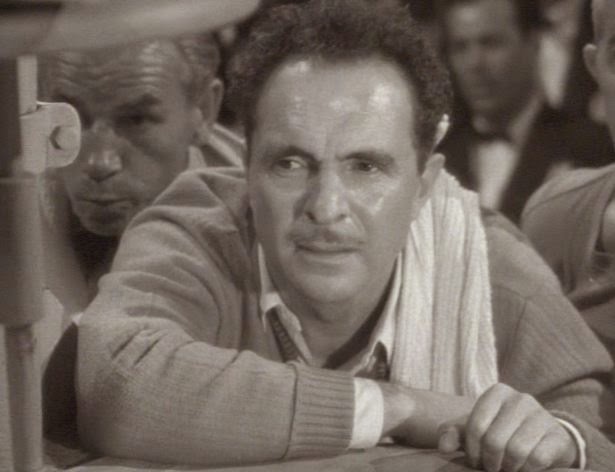
Another one of the joys of this movie is the parade of wonderful character actors:  Sam Levene as Mickey’s trainer and cut-man, Happy, who suffers from the corner every time he’s hit, and has some great wisecracks.
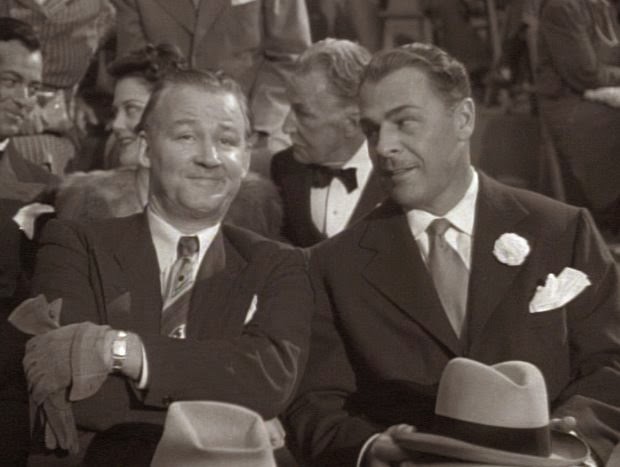
Tom Tully plays a rival racketeer, a great performance that runs a knife-edge of humor and frightening cruelty.  He tells a funny story about having indigestion, and he’s willing to kill for spite, let alone money.  Everybody in this movie has two sides.  Walter Sande his is partner.

Bob Steele, who’d been around since the days of the silents and made a name for himself in westerns, plays boxer Sailor Graves in a delightfully good-natured and even comic performance.

Watch for the extras, including Milburn Stone, Ray Teal, and blink-and-you-miss-her Shelley Winters in a non-speaking role as a boxing groupie who crashes training camp.  She’s driving the convertible.
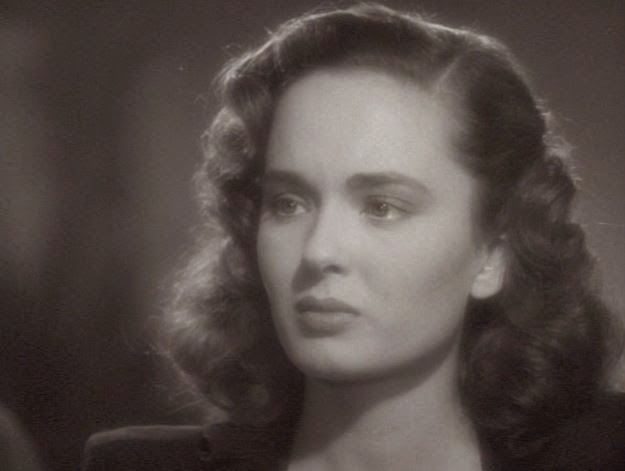
Ann Blyth, we could also note, is photographed absolutely beautifully in this movie.  You can really see the MGM gloss in how the movie handles her.  She conveys dignity, gravity, and decency, and her thoughtful expression darkens, cringes every time someone speaks of gambling and mobsters. She was coming out of one of the worse periods of her personal life—her spine injury and death of her mother—and slogged out these bad memories in her intense bad-girl role in Swell Guy (1946), which we discussed here, and popped up only briefly in Brute Force (1947), which we’ll discuss down the road.  In a way, this loan-out to MGM was, for her as much as Rooney, a kind of reboot to her career. 

She would head back to Universal and a couple more intense dramas and characters of dubious moral conduct: A Woman’s Vengeance (1948) which we discussed here, and Another Part of the Forest (1948) discussed here.  She was about to enter the busiest and most prolific period of her screen career.  Though she was still a young woman, just 19, and she would not yet be through playing teens, still, not since the early four films at Universal in 1944 had she really been locked into ingĂ©nue roles.  Instead, she could and would play women who, if not chronologically older, were certainly world-wise and knowing.  Her own personal maturity and empathy contributed to this ability.  A playfulness, even goofiness that was also part of her personality, would remain hidden and that would not come out until later films: Mr. Peabody and the Mermaid (1948) here; Once More, My Darling (1949) here; and Rose Marie (1954) discussed here.

A syndicated review in the Toledo Blade called the movie a…

Great comeback by Ann Blyth, who’s Mickey Rooney’s sweetheart in Killer McCoy.  She’s the Mildred PierceAcademy Award nominee who broke her back tobogganing.  It threatened to end her career!  Hollywood’s happy for her...

Mickey Rooney’s career would lose momentum, despite his splendid performance in this film, and would ride a variety of crests and valleys through the coming years, but endured with remarkable longevity, which itself was a tribute to this very talented man.


Killer McCoy is available on DVD from the Warner's Archive Collection.

Have a look at the other great bloggers posting this month as part of the getTV Mickey Rooney Blogathon hosted by Once Upon a Screen, Outspoken& Freckled and Paula’s Cinema Clubtaking place throughout the month of September.

Come back next Thursday when we head back west on TV’s Wagon Train for another episode, “The Martha Barnham Story” where Ann Blyth plays an officer’s haughty daughter whose bigotry will alienate a former love and mean life or death for herself and others.


Posted by Jacqueline T. Lynch at Another Old Movie Blog.

******************************
Private Screenings, Turner Classic Movies, Robert Osborne interview with Mickey Rooney.


Rooney, Mickey.  Life Is Too Short. (NY: Villard Books, 1991).


Toledo Blade, July 9, 1947, “Filmdom chatter box”.

****************************
As  most of you probably know by now, this year's TCM Classic Cruise will set sail (proverbially) in October, and one of the celebrity guests is Ann Blyth.

TCM has just published the itinerary for the cruise.  Ann will be doing a couple hour-long conversation sessions, and will also be on hand for a screening of Mildred Pierce.

Have a look here for the rest of the schedule and events with the other celebrity guests. Unfortunately, the cruise is booked, so if' you're late, you can try for the waiting list.

I, sadly, am unable to attend this cruise, but if any reader is going,  I invite you (beg you) to share your experiences and/or photos relating to Miss Blyth on this blog as part of our year-long series on her career.  I'd really appreciate your perspective on the event, to be our eyes and ears.  Thanks.

****************************
 THANK YOU....to the following folks whose aid in gathering material for this series has been invaluable:  EBH; Kevin Deany of Kevin's Movie Corner; Gerry Szymski of Westmont Movie Classics, Westmont, Illinois; and Ivan G. Shreve, Jr. of Thrilling Days of Yesteryear.  And thanks to all those who signed on as backers to my recent Kickstarter campaign.  The effort failed to raise the funding needed, but I'll always remember your kind support.

***************************
TRIVIA QUESTION:  I've recently been contacted by someone who wants to know if the piano player in Dillinger (1945-see post here) is the boogie-woogie artist Albert Ammons. Please leave comment or drop me a line if you know.
****************************
 HELP!!!!!!!!!!

Now that I've got your attention: I'm still on the lookout for a movie called Katie Did It (1951) for this year-long series on the career of Ann Blyth.  It seems to be a rare one.  Please contact me on this blog or at my email: JacquelineTLynch@gmail.com if you know where I can lay my hands on this film.  Am willing to buy or trade, or wash windows in exchange.  Maybe not the windows part.  But you know what I mean.

Also, if anybody has any of Ann's TV appearances, there's a few I'm missing from Switch, The Dick Powell Show, the Dennis Day Show (TV), the DuPont Show with June Allyson, This is Your Life, Lux Video Theatre.  Also any video clips of her Oscar appearances.  Release the hounds.  And let me know, please. 

***************************

A new collection of essays, some old, some new, from this blog titled Movies in Our Time: Hollywood Mimics and Mirrors the 20th Century is now out in eBook, and in paperback here.

I’ll provide a free copy, either paperback or eBook or both if you wish, to bloggers in exchange for an honest review.  Just email me at JacquelineTLynch@gmail.com with your preference of format, your email address, and an address to mail the paperback (if that’s your preference).  Thanks.


Thursday, May 29, 2014

Ann Blyth on Radio: Three Performances

Ann Blyth appeared in 32 films over the course of a screen career that lasted 13 years.  She made possibly as many as 400 radio performances and appearances in her career, over a course of several decades.  Today we’ll talk about three of those performances, and about the peculiar sensation of sound and imagination that creates the so-called “theatre of the air.”

In the middle twentieth century, radio was the main entertainment vehicle, with access to far greater audience numbers than even the movie industry at its most popular.  Acting on radio required a different skill set than performing on stage, but it was like being on stage, especially for shows that were broadcast in front of a live audience. 

Radio required different acting than on screen, yet like film acting, it relied on the actors’ ability to emote and connect with an electronic device—in this case, a microphone instead of a motion picture camera—rather than to play to the audience, even if an audience was present.

As we’ve mentioned in this previous post on old time radio, and in this one on Ann Blyth’s appearance on the Studio One episode of “The Angelic Avengers,” some stars were more successful on radio than others, and some more prolific.  Ann, began her acting and singing career on radio when she was a child of six in New York City, had learned the ropes early on and by the time she was an adult, performed splendidly in a medium that required precise articulation, breath control, the ability to use accents, and most especially, the quality of intimacy with the listener that makes really fine old time radio performances so thrilling and appealing.

Our first show is a version of “State Fair” performed on General Electric Theater September 10, 1953.  This is the chestnut that had been made into a film three times over three decades, and popped up on radio from time to time.  Ann had performed in another version for the Hallmark Playhouse in 1948.

This script was adapted by one my favorite television writers, Kathleen Hite, and because of the half-hour time constraint, focuses on the problems of Ann’s character, Frake family daughter Margie and her experience at the state fair.

Tom Tully is her dad, Verna Felton is her mother, and features old radio and film standbys Sam Edwards, Joe Kerns, Dick Ryan, and Lamont Johnson.  Ken Carpenter is the announcer, who keeps reminding us how wonderful General Electric appliances are, and at one point Ann heartily agrees, as they contribute to “the ease of modern living.”  It seems we can get a standing freezer for $2.69 a week, plus a small down payment.

The show was performed before an audience, but then edited and prettied up before being broadcast on “transcription,” or recording.  There’s a lot of “fair” sounds to add and with some quick cutting, the show is well-produced.

Though radio shows, like stage and screen, were rehearsed beforehand, there is still an element akin to a “cold” reading because the actors are not playing to each other, not playing to the audience, not working with props, or costumes, or any of the usual devices that help them to get into character.  They must just stand before the mic and BE that character, only through their voice, yet performing in this situation is more physical than it seems. 

Listen to the mechanics of Ann’s expression of emotional turmoil: her irritability, her fight with her boyfriend, speaking her lines through tears, and later with her parents, sobbing on the car ride, sounding frustrated and brokenhearted.  We can’t see her, so she can’t rely on facial expressions, body movements, no trembling lip, hanky twisted in hands or dabbing at tears, no turning from the camera to hide the inability to manufacture tears behind heaving shoulders.  No glycerin drops in the eyes courtesy of the makeup man.

She’s got to sob, really.  Because the only thing that sounds like sobbing is sobbing.  She’s got to bring it up from the belly, and it’s got to be messy, nose-running, stomach-tightening sobs.  We have to HEAR her.  And then she’s got to be able to put on the brakes and stop it instantly because of the quick shifts in scene on radio. 

Ann also narrates the episode, voicing over scenes, in the interest of time constraint.  She tells us she is “full of feelings that I didn’t understand, that welled up quickly, soared and flew, and then slipped away into nothing.  Then I’d be all empty inside and lonely.”

The really fun scene is the roller coaster, where she meets the reporter who becomes her new love.  Listen to the roller coaster sounds, the carnival barker, the ratcheting of the cars on the cogs up the coaster slope, and then we can imagine, the car teeters for a moment at the top, then plummets, making us feel the lurching in our own stomachs.  Listen to her splendid, genuine screams, timed right at the moment of descent and the rush of speed.  The ride ends with their chuckling at the exhilaration, and her embarrassed giggle for having screamed.  Good radio sounds very natural, as if we are eavesdropping.

Listen to the episode here:


Or visit the Internet Archive website here and scroll down to "State Fair" where you can either listen or download to your computer.

Next, we have a darker mood and a sinister tale of SUSPENSE.  Suspense was a long-running program from 1942 to 1962 (its ending in September 1962, along with the final episode of Yours Truly, Johnny Dollar would mark the end of the Golden Age of Radio), and featured the biggest Hollywood stars in top-notch scripts.  Harlow Wilcox is our pitchman for sponsor Autolite Spark Plugs.  I love that distinctive hollow two-note chime we hear as a show theme and feel in the pit of our stomachs.

Edmund O’Brien, with whom Ann starred in the film Another Part of the Forest (1948), discussed here, is the lead in “Muddy Track”, broadcast November 11, 1948.  He’s a mug down on his luck, and takes a job for a bookie.  He finds himself in the wrong place at the wrong time, and ends up being a hunted fugitive.  Ann plays a damsel in distress…or is she?

This is a studio-produced show, with no live audience.  The intimacy is controlled, and every sound is intimate in this show, wonderfully evocative of mood and location.  The tinkling of glasses, a lazy plunking of a piano tells us we’re in a bar.  The sound of someone writing on a notepad in a heavy hand, scratching the pen across the paper.  All the soft sounds of life going on all around us that we usually do not notice in the din and cacophony of our world today, where attention deficit syndrome is as common a diagnosis as obesity, and as much a product of our society.

Edmund O’Brien’s resonant voice is made for radio, his cynicism, his worry, his panting panic as he narrates his actions.  He discovers a dead body, and then realizes he is being set up as a fall guy.

Ann’s first entrance is a sharp, gasp of terror when she discovers O’Brien in the compromising situation.  He pretends he is a cop investigating the murder, and he hustles her away to a hole-in-wall restaurant to question her.  She’s rattled, recovering from the shock, drinking a cup of tea he’s ordered for her.  Ann, still teary and upset, delivers her plot exposition while swallowing sips of liquid—again, the mechanics of acting before a microphone.

Later, when they are on the run together in a city park, in order to hide from a cop strolling by, they kiss each other quickly, pretending they are lovers.  The technique used here to illustrate the urgency of the situation—which then becomes a moment of true passion—is for Ann to say her line to the point her words become mingled into a kiss.  Though we next have O’Brien’s voice-over narration describing his feelings, it is not the explanation of the kissing that thrills the imagination; it is the actual muffled sound of the kiss interrupting the line and the following moments when we are allowed to hear them only breathing.

It’s like G-rated phone sex.

At the end of the episode, were are told Ann Blyth can now be seen in Mr. Peabody and the Mermaid, which we discussed here.  Have a listen to “Muddy Track”:


Or visit the Internet Archive website here and scroll down to "Muddy Track" to listen or download to your computer.

Finally, we have another mysterious outing in the popular “Shadow of a Doubt,” a version of Alfred Hitchcock’s 1943 film that was produced on radio by several different programs.  This one is from Hollywood Sound Stage, a Screen Guild Players incarnation that raised funds in support of the Motion Picture Relief Fund.  It was broadcast January 10, 1952.  (Ann Blyth had previously performed another version for Ford Theater in 1949 with Ray Milland.)

Here her co-star as the sinister Uncle Charlie is Jeff Chandler, another superb radio voice, and our favorite Mr. Boynton on Our Miss Brooks.


Ann is on almost the entire show. She narrates in a smooth, controlled voice, and she plays the intelligent niece whose hero-worshiping of her uncle melts into disillusionment and terror.

One fun aspect to the production is that she gets to hum “The Merry Widow Waltz” during the dishwashing scene.  While her mother and Jeff Chandler speak, we hear the clatter of plates in the background.  Ann’s lovely voice hums the waltz behind the other two actors, and she frequently interrupts herself to say her own lines, then back to the tune.

Later, in the moment where she trips on the broken wooden step, we hear a sickening thud, punctuated by her gasp and shriek, “Mother!”  It requires very quick and precise timing. 

In the final scene with the struggle on the moving train, we hear the rush of the increasing speed of the train, and her scream dies off in a kind of aural “fade to black”.

Listen to “Shadow of a Doubt” here:


Or visit the Internet Archive website  and scroll down to "Shadow of a Doubt" to listen or download to your computer.

I sometimes think in our fast-paced world of media, especially portable media, exploding all around us, that we really don’t listen enough, or listen well.  It’s hard when there are so many distractions, and much of what we see and hear in the media today is less entertaining than it is a mere distraction.

To be fully engaged, we need to be quiet sometimes, very still, and listen.  Sounds have textures, most especially the human voice.

Come back next Thursday when we cover a tale of two stage dramas:  Ann’s roles in Thornton Wilder’s Our Town at the La Jolla Playhouse in 1950, and in Wait Until Dark in Chicago in 1967.

Publicity photo, credit unknown at this time.

****************************
THANK YOU....to the following folks whose aid in gathering material for this series has been invaluable:  EBH; Kevin Deany of Kevin's Movie Corner; Gerry Szymski of Westmont Movie Classics, Westmont, Illinois; and Ivan G. Shreve, Jr. of Thrilling Days of Yesteryear.

***************************
HELP!!!!!!!!!!

Now that I've got your attention: I'm still on the lookout for a movie called Katie Did It (1951) for this year-long series on the career of Ann Blyth.  It seems to be a rare one.  Please contact me on this blog or at my email: JacquelineTLynch@gmail.com if you know where I can lay my hands on this film.  Am willing to buy or trade, or wash windows in exchange.  Maybe not the windows part.  But you know what I mean.

Also, if anybody has any of Ann's TV appearances, there's a few I'm missing from Switch, The Dick Powell Show, the Dennis Day Show (TV), the DuPont Show with June Allyson, This is Your Life, Lux Video Theatre.  Also any video clips of her Oscar appearances.  Release the hounds.  And let me know, please. 

***************************
A new, collection of essays, some old, some new, from this blog titled Movies in Our Time: Hollywood Mimics and Mirrors the 20th Century will soon be issued in eBook as well as print.  I hope to have it published within the next two weeks.

I’ll provide a free copy, either paperback or eBook or both if you wish, to classic film bloggers in exchange for an honest review.  Just email me at JacquelineTLynch@gmail.com with your preference of format, your email address, and an address to mail the paperback (if that’s your preference).  Thanks.


Thursday, April 25, 2013

I'll Be Seeing You - (Again)


I sometimes like to watch Christmas movies when it’s not Christmas.  I’m speaking of classic films, of course, because as we’ve mentioned before, Christmas is usually only part of the setting in these films, the background.  It is hardly ever the single theme of the movie.  When watching a classic film with a Christmas setting, it is usually a cozy, sentimental experience, and we are never left—as we often are in modern-day Christmas movies—feeling as if the yuletide is being shoved in our face with all the subtlety of being smacked with a custard pie.

Cozy, sentimental, yes, but also classic films in a Christmas setting usually have a dramatic edginess to them that heightens our emotions and makes the sentimental denouement all the more powerful.  What’s at stake is not the tiresome Best Christmas Ever that so many modern stories are concerned with, but rather the retribution for the crime committed, the redemption of a shattered, sinful human…and sometimes you can toss in the angst of World War II.

We have all of that in “I’ll Be Seeing You” (1944).  We’ve covered this move here in this post at length, but seeing the movie recently again on TCM, a few more thoughts occurred that I wanted to bore you with.

The extra insight we get from watching a movie like “I’ll  Be Seeing You” when it’s not Christmas was first brought home to me many years ago.  The first time I’d seen the movie was, actually, during one Christmas when I was a teenager, but the next viewing was several years later, on a hot summer day.  Nothing Christmassy about it.  I can recall having to run some errands, though the only thing I remember clearly is going to the bank.  I delayed leaving the house because the movie had me in its clutches.  I think I stood in front of the TV with my car keys in my hand for the longest time, unable to pull away.  I remembered seeing it before, but now that years had passed, and it was a hot summer day and there was no tinsel anywhere—I was no longer focused on the Christmas week/New Year’s events of the movie, and settled in on the wonderful everyday detail of this really underrated film.

William Dieterle directs, and his inclusion into the movie of such mundane images as the jigsaw puzzle father Tom Tully has set up in the living room, the claustrophobic room at the YMCA, the family around the table, the exuberant New Year’s Eve party, the getting ready to go out to the party, the baking, the housecleaning.  The way the actors fit into these settings is strikingly meaningful and neatly done. 

Our attention is drawn to the jigsaw puzzle because Joseph Cotten stoops to pick up a piece that has fallen on the floor, something so common when we make jigsaw puzzles.  The pieces are always trying to escape.  Picking up a piece is also a metaphor of sorts, if you want to stretch it that far. 
 
We experience the prison cell of a room at the Y when Cotten enters and we see his heavy steps, his waning strength sapped by indecision, his helpless anxiety when he enters.  The room becomes all the worse for his reactions.  Later, of course, the horrific panic attack and the room almost becomes alive with terror.

I love the clutter of the house, the tchotchkes on the mantle, that extra chest of drawers in the upstairs hall.  Shirley Temple’s room with the tennis rack and pennants on the walls.  (Though I am puzzled by the closet in the living room entryway.  Look at the set, where the windows on either side are placed, and the outside of the house.  It doesn’t seem as if a closet should fit into that wall there.)

I love the ornaments on the pine tree in the front yard.  We are given so much to look at in this movie. 

The movie is almost a hybrid cross between William Wyler’s “The Best Years of Our Lives” (1946) and Alfred Hitchcock’s “Shadow of a Doubt” (1943).  In “Best Years,” we have the troubled veterans returning to a society that is too much for them to handle, a world that has passed them by, just as it as Ginger Rogers and Joseph Cotten in this movie.  The taxi ride Ginger Rogers takes from the train station to her uncle and aunt’s house is similar to the cab ride of the three vets.  We see her view from the back seat, the cozy, cottage-like house out the cab window, a paperboy tossing a newspaper over the white picket fence.  Homey, idyllic, and greeted warmly by Spring Byington.  Everything should be wonderful from now on, but it isn’t.

Like a Hitchcock movie, all is not what it seems.  There is a restless, even sinister undercurrent here, and it takes a while for us to sort it out.  What I really love is that though we learn that Ginger Rogers on furlough from prison where she is serving a sentence for manslaughter, and that Joseph Cotten is on furlough from the psychiatric ward of a veterans hospital, they are not stereotypes of a convict and a mental patient.  We learn to like and accept them before we know anything about them, and we must weigh our agreeable first impression with an unsettling second glance.

Miss Rogers, who gives a really fine, nuanced, understated performance, is pensive, and really the only one in complete control of her emotions and philosophies.  She has had plenty of time to think in jail, about herself and about life in general.  She is deeply troubled, but she has both feet on the ground, so much so that angst-ridden Mr. Cotten quickly comes to lean on her emotionally and she provides the foundation for his recovery.


The “nice” middle-class family has some interesting Hitchcockian foibles.  For instance, when Spring Byington relates that life is full of accepting “second-best” choices, we may conclude a dismal life or at least a dismal marriage between her and Tom Tully.  It takes several scenes more for us to realize the first impression we have of her is incomplete, and that her character and her life is many-layered.

Tom Tully first presents as a kind of stuffy, pontificating, self-congratulatory mental lightweight.  His first meeting with a clearly embarrassed Ginger Rogers is awkward as they sort out their roles: the repentant, grateful niece, and the benefactor who reminds her he paid for her lawyer.  When he grandly announces that they should talk no more about it, as if he is waving off all she owes him, we might expect him to keeping reminding her about her imprisonment and his kindness to her, but he doesn’t.  Tom Tully turns out to be a nice guy, a little stuffy, but genuinely concerned, just a drug-store owner set in his ways.  Again, first impressions prove false.  I love his hesitation as he winds up his prayer, as if reviewing a mental list of people for whom he must pray.  Then caps it with a satisfied, "Amen."

Shirley Temple, whose morbid curiosity over her elder cousin’s imprisonment leads her to make one indelicate remark after another, but gradually demonstrates she’s only putting her foot in her mouth through ignorance and immaturity.  She's not the Bad Seed after all, she's just a teenager.

Forgiveness is strangely sometimes harder to do over the little things than the big things.  We find ourselves learning to shrug off the insensitivities of this crew in order to see how really fine they are, just as Ginger Rogers and Joseph Cotten must shrug off a thousand little pinpricks life is going to mete out to them if they are to really move forward.

And I love the shot of Spring Byington and Shirley Temple putting the ornaments back into the box, as if demonstrating that we can even move on after Christmas, that the holiday can be managed sanely, without overwhelming us.  Also because I have a decades-old ornament box just like that.  Kind of beat up now, but I wouldn’t part with it.  It’s older than me and deserves my respect.

When the movie ended and I finally left for the bank, the story—as a really good movie will do—came with me on the ride.  The hopeful, happy ending leads only to more questions—as a really good movie will do.  How long will the war be over before Ginger Rogers gets out of prison and Joseph Cotten is released from the hospital? 

Do they marry right away, and will they live in the same town as their new adopted family that Spring Byington, Tom Tully, and Shirley Temple represent?

 
Scenarios fill the mind like jigsaw puzzle pieces.  A post-war job.  What kind of a job?  Children.  More family meals around that table on visits and holidays?  Do they help look after Spring Byington and Tom Tully in their dotage? 

Does the mundane and “second best” form a protective blanket around the troubled couple at last?


Thursday, December 20, 2012

Lady in the Lake - 1947


“Lady in the Lake” (1947) uses playful images of Christmas in that clever brand of sarcasm used by only the best private eyes.  And Robert Montgomery.
This is our second installment of A Very Gumshoe Christmas, and we take up where “Alias Boston Blackie” on Monday left off…from B-movie to classic noir.  The loner detective grows up, and grows cynical.  Christmas throws us off the trail from the start, but never Philip Marlowe.
There will be no plot spoilers, just a few impressions of an unusual and daring film. 
“Lady in the Lake” is famous foremost for its unique first-person camera view, and for discussions back and forth by fans for decades on how effective it is or isn’t.  Obviously, the camera has some limitations—for one, it does not accurately imitate the peripheral vision of the human eye.  Some scenes may seem slow or unintentionally comical to the modern viewer as the actors play directly to the camera.  But this wild experimentation is exactly what deserves our respect in an industry where “copycat” is the usual art form and risks are rare. 


Robert Montgomery, who we last saw here in “Night Must Fall”(1937) makes his official directorial debut with this movie, and also stars.  However, as he is playing the lead, detective Philip Marlowe, we see all the action from his viewpoint, but only see him a few times in the course of the film when he happens to look in a mirror. 


On another occasion, his shadow on a wall as he is talking with Audrey Totter is his stand-in.
This may make the film frustrating for Robert Montgomery fans who want to see him (the film was not a box office hit in part for this reason), but true fans of Mr. Montgomery should appreciate his ingenuity in crafting this film.


Audrey Totter, who we last saw here in “Tension” (1949), plays a complex role of a magazine editor who hires Montgomery to find the missing wife of her publisher boss, played by Leon Ames.  Miss Totter should have gotten some kind of prize for playing probably 99 percent of her work in this movie directly to the camera.  That is a workout, and she is a lot of fun to watch; at turns scowling, flirting, pleading, and seducing.  (Today is Miss Totter's 94th or 95th birthday - not sure of the year of birth.  According to IMDb website she is residing at the Motion Picture and Television Hospital in California.  A very happy birthday to a terrific and fondly remembered actress.)


Lloyd Nolan is excellent as a tough cop.  He’s great in whatever he does, and I actually would have loved to have seen him take the lead and play Marlowe in this movie.  His down-and-dirty growl of a voice.
 
Tom Tully is the world-weary police chief.  Jayne Meadows is a standout as a mercurial, almost manic, woman who knows a lot more than she lets on. 
Dick Simmons is a smooth and deceptively friendly gigolo.  You can tell he's a gigolo by the striped jersey.
There are some lines tossed around that would make for a great movie no matter how it was filmed.  Audrey Totter, whose magazines are of the sensationalist pulp variety, complains to an underling that a new magazine cover design needs more gore. "Not enough gore."
Montgomery, recovering from being slugged by the Southern “gentleman” Dick Simmons remarks, “At least he had the decency to hit me above the Mason-Dixon line.”
And Lloyd Nolan’s remark, “How does it feel dying in the middle of someone else’s dirty love affair?”  I love that line.
Despite the restriction of actors playing directly to the camera, there are flashes of remarkable electricity to their performances, moments akin to a stage actor’s reactions.  Some of their responses and facial actions look almost improvisational. 
Because we are the camera’s eye, we see everything Montgomery sees.  Some of this gimmick is playful and funny, as when Montgomery’s leering glance follows Totter’s curvaceous secretary around the room, and with a sharp, somewhat jealous interjection by Totter, our attention is swiftly brought back to the mollified Miss Totter behind her desk.
Sometimes the gimmick is quite eerie, as when we discover bullet holes in a glass shower door, we approach and open the door, and our gaze rests upon bullet-gouged porcelain tiles in the shower stall, falling down upon the naked corpse crumpled on the floor.


Or when Montgomery, injured after a car wreck, crawls (and so do we), hand over hand, across a road to a phone booth that seems a mile away.
 
We are stared at.  We are flirted with.  We are punched in the face. We kiss Audrey Totter.  She serves us a highball. We notice a hundred different clues, and sometimes, as when Montgomery lifts a phone receiver to his mouth and talks, we look at nothing, like at the corner of a table, just as we would absently look at nothing while we are concentrating on a voice in our ear.
All this would be enough to make a fun and very different movie, but set during Christmastime, the director uses images of Christmas in a very cavalier and smart aleck way. 
 
 
We begin with the opening credits, which are title cards designed to look like Christmas cards.  Images of Wise Men, and holly, Santa, poinsettia, all the iconic graphics and over them, a medley of Christmas carols in uplifting choral arrangements that may make us think we are about to watch a heartwarming tale of love and repentance.  In a way, maybe, but it’s a crooked road to repentance.
 
 
As the credits finish and the Christmas carols end, the last title card reveals a handgun.  We were had.  Trust nobody.
We start three days before Christmas.  Robert Montgomery takes on a missing person job, that soon turns into a murder investigation.  All along the journey, though he is a man without family and evidently has no Christmas plans, the yuletide follows close on his heels, a shadow of irony.
We knock on doors and are faced with Christmas wreaths.  He remarks to the gigolo Simmons, “I like your tan.  It’s very Christmassy.”
We intrude upon an office Christmas party, where a reserved and gentlemanly Leon Ames hands out gifts to his employees. 


In a scene with Audrey Totter, Montgomery confronts her with conflicting evidence.  He demands she own up to secrets, and when he has found a gun that was used to murder, he hands it to her gift-wrapped as a gruesome present.  She plays the scene framed close to a desktop Christmas tree.  Christmas stays in the tense scene like a mocking clown.


Leon Ames takes him aside and want to hire him, too.  He nervously picks at the tinsel on the branch of a Christmas tree that juts out from the side of the frame.  Christmas is pushy, demands attention and will not be left out.
 
When we are arrested and interrogated by Tom Tully, Mr. Tully is interrupted by a phone call from home.  It is his little daughter, who wants Daddy to come home and help her put up her stocking.  With quick, wary glances to us, he indulgently listens to his daughter’s prattle, even helping her through her recitation of “T’was the Night Before Christmas.”  It is offbeat, funny, and very surreal.
I like the scene where, trying to escape Lloyd Nolan hovering in the police station hall, we duck into the press room and find a “journalist” lying on the table, speaking “pillow talk” into the phone to his lady friend, a Racing Form by his head. 
After a beating, a car wreck, and a belly full of people lying to him, Montgomery is saved by Audrey Totter, who responds to his emergency call and brings him, unconscious, to her apartment.   She gives him a Christmas present: a robe she had bought for another man.  Like earlier false clues that went nowhere, even the gift to him is not a gift to him.  Marlowe’s world is made up of lies.
 
On Christmas Day, they listen to “A Christmas Carol” on the radio, which was an annual event back in the day, though it doesn’t sound like Lionel Barrymore, and we blow streams of cigarette smoke as we regard Audrey Totter lying contentedly on the living room couch, her eyes drinking us in, across from where we are sitting. 

When the program ends, she snaps off the radio and resumes, as if picking up in mid-sentence, the tale of her hardscrabble life.  Only Scrooge could have interrupted her.  She asks Montgomery what he did last Christmas Eve.  He spent it in a bar.  She spent it in a nightclub.  This Christmas is an improvement, or should be if they weren't so depressed.  Christmas offers redemption, but you have to trust it.  These two lonely people have some serious trust issues.
I was a bit surprised at the can of pork and beans on the kitchen counter.  I would have thought Audrey Totter was decidedly not a pork and beans person.
Montgomery has one task left, and, spying his quarry window-shopping at a Christmas-decorated window, we have a final, very dramatic scene leading to the conclusion of the case.  The movie, like detective Philip Marlowe, is flawed, but has guts.  Teasing us with Christmas images in an otherwise grim movie is an irresistibly smartass thing to do.