Requiescat in pace et in amore, Mrs. Black.
Showing posts with label Shirley Temple. Show all posts
Showing posts with label Shirley Temple. Show all posts
Tuesday, February 11, 2014
Shirley Temple 1928-2014
Always got a kick out of this routine with Shirley, Alice Faye, and Jack Haley from Poor Little Rich Girl (1936). Sorry about the colorization.

Thursday, April 25, 2013
I'll Be Seeing You - (Again)

I sometimes like to watch Christmas movies when it’s not Christmas. I’m speaking of classic films, of course, because as we’ve mentioned before, Christmas is usually only part of the setting in these films, the background. It is hardly ever the single theme of the movie. When watching a classic film with a Christmas setting, it is usually a cozy, sentimental experience, and we are never left—as we often are in modern-day Christmas movies—feeling as if the yuletide is being shoved in our face with all the subtlety of being smacked with a custard pie.
Cozy, sentimental, yes, but also classic films in a Christmas setting usually have a dramatic edginess to them that heightens our emotions and makes the sentimental denouement all the more powerful. What’s at stake is not the tiresome Best Christmas Ever that so many modern stories are concerned with, but rather the retribution for the crime committed, the redemption of a shattered, sinful human…and sometimes you can toss in the angst of World War II.
We have all of that in “I’ll Be Seeing You” (1944). We’ve covered this move here in this post at length, but seeing the movie recently again on TCM, a few more thoughts occurred that I wanted to bore you with.
The extra insight we get from watching a movie like “I’ll Be Seeing You” when it’s not Christmas was first brought home to me many years ago. The first time I’d seen the movie was, actually, during one Christmas when I was a teenager, but the next viewing was several years later, on a hot summer day. Nothing Christmassy about it. I can recall having to run some errands, though the only thing I remember clearly is going to the bank. I delayed leaving the house because the movie had me in its clutches. I think I stood in front of the TV with my car keys in my hand for the longest time, unable to pull away. I remembered seeing it before, but now that years had passed, and it was a hot summer day and there was no tinsel anywhere—I was no longer focused on the Christmas week/New Year’s events of the movie, and settled in on the wonderful everyday detail of this really underrated film.

William Dieterle directs, and his inclusion into the movie of such mundane images as the jigsaw puzzle father Tom Tully has set up in the living room, the claustrophobic room at the YMCA, the family around the table, the exuberant New Year’s Eve party, the getting ready to go out to the party, the baking, the housecleaning. The way the actors fit into these settings is strikingly meaningful and neatly done.
Our attention is drawn to the jigsaw puzzle because Joseph Cotten stoops to pick up a piece that has fallen on the floor, something so common when we make jigsaw puzzles. The pieces are always trying to escape. Picking up a piece is also a metaphor of sorts, if you want to stretch it that far.

We experience the prison cell of a room at the Y when Cotten enters and we see his heavy steps, his waning strength sapped by indecision, his helpless anxiety when he enters. The room becomes all the worse for his reactions. Later, of course, the horrific panic attack and the room almost becomes alive with terror.

I love the clutter of the house, the tchotchkes on the mantle, that extra chest of drawers in the upstairs hall. Shirley Temple’s room with the tennis rack and pennants on the walls. (Though I am puzzled by the closet in the living room entryway. Look at the set, where the windows on either side are placed, and the outside of the house. It doesn’t seem as if a closet should fit into that wall there.)
I love the ornaments on the pine tree in the front yard. We are given so much to look at in this movie.

The movie is almost a hybrid cross between William Wyler’s “The Best Years of Our Lives” (1946) and Alfred Hitchcock’s “Shadow of a Doubt” (1943). In “Best Years,” we have the troubled veterans returning to a society that is too much for them to handle, a world that has passed them by, just as it as Ginger Rogers and Joseph Cotten in this movie. The taxi ride Ginger Rogers takes from the train station to her uncle and aunt’s house is similar to the cab ride of the three vets. We see her view from the back seat, the cozy, cottage-like house out the cab window, a paperboy tossing a newspaper over the white picket fence. Homey, idyllic, and greeted warmly by Spring Byington. Everything should be wonderful from now on, but it isn’t.

Like a Hitchcock movie, all is not what it seems. There is a restless, even sinister undercurrent here, and it takes a while for us to sort it out. What I really love is that though we learn that Ginger Rogers on furlough from prison where she is serving a sentence for manslaughter, and that Joseph Cotten is on furlough from the psychiatric ward of a veterans hospital, they are not stereotypes of a convict and a mental patient. We learn to like and accept them before we know anything about them, and we must weigh our agreeable first impression with an unsettling second glance.

Miss Rogers, who gives a really fine, nuanced, understated performance, is pensive, and really the only one in complete control of her emotions and philosophies. She has had plenty of time to think in jail, about herself and about life in general. She is deeply troubled, but she has both feet on the ground, so much so that angst-ridden Mr. Cotten quickly comes to lean on her emotionally and she provides the foundation for his recovery.

The “nice” middle-class family has some interesting Hitchcockian foibles. For instance, when Spring Byington relates that life is full of accepting “second-best” choices, we may conclude a dismal life or at least a dismal marriage between her and Tom Tully. It takes several scenes more for us to realize the first impression we have of her is incomplete, and that her character and her life is many-layered.

Tom Tully first presents as a kind of stuffy, pontificating, self-congratulatory mental lightweight. His first meeting with a clearly embarrassed Ginger Rogers is awkward as they sort out their roles: the repentant, grateful niece, and the benefactor who reminds her he paid for her lawyer. When he grandly announces that they should talk no more about it, as if he is waving off all she owes him, we might expect him to keeping reminding her about her imprisonment and his kindness to her, but he doesn’t. Tom Tully turns out to be a nice guy, a little stuffy, but genuinely concerned, just a drug-store owner set in his ways. Again, first impressions prove false. I love his hesitation as he winds up his prayer, as if reviewing a mental list of people for whom he must pray. Then caps it with a satisfied, "Amen."

Shirley Temple, whose morbid curiosity over her elder cousin’s imprisonment leads her to make one indelicate remark after another, but gradually demonstrates she’s only putting her foot in her mouth through ignorance and immaturity. She's not the Bad Seed after all, she's just a teenager.
Forgiveness is strangely sometimes harder to do over the little things than the big things. We find ourselves learning to shrug off the insensitivities of this crew in order to see how really fine they are, just as Ginger Rogers and Joseph Cotten must shrug off a thousand little pinpricks life is going to mete out to them if they are to really move forward.

And I love the shot of Spring Byington and Shirley Temple putting the ornaments back into the box, as if demonstrating that we can even move on after Christmas, that the holiday can be managed sanely, without overwhelming us. Also because I have a decades-old ornament box just like that. Kind of beat up now, but I wouldn’t part with it. It’s older than me and deserves my respect.
When the movie ended and I finally left for the bank, the story—as a really good movie will do—came with me on the ride. The hopeful, happy ending leads only to more questions—as a really good movie will do. How long will the war be over before Ginger Rogers gets out of prison and Joseph Cotten is released from the hospital?
Do they marry right away, and will they live in the same town as their new adopted family that Spring Byington, Tom Tully, and Shirley Temple represent?

Scenarios fill the mind like jigsaw puzzle pieces. A post-war job. What kind of a job? Children. More family meals around that table on visits and holidays? Do they help look after Spring Byington and Tom Tully in their dotage?
Does the mundane and “second best” form a protective blanket around the troubled couple at last?
Friday, May 25, 2012
Seabiscuit (2003) & The Story of Seabiscuit (1949)

“The Story of Seabiscuit” (1949) and “Seabiscuit” (2003) raise the question on whether or not it is better to let some time pass before making a movie about an actual historical figure or event. Exploiting the excitement of the moment is irresistible, but we inevitably learn more, and perhaps even feel more, when time matures our perspective.
The historical figure in this case is the champion 20th century thoroughbred Seabiscuit, and the event is the match race with War Admiral, and the Santa Anita Handicap…and the Great Depression.
This is our entry into Page’s Horseathon hosted by My Love of Old Hollywood. Have a look at her blog for the other entries.
This is also the second part of our series on racehorses in the movies, please see Monday’s post on “Secretariat” (2010) and “Casey’s Shadow” (1978).
The two movies on Monday gave us a chance to consider a film made during its era (1970s) and a film made in 2010 about the 1970s. The past, we noted, is always cleaned up a bit, but in our nostalgic look back we see more than we did then, and learn more.


The soft colors of this film are wiped away when we find ourselves plunked down for the great match race between War Admiral and Seabiscuit. We are shown actual newsreel footage of the exciting race.

But unless one knows the history and the significance of the event, then watching this film may do nothing to stimulate either the imagination or appreciation for the magnitude of the moment.
This is where “Seabiscuit” (2003) shows its brilliance.
Based on the excellent book by Laura Hillenbrand, “Seabiscuit: An American Legend” (NY: Ballantine Books 2002), the film is both written and directed by Gary Ross. Wisely, he ties together scenes in the movie with narration by historian David McCullough, whose voice we may instantly recognize from other documentaries and so bestowing on this film from its opening moments the imprimatur of legitimacy. We are given to understand that this story is important and has value, and that we are capable of understanding it even if we know nothing of horses.

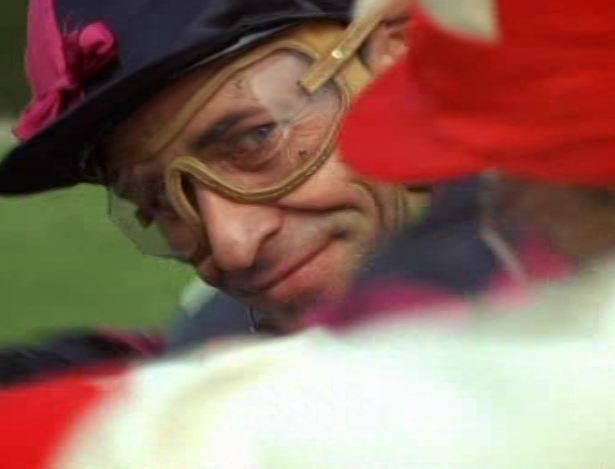


Grandpa pulls us on his lap and explains that candy cost a penny. He explains that there was no television. We have to understand these things first before he gets into his tale. Now, maybe he embellishes a little bit, but certainly through his telling we can hear and see and smell the details of his story about sneaking into the circus tent (or what have you).
Sometimes the best way to tell a story is to not assume your audience will appreciate it or understand it -- but help them to do so. It doesn’t necessarily talk down to them. If done the right way, it’s just holding their hand.
Handholding can be very comforting.


I love William H. Macy’s line, “I can take one comeback, but this is ridiculous. Who’s next, Lazarus?”

“Casey’s Shadow” misses the glorious and unabashed sentiment of “Seabiscuit” (2003), and “Secretariat” fails to really take the audience by the hand to appreciate the era of the early 1970s as well as “Seabiscuit” does with the 1930s. “The Story of Seabiscuit” (1949) has really only its archival footage of the great horse to recommend it.

I know I can accept it at face value, and not just because of this movie.
I remember the horse Secretariat and the huge thrill we got watching him win each race, one by one, of the Triple Crown. Anyone who recalls that will understand the Depression audiences who hunkered by their radios to listen to Seabiscuit tear down the back stretch.
Largely because of that memory, I’ll be watching the Belmont Stakes next Saturday to see if I’ll Have Another will be the first horse in 34 years to take the Triple Crown.
Please have a look at the other blogs participating in the Horesathon sponsored by My Love of Old Hollywood.

Subscribe to:
Posts (Atom)