Showing posts with label Thomas Mitchell. Show all posts

Thursday, August 8, 2013

Adventure in Manhattan - 1936


Adventure in Manhattan (1936) is a strange mixture, not always successful, but intriguing, nevertheless, of drama and romantic comedy—and stretches our ability to suspend our disbelief simply because it is both suspenseful and comedic.
The movie pairs Jean Arthur and Joel McCrea for the first time (they would later be paired together in the magnificent The More the Merrier– 1943, which we discussed here).  Some comments I’ve noted express disappointment that Arthur and McCrea fail to live up to the Nick and Nora Charles image in this movie.  That’s because they’re not Nick and Nora Charles.
I sometimes wonder if we are not too mired in genre to an extent that we cannot accept hybrid.  I find it very odd that an audience that can accept films of fantasy and science fiction and are able to suspend their disbelief under the implausible circumstances of these kinds of films, yet cannot suspend their disbelief watching a movie which simply has both dramatic and comic elements to it at the same time.  We struggle to paste one label or the other on a film.  Adventure in Manhattan is both, sometimes alarmingly so.
This week and next were going to cover two movies that deal with stolen art.  Unlike films about bank heists that show thuggish gangsters, theft in the art world always seems to be done by gentlemen, or at least devil-may-care scamps.  We are perhaps left with the fallacy that no one really gets hurt in art theft, and that it is more or less a high-stakes gentleman’s game, like polo without the horses. But crime is done, people do get hurt, there are consequences, and these two films show us the difference in genre and how we accept genre.
The movie we’ll talk about next week is Crack-Up (1946), strictly noir, and the gentlemanly art of stealing art shown as a world of dark shadows and grim postwar angst, psychological terror, and a really mean trick.  It stars Pat O’Brien and Claire Trevor, and they are not Nick and Nora Charles, either.
Both films have plots that hinge on a really mean trick.
Adventure in Manhattan is part 1930s with a little hint of 1940s noir thrown in, quite unexpectedly, and this is what is most tantalizing about the film—and most unbalancing.  It seems to be a precursor of what will come, but quite unconsciously.  It is not trend-setting; it is only experimentation.


Joel McCrea is a writer of crime stories.  He writes newspaper columns on real-life crimes and mystery novels about famous cases.  He is very successful, very much in demand, and very well aware of his gifts and his success.  He’s charming and so confident that he drives everyone else around him nuts.  He’s the kind of guy who does everything perfectly.  You want to see him mess up just once to see if he’s real.
A series of art thefts and jewel robberies has occurred, and we are told this as the film starts with several flashing headlines and the blare of police sirens.  We are in New York City in the middle of the Great Depression.  

Thomas Mitchell is a newspaper editor, the kind of crabby, shrieking, in-your-face-palooka who wants a feature story on the crime wave.  He hires Joel McCrea to investigate and to write purple prose on the crime spree.
“Involve a woman in it!”
He’s getting a little ahead of us.  But we can tell by the cast of credits that the only woman listed is Jean Arthur, so there’s going to be a woman in it, and the job is all hers.
I wonder if newspaper offices are to thirties movies as living rooms are to fifties movies?
Enter Joel McCrea, know-it-all, laconic, wearing his fame like a kingly robe.  He presumes to sit right down at Thomas Mitchell’s typewriter, still wearing his hat and begins to weave a tale.  (I recall a funny line in the old Mary Tyler Moore Show where the character of Lou Grant tells Mary about the good old days when he used to work in a newsroom, and he said that they were real newsman because they wore their hats in the office.)
Mr. McCrea takes a break from his masterpiece, and heads to the local bar the reporters hang out, where he grabs a beer and a cheese sandwich, and where his fellow journalists are playing pool. One of the fellows is a playwright, played by hangdog Victor Kilian, who we last saw with Jean and Thomas Mitchell in Only Angels Have Wings (1939).  The play he is currently writing will figure a great deal in the story, but we don’t know that yet.  And neither does he.
McCrea is smooth and confident and chatters about the latest robbery, which aggravates the other reporters who just can’t seem to get any leads.  McCrea acts self-superior, lecturing them, but it’s not just arrogance.  He really is superior.  He’s much smarter than the fellows and he takes the route of solving the crimes by what today we would consider a rather modern tactic: he uses profiling. He tries to get into the head of the man he thinks is behind these crimes.  McCrea, interestingly, plays his character like a charming egghead, who knows people’s psychology, but does not have the social skills to get close to anyone himself.  For all his intelligence, he is socially inept and doesn’t know it.
He plays pool and makes fantastic shots, never missing one.  When he leaves, Mr. Kilian remarks, echoing the other guys’ thoughts, “How do you live with a guy like that?”
Jean Arthur enters the story at this point, and her work in this film, as usual, is deft and many layered. We’ve mentioned before that there’s no one like her for playing along that thin knife edge of comedy and drama, of evoking great pathos, even tragedy, and yet still being able to shine a ridiculous spotlight on her character.  In this movie, her character might be considered all over the place by some viewers because at times she is very dramatic, and at other times she is doing screwball comedy.  We struggle to find what pigeonhole to put her in.
This is probably the same difficulty that early directors and the studio head Harry Cohn had with Jean Arthur, until the mid-thirties when she began to hit her stride, showing that she can do these unusual characters that flourished in the Depression era like nobody else. She’s not doing Nora Charles.  She’s doing Jean Arthur.
We first see her walking down a crowded city street.  She is bundled up to the neck in a plain unflattering raincoat and her cloche hat is pulled down close over her eyes.  Droplets of rain dot her hat and shoulders as she sidles up to people quietly, with anxiety and embarrassment, but desperate, she begs for money.
Joel McCrea sees her.  Neither he, nor the movie audience of the day, is surprised to see woman trying to quietly ask for change on a city street corner.  But his attention is distracted by an automobile accident close by.  We hear the screech of tires, a crash and everyone walking on the crowded sidewalks rushes to the scene of the accident.  We see that Jean Arthur moves through the crowd and tries to get close to Joel McCrea, because it looked as if he might have given her some money only a moment before and she doesn’t want to lose him. Instead, she gets up to him and then disappears.  When the chaos dies down, he realizes his wallet is missing.  He looks around and sees Miss Arthur walking quickly away.  She has taken his wallet.
 
She gets into a taxi.  He gets into another and utters that immortal line “Follow that cab!”
She gets out at a beauty salon.  A beauty salon?  We would have expected anything but this, and from this point on the next series of scenes is nothing like we would’ve ever expected to see. 
And culminates in one of the most shocking scenes I’ve ever seen in a movie of this era.
Bess Flowers is one of the beauty shop attendants.  At least she has to work in this movie and is not just some party guest this time.
He waits for her to come out of shop because he wants to follow her to see what she is doing with his money.  She emerges beautifully coiffed and in a dazzling white outfit.  She gets into a cab.  He forces his way in, and she is embarrassed and nervous and wants to stall him from going to the police.  He is cynical and disbelieving of her pleas for help.  He has every intention of turning over to the cops, but he is a student of human nature, and he wants to make her wriggle on the hook while he dissects her emotions.  He does not really care about her plight; this is only another psychological game for him.
She tells him that she had to steal the money, because she’s waited three years for tonight.  She has an appointment to see someone and begs him to give her only the next few hours and then she will go with him to the police.  He is dubious, but she invites him to come with her because he doesn’t trust her.  It’s wonderful to see Jean Arthur in these scenes because of her sensitive ability to seem so complicated and yet so transparent.  I can think of so many other actresses who would put a hearts-and-flowers spin on the scene, like an orphan in a snowstorm. Jean just looks very real and very uncomfortable, as if her own words are being dragged out of her, as if the very act of giving plot exposition is killing her.
She tells him that she is going to visit her ex-husband.  He was very cruel to her and they were divorced.  She fell in love with another man, and ran away with him, but she is now separated from that man, and she is alone.  She had a daughter with her husband and he kept custody of the child.  Today is her daughter’s fourth birthday, and she is going to go visit her.  She had asked her husband repeatedly to allow her to see the child, but he always refused.  Finally, tonight, he’s allowing her to see her daughter.  Jean tells Joel, “I couldn’t let her see me the way I was.”
Her damsel in distress routine is very genuine, but it does not move Joel.  He has told his reporter friends that they get too sentimental in their stories, they forget to be objective and that is why he is always able to solve crimes.  
They arrive at her ex-husband’s mansion and the butler answers the door.  The husband is there, pompous and severe.  He allows Jean Arthur to go visit her daughter, and tells her the girl is in the next room.  Jean rushes into the room, leaving the ex-husband and Joel McCrea to size each other up in the foyer.  We think that the husband probably thinks that Joel McCrea is Jean’s latest lover.
Okay.  You know this thing I have about always giving out spoilers.  I’m not going to go into detail about the mystery of this story, or who the guilty person is.  But I have to go into detail about this scene that’s coming up because it shocked the socks off me.  If you do not want to get the surprise, run away from this paragraph as if you are running for your very life from the bulls of Pamplona.
Are they gone?  Good.  Now we can talk in whispers.
Just as we are about to smile at the way Joel McCrea realizes he is being mistaken for “the other man,” we hear Jean’s piercing scream from the other room.  Joel rushes into the room and we get a quick, sliding close-up on his shocked expression.
Then the camera shifts to the interior of the room and we see a small white child’s coffin dimly illuminated in the dark room.  Suddenly this has become a Universal horror picture.  We look around for Bela Lugosi.  Jean is prostrate on the floor, crying. 

Joel leads her away.  The pompous ass of a husband says that the child died the day before yesterday, so there would be no harm for her to have her visit from her mother, now.  He has exacted his final, most-heartbreaking revenge on his ex-wife.
This scene will cause you to offer up your favorite exclamation of alarm and dismay, perhaps several times.  You may even need a drink.  I recall myself saying to the TV, "I can't believe they did that."
The discomfort this scene causes the audience is remarkable and may be one of the greatest reasons why some viewers tend to see this film as a failed Nick and Nora Charles, because so much of the rest of it is funny and lighthearted, with teasing banter between Jean Arthur and Joel McCrea.  But this scene stands out like a sore thumb.  It is too much reality shoved into a cozy little romantic comedy world.  It is not movie-melodramatic, the way you might see the coffin in a monster movie, because it is real, and because it is Jean Arthur.  She has such a real presence in her films.  She is the woman on the Depression-era streets.  She’s the shop girl.  The newspaper reporter.  She’s the noble, the indefatigable and the downtrodden common woman.  And yet she still manages to be somehow ethereal and above us, if only for the purity of her conflicting emotions.
The next scene finds Jean in Joel’s apartment, lying on his bed, and he revives her with a drink. She really looks ill.  She is not the swooning type, but she really looks like she wants to die and doesn’t want to say so.  Joel tells her that she will stay here for the night and asks if there’s anything else he can do.  With difficulty, she tells him that she would like to have her daughter’s ring.
Mr. McCrea, with the relish for revenge, and the first real flush of emotion we’ve seen him display so far, says that he is only too happy to go back and face her ex-husband.  We imagine he wants to sock him.
When he goes back to the mansion, it is dark.  There are no lights in any of the windows and when he approaches the door, a night watchman questions him and asks him to leave.  Joel tells him that he was here only a little while ago speaking with the owner of the house.  The night watchman tells them that the owner is in Europe, and that the tenant to whom he is renting the home is not here right now.  And he kicks Joel out. 
Huh?  Is this a ghost story?
Now we have a different mystery on our hands, quite apart from the jewel heist.  Joel McCrea, with his inquisitive mind and his stubborn nature, is intrigued.  He sneaks back into the house and walks around in the dark.  He finds the child’s coffin, which has been tipped over one end on the floor.  There is no body inside.
We have definitely entered creepy movie territory.  Joel is then accosted by man with a gun, played by Reginald Owen.  They exchange words, and they also exchange neckties.
Neckties?  
The man with the gun admires Joel’s tie, and Joel, attempting to be cute and to distract him because he’s pointing a gun, tells him he can have it, and so they trade ties.
Is the guy with the gun a crackpot?  Or have we just crossed over back into screwball comedy?
 
Suddenly the lights come on and people come out of the woodwork.  They are Joel’s reporter buddies with Miss Arthur in tow.  She is an actress in Victor Kilian’s play and some of the others are actors in his cast.  It was all a practical joke.
Jean Arthur is rueful, feels guilty, but thanks Joel for being gallant enough to come to her aid. We can see that he is embarrassed and sore about it, but he is a gentleman and a good sport.  He offers to buy everybody drinks, and this the beginning of his teaming up with Jean Arthur. 
We also have a foreshadowing in the scene of who the real criminal is behind the robberies, and very shortly, the film tells us point-blank who the bad guys are, so there really isn’t much of a mystery for the viewer.  From now on, the movie is about how Joel McCrea cracks the case, and a lot of that has to do with how he also plots to get back at Jean Arthur for her trick on him.  Both subplots are intertwined.
Victor Kilian’s play also has a lot to do with the case.  It is a World War I melodrama and Jean Arthur plays a kind of Red Cross volunteer or ambulance driver.  We see her in a kind of uniform.  She is a good actress and she is a lady, not a chorus girl.  Listen to her voice in this movie.  It’s slightly lower than her usual squeak, the quality of her voice that Edward G. Robinson once commented was like freshly grated peppermint.  There is something wistful and sad about her, as if she is still wearing the cloak of her many damsel-in-distress roles of the twenties and early thirties.  She made five movies in 1936, including the magnificent Mr. Deeds Goes to Town.  She was starting to come into her own and Columbia started to realize this.
Another movie she made in 1936, The Ex-Mrs. Bradford, was the real Nick and Nora knockoff, with William Powell, the real Nick, as her costar.  We’ll talk about that one sometime or other.
Adventure in Manhattan seems to start to get off-kilter from this point on, but mainly perhaps because Joel McCrea was trying to keep Jean Arthur off-kilter.  He sets the tone for the whole movie by playing small jokes on her to make her exasperated.  He invites her to the Ritz for lunch, but brings her home to his apartment instead, which he says he calls the Ritz and they eat beans.  She ends up having to cook them herself.  Reginald Owen shows up.  He is a wealthy man about town and is also the angel in charge of producing Victor Kilian’s play.  
When he shows up unexpectedly for lunch, they invite them to have beans and they sit there, eating their beans, trading banter.  We’re deep in screwball comedy territory again.  At one point Mr. Owen wanders into Joel’s bedroom to admire the valuable and artistic furnishings—Joel has an eye for art, which is probably why he’s so good at finding art thieves.  All three of them go Joel’s bedroom and eat their plates of beans.
A climactic scene occurs with a robbery during a live performance of the play in which Jean is performing.  She stumbles on the bad guys backstage, and drags Victor Killian to help her investigate, because after all, when you’re really in trouble, you go to the nearest playwright.  I can’t tell you how many times people have asked me to fight crime.  It’s really annoying.  I’m just sitting down to dinner, and they’re at the door, just because I write plays and I’m in the neighborhood.
The shift between scenes of extreme horror and extreme silliness make this film seem like it’s swinging back and forth on a pendulum and we don’t know what to think of it—but isn’t that the very essence of a mystery, a suspense story?  It plays upon what we were expecting and does not deliver.  I think the ultimate joke is played on us.  The audience, unlike Joel McCrea, are not always good sports.
Come back next Thursday for Crack-Up, where, again, all is not what it seems, and this nearly sends Pat O’Brien into a mental breakdown in a psychological post-war art mystery.  But it’s noir, so we don’t take offense if we’re caught in the middle of a shell game. That’s to be expected.

Monday, November 5, 2012

Mr. Smith Goes to Washington - 1939


“Mr. Smith Goes to Washington” (1939) has grown to legendary status. It represents an icon of 20th Century American popular culture. It stands tall among the giants of that pantheon of 1939 films. It generated great controversy at its release, but today, though it enjoys restoration and placement in the Library of Congress as a film of significance, it is perhaps seen in the soft nostalgic glow as just another example of “Capra-corn.”


Its simplicity is both its greatest dramatic asset and its singular fault among critics. That is the dichotomy of any Capra film. Paradox is the order of the day. Just a few examples:

This movie was banned both in Nazi Germany and the Soviet Union for showing the American democratic process in a positive light. However, this film was roundly criticized by Washington as showing senators in a negative light and the political process as being rife with corruption. They wanted it banned, too.

The movie shows corruption in Congress, but no political party is ever named. Claude Rains plays the senior senator, who has compromised his integrity for graft, and James Stewart plays the junior senator from the same state. We do not know with which party they are affiliated. We do not even know which state they are from, but since the story is partly based on a book which named Montana as the home state, the senator from Montana walked out on this movie at its preview at Constitution Hall in Washington. Many other senators were no-shows in protest.

Art reflects life, as we realize the main message of this film is the crime of arrogance. Politics is rife with it. Both political parties are guilty. Graft is graft, no matter who does it.

And it’s easy see how Capra both pulled away and exploited the combustible nature of politics in this film. We take politics personally. We cringe and get our backs up when we hear an opposing political viewpoint. That is human nature. How we behave about how we feel is what makes us ladies and gentlemen…or thugs.

Politics is also rife with idealism, sometimes pure and hopeful in its natural state; sometimes exploited in creative political ads meant to play on the emotions of the public and how well they respond to dramatic backlighting of a candidate in his shirtsleeves superimposed over a waving flag. It’s hokey, and it’s still being done. The arrogance of politicians in believing we are really that stupid.

Director Frank Capra was a conservative Republican. The scriptwriter, Sidney Buchman, was a Communist Party member between 1938 and 1945. Yet, they shared ideals and vision for this movie. (Buchman would be blacklisted in the 1950s when he refused to name names.)

Most of those shots of Washington buildings and monuments were taken on the sly; the United States Parks Service denied the filmmaker access.

One more paradox: despite this canon of idealistic films of Capra’s, “Mr. Smith Goes to Washington” is actually quite a dark movie, sinister and cynical. James Stewart is the only Pollyanna of the bunch, and by the end of the movie even he gets his teeth kicked in.

Long post ahead. You’ve come this far. It would be a shame to turn back now.

We begin the movie with that heartthrob Charles Lane as a reporter, holed up in a phone booth barking in his sexy nasal twang about the sudden death of a senator and the need for his state to send an immediate replacement.

Only a truly great movie would start the show with Charles Lane.

We learn right off the bat that Edward Arnold, the prototype of the greedy corporate thief, runs his state with an iron hand and a bottomless wallet. Guy Kibbee is the harried governor, who asks “How high?” when Mr. Arnold tells him to jump, much to the chagrin of his wife, Ruth Donnelly, and his large family of children. The kids suggest James Stewart as a replacement senator. Stewart runs the Boy Rangers (because the Boy Scouts of America didn’t want to touch this film with a ten-foot pole), and publishes a boys’ newspaper and recently heroically fought a forest fire.


Edward Arnold is great in this film, with his voice kept low and sneering. If he bellowed and blustered it would not be half so chilling as that snide, quiet confidence he displays.

One of the real delights of this film is spotting the character actors. Porter Hall and Grant Mitchell are senators, Jack Carson gets a couple lines as a reporter. Lafe McKee (who we discussed in this previous post) gets a brief, but iconic moment in this film when he stands before the Lincoln Memorial helping his little grandson to pronounce the difficult words in the Gettysburg Address, which is engraved in stone on the building.

As he says the word “freedom”, we get a shot of an elderly African-American man standing nearby, who has removed his hat in respect for Honest Abe. If this man is over 77 years old, he might have been born a slave. Politics is personal.

Eugene Pallette is on board as Edward Arnold’s right-hand man. Catch the scene where Pallette struggles to get his large body out of a phone booth. Dub Taylor, who we last saw in “Cowboy Canteen” (1944), is a wisecracking reporter who is part of a gang that interviews a bewildered James Stewart upon his arrival in Washington. You might even catch a glimpse of a young Craig Stevens as a reporter in the Senate chamber gallery writing fast and furious with a pencil.

Dickie Jones, the young Senate page who helps out Stewart, you’ve likely seen in many films.

Much of this movie, when it really works well, hinges on the magnificent Jean Arthur. Her performance is transcendent. She is secretary to Claude Rains, and has seen enough of Washington’s seamy side to stamp out any idealism she once might have had. As she tells Rains, “When I came here my eyes were big blue question marks. Now they’re big green dollar marks.”

She is assigned to babysit James Stewart, whom she first regards with eye-rolling bemusement tinged with disdain. Gradually, however, her own latent idealism is re-ignited under his slow-talking, sincere, nervous charm. He tells her about the beauty of his state, and his father, a small-town newspaper publisher who was murdered for standing up to a mining company, and how his father told him to look with wonder at life around him and “Always try to live as if you’ve just gotten out of a tunnel.”

She is moved, in spite of her own misgivings and fear of being duped. You can see all of that in her delicate expression, her sense of breathlessness, and we watch her falling in love with him. As we’ve discussed before, Jean Arthur had a remarkable ability to play pathos and comedy right at the same time. I can’t think of anybody else who could work as well at this deceptively complex role, with perhaps the exception of Barbara Stanwyck. Jean Arthur’s faith in politics and mankind is rekindled, and then dashed again as her heart is broken when James Stewart becomes the prey of Edward Arnold and his machine.

Stewart gets himself targeted when he proposes a bill, with Jean Arthur’s help, to create a national boys’ camp where boys from all walks of life, races and creeds, can come together. The land he chooses is the spot Edward Arnold wants and has been sneakily buying up under false names. Claude Rains, the “Silver Knight”, a respected senator who has been kept in office for decades by allowing himself to be Mr. Arnold’s stooge, must now crush James Stewart on the orders of his boss. He even dangles his society snob daughter, played by Astrid Allwyn, in front of Stewart as a diversion.

Jean Arthur, who knows all of this, is heartsick. One of her best scenes is in the press club bar with pal Thomas Mitchell, as she self-medicates her pain with booze. She and Mitchell also played confidantes that same year in “Only Angels Have Wings” discussed here. Frank Capra, quoted in Frank Capra-The Catastrophe of Success by Joseph McBride (Simon & Schuster, NYC, 1992), p. 417 - “I defy any other actress to play that scene,” Capra marveled, “She’s a great actress, much better than she knows. She made it believable with little things, like the way she tried to pick up her glass and didn’t know which glass she was picking up.”

During this scene she tipsily mourns sending James Stewart off to the Senate with a bill that was going to make him a target of the bad guys: “I felt just like a mother sending her kid off to school for the first time. Watching the little fellow toddling off in his best bib and tucker. Hoping he can stand up to the other kids.” It’s hysterical, and heartbreaking at the same time.

Though I think my favorite line is when Thomas Mitchell, in her apartment looking for stuff to mix cocktails, asks her where the bitters are. She replies absently, “In the thing there. Behind the thing.”

At her drunken scene, she accepts Mitchell’s longstanding marriage proposal as a way to escape Washington and the hypocrisy around her. In Jean Arthur - The Actress that Nobody Knew (Limelight Editions, NYC, 1997), p. 116 - author John Oller quotes Howard Hawks, who directed Mitchell and Miss Arthur in “Only Angels Have Wings”, remarking of Arthur’s work in this scene, “That was a beautifully-done thing.”

Jean is quoted explaining the scene, “The trouble about a woman being drunk is you have to be careful not to go overboard because then it’s not funny…A man can be awfully funny when he’s drunk but not a woman.”

Still a little drunk, she and Mitchell head back to her office so she can clean out her desk (her stuff, comically, includes a large rag doll). She runs into Mr. Stewart there, and vents her anger at him for being so gullible. She clues him in on the facts of life, how he is being used, and how the bad guys are playing him for a sap. When she marches out, she stops, as if overwhelmed by her own misery, and leans on the wall out in the empty hallway. Thomas Mitchells hovers by her, concerned. Her back to us, she sobs with her head against the wall and we see, as does Thomas Mitchell, that there will be no marriage between them, that she is in love with Stewart, and that she is hopelessly afraid for him. It’s wordlessly eloquent, all done with body movement.

Two more brief moments I love: When she sleepily awakes, still sitting in the Senate gallery to watch him below standing alone in the middle of the night during his filibuster reading softly from the Bible, “and the greatest of these is charity.” Also when she sends him a love note tucked inside a bound copy of the Constitution.

James Stewart grows up a lot now. He sees the corruption, confronts Claude Rains and tries to spill the beans in Congress. He is silenced when Rains pulls a fast one on him and accuses him of corruption instead. Stewart gets pilloried. Jean Arthur finds him, at last, with his suitcases prepared to leave town, sitting before the Lincoln Memorial at night, crying with that bewildered pain we suffer when people, whether it’s the kids on the playground, our coworkers, or our family, have rejected us.

Just as Jean Arthur was so perfect for her role, I don’t think any other actor would have done as well in his part as James Stewart. Capra had originally hoped to use Gary Cooper in an extension of his “Mr. Deeds” role, but that fell through. Cooper was great, and Jean Arthur loved working with him, had a crush on him, but Cooper’s innocent heroes had something yet sly and knowing about them. Stewart is completely at the mercy of his own unthinking exuberance.

Jean Arthur saves him. She coaches him through a filibuster from her perch in the gallery of the Senate chamber. It’s a terrific showdown, a gunfight with ideals and stubbornness rather than six-shooters.

As Stewart’s voice grows hoarse through the weary hours of his filibuster, Edward Arnold tries to spin lies in the press to their home state, telling the public only what he wants them to know, faster than you can say Fox News.

These scenes are where Capra, in another paradox, both captures the emotions of the audience but also loses believability when small newsboys on the side of James Stewart are used to convey the David versus Goliath aspect. I suppose it’s difficult to find imagery to support the nobility of the common man without getting hokey. It’s difficult sometimes for Capra, anyway.

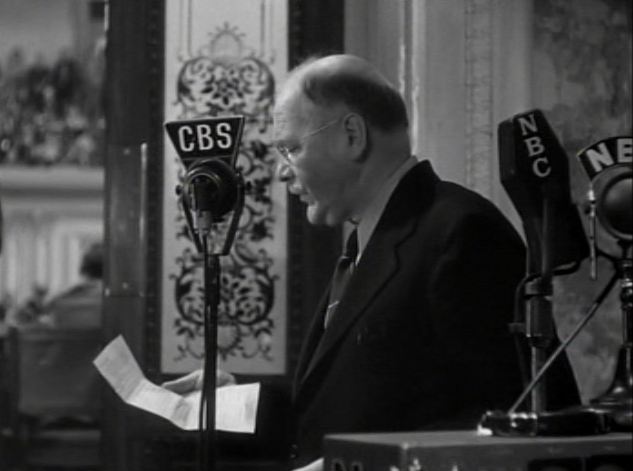
I get a kick out of real radio newsman H.V. Kaltenborn used here, standing in front of a mic, narrating the magnitude of the moment. Waxing eloquent with the few minutes allotted him in days when live news was in its infancy. Today we have hack media personalities -- I hesitate to call them journalists -- telling us about the latest poll or topic trending on Twitter. And the overuse by CNN of “breaking news” with asinine repetition to hijack our attention over topics which are neither news nor breaking.

Many of us remember a time when the announcement “Special Report” was given sparingly and only for really big news. Our stomachs turned when we heard it because it usually followed with the first reports of an assassination.

But Mr. Kaltenborn stands at his post, using proper English and trying to give the circus some dignity, instead of trying to turn something dignified into a circus.


The Senate chamber scenes are wonderful. A replica was created on the Columbia lot. The pageboy explains to Stewart, and to us, who sits where, and the history and significance of the setting. In many scenes, we may note that many of the desks are empty -- a silent gesture showing that our senators are not always on the job.

I love the shots of Jean Arthur in the gallery throwing signs to Stewart like a catcher to a pitcher to guide him through the filibuster process.

There is some strong imagery in the Senate chamber. We see Claude Rains and the other senators filmed from the floor to the ceiling so they look like giants. We see shots down from the ceiling at the menagerie of “senators” and extras looking small as they fill the room, a tight cluster of humanity. The arrogance of the senators when they turn their backs to Stewart as he speaks.

The climax is strangely quiet. Claude Rains directs the pageboys to carry in baskets of telegrams from an angry public denouncing James Stewart because of the lies they have been fed by Edward Arnold. It’s almost like that glorious scene in “Miracle on 34th Street” (1946) when the letters to Santa arrive. But these scraps of paper do not save Mr. Stewart. They condemn him.

He first looks heavenward, a Christ-like figure as if to say, “Why hast thou forsaken me?” Then he locks his gaze on Harry Carey, who is sublime as President of the Senate, smiling through his fingers as he tries to mask his bemusement at Stewart through previous scenes. He is a kind of craggy-faced Will Rogers type character whose eloquence is not in his quips, but in his expression.

Mr. Carey gives him a gentle smile of encouragement, and Mr. Stewart finds the will to continue despite it being a lost cause. James Stewart is triumphant in this moment, not because he has won, but because he has fought the good fight.

I find the ending is where Frank Capra loses us again in a saccharine solution. Claude Rains, overcome by his conscience, hysterically confesses his guilt. Convenient, but unlikely. We know too well that people in office rarely admit guilt. Especially if it would lead to a conviction.

Claude Rains is fascinating to watch in the film. He has a complex role and his evolution is just as important as Stewart’s or Arthur’s. He is a man of ideals who gave up most of them in order to survive in the Washington jungle.

Early on in the film, a banquet is held to welcome Stewart to political life, and Mr. Rains is surprised to discover that Stewart is the son of his old friend. He leans over the dais to spy Stewart’s mother, the lovely Beulah Bondi, who exchanges a look of fond reminiscence. Here is where we first see that Rains has an honest past, and this is where his struggle of conscience begins. He carries the burden through the film.

We see a lot of father-son imagery in the movie: between Rains and Stewart, between Stewart and his Boy Rangers, with the pageboy, between Harry Carey and Stewart.

The first time I went to Washington, D.C. as a young woman and stood in the visitors’ gallery of the Senate chamber, I could not help but think of how it looked in “Mr. Smith.” It was one of many trips. Washington, D.C. is a place I never get tired of visiting. One can feel cynical and still be inspired.

Despite its occasional hokey sentimentality, these are the real truths expressed in this movie. Jean Arthur reminds a disgusted Stewart that, “They aren’t all Taylors and Paines in Washington. That kind just throw big shadows, that’s all.”

Another truth is Claude Rains’ dismissal of the people voting him out when they learn of the corruption: “You can’t count on people voting. Half the time they don’t vote anyway.”

We get heartily sick of the nastiness of political campaigns, especially when they seem to last so long. But it is a good thing, I think, that we air our grievances so publicly and that other nations can see our anger and discontent. Because they also see that it all leads to election day. No coups, no hanging or shooting the opposing party when you’ve won and they’ve lost. The winners take office. At the end of the term, we vote again. Like clockwork. It’s that splendid confidence in our own system that drove both Nazi Germany and the USSR to ban this movie. It was our suspicion of our own leaders that drove Washington insiders to criticize this film at its premiere. Trust and suspicion, in healthy doses. A marvelous paradox Frank Capra didn’t create, but was clever enough to appreciate.

This movie, despite, or because of, its sentimentality has inspired many over the decades. It was one of my mother’s favorite movies, and she presented it to me as a kind of civics lesson. When the reporters rush from the Senate chamber shouting, “Filibuster! Filibuster!”, I recall my mother echoing, “Filibuster!” excitedly when I saw it the first time on TV, grinning, urging me to see what happens next. She was one of the most politically astute people I ever knew. Though neither of my parents were joiners of causes, they learned early the intimate place politics had in their lives when as children the programs like the CCC and the WPA created by President Franklin Delano Roosevelt saved their lives.

Growing up in poor families, President Roosevelt literally kept them from starving and gave them job training and hope for the future. They never took politics for granted after that. It was personal. The most important program in my house was the news. They devoured news magazines and newspapers, and we watched conventions like some people watched the World Series.

When they got ready to go vote, my father shaved. My mother put on makeup. Reading glasses, check. Notes on specific ballot questions, check. They announced with almost theatrical dignity, “We Are Going to Vote,” as if they were about to save the world.  Being able to vote gives you a great sense of power.  Ask anybody who can't.

We were to be good until they got back from saving the world.

I am voting tomorrow because that is what I was raised to do. Because my mother loved “Mr. Smith Goes to Washington”. Because my mother, rest her soul, who never had a driver’s license or a passport, were she living today would be denied the right to vote by some politicians who are aching to get a whip-smart, no nonsense liberal like her off the books.

And because like James Stewart in the movie, I get all choked up when I visit the monuments in Washington, D.C.