Showing posts with label Martin Ritt. Show all posts

Monday, May 21, 2012

Secretariat (2010) & Casey's Shadow (1978)


This week we’re going to talk about horses. Four movies, three horses, two blog posts, and one blogathon. More about that later.

In this season of thoroughbred horseracing where every two weeks we have another event -- the Kentucky Derby, the Preakness Stakes, and coming up, the Belmont Stakes -- most of us follow these events on television. I watch them every year, mainly because of the excitement that I still remember as a child watching one horse called Secretariat win each one of them, one by one.

I was reminded of that thrill several months ago when flicking channels I caught a few minutes -- only a few minutes -- of the film “Secretariat” (2010). I want to say it was more than the rush of nostalgia that came over me for those days, but I really had the strangest feeling of time travel and being in the moment once again. It had something to do with the race announcer shouting his incredulous superlatives at Secretariat’s speed, and partly having to do with the frocks and neck scarves of Diane Lane, but for a few moments I was there. That’s where the idea for this series began.

Horse races take only a couple minutes, but reading this post is going to take up your whole lunch hour. Another Long Post from Another Old Movie Blog.

This two-part series is about a sense of personal nostalgia, but also the way the movies take this idea of nostalgia and use it as a device for storytelling. We’ll be comparing films made in particular eras -- in this case the 1930s/40s and the 1970s -- and contemporary films set in those eras which always tends to clean up the past a little. We remember things a little brighter than they were.

We’ll be talking about horses insofar as how we project our thoughts and our feelings and our greatest desires upon them. The horses here are champions, and we like to think they like to be champions. But, despite all the horse whispering that goes on, we really don’t know what they think. We love them, and we manipulate them.

Today we’re going to discuss “Secretariat”, and “Casey’s Shadow” (1978) that take us to the 1970s. Friday we have “Seabiscuit” (2003) and “The Story of Seabiscuit” (1949) that take us to the 1930s. We’ll conclude on Friday, rather than the usual Thursday post, so we can latch onto the horse blogathon sponsored by Page over at My Love of Old Hollywood.

Secretariat and Seabiscuit were real horses. Casey’s Shadow is a fictional character, and that film is based on a short story by John McPhee that was originally published in the New Yorker magazine April 29, 1974. It is about a real race, however, the Ruidoso All-American Futurity held in New Mexico, which is called the richest horse race in the world. Secretariat and Seabiscuit were thoroughbreds, but Casey’s Shadow is a quarter horse, which excels at shorter races under a quarter of a mile. It is the most popular breed of horse in America, and they can be found anywhere from racecourses, to working ranches.

We hear a lot about breeding in these movies. Breeding, and training, and heart, a sense of courage in the horse, and the jockey, and sometimes in the owner. There’s also lot about money changing hands.

When Secretariat won those three important horse races in 1973, the Kentucky Derby, the Preakness and Belmont which together are called the Triple Crown, he was the first horse to do it in 25 years. (At this time, I’ll Have Another just won the Preakness, and so with a Kentucky Derby win already under his belt, he may be the first horse in 35 years to win the Triple Crown. We’ll have to wait and see next weekend. The last horse to win was in 1978. There were three winners that decade.)

Secretariat became a rock star, featured on magazine covers and the talk of everyone everywhere. Even for those of us who grew up in suburbia and had very little contact with horses knew his name. Children sped on their bikes down the street pretending they were riding Secretariat.

The early 1970s was an age where sports heroes began to take off in popular culture. I’m not sure if it was because of the disillusionment with Vietnam War, Watergate, or the general cynicism that began to creep into our society, but we looked to sports for heroes, and they came by the bushel full in the 1970s. Tennis stars became household names, and Muhammad Ali of course, and baseball players began to garnish fabulous salaries. The Super Bowl started becoming an event in popular culture and not merely a sporting event, giving birth to the Super Bowl Party and the end cap display of nachos in grocery stores. Sports moved from the back page of the newspaper to the forefront of our consciousness.

And then there was the mighty Secretariat, no less a hero because he was a horse.


“Secretariat” (2010), put out by the Disney studios, carries that familiar tone of Disney films as a feel good movie. The early 1970s looks cleaned up a bit, and some of the dialogue with “feeding” lines and clichéd keep your chin up speeches sounds a bit clunky here and there. Still, the movie catches enough of a flavor of the era to remind someone who remembered it firsthand of the excitement of that horse’s victories.

But I’m not sure it packs enough of a punch to instill this sense of understanding for someone too young to remember. “Seabiscuit”, which we’ll talk about on Friday, does.

When we are young we soak ourselves in popular culture: TV, music, commercials, everything is grist to the mill of our development. The older we grow, the less influenced we are by popular culture, the less we even care about it.

It is a true story of owner Penny Chenery Tweedy, a woman in a male-dominated sport -- the sport of Kings. She is a Denver housewife and mother of four, whose father owns a horse farm in Virginia. She grew up in a world of orderly stables, green pastures set off by neat white fences, a grand house with a dark paneled den laced with photos of horses on the walls, and shelves and mantles lined with trophies. Her elderly parents die, and she must dispose of their estate. Her brother, who is a university professor and has no interest in the horses, wants her to do this quickly. He fears a six-million dollar estate tax. We should all have such worries.

But she does care deeply about the horses and her family heritage. Mainly from sentiment, and being her father’s girl, she plays hooky from housework off and on for the next three years and raises a new colt, putting off the sale of the farm until she can race him. Diane Lane plays Penny in a warm and sympathetic manner. She is gutsy, but every inch a lady, a southern gentlewoman -- with no trace of Virginia in her speech -- who is trying to be supermom to everybody. She is full of pep talks, and a little horse whispering.

We are involved more with the people around Secretariat than the horse. John Malkovich plays the French-Canadian trainer who dresses colorfully and speaks colorfully, and lapses into French when provoked. He’s a thin-skinned bundle of neuroses, a great character to play. Though he occasionally berates the jockey, he wishes him “Bon chance” when he mounts to ride.

I think my favorite is Margo Martindale, who plays Elizabeth Ham, the secretary to Diane Lane’s father, whom Miss Lane has also inherited. Martindale gives Eve Arden a run for her money in the supportive and wisecracking friend category. It is she who gives Secretariat his name.

Fred Thompson and James Cromwell are among the wealthy gentlemen horse farm owners who cross paths with Diane Lane, and Nestor Serrano as a less genteel rival.

We get snatches of Miss Lane’s family life, her ersatz hippy daughter (though to be fair, most teens in the late 1960s and early 1970s if they aspired to the hippy counterculture really were ersatz, only playing at the game), and her lawyer husband who wants his wife home and out of the horse business. After a few wins and some feel good speeches, her husband comes around and the kids see what a great mom they have because she’s doing her own thing, which is groovy, and being successful at it, which is groovier still.

A cute bit where she and Nelsan Ellis, who plays the groom, Eddie Sweat, wash the horse to the background of “Oh, Happy Day”. This is reprised at the very end of the film when we see the final burst of glory that the amazing horse gave when he won his third race, clinching the Triple Crown.

He rounds the final turn. Along with a reprise of Lane’s voiceover of the Book of Job (39:22) which introduces the film -- “He laughs at fear, afraid of nothing...he cannot stand still when the trumpet sounds…” -- we get the joyous burst of “Oh, Happy Day” and that magnificent horse wins, just as he did in 1973, by an astounding 31 lengths. His speed records at the Kentucky Derby and the Belmont still stand.

I especially like that the end credits give us cameos on the what happened to the characters (though they do not mention Penny Chenery Tweedy’s divorce the following year from her husband), and show the real Penny, an elderly, but still spirited lady, sitting as an extra in the stands.

The crowd scenes in these movies show how important these shots can be to the tone and “reality” of a movie. In “Secretariat” the crowd scenes are shot very tight, in small groups. After all, hiring numerous extras and CGI are expensive. To maintain “1973” we have to shoot carefully chosen setups with a small group of actors in appropriate costumes and hair styles. The crowd scenes in “Secretariat” feel very tightly controlled. They seem stagy.

The horse racing scenes of necessity must be controlled, but this is done fairly well. We get our share of thundering hoof beats and panting, snorting horses, though most of the drama in the movie is centered on Diane Lane.

Among Penny’s speeches: “Our father came from nothing. And his legacy to me isn’t money. It’s the will to win, if you can, and live with it if you can’t.” A fine and sensible legacy, but her brother wants none of it, “If you stumble and fall, you don’t just make us fools, you make us beggars.”

And her husband, played by Dylan Walsh, “When your horse people call the house they don’t ask for Mrs. Tweedy. They ask for Ms. Chenery. Is that who you’ve become?”

We may have grown tired of the chauvinist streak in characters who today sound like cartoons for doing it, but we have to remember that the women’s movement was in its early days. His sentiment is genuine. What did not sound genuine to me was a reporter’s marveling at another horse “turning in awesome workouts,” and her daughter commenting on seeing Lane on TV, “Mom looks awesome.” This was years before we turned “awesome” into a meaningless word parroted with unrelenting foolishness.

She should have been "far out".

A favorite shot: when a little girl takes Secretariat’s picture. She’s holding one of those 110 Kodak cameras with the flash bar on top. How many of you had one of those?


“Casey’s Shadow” (1978) is both brisk in its 1970s reality -- it was after all filmed in the era it depicted so there’s nothing artificial here -- and strangely lulling in the direction of Martin Ritt, who takes us on the journey of another horse to both victory and tragedy, and dealing with each with a shrug. There are no platitudes here, and this is not a “feel-good” movie. There is humor, tinted by the 1970s cynicism that grew even stronger the farther we get away from the sight of Diane Lane in her formal gown, complete with opera gloves, talking to her horse.

The pace is slow -- the movie’s pace, not the horse’s -- and this reflects the original short story, which is quite long and leisurely. Movies are not made this way anymore, and neither are short stories. Our attention span has taken a hit in the last 30 years or so.

The story is set in the back Cajun country of Louisiana, where Walter Matthau plays a horse trainer, who drifts in and out of his Cajun accent, and sometimes goes by the nickname of Coonass.

His wife has left him. We don’t know exactly when or why, but he seems little disturbed by it. The youngest of three boys, Casey, mopes about and gets into trouble with great regularity. Casey needs somebody to look out for him, and Papa Walter’s not doing the job.

Neither Casey, played by Michael Hershewe, nor his middle boy, have southern accents, though his eldest son, Buddy, played by Andrew Rubin, does attempt one.

Rubin is good in his role as the 20-something lad following in his father’s footsteps as a trainer of quarter horses. Happily for the family, he has a far greater sense of responsibility than his dad, and Buddy is one who looks out for Casey, and tries to get meals on the table. He warns his father there is no food in the house. The gentle young man bears the weight of the world on his shoulders. He blows his stack when the others do not do their chores and the house looks like a pigsty.

Actually, pigsties are neater than their tumbledown house. No neat white fences here. Both the house and the barn look like they’re about to fall down.

In “Secretariat” we are introduced to the idea of breeding through sires and dams, and how important bloodlines are to determine not just the health of a horse, but the spirit. We get more lessons on breeding in “Casey’s Shadow”, but not just about quality horses. What makes a quality human is also explored.

Alexis Smith plays Sarah Blue, a southern gentlewoman who owns and breeds champion quarter horses. Breeding quality is her mantra. Unlike Diane Lane, Miss Smith manages a credible soft southern accent. But, we do not see her even once in opera gloves. First, because we are in the late 1970s now, and styles changed with alarming swiftness. Elegance has been replaced by leisure suits. This I remember, too, from childhood.

Second, Sarah Blue is a hands-on owner. She has a reputation for sometimes sleeping with her prize horses in the stable, and spoiling her favorite horse with Milky Way bars. Smith makes her entrance in the film riding on a horse, accepting with dignified nods the men who respectfully call out, “Mornin’ Miz Blue” to her. She had made many “slinky walk” entrances in movies, but never on a horse. In her jeans and cowboy hat low over her eyes, she looks like a cross between Queen Guinevere and Paladin.

Another difference that distinguishes her from the dainty Miss Lane is a surprising yuk, yuk, yuk chuckle that sounds like Mortimer Snerd. At first I thought she meant to inject the flavor of cornpone in her character, but then it struck me that possibly this was close to how Alexis Smith really laughed.

Director Martin Ritt, whose “No Down Payment” we covered a few weeks ago, had a style of direction that leaned toward introspection and a natural feel for his characters and setting. “Casey’s Shadow” is shot with this leisurely sense of a natural setting, there is very little manufactured drama in terms of camera shots or lighting. Indeed, most of the film is shot outdoors.

Alexis Smith’s performance in this movie is probably the most natural and unaffected she ever gave, so it stands to reason Ritt would allow Smith’s own ridiculous laugh to rip out of her.

In his “Everything Was Possible - The Birth of the Musical ‘Follies'” (Alfred A. Knopf, NY, 2003), author Ted Chapin called Smith’s laugh a cackle. Columnist Louella Parsons referred to “…that devastating laugh of hers,” (syndicated in Milwaukee Sentinel, May 27, 1948). “I haven’t known a girl to laugh like she does since Carole Lombard.”

I also got a chance to hear a clip of a 1980 radio interview where she does, indeed, rip out a maniacal giggle in between intelligent and ladylike remarks. It seems this was a goofy side of her Warner Bros. decided not to show in their carefully groomed ice princess.

Smith has the job in this movie of being the moral counterpart to Walter Matthau. He falls from grace big time, and his own code of ethics, which is simply, “Never run a hurtin’ horse.”

But he is only human, and greed is a very human failing.

Eldest son Andrew Rubin comes home with a new horse for their boss, Calvin Lebec, played by Harry Caesar. Mr. Caesar is at first disgusted because he wanted Rubin to buy a nice young colt to race, but what he came home with was an old mare. However, like Jack, who sold the cow for some magic beans, there’s a hidden opportunity here. The mare foals, and the colt that is born is the son of Alexis Smith’s famous champion horse.

In quarter horse breeding, artificial insemination is allowed (it’s not in the breeding of thoroughbreds), and through some shady deal, the semen is sold without Miz’ Blue’s control. And when it comes to breeding her horse, she is a bit of a control freak.

She hears about the young colt, and comes to buy him, but Walter has his own plans. He wants to take the colt, called Casey’s Shadow, to the Ruidoso race in New Mexico and win, and go to Tahiti “where the women don’t wear no tops.”

They strike a deal where she can buy the colt after the big race.

But events conspire to challenge Matthau’s single code of ethics: “never run a hurtin’ horse.”

First, Casey, who roams backwoods race courses looking for someone to con and beat at pool or matching pennies -- he is his father’s son -- twice injures the horse in foolish demonstrations and a race for money. Walter’s ready to kill him, but we begin to see it’s not just because the boy has done a cruelty to the animal; it’s because the animal is their fortune and the kid is blowing it.

As much as we want to throttle Casey for his shiftless and thoughtless behavior, the little boy also breaks your heart. His mother ran out of him, and his adored older brother Buddy will go away soon because Alexis Smith has hired him to be her new trainer. A rival trainer kills his pony (accidentally -- he had intended to kill Casey's Shadow).  Everybody leaves Casey. Walter pays little attention to anything but his beer.

By the way, though we watch the colt grow to a big, strong horse, the boy stays the same size over a period of two years. I think we’re not supposed to notice that.

They patch up the horse and he’s sound enough to run. They truck him from Louisiana to New Mexico in a horse trailer pulled by Matthau’s broken down pickup. Casey’s Shadow wins a qualifying heat. They’re one step away from going to Tahiti.  Where the women don't wear no tops.

But the horse hurts his leg. He’s limping a little bit. If Walter pulls out of the finals, Alexis Smith will still buy the injured horse. They’ll get $50,000 just for not running him. Walter will lose nothing.

His sons do not want him to race Casey’s Shadow, and neither does owner, Harry Caesar.

Walter is obstinate. He tells them, “This horse is my only chance. You see Sarah Blue offer ME a job, or Ted Patterson or anybody?”

He tries to explain his shift in values.

“I had my beer, farm, you kids. Seemed like enough to me. More than enough…then he come along.” He wants to, “Get my name in the record books…right up there along with Sarah Blue and God. I know it’s wrong to run a hurtin’ horse, Buddy, but I got to do it.”

Alexis plays high stakes, but the money means little to her. I wanted to know more about her character. Is she married, widowed, divorced? Does she have children? We see only that she is a woman of few words, runs her racing stables alone and does not seem to have the difficulty Diane Lane did of being a woman in a male-dominated sport.

When they saddle up the horses for the big race, Matthau and his team are stoic, all business, tightening, fastening, poking and prodding the horse like he is a boxer in the locker room getting ready for a match. Alexis Smith, however, combs her fingers through her horse's forelock, wipes his face, runs her hand over his eyes, carefully slipping on the blinkers, looking like she is dressing her child for school.  Any minute you expect her to lick her fingers and smooth down his hair.  She smiles at him.  Her pride and joy.  One senses she is simply more comfortable with horses than people.

When she sits in Walter’s pigsty of a kitchen talking business, she does not bat an eye over the mess around her. When his eldest son, in an endearing gesture, nervously plunks down what looks like a plate of Oreo cookies for their guest, she snatches one when she leaves because a real lady fits in anywhere.

Buddy is very careful about standing and taking off his hat in her presence, but he needs to remind Walter to do this. Walter sometimes does and sometimes doesn’t. Especially when he’s drunk.

Matthau’s character is laconic, and larger than life despite his low-key amusement at hustling suckers at country racecourses. He is incorrigible, lovable somehow despite his lack of grace. But when this choice comes up that he has to make -- race an injured horse or not, this is where we determine the kind of man he is.

He races the horse.

The crowd scenes that show the limitations of filming in “Secretariat” here are grand shots. The cameras are brought to actual race days at Ruidoso, so the enormous crowd of onlookers are not actors. They are natural, in their own clothes and habits, paying attention or not paying attention, gabbing and drinking. We see people laying down their money at the betting booths, and scooping it up if they win. We hear the loudspeaker announcements. It’s like a documentary about racing.

It’s very absorbing, except for the scene where Casey’s Shadow wins the race and we see Walter Matthau hoot and holler and run onto the track. I couldn’t help but think of him as a movie star who plays a scene in front of a crowd who were told by the announcer, “We’re going to hold the sixth race for a few minutes so a movie can be shot. When Walter Matthau runs across the track, everybody cheer and clap.”

It looks artificial despite its ironically very natural setting.

Just like John Malkovich wishes, “Bon chance” to the jockey in “Secretariat”, Walter and Buddy wish “Bon chance” to the middle son who is the jockey on Casey’s Shadow. We never get to know much about him, except he’s girl crazy.

Then, after the jubilation of the win, they discover the horse is lame. For good. The vet recommends he be euthanized.

There’s no real loss here, in business terms. Alexis Smith will not buy the lame horse now, the deal is off, but she is not disappointed about that; there will be other horses. She is angry because Walter willingly destroyed a horse for his own personal gain.

“You knew this would happen,” she says. He did. It was never a matter of IF the horse got permanently injured. He knew it would be.

The horse is no longer needed now the race has been won and Walter's got the money and his name in the record books.  The animal is disposable.

His sons are disgusted with him, and the younger ones want to go with Andrew Rubin to his new job as Alexis Smith’s trainer. She takes them all in.

The last we see of her is when the boys are clambering over her horse trailer and she pokes Casey in the belly saying, “Welcome aboard, cowboy.”  We never get to find out if she turns into a surrogate mother.  Walter comes to apologize, and tells them that he has spent some of the winnings to get the horse an operation on his leg.

In the final scene, the boys go home with their father. Blood may be thicker than water, but one can’t help but feel they’d be better off with Miz Blue. She runs a tight ship, and they’d get three square meals a day with her.

Walter’s paying for the horse’s operation is not entirely altruistic. The horse will never race again, however as a champion it will earn high stud fees. No loss. Except to the horse, perhaps, who now must endure a long, painful ride home to Louisiana and perhaps pain the rest of his life. We don’t know.

We only see lovable scamp Walter Matthau and his three aimless boys going home together. It should be enough, and it’s not, even though these are the cynical years of the late 1970s where the kind of platitudes we see Diane Lane spout are too unrealistic, perhaps too embarrassing to hear anymore.

Perhaps this is what made an otherwise interesting film founder at the box office.


From a review by Robert H. Newhall syndicated in the Bangor Daily News, March 27, 1978, “…as a father he is a cipher, for he gives his sons no direction, no uplift at all…it is difficult to warm to Matthau.” He has kinder words for Smith, “As this upright woman, Miss Smith, always a Junoesque beauty, brings a class to the screen that is sadly lacking these days. Even in her small role, she is credible, giving the film an affirmative bias.”

Alexis Smith, interviewed by Ed Blank of the Pittsburg Press December 17, 1978, noted that she enjoyed working with Walter Matthau and admired Martin Ritt, “He brought out really human qualities in all in all of us. It was one of my best working experiences.”

In the New York Times of November 11, 1978, she noted that there were three directors in her film career from whom she felt she learned the most. These were Edmund Goulding, who directed her in “The Constant Nymph” (1943) see this previous post here, Frank Capra, who directed “Here Comes the Groom” (1951) see post here, and Martin Ritt of “Casey’s Shadow.”

I get a chuckle out of the ice princess, clad in jeans, strolling into a crowded bar for a business meeting to the background sound of “Ramblin’ Man” by The Allman Brothers Band.

TCM is showing “Casey’s Shadow” Friday, June 1st at 8:00 a.m., if you want to have a look. Let me know what you think.

Come back Friday for more horse racing, and two very different movies about the same famous champion, Seabiscuit, as part of Page’s Horseathon.




Monday, April 30, 2012

No Down Payment - 1957


“No Down Payment” (1957) is an unblinking, fly-on-the-wall look at 1950s suburbia. This depiction has a sharp and beguiling quality of self-awareness, which one senses was careful and deliberate. There are issues raised, but no real messages that are not tempered the by the characters’ helplessness to be anything other than what they are.

The very examination of suburbia as a topic might be considered dated, as dated as the copper Jell-O molds on Sheree North’s kitchen wall, but the outlook of the movie is bravely modern. In some respects, issues discussed here, like the precarious financial balancing act in a credit-powered economy, are still strangling us today.

Long post. Spoilers ahead.

Just about four years ago we covered the movie “Strangers When We Meet” (1960) here. I wish I had known about “No Down Payment” at the time I wrote about that movie, because they would have made great companion pieces. They are both about suburbia in Southern California, the car culture, a young post-war population coming of age as the 1950s “Silent Generation”. They also have in common the actress Barbara Rush. In “Strangers” she plays the wife of Kirk Douglas, a woman comfortably settled in her suburban kitchen, but ambitious for her husband to excel and obtain even more for them. She is devastated to learn of his extramarital affair.

In “No Down Payment”, Barbara Rush is the more settled wife of Pat Hingle, who is a more modestly successful owner of an appliance store. They appear to have a happy marriage, though not without stress. The two movies have a couple of important differences, however. One is that “Strangers” is in color and has a more glossy look to it, a more soap-opera storyline. It is focused more tightly on the extramarital affair of Kirk Douglas and Kim Novak. The other characters are like satellites that bounce off their relationship.

“No Down Payment” was directed by Martin Ritt, who had a particular knack for introspective films. He was one of those directors who ran up against blacklisting in the 1950s (a couple of the screenwriters on this project were blacklisted), and we'll be covering at least two other Ritt-directed movies this summer.

This is an ensemble piece. The acting is very good, and the writing is excellent. It has a quiet, black and white look, and being the earlier picture by three years there is a less cynical view of the suburban jungle. However, the examination of this world is refreshingly straightforward, and manages to take what is a familiar landscape a turn it into a strange new world. The so-called Silent Generation may have been less political and more secretive about its anxieties, but we can see that there was a lot of self evaluation going on.


The film begins with a shot of interstate highways all forming a tangle of knots on which the flow of traffic is never ending. Jeffrey Hunter and Patricia Owens are a new a couple coming to live the in a housing development called Sunrise Hills, which is advertised on a billboard as “a better place for better living”. A moving van follows them. I love how they pass several billboards for several different kitschy-sounding housing developments, all promising bliss.

He is a young engineer, she is an attractive young wife for whom being an attractive young couple is very important. The veneer is what appeals to her.

It is Sunday, this moving day. They drive by a modern-looking church where the homogenous congregation, their new neighbors among them, file out into the morning sunshine. Mr. Hunter and Miss Owens beam at each other. Truly, they have come to the promised land.

Pat Hingle and Barbara Rush are solid, steady, nice people, who introduce our first set of cracks in the veneer of Sunrise Hills. Miss Rush brings their children home from church, annoyed to see Mr. Hingle washing their car where everyone can see him. He does not attend church with them and his son wonders if his father is going to hell.

Another couple is played by Tony Randall and Sheree North. He is a used car salesman. They have one son. Tony Randall is a man deeply dissatisfied with his luck, who wants to be Somebody, meaning Somebody Rich. He cares nothing for real achievement but wants the glitz and the gloss as fast as possible. He is also a charming and irritating alcoholic. Mr. Randall is a marvel in this movie. His work here is excellent. He is a desperate extrovert and a tragic loser, still possessing his comic vulnerability of the characters he played in Doris Day movies, but here it takes a darker spin.

Randall’s money troubles are a major theme for the 1950s suburban couple and hence the title of the movie.

“No money down. Nothing to lose. Just change your name. Go away. Hide. Quit your job. And the finance company will never know where you are…. We’re only 25 years in debt.”

Pat Hingle affably consoles Hunter on the worry of a mortgage, "Nobody in this housing development is allowed to own a home they can actually afford."

And these houses are cracker boxes.  What would they have thought of today's McMansions?

This is meant to be humorous party conversation but there’s also a very strong indictment against the new 1950s economy, which has implications today. Jeffrey Hunter, the new guy on the block, marvels “Twenty years ago none of us could have afforded a house like this. I think we were born in the right time.”

Pat Hingle has another viewpoint, maintaining that the Greatest Generation was perhaps the generation behind the eight ball. He talks of their youth of poverty, of going on relief in the Depression, “I don’t call that being born at the right time.”

But he concedes, “I guess we do have more security than our parents ever had,” and, “there’s not many guys that have to sweat for a living, not anymore, not in the States.”

Jeffrey Hunter, a GI-Bill college graduate is involved in automation, a science which involves inventing things to make fewer employees necessary, and about which he feels guilty. That is his cross to bear. He will have others before the film is over.

He fixes Tony Randall’s son’s radio, pulling out a screwdriver from his inner suit coat pocket -- must be a trait of engineers -- and tinkers with something magical called a transistor. No microchips yet, but we’re getting there.

We old movie buffs love to watch classic films as an insight to a particular era gone by, but most of these films, whether it’s a movie about the 1930s or the 1940s or any era, are not self aware or self-conscious about that era. When Buster Keaton chases a streetcar he is not saying to the camera “look -- it’s the 1920s and there are not going to be streetcars in another 20 years.” “No Down Payment” is totally, deliciously conscious of its era. It’s almost as if they are picking things out of the air on purpose and putting them in the box and saying, “This is what we’re going to seal up in a time capsule to tell people what we’re like in 1957.”

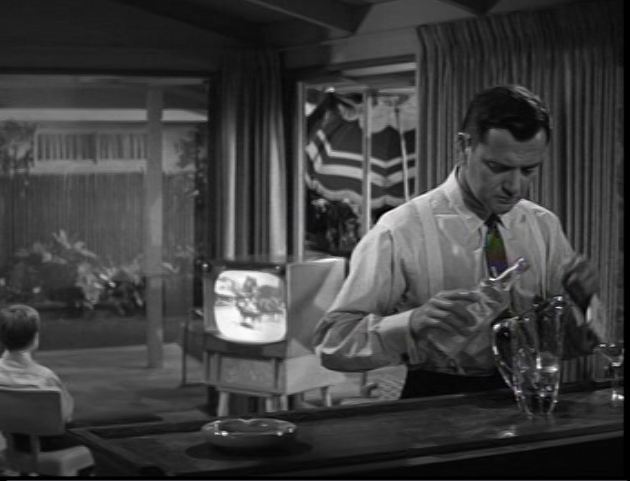
The floor plan in the houses is identical, right down to where they choose to put their television sets. Their children sit in front of the TVs like zombies.  Ten years later they will "tune in, turn on, drop out," but that zen-like self indulgence and self absorption all began cross-legged in front of the TV when they were kids.

Tony Randall spends money he does not have to buy his son a bike, because every new thing his son gets is a trophy to announce to others his own success.

The wives welcome the new neighbors with the manta that their development is a “A great place to raise children.” It truly is an incubator of sorts.

When Hunter and Owens tour the empty rooms of their new home, which is situated cheek-by-jowl with other houses on the street, they see the last couple of the group, played by Cameron Mitchell and Joanne Woodward -- through their large windows, cuddling in their bedroom. The scene reminded me of a passage in William Manchester’s narrative history of the 20th century, The Glory and the Dream (Bantam Books:NY, 1974) p. 782 - “Picture windows became windows for looking in.”

Much later in the movie, when preparing for bed, Patricia Owens meticulously pins their bedroom drapes closed.

Cameron Mitchell and Joanne Woodward are, in a sense, almost for what passes like the “wrong side of the tracks” couple in this housing developing that has no tracks and therefore supposed to be egalitarian. They are both originally from Tennessee and came out to Southern California during the war. (Tony Randall even teasingly refers to them as Daisy Mae and Li’l Abner.) Mitchell is a highly decorated World War II vet, who saw action in the Pacific theater. He runs a gas station in their community, but he has ambitions to be their village chief of police.

At home, he fills the walls of his garage with his memorabilia from the war, Japanese flags and swords and his medals pinned to a board. He misses being in uniform and having authority. Joanne Woodward displays again her remarkable facility for displaying a character almost as if she were a holding up her adopted personality like glass ball and we can see right through it all sides. Her ability to thoroughly crawl into the skin of her characters might make her a candidate for being called the Meryl Streep of her day. Except that I think Meryl Streep’s process for developing a character is entirely cerebral, whereas Joanne Woodward’s seems to be an intuitive and playful sense of the emotional palette of her characters.

Her character has no children, desperately wants children, and is so much like a child herself, the babysitter of the children in the neighborhood. She is bouncy, joking and goofy. Like her husband she has very little education, and like him, she is sensitive about that. She is delighted that the upwardly mobile and beautiful Patricia Owens befriends her. She feels unworthy. We are told that she had a child before they were married, but at his insistence she gave it up for adoption. We later discover that he believed that the child was not his.

When we first see them, they appear happy with each other, but later on his dissatisfaction with his life manifests itself into dissatisfaction with her.

The new neighbors are introduced at a barbecue, the suburban tribal ritual. The men check out each other’s wives, and check out each other’s wartime service.

A subplot to the movie involves one of Pat Hingle's employees named Iko, played by Aki Aleong. Like the other men in the neighborhood, he is a former GI, but because of his Japanese ancestry, he is discriminated against in this restricted neighborhood. Housing developments restricted to whites only was common as dirt in the 1950s. Iko has a wife and children, and a television set, too, but he wants more. He wants to live closer to his job, and upward mobility like everyone else. He appeals to Hingle to help him make an application to the council and here we see Hingle’s greatest conflict. He likes Iko. Hingle and his wife have had dinner at Iko’s house. He wants to help, but he hesitates.

So torn by the issue, and perhaps upset with himself more than anyone, he picks a fight with his wife about racial prejudice. She likes Iko and his family as well, but echoes the same concerns about breaking conformity that Hingle has but doesn’t want to admit.

"How can you call yourself a good Christian and speak like that?" he shouts, still mad at her for wanting him to go to church.

"Don't you bring the church into this."

"What good is the church if it can't teach a person to lend a helping hand to some human being that really deserves it." She throws the prejudice right back in his face where it belongs. The problem of racial prejudice may exist in society, and it may exist in the town council, but first and foremost, he must wipe it out in himself and have the courage of his convictions. First one must have courage, and then one must have convictions.

Another passage of William Manchester, who refers to the Alexis de Tocqueville’s 19th century assessment of a young America,

“Though Americans took great pride in talking about their individualism, he [de Tocqueville] noted, their special genius -- and the source of their greatest potential weakness -- lay in their ways of cooperation with each other…creating a dictatorship of the majority. ‘In times of equality,’ he wrote, ‘no matter what political laws men devise for themselves, it is safe to foresee that trust in common opinion will become a sort of religion, with the majority as the prophet.’”

Though social conformity is a strong force, the money angle is what drives them more fiercely. Tony Randall, tragic with a drink in his hand and a smile on his lips and that wonderfully giddy giggle, "what this country needs is easy credit. No man should have to pay cash for anything. No money down is the secret to prosperity...if only the banks would loosen up, every man could have anything he wants, not when these old and washed up -- now, when he's young and washed up."

Interesting that at their backyard barbecue they first dance to a song on a hi fi called “Something's Got to Give,” a 1940s swing number here in a more sedate arrangement. These people are not kids. Rock n’ roll is not their era. However, later on in the movie they dance to a “rock” number called “The Drive-in Rock.” Car culture and rock n’ roll in one flick of the switch by the director.

They march into each other’s homes, dance with each other’s wives, open each other's refrigerators. There is a sense of community and camaraderie. A very interesting scene when a seed is planted for later plot development -- Tony Randall dances with Jeffrey Hunter's wife, and gets a little smarmy because he's been drinking. Hunter stands by watching, angry but does nothing. He is passive, looking for some social clue as to how to behave in this new setting.

It is Cameron Mitchell who takes over and comes to the rescue in a manly and authoritative way. He cuts in on Tony Randall and begins to dance with Patricia Owens himself, a proper and gentlemanly dance. She is grateful and thanks him, and his “Not at all, Ma’am,” is a sign of his Southern courtliness. He has saved her, and at the same time humiliated Hunter by taking action. Later on however, flushed with his success and how good being a hero has made him feel, he begins to pursue Patricia Owens on his own.

More observations on contemporary society by Joanne Woodward who recalls a little brother who died of pneumonia, "Just think, today he could've taken one shot of penicillin and he could've gotten over it like a cold."

No babysitters. They leave their kids with each other or leave them alone. Tony Randall gets into trouble with a shady business deal and runs away in the middle of a party at his house, and his wife and Pat Hingle follow. The party continues in their home without them, their neighbors unconcerned about their absence. Their little boy gets up and wants a drink so the presiding grownups give him a bottle of Coke.

Today we might hesitate over a myriad of legal repercussions of staying in a neighbor's home, unasked, with their child unattended by the parents. Today we would hesitate giving 8 ounces of sugar and caffeine in the middle of the night to a small child, knowing we would have to probably scrape him off the ceiling.

Sheree North has finally had it with Tony Randall and tells him to get a steady job and stop his get rich quick schemes. "You're never going to make a million, so stop dreaming about it!" It is the worst thing she can ever say to him, the cruelest thing and yet the kindest thing. She is effectively telling him and us the American dream is not for everybody. We cannot all be rich. Some of us will just be lucky if we can pay our bills.

Cameron Mitchell is turned down for the job of chief of police, and he becomes surly. He has no college degree. Instead of trying to step up into society, he now declares it his enemy. He also goes after Patricia Owens.

Hingle makes a prescient remark, "Pretty soon a guy’s going to have to have a master's degree to clean toilets."

Mr. Mitchell also kicks in the TV tube. Now we know that the earth is cracking. When you've destroyed your TV, your whole world is shot.

When Hunter is away on a business trip, Cameron Mitchell comes calling on Patricia Owens, and we are meant to conclude that he has raped her. She runs not to the police, but to the neighbors. Hingle immediately wants to call the police, but she tells him not to. Barbara Rush suggests they call her doctor, but Owens refuses that as well. They let her stay the night and offer comfort and protection, but there is no suggestion of seeking justice.

By the way, another subtle point being made by the scriptwriter and director: the little daughter of Hingle and Rush interrupts while they are trying to comfort and get the story out of Patricia Owens. She refers to the new neighbor lady by her first name. Author William Manchester also had an observation on this:

“The term ‘polite society’ fell into disuse because society wasn’t polite any more. The increasing use of first names was extraordinary. Once it had been limited to family and friends…the suburbanite who arrived home to find her bathroom being used by a strange boy might be greeted, ‘Hi, Doris.’ In suburbia, this was looked upon as just friendliness. Any objection to it would be regarded as snobbish and resented.” (pp.782-783.)

When Jeffrey Hunter learns of the attack he tries to avenge her, unsuccessfully. He tries also to comfort her in a nice speech about sharing each other's burdens. For the 1950s this was probably a very loving and affirming scene. He reminds her that she need not be ashamed or feel defiled. Today, however we might look at it with a different viewpoint. Instead of telling her she has the right to feel angry and the right to seek justice for the crime of violence done to her, it looks as though she is merely being forgiven by a loving husband for being damaged goods.

No charges are brought against Cameron Mitchell. Instead, the old stock movie solution of having him be killed. This is so much more convenient in movie terms. Her shame is not brought out into the open with a public trial, and he goes away. It is a disappointment, but great strides have been taken in this movie to explain the 1950s, so perhaps we can't expect them to be too forward-looking. It is enough to deal with the problems of the present.

Hingle considers all of this, Randall’s alcoholism and his money problems chasing the dream, Cameron Mitchell's violent reaction to not measuring up in post-war society, the racial prejudice that faces Iko.

"I guess owning a house with a deep freeze is not the answer." He wants to know how they got to be where they are. "Whatever it is that makes us afraid to help Iko. That makes Jerry afraid that he's not going to make it big. That makes Troy afraid he's going to be a nobody unless he's wearing some kind of uniform. Afraid, afraid. Now if we can find out what that is, I think we've got the answer."

We are escorted out of Sunrise Hills on another lazy Sunday, watching new widow Joanne Woodward moving out of her home. At the church we see that Pat Hingle has finally joined his family, and that Iko and his family are new parishioners. It's all lovely and homogenous. If you don't look too hard for the cracks.

I would have like to have seen the effort Hingle made in council to get Iko accepted. I would like to know what denomination this now less homogenous congregation represents. I’d like to know where Joanne Woodward is going, as her taxi speeds by the billboard for Sunrise Hills and up the exit ramp to the interstate.