Showing posts with label Barbara Rush. Show all posts

Monday, April 30, 2012

No Down Payment - 1957


“No Down Payment” (1957) is an unblinking, fly-on-the-wall look at 1950s suburbia. This depiction has a sharp and beguiling quality of self-awareness, which one senses was careful and deliberate. There are issues raised, but no real messages that are not tempered the by the characters’ helplessness to be anything other than what they are.

The very examination of suburbia as a topic might be considered dated, as dated as the copper Jell-O molds on Sheree North’s kitchen wall, but the outlook of the movie is bravely modern. In some respects, issues discussed here, like the precarious financial balancing act in a credit-powered economy, are still strangling us today.

Long post. Spoilers ahead.

Just about four years ago we covered the movie “Strangers When We Meet” (1960) here. I wish I had known about “No Down Payment” at the time I wrote about that movie, because they would have made great companion pieces. They are both about suburbia in Southern California, the car culture, a young post-war population coming of age as the 1950s “Silent Generation”. They also have in common the actress Barbara Rush. In “Strangers” she plays the wife of Kirk Douglas, a woman comfortably settled in her suburban kitchen, but ambitious for her husband to excel and obtain even more for them. She is devastated to learn of his extramarital affair.

In “No Down Payment”, Barbara Rush is the more settled wife of Pat Hingle, who is a more modestly successful owner of an appliance store. They appear to have a happy marriage, though not without stress. The two movies have a couple of important differences, however. One is that “Strangers” is in color and has a more glossy look to it, a more soap-opera storyline. It is focused more tightly on the extramarital affair of Kirk Douglas and Kim Novak. The other characters are like satellites that bounce off their relationship.

“No Down Payment” was directed by Martin Ritt, who had a particular knack for introspective films. He was one of those directors who ran up against blacklisting in the 1950s (a couple of the screenwriters on this project were blacklisted), and we'll be covering at least two other Ritt-directed movies this summer.

This is an ensemble piece. The acting is very good, and the writing is excellent. It has a quiet, black and white look, and being the earlier picture by three years there is a less cynical view of the suburban jungle. However, the examination of this world is refreshingly straightforward, and manages to take what is a familiar landscape a turn it into a strange new world. The so-called Silent Generation may have been less political and more secretive about its anxieties, but we can see that there was a lot of self evaluation going on.


The film begins with a shot of interstate highways all forming a tangle of knots on which the flow of traffic is never ending. Jeffrey Hunter and Patricia Owens are a new a couple coming to live the in a housing development called Sunrise Hills, which is advertised on a billboard as “a better place for better living”. A moving van follows them. I love how they pass several billboards for several different kitschy-sounding housing developments, all promising bliss.

He is a young engineer, she is an attractive young wife for whom being an attractive young couple is very important. The veneer is what appeals to her.

It is Sunday, this moving day. They drive by a modern-looking church where the homogenous congregation, their new neighbors among them, file out into the morning sunshine. Mr. Hunter and Miss Owens beam at each other. Truly, they have come to the promised land.

Pat Hingle and Barbara Rush are solid, steady, nice people, who introduce our first set of cracks in the veneer of Sunrise Hills. Miss Rush brings their children home from church, annoyed to see Mr. Hingle washing their car where everyone can see him. He does not attend church with them and his son wonders if his father is going to hell.

Another couple is played by Tony Randall and Sheree North. He is a used car salesman. They have one son. Tony Randall is a man deeply dissatisfied with his luck, who wants to be Somebody, meaning Somebody Rich. He cares nothing for real achievement but wants the glitz and the gloss as fast as possible. He is also a charming and irritating alcoholic. Mr. Randall is a marvel in this movie. His work here is excellent. He is a desperate extrovert and a tragic loser, still possessing his comic vulnerability of the characters he played in Doris Day movies, but here it takes a darker spin.

Randall’s money troubles are a major theme for the 1950s suburban couple and hence the title of the movie.

“No money down. Nothing to lose. Just change your name. Go away. Hide. Quit your job. And the finance company will never know where you are…. We’re only 25 years in debt.”

Pat Hingle affably consoles Hunter on the worry of a mortgage, "Nobody in this housing development is allowed to own a home they can actually afford."

And these houses are cracker boxes.  What would they have thought of today's McMansions?

This is meant to be humorous party conversation but there’s also a very strong indictment against the new 1950s economy, which has implications today. Jeffrey Hunter, the new guy on the block, marvels “Twenty years ago none of us could have afforded a house like this. I think we were born in the right time.”

Pat Hingle has another viewpoint, maintaining that the Greatest Generation was perhaps the generation behind the eight ball. He talks of their youth of poverty, of going on relief in the Depression, “I don’t call that being born at the right time.”

But he concedes, “I guess we do have more security than our parents ever had,” and, “there’s not many guys that have to sweat for a living, not anymore, not in the States.”

Jeffrey Hunter, a GI-Bill college graduate is involved in automation, a science which involves inventing things to make fewer employees necessary, and about which he feels guilty. That is his cross to bear. He will have others before the film is over.

He fixes Tony Randall’s son’s radio, pulling out a screwdriver from his inner suit coat pocket -- must be a trait of engineers -- and tinkers with something magical called a transistor. No microchips yet, but we’re getting there.

We old movie buffs love to watch classic films as an insight to a particular era gone by, but most of these films, whether it’s a movie about the 1930s or the 1940s or any era, are not self aware or self-conscious about that era. When Buster Keaton chases a streetcar he is not saying to the camera “look -- it’s the 1920s and there are not going to be streetcars in another 20 years.” “No Down Payment” is totally, deliciously conscious of its era. It’s almost as if they are picking things out of the air on purpose and putting them in the box and saying, “This is what we’re going to seal up in a time capsule to tell people what we’re like in 1957.”

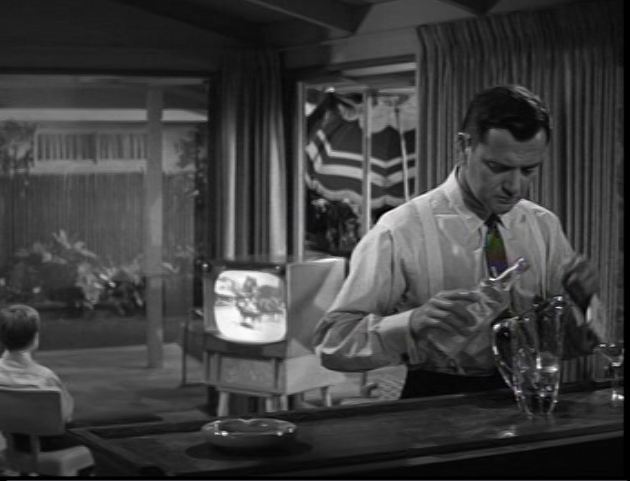
The floor plan in the houses is identical, right down to where they choose to put their television sets. Their children sit in front of the TVs like zombies.  Ten years later they will "tune in, turn on, drop out," but that zen-like self indulgence and self absorption all began cross-legged in front of the TV when they were kids.

Tony Randall spends money he does not have to buy his son a bike, because every new thing his son gets is a trophy to announce to others his own success.

The wives welcome the new neighbors with the manta that their development is a “A great place to raise children.” It truly is an incubator of sorts.

When Hunter and Owens tour the empty rooms of their new home, which is situated cheek-by-jowl with other houses on the street, they see the last couple of the group, played by Cameron Mitchell and Joanne Woodward -- through their large windows, cuddling in their bedroom. The scene reminded me of a passage in William Manchester’s narrative history of the 20th century, The Glory and the Dream (Bantam Books:NY, 1974) p. 782 - “Picture windows became windows for looking in.”

Much later in the movie, when preparing for bed, Patricia Owens meticulously pins their bedroom drapes closed.

Cameron Mitchell and Joanne Woodward are, in a sense, almost for what passes like the “wrong side of the tracks” couple in this housing developing that has no tracks and therefore supposed to be egalitarian. They are both originally from Tennessee and came out to Southern California during the war. (Tony Randall even teasingly refers to them as Daisy Mae and Li’l Abner.) Mitchell is a highly decorated World War II vet, who saw action in the Pacific theater. He runs a gas station in their community, but he has ambitions to be their village chief of police.

At home, he fills the walls of his garage with his memorabilia from the war, Japanese flags and swords and his medals pinned to a board. He misses being in uniform and having authority. Joanne Woodward displays again her remarkable facility for displaying a character almost as if she were a holding up her adopted personality like glass ball and we can see right through it all sides. Her ability to thoroughly crawl into the skin of her characters might make her a candidate for being called the Meryl Streep of her day. Except that I think Meryl Streep’s process for developing a character is entirely cerebral, whereas Joanne Woodward’s seems to be an intuitive and playful sense of the emotional palette of her characters.

Her character has no children, desperately wants children, and is so much like a child herself, the babysitter of the children in the neighborhood. She is bouncy, joking and goofy. Like her husband she has very little education, and like him, she is sensitive about that. She is delighted that the upwardly mobile and beautiful Patricia Owens befriends her. She feels unworthy. We are told that she had a child before they were married, but at his insistence she gave it up for adoption. We later discover that he believed that the child was not his.

When we first see them, they appear happy with each other, but later on his dissatisfaction with his life manifests itself into dissatisfaction with her.

The new neighbors are introduced at a barbecue, the suburban tribal ritual. The men check out each other’s wives, and check out each other’s wartime service.

A subplot to the movie involves one of Pat Hingle's employees named Iko, played by Aki Aleong. Like the other men in the neighborhood, he is a former GI, but because of his Japanese ancestry, he is discriminated against in this restricted neighborhood. Housing developments restricted to whites only was common as dirt in the 1950s. Iko has a wife and children, and a television set, too, but he wants more. He wants to live closer to his job, and upward mobility like everyone else. He appeals to Hingle to help him make an application to the council and here we see Hingle’s greatest conflict. He likes Iko. Hingle and his wife have had dinner at Iko’s house. He wants to help, but he hesitates.

So torn by the issue, and perhaps upset with himself more than anyone, he picks a fight with his wife about racial prejudice. She likes Iko and his family as well, but echoes the same concerns about breaking conformity that Hingle has but doesn’t want to admit.

"How can you call yourself a good Christian and speak like that?" he shouts, still mad at her for wanting him to go to church.

"Don't you bring the church into this."

"What good is the church if it can't teach a person to lend a helping hand to some human being that really deserves it." She throws the prejudice right back in his face where it belongs. The problem of racial prejudice may exist in society, and it may exist in the town council, but first and foremost, he must wipe it out in himself and have the courage of his convictions. First one must have courage, and then one must have convictions.

Another passage of William Manchester, who refers to the Alexis de Tocqueville’s 19th century assessment of a young America,

“Though Americans took great pride in talking about their individualism, he [de Tocqueville] noted, their special genius -- and the source of their greatest potential weakness -- lay in their ways of cooperation with each other…creating a dictatorship of the majority. ‘In times of equality,’ he wrote, ‘no matter what political laws men devise for themselves, it is safe to foresee that trust in common opinion will become a sort of religion, with the majority as the prophet.’”

Though social conformity is a strong force, the money angle is what drives them more fiercely. Tony Randall, tragic with a drink in his hand and a smile on his lips and that wonderfully giddy giggle, "what this country needs is easy credit. No man should have to pay cash for anything. No money down is the secret to prosperity...if only the banks would loosen up, every man could have anything he wants, not when these old and washed up -- now, when he's young and washed up."

Interesting that at their backyard barbecue they first dance to a song on a hi fi called “Something's Got to Give,” a 1940s swing number here in a more sedate arrangement. These people are not kids. Rock n’ roll is not their era. However, later on in the movie they dance to a “rock” number called “The Drive-in Rock.” Car culture and rock n’ roll in one flick of the switch by the director.

They march into each other’s homes, dance with each other’s wives, open each other's refrigerators. There is a sense of community and camaraderie. A very interesting scene when a seed is planted for later plot development -- Tony Randall dances with Jeffrey Hunter's wife, and gets a little smarmy because he's been drinking. Hunter stands by watching, angry but does nothing. He is passive, looking for some social clue as to how to behave in this new setting.

It is Cameron Mitchell who takes over and comes to the rescue in a manly and authoritative way. He cuts in on Tony Randall and begins to dance with Patricia Owens himself, a proper and gentlemanly dance. She is grateful and thanks him, and his “Not at all, Ma’am,” is a sign of his Southern courtliness. He has saved her, and at the same time humiliated Hunter by taking action. Later on however, flushed with his success and how good being a hero has made him feel, he begins to pursue Patricia Owens on his own.

More observations on contemporary society by Joanne Woodward who recalls a little brother who died of pneumonia, "Just think, today he could've taken one shot of penicillin and he could've gotten over it like a cold."

No babysitters. They leave their kids with each other or leave them alone. Tony Randall gets into trouble with a shady business deal and runs away in the middle of a party at his house, and his wife and Pat Hingle follow. The party continues in their home without them, their neighbors unconcerned about their absence. Their little boy gets up and wants a drink so the presiding grownups give him a bottle of Coke.

Today we might hesitate over a myriad of legal repercussions of staying in a neighbor's home, unasked, with their child unattended by the parents. Today we would hesitate giving 8 ounces of sugar and caffeine in the middle of the night to a small child, knowing we would have to probably scrape him off the ceiling.

Sheree North has finally had it with Tony Randall and tells him to get a steady job and stop his get rich quick schemes. "You're never going to make a million, so stop dreaming about it!" It is the worst thing she can ever say to him, the cruelest thing and yet the kindest thing. She is effectively telling him and us the American dream is not for everybody. We cannot all be rich. Some of us will just be lucky if we can pay our bills.

Cameron Mitchell is turned down for the job of chief of police, and he becomes surly. He has no college degree. Instead of trying to step up into society, he now declares it his enemy. He also goes after Patricia Owens.

Hingle makes a prescient remark, "Pretty soon a guy’s going to have to have a master's degree to clean toilets."

Mr. Mitchell also kicks in the TV tube. Now we know that the earth is cracking. When you've destroyed your TV, your whole world is shot.

When Hunter is away on a business trip, Cameron Mitchell comes calling on Patricia Owens, and we are meant to conclude that he has raped her. She runs not to the police, but to the neighbors. Hingle immediately wants to call the police, but she tells him not to. Barbara Rush suggests they call her doctor, but Owens refuses that as well. They let her stay the night and offer comfort and protection, but there is no suggestion of seeking justice.

By the way, another subtle point being made by the scriptwriter and director: the little daughter of Hingle and Rush interrupts while they are trying to comfort and get the story out of Patricia Owens. She refers to the new neighbor lady by her first name. Author William Manchester also had an observation on this:

“The term ‘polite society’ fell into disuse because society wasn’t polite any more. The increasing use of first names was extraordinary. Once it had been limited to family and friends…the suburbanite who arrived home to find her bathroom being used by a strange boy might be greeted, ‘Hi, Doris.’ In suburbia, this was looked upon as just friendliness. Any objection to it would be regarded as snobbish and resented.” (pp.782-783.)

When Jeffrey Hunter learns of the attack he tries to avenge her, unsuccessfully. He tries also to comfort her in a nice speech about sharing each other's burdens. For the 1950s this was probably a very loving and affirming scene. He reminds her that she need not be ashamed or feel defiled. Today, however we might look at it with a different viewpoint. Instead of telling her she has the right to feel angry and the right to seek justice for the crime of violence done to her, it looks as though she is merely being forgiven by a loving husband for being damaged goods.

No charges are brought against Cameron Mitchell. Instead, the old stock movie solution of having him be killed. This is so much more convenient in movie terms. Her shame is not brought out into the open with a public trial, and he goes away. It is a disappointment, but great strides have been taken in this movie to explain the 1950s, so perhaps we can't expect them to be too forward-looking. It is enough to deal with the problems of the present.

Hingle considers all of this, Randall’s alcoholism and his money problems chasing the dream, Cameron Mitchell's violent reaction to not measuring up in post-war society, the racial prejudice that faces Iko.

"I guess owning a house with a deep freeze is not the answer." He wants to know how they got to be where they are. "Whatever it is that makes us afraid to help Iko. That makes Jerry afraid that he's not going to make it big. That makes Troy afraid he's going to be a nobody unless he's wearing some kind of uniform. Afraid, afraid. Now if we can find out what that is, I think we've got the answer."

We are escorted out of Sunrise Hills on another lazy Sunday, watching new widow Joanne Woodward moving out of her home. At the church we see that Pat Hingle has finally joined his family, and that Iko and his family are new parishioners. It's all lovely and homogenous. If you don't look too hard for the cracks.

I would have like to have seen the effort Hingle made in council to get Iko accepted. I would like to know what denomination this now less homogenous congregation represents. I’d like to know where Joanne Woodward is going, as her taxi speeds by the billboard for Sunrise Hills and up the exit ramp to the interstate.

Thursday, October 13, 2011

Alexis Smith


Alexis Smith had a rare opportunity to stretch her acting muscles in “The Constant Nymph” (1943), discussed here in Monday’s post. She remains for me a mystery, a particularly interesting actress both for her ability, which I suspect was far greater than she was usually allowed to demonstrate; and especially for that very fact that she wasn’t allowed to demonstrate it very often.

Odd, when you consider she was plucked out of college to be fashioned into “The Dynamite Girl” by Warner Bros., subjected to the usual flurry of sexy publicity photos, and was soon paired with greats such as Humphrey Bogart, Errol Flynn, Cary Grant, Charles Boyer, Clark Gable, and Fredric March. (We’ve covered “Conflict” -1945 here, and “Any Number Can Play” - 1949, here.)

Both 5'9", Charles Boyer and Alexis Smith see eye-to-eye in "The Constant Nymph" even if their characters do not.

Despite easily being able, whether the material was good or not, to shine in her roles, sometimes steal scenes outright just by the force of her own splendid magnetism, she was often relegated to parts where she played little more than a type: a clothes horse, an ice princess, an elegant but haughty love interest.

In the 1950s, when her contract at Warners ended, she had fewer roles if a bit more variety in them. Also, time was catching up and she endured a series of those older repressed woman roles, the typical leavings of that era for aging actresses of Hollywood’s Golden Age. Aging? She was only in her 30s at the time.

But, despite sometimes having very little to work with, she made the most of them. In “The Young Philadelphians” (1959), she plays the lonely, stifled trophy wife of an elderly man. Paul Newman is his young assistant. From the moment they meet, Alexis and Mr. Newman are intrigued by each other, leading to, but not quite reaching, a love affair. Though Paul Newman is quite good in this movie, (actually so is Robert Vaughn in a minor role), much of the drama is pretty flat. Alexis Smith stole the film, what few minutes she had in it, and would have been a far more exciting partner for Newman than the rather predictable debutante played by Barbara Rush.

So, what seems strange about her career is not so much missed opportunities of roles she never got, but that she was chronically under-used.  The characters she played never went far enough or deep enough.  It takes a special kind of actress to enhance what is not on the page.

One of my favorite roles of hers is in “Here Comes the Groom” (1951), discussed here, where, as a second lead, she plays the awkward, lovelorn goof, too gangly and socially inept to get out of her own way. It’s as if she’s making fun of her earlier ice maiden roles. Bing Crosby teaches her how to be a hot tomato.

At one point he asks her why she wears ugly, sensible shoes.

“Because I’m too tall, if you must know!” she blurts out with building hysteria, which is endearing, as if it is her most embarrassing secret.

It seems too simple, but I can’t help wondering if that was it all along. In a 1980 interview with the Los Angeles Times, she noted that, "At the time, only cute little girls did musicals…It doesn't work out so badly now, but when you're 5 feet 9 in high school, you'd give anything to be a cute little girl."

Did her height set her off as patrician and aloof, and austere?  Did her striking appearance make her a square peg?

In the 1946 “Night and Day”, which attempted, sort of, to present the life of Broadway composer Cole Porter, a cast including Eve Arden, Mary Martin, Jane Wyman, and Ginny Simms belted out a smashing array of Cole Porter hits. Alexis Smith played Mrs. Porter. Everybody with a studio tour pass that day got to sing and perform in this movie. Including Monty Woolley, gosh-all-hemlock. Not Alexis. She spent the entire movie smiling encouragingly at Cary Grant from the audience while he avoided her for his work.

What a waste.

Now the calendar pages flip furiously and we jump a few decades into the future. Have a look here at this cover from Time Magazine, May 3, 1971. Go ahead, I’ll wait.

(Wipes her glasses on her shirt tail. Hums the first two acts of the score of “Rigoletto”. Sharpens a couple of pencils.)

Back? Good. You have to pull that screen door or it won’t shut.

Now then…

That’s Alexis, at 50 years old, svelte, sexy, and doing a chorus girl’s high kick in the Broadway show “Follies” at the Winter Garden.   Resurrecting a wobbly career that had died and given up the ghost.  So people thought.

The cover of Time.

It’s been called the biggest career comeback ever. (Here’s the lead the article by Peter De Vries.)

“Follies”, music and lyrics by Stephen Sondheim, directed by Hal Prince and Michael Bennett, was a remarkable production for many reasons. Since I’m not sure how many theatre buffs read this blog, I’ll just say it was a groundbreaker and leave it at that. It is a complex show, where several aging “Follies” stars must revisit the aspirations, and mistakes, of their former selves (which are moving about the stage like ghosts). Alexis, similarly, may have been working out a lot of demons about her real former film career while on this gig.

This gig, for which Alexis Smith won the Tony Award for Best Lead Actress in a Musical.

Best actress in a musical. Hear that, Jack Warner?

Author Ted Chapin, who wrote “Everything Was Possible - The Birth of the Musical ‘Follies’” (Alfred A. Knopf, NY, 2003), mentions Alexis Smith being overheard during rehearsal after reading another publicity article where she was inevitably and tiresomely pronounced “tall and striking”.

“She remarked: ‘I wish I could someday play someone short and fat.’” (pp. 56-57)

And here she is below, the tall girl, doing her big, flashy number from “Follies” in her now iconic red dress. Just having a clip, any clip, from a Broadway show is a treasure because it’s so rare, especially in those days when people didn't have cell phones and tiny video recorders to sneak into the mezzanine and secretly tape stuff.

Michael Bennett’s choreography from this show is fantastic (of course it was, it was by Michael Bennett), and you get a hint of it here, the inventive placement of male chorus dancers with their backs to the audience, navigating a multilevel raked set. It’s not the best quality video or audio, but heaven bless the person who cleaned it up and shared it. Note how the tempo picks up as the song moves along. By the end of the song, the pace is frenetic. Alexis doesn’t miss a beat.

She’s 50 years old. She’s hustling like a 20-year-old theatre gypsy.

Humphrey Bogart, Clark Gable, and Errol Flynn are dead. Cary Grant’s retired.

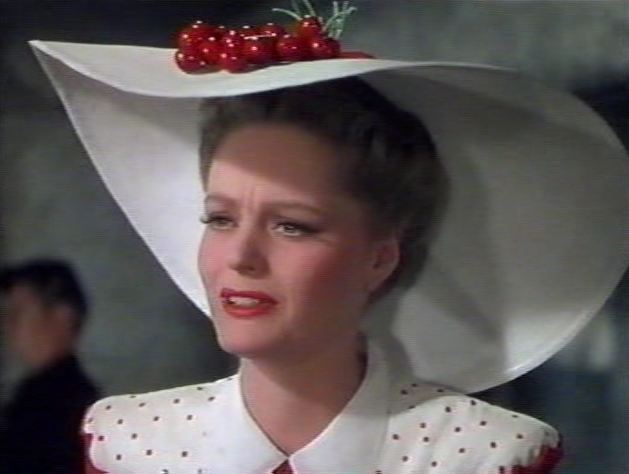
Did not do her own singing in "San Antonio". 

She’s not being dubbed with someone else’s voice, like she was in “San Antonio” (1945).

She is not wearing a body mic.

The director/producer was looking for old movie queen has-beens (Yvonne De Carlo also had a memorable minor role in the show) to push the drama and the pathos, and the angst of aging. What better people to illustrate faded dreams than by using performers whose careers were long behind them and never did live up to their potential?

The tall girl shoved it all down their throats.

Remember to scroll down to the bottom of the page and mute the music so you can hear the video.


After many script changes in the out of town tryouts, she was given this new number to learn at the 11th hour.  Again, here from Ted Chapin’s book: “Alexis Smith was quietly working away. No one was aware of it, but she was working harder and pushing herself further than anyone else.” (p.63)

When given the football, she surprised everyone.

“…For the cold, regal woman who spit out acid remarks all night long to emerge in red fringe, revealing a terrific pair of legs, and dance up a storm -- well, that was revelatory. And it had turned out that Alexis was also a really good actress, well able to get laughs, be hard-edged when called upon…when it came to pure showbiz, it was the sexy movie lady in the red dress who won the day -- and stole the show.” (p.283).

Here’s another clip, a song from that same show, but performed 14 years later in 1985 as part of the “Best of Broadway” TV special from the PBS “Great Performances” series. She was 63 years old here, still spitting her character’s protective sarcasm borne of years of hurtful neglect. I expect she knew something about that, professionally speaking. There is a live studio audience, but since this is set up specifically for TV, she must obviously play to the cameras as well. Look how pointedly she hits her marks. That’s a movie star.


And a Broadway star. She did some other shows. In 1979, the year after studio head Jack Warner died, she won another Tony nomination for her role in the musical “Platinum.”

With the passing years she seemed to grow into that patrician elegance that the Warner Bros. studio decided she should have had at 20. It came more naturally to her now. She had fun with it sometimes, in regional theater, a few more films and TV guest spots. She was nominated for an Emmy for a guest role in 1990 on the NBC series “Cheers”. She was 69 years old.

Then her natural evolution into a grand dame, in a small role in “The Age of Innocence” (1993). A graceful and dignified curtain call for her, it was released to theaters a few months after her death. She left behind her husband of 49 years, fellow actor Craig Stevens, best remembered for his “Peter Gunn” TV series, and with whom she sometimes appeared in stock.

She was said to be well-liked by movie crews back in the day, was a hard worker, and fanatically took lessons on various subjects most of her life, a disciplined, intelligent woman who followed her curiosity with passion. In middle age, she was still taking singing and dancing lessons.

Probably was also not responsible for this hat with the bobbing cherries on top from "San Antonio".

She once famously remarked that she never watched her movies on TV because they weren’t that good when they were made and probably would not have improved with time.  Still, she made her characters as interesting as she could from whatever lofty perspective she had on life at 22, at 30, at 39, at 69…

At 5-foot-9.

The Time Magazine article from 1971 mentioned above noted that she had, “unbeatable, unbeatable cool.”

I suspect she always had; but we were allowed only glimpses -- if someone passed her the football.