Showing posts with label Paul Kelly. Show all posts

Thursday, March 15, 2012

Storm Center - 1956


“Storm Center” (1956) asks the question -- what is the meaning of the phrase free public library? Bette Davis plays a widowed librarian who defends free speech against the town council, and the town, that is uncomfortable with it. We have several shots of the library where she works, on which is chiseled in stone FREE PUBLIC LIBRARY. Director Daniel Taradash wants us to remember this.


The library, by the way, is an old friend to us movie buffs. You may recognize it is the same library where Teresa Wright bolted in the night to get information from newspapers on her sinister uncle in “Shadow of a Doubt” (1943). Both movies were filmed in Santa Rosa, California.


 Teresa Wright in "Shadow of a Doubt"

Another shot from "Shadow of a Doubt"
 The movie starts out with a bold title sequence and music theme that, like the movie we discussed on Monday, “Trial”, seems forward-looking and carries a hint of a turmoil of the early 1960s. The title sequence is by Saul Bass, another favorite among old movie buffs.

Similar in style to the title sequence of “Vertigo” (1958), we have a face, in this case a pair of eyes superimposed over the typeface of a book. The eyes are eagerly reading the pages as if searching for some information. We hear the ominous sound of the kettle drum and soon the words and the blinking eyes are enveloped in flames. It is a premonition of things to come.

The movie has an interesting premise. Bette Davis carries a book in her library about communism. It is a kind of manifesto on the idealized communist society. We don’t really know too much about the book, except that we are told it is propaganda. Bette Davis admits herself that it is propaganda, and she believes it is a foolish book. We are told from the beginning that she is an open-minded guardian of free speech. She keeps the book in her library not because she agrees with its premise, but because she believes it will educate that the communist way of life is unappealing, false, and inevitably strips the citizens of such a society of their freedoms.

The film wants the viewer to know this right off about her to have no doubts about her sincerity (or her being a nice person), and the film is not very subtle in pointing out who the good guys are and who the bad guys are. The film’s chief problem is its lack of subtlety. The other problem is that the movie was not made earlier. As noted in Monday’s post, by 1956, the worst years of the communist witch hunts both in Hollywood and in America had begun to fade by this time, when people began to wise up that repression is repression whether its imposed on us from other nations or home-grown. It would have been better had this movie been made in 1950, that certainly would have been a bold move. Hollywood is famous for concocting films as an afterthought.

Bette Davis’ work in this film is interesting in two respects. First, we see again her admirable willingness to work as a character actor. She found character parts far more interesting and this probably gave longevity to her career. On the other hand, this is one movie where Bette Davis performs at her most heavily mannered. Her prim and proper intonation becomes somewhat grating after a while. I think her finest scene in this film is towards the end where she breaks down under the heartbreak of having lost the affection of the town’s children.

Her character has been widowed many years. She lost her husband early in their marriage when he was killed in World War I. She never remarried, she never had children. We are meant to see that the kids in town, on whom she dotes, are like her surrogate children. When the children follow their parents’ example and shun Miss Davis, she falls apart. It gives the film a needed human touch to it, because for most of the time we are dealing with very intellectual matters. Freedom of speech, civil liberties, repression, and taking a stand politically is often based on airy notions rather than gut wrenching and heartfelt responses to a social issue. Her emotional scene here reminds us that she is not just an intellectual middle-aged woman fighting for some intangible believe like freedom of speech; she’s a lonely woman who lived for her town and is now an abandoned by it.

Another nice scene, very brief, is when she is discussing her plans for a new children’s wing for the library with Paul Kelly, who is a local judge and a longtime friend. We last saw Kelly in “Split Second” in this post. Kelly often played villains but in this film he plays a man on the fence, a decent man who was caught in the spokes of a wheel being turned by others. They stand together in the stacks, (for anyone who has never worked in a library, the stacks are the rows of bookshelves) and as he talks she stands behind him and picks lint off his shoulders. It is a nice homey touch.

Later on in the film Kelly gets a monologue where he seems to give us a hint of their youth, that perhaps he regrets that her husband was the one who won her.

Brian Keith is an up and coming young city official who leads the movement to have this book removed from the library, and when Bette Davis refuses, he heads the movement to remove her. Keith is good in this role; he was in any role he took. Bette's chief nemesis is not played by a stereotyped close-minded ignorant bigot. Keith is intelligent, smooth and professional. We know he has political ambitions, but he never comes off as a man who willingly would destroy the lives of others for his own purpose, even though that is what happens. He does not seem hypocritical or insincere. When he talks about the book’s propaganda message, he says we’re in a war, and we can believe that he means it. It would be nice to know more about his character, but we really don’t see too much of him.

Much of the story is devoted to a young boy who becomes a symbol of what intolerance can do in a community, and becomes the catalyst for change in a tragic event. The boy is played by Kevin Coughlin, who was about nine or 10 when he did this film. This was his first movie. Before this he worked for four years as a minor character, T.R. Ryan, on the TV show “Mama”, which was taken from the book and film “I Remember Mama.” Young Kevin makes a big impression in this movie. I would not say that he was a terrific child actor, indeed his performance is almost as stilted and mannered as Bette Davis’ is. However, he plays a boy who is high strung and obsessive. He throws an extreme amount energy in just about every scene he plays. Whether he is happy, tired or pleased, frightened or angry it all pretty much comes out the same way, like a burst of uncontrollable agitation. One wonders if the little guy was exhausted by the time filming was over. Again, it’s not a great performance technically, but you have to admire the energy with which this boy attacked this part. He gave it all he had.

Kevin’s dad is played by Joe Mantell, an average palooka in a loud shirt who wishes his son would get his nose out of a book and act like the other boys. Bette Davis, who apparently counsels parents on the side, tells him, “Stop wishing Freddie were somebody else…we put far too much stress on conformity in this country.” That’s something, to hear that in the middle of the 1950s.

She tells him to value his son’s differences, forward thinking surely, but when Bette Davis recommends to Freddie a book called “Stories from the Bible”, we know we are being told by the director and the producer, and the studio, that even though she thinks conformity is lousy she still has “real” American values. We’re being condescended to. For the audience, it’s a little like being made to ride a bicycle with training wheels. We’re big kids and we don’t need training wheels.

Kim Hunter plays Bette Davis’ assistant at the library. Miss Hunter is also Brian Keith’s girlfriend. He wants to marry her, but she is reticent because she has been married previously and is afraid of making the same mistakes. Whether or not she had ever been married before has nothing to do with the story, so it’s interesting that they chose to put that in.

Kim is a defender of Bette Davis.  When Brian Keith complains that Miss Davis is being stubborn by not taking that book out of the library, Hunter explains that Davis is a proponent of civil liberties and intellectual freedom, just a harmless old lady set in her ideas. The phrase “civil liberties” strikes a chord in Brian Keith and he gets the germ of an idea. He tries a new tactic.

In a smooth and almost sinister manner he asks Miss Davis about organizations to which she has belonged or to which she has donated money, and he rattles off the names of a few of them. It seems that many of these organizations later turned out to be communist fronts. She says that she knew that and that is why she no longer belongs to them. Mr. Keith’s interrogation is not hysterical or barking the way Joe McCarthy conducted his public events, and for that reason it is all the more eerie because of his controlled manner. He makes no accusations, he only asked questions that are veiled insinuations, and these begin to turn the minds of the fellow council members. They all start to feel uncomfortable with this little old lady librarian. When she walked in the door she was their old friend, but now she’s a spy for the Kremlin.

Bette Davis defends her decision again about the book by saying she also kept “Mein Kampf” in the library. She says it made her sick to her stomach to see people take it out, but that it did not lead to the spread of "Hitlerism" in this country, because people were able to read for themselves that nazism was monstrous. She believes that given a choice, intelligent people will always decide intelligently.

But, intelligent people often lose their intelligence when gripped by fear and paranoia.

They fire her.

The rest of the film is meant to take place over a series of months as Bette Davis is slowly shunned by townspeople and then finally by the children. What she does for an income is not explained. Kevin Coughlin begins to obsess more and more on what his father has told him about the librarian. Joe Mantell recalls her remark about there being too much conformity in this country, and he calls that “Pinko talk”. Freddie becomes increasingly hostile to people and to books, which he once loved. He feels that he has been betrayed.

Some of her old friends are torn by what has happened to Bette Davis and begin to feel guilty that they did not stand by her, Paul Kelly included. Look for Kathryn Grant, who would marry Bing Crosby the following year, the mayor’s daughter. She is one who supports Bette Davis. The movie has a very large collection of people in minor roles and in bit parts. The whole town shows up for the dedication ceremony of the new children’s wing of the library.

A pair of identical twin sisters, interestingly named  Dora Dee and Laura Lee Stansauk, sing a hymn to the library.  I think this was their only film. They sing well, and one wonders how they came to be in the film, if perhaps they were Santa Rosa locals, much as the standout Edna May Wonacott in “Shadow of a Doubt”? If any reader knows more about them, please give us a shout.

Bette Davis pretty much gives up her protest about free speech and prepares to slink away from town. Not before Paul Kelly decides enough is enough and brings her to the dedication ceremony. Young Kevin confronts her and calls her communist, his shrieking echoing in the loudspeaker.

She is so rattled by his repeated shouting, that she slaps him several times in the face. It is a very weird scene, and one today is inclined to laugh. A wee bit over the top, yes indeed.  And one wonders why no one in the crowd objects to the ex-librarian hitting this young boy in the head and shaking the stuffing out of him. One can only assume that they are tired of Kevin’s shrillness as well. By this time we all need a break from Kevin.

Kim Hunter breaks up with Brian Keith because she’s pretty sick of the whole mess. She’s got a nice piece here:

“Whatever was the issue? Do you remember? A stubborn woman was fired. The council blew itself up with civic virtue. The city got something to buzz about. I got a better job. You got a platform.”

Keith is offended and responds, “You make it sound like a grab bag.”

“What do you think it was? Patriotism?” A great scene of weary sarcasm, disgust, and despair.

Okay spoiler time.

Kevin burns down the library.

You still with me? Should I have given you more warning? Sorry, I was only talking to myself and I forgot you were there.

No sir, not subtle at all, this movie. We have a close-up on the titles of several books that are burning, including Shakespeare, “Alice in Wonderland”, and “The Story of Jesus”.

The townspeople are now contrite that they have fired a nice old lady and driven a high-strung little boy to lunacy. Bette’s lesson is that she should have stood her ground and fought back.

Hard lessons, easy platitudes. Both “Trial” and “Storm Center” reflect on a dark era in our history, but do it from a safe distance. Both raise interesting questions, but sometimes handle them clumsily. Nevertheless, the films give us a taste of the turmoil of those years. It is very easy to decry extremism, whether it be left wing extremism or right wing extremism. The trouble is it’s always the other guy who’s the extremist. We rarely recognize it in ourselves. In this respect, these films remain quite timely. Particularly in an election year when slapping labels on people is an easy way to get attention.

That impressive old brownstone library in Santa Rosa I believe no longer exists. Maybe some readers can tell us more about that.

Thursday, October 27, 2011

Split Second - 1953


“Split Second” (1953) straddles the portal from 1940s film noir to 1950s paranoia genre, and we can see an era turning before our eyes.

It almost aspires to a horror movie, but there are no giant insects or Martians. Just one atom bomb ready to explode at dawn, marking the end of this hellish night, with no new day to follow.

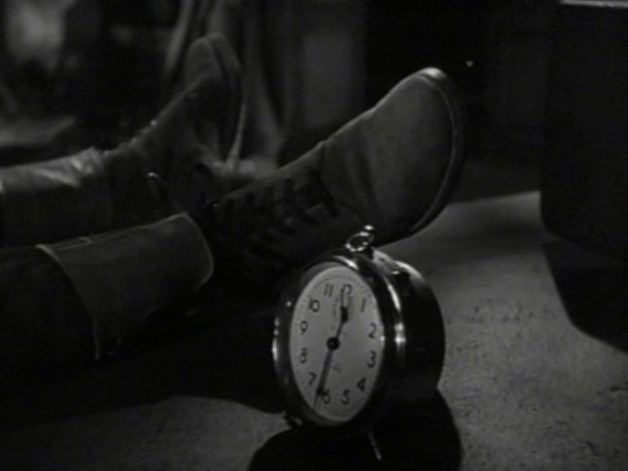
This movie marks the directorial debut of actor Dick Powell. His work here is strong, fast-paced, and solid. Note the alarm clock on the table in many scenes, reminding us that time is precious and slipping away from us. The script by William Bowers and Irving Wallace keeps the story moving briskly, with unexpected touches of macabre humor. This  keeps us and the characters on an even keel and brings us down to earth when our skin begins to crawl.

Keith Andes is a reporter assigned to cover the latest atom bomb test blast in the Nevada desert, but he gets taken off the story when a bigger one (if you’ve seen one atom bomb go off, you’ve seen them all) occurs. Murderer Stephen McNally and his partner Paul Kelly have broken out of prison and are on the loose.

Somewhere in the restricted test blast area.

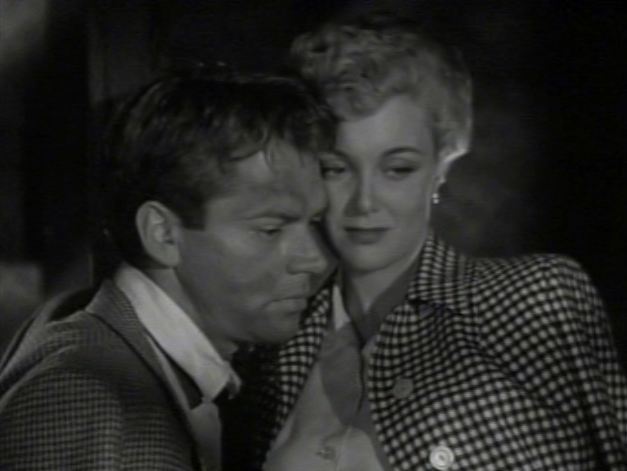
Mr. Andes stops at a lonely desert diner and meets up with Jan Sterling, a night club dancer down on her luck, on her way to Reno. He comes up with the 50 cents for her pie and coffee. Yeah, we’ve seen this before. This part of the film, with the lone car driving on the dusty highway, the run-down diner, the gas pumps, looks like we’re about to enter a 1940s film noir nightmare. All the usual suspects start to show up.

McNally, one of the very best bad men in movies, whose handsome, rugged charm and wry, funny delivery to his lines, is offset by his suddenly volatile personality. We don't dare take our eyes off him.  He's exciting.

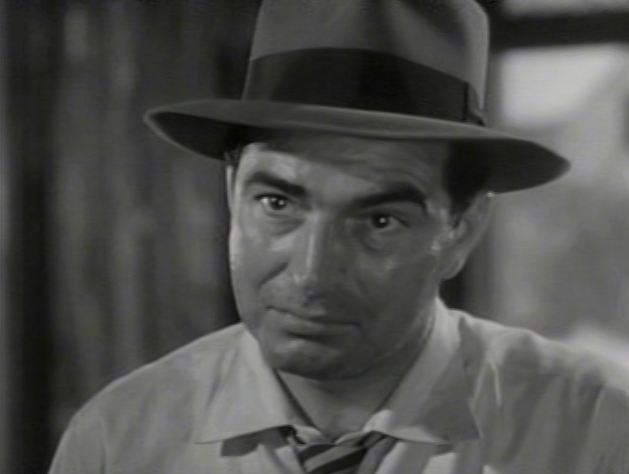
Paul Kelly is his older sidekick, and he’s been shot in the stomach. McNally won’t ditch his friend. They meet up with a pal called Dummy played by Frank DeKova. Frank doesn’t say much, but he reads comic books constantly, and the subject matter -- atomic super heroes, is our first clue that we’re about to enter a weird new world.

Alexis Smith and Robert Paige drive up to the gas pump. She’s in the driver’s seat. For now. It will be the last time she has control in this movie. Her fur stole is over the back of the seat between them. He’s not her husband.

Alexis, who we lamented in this recent post about not getting very good roles during her contract with Warner Bros., gets a good role here. She’s the restless, well-to-do wife of a doctor back in California. She’s run off with family friend Mr. Paige, who sells insurance.

Which, forgive me insurance brokers, cracks me up. Funny how insurance salesmen always end up being the fall guy in the old movies. Think of poor sap Fred MacMurray in our favorite insurance movie, “Double Indemnity” (1944) which we covered here.

Mr. Paige is likewise behind the 8-ball because of some very bad choices and a very bad dame.


Eventually, all seven unlikely travelers end up packed together in Mr. Andes’ big woody station wagon with the leaky radiator, driving through the desert like a Bizzaro World field trip. Mr. McNally, smart enough to work an ace up his sleeve, calls Alexis’ doctor husband, played by Richard Egan. McNally threatens to kill Alexis unless Mr. Egan comes to their hideout and takes the bullet out of his pal Paul Kelly.

Their hideout, until they can hook up with the rest of the gang, is an abandoned saloon in a ghost town.

In the atom bomb test range.

We’ve been well warned that the bomb will go off at dawn, so the alarm clock is ticking. Stephen McNally, with the bravado of a psychopath, is willing to play “chicken” with the bomb, until his friend gets medical help. The ensemble cast suffers agonies -- over the bomb, over their own past and present mistakes, and must submit to the brutality of their captor.

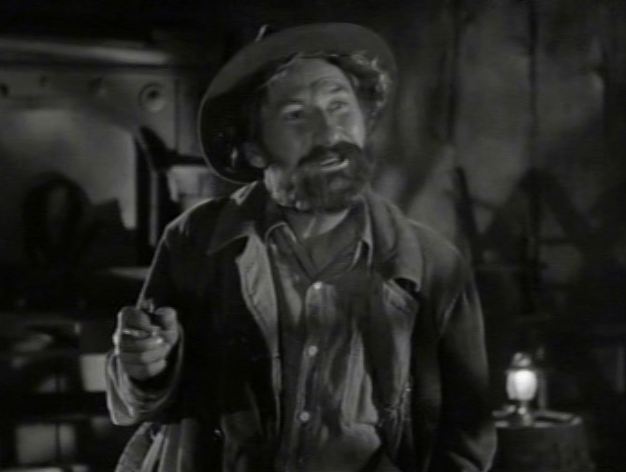
They are joined suddenly by Arthur Hunnicutt, who plays a folksy lone prospector on his way out of town. Mr. Hunnicutt, full of long-winded tall tales, brings humor to the script in his ability to annoy the others, but he’s also a safety value in his own homespun way. He’s a hoot.

They are a collection of interesting contrasts. Andes, the reporter, is not your typical cynical tough guy with rapid fire speech. He is quiet, easy going, charming, but passive. He’s willing to watch and bide his time.

Jan Sterling has some of the best lines, which she delivers with her blasé pout. Her character does not grow or change much, but she is a tough cookie with a heart and a conscience. When the doc shows up, she’s the one who helps with the operation.

At one point, McNally orders her to the kitchen of this old saloon “with that other dame to fix us something to eat.”

Being women, Alexis and Jan are naturally in charge of meals though they have nothing to cook. I am likewise, by virtue of my gender, able to put together a four-course meal with nothing but a can of beans, two soda crackers (Crown Pilots, ayah) and a teaspoon of Crisco. It’s a gift. Any woman can do it.


We never do get to see what they’ve had for supper, but afterwards they all settle down to listen to the portable radio and smoke. Just a relaxing evening at home.

The soft dance music and melodious ballads are interrupted by the radio announcer gleefully telling them, “We’ll try to give you ample warning so that you can get to your roofs and watch the flash from the explosion.”

Were we ever so innocent? I recall some comment singer/actress Kitty Carlisle made in her autobiography about watching a bomb blast from a hotel terrace, I think, in Las Vegas, a momentary distraction from a party. Like Alexis Smith in this movie, dressed to the nines.

These are strange days. McNally jokes about DeKova’s comic book, “In the next chapter, the Martians invade.”

The old prospector is fascinated by the bomb. A veteran of World War I, he marvels, “Just think what we could have done with a couple of them things at the Marne.”

Jan Sterling quips about their predicament, “Quite a spot. Between the devil and the bright red bomb.”

They are waiting for Richard Egan to show up, driving all the way from California into the restricted area here in Nevada. I’m not sure how he makes it through security checkpoints, but he’s Richard Egan. We trust him to do the job.

Alexis doubts he will come, knows that a cheating wife need not expect such devotion.

“He wouldn’t cross the street for me, much less risk his life.”

She tries to hedge her bets by urging her Insurance Man lover to do something.  Still, she is a little fascinated by the brute with the gun. Her Insurance Man looks less dashing in this dim light.  He is careful, perhaps regretting taking this trip, but when a leering McNally orders Alexis to go with him to the kitchen, Mr. Paige challenges McNally to a fight.

Mr. McNally, with a coolness that belies his own anxieties this evening, calmly shoots him dead. And drags Alexis off to the kitchen.

With a tear-streaked face she begs him not to kill her, but then the penny drops and she realizes he’s got another use for her just now. Hedging her bets again, she lets him kiss her. She’s not being clever or calculating, she’s just in a dead panic, like a drowning person ready to cling to anything floating by. If he wants a woman, by gorry, she’ll be his woman with everything she’s got.

Here’s where the subtlety of many classic films in addressing scenes of extreme violence or sexual situations is intriguing. We are taken back to the main room where the others sit and wait or sleep, or talk in whispered conversations. We get a tale from Jan Sterling about her miserable childhood and rotten parents. Time passes, but we don’t know how much time. Our attention is diverted to what is happening in the main room.

But we keep thinking about the sexual assault in the kitchen.

A funny paradox.  An explicit scene of violence that hammers the message home tends to make us draw back.  Here instead, lured into imaging the worst, we are drawn ever closer emotionally to the assault precisely because we have the safety of being voyeurs in our imaginations.

Alexis is eventually released from the kitchen like a skittish heifer after being branded -- self-conscious, shaky, nervously swiping her hair from her eyes. Jan Sterling sidles up to her, not to comfort, but to ask for a drink from Alexis’ hip flask and get the dirt.

Alexis, tense as a cat, fumbles with yet another cigarette, and masks degredation with another application lipstick, “Why don’t you just ask me what you want to know?”

“Do I have to?” Jan fires back, with a sarcastic smile. No, she doesn’t, and neither do we.

Richard Egan finally shows up to dig the bullet out of Paul Kelly. McNally needles Mr. Egan about his wife. “She decided not to depend on you entirely.” Alexis slinks away. The evening for her is a string of bad choices, panic, and humiliation. For everyone, a night of confidences, threats, secrets, and compromises.

McNally has had Alexis, so now he pursues Jan, who is smarter and better at pretending. She can handle McNally. She’s known men like him before.

Alexis, meanwhile, is baffled at Egan’s heroism.

“Are you still in love with me?” It's a fine moment; she's genuinely struggling to understand, perhaps even hoping that he does still love her.  She does not know, and even before this night is over, will never learn unselfishness and compassion. Her life has been ruled by her immediate desires, and she assumes that is everyone’s motive.

Mr. Egan is the stalwart, dependable man, a disappointed husband who’s been hurt enough and is more than willing to cut Alexis loose, (similar to his role in “A Summer Place” - 1959) but he’s genetically programmed to do the right thing and sticks his neck out for her, the room full of strangers, and his patient.

When the operation begins, Paul Kelly gets religion and wants a verse read from the Bible. The prospector has one in his gunny sack, right next to his gun.

His gun? Why he did not reveal to his fellow captives when he first arrived that he had a gun is a mystery and can only be chalked up to his maddeningly independent personality. He gets around to things when he gets around to them.

Nice, ironic scene where McNally reads to his pal in a flat voice, “Blessed are the meek for they shall inherit the earth” as the Sodium Pentothal is being injected.

But the gun comes out during the operation when Mr. Andes makes a play for it. McNally beats him to a pulp, and even slaps around Jan Sterling for trying to interfere. This cements the bond between Andes and Miss Sterling, and in a cozy moment when they become resigned to the fact that they are probably going to die, he jokes, “Sooner or later one of us has got to learn to fight.”

“We’ll take up judo in the next world,” she replies. If there was more time there would be a romance, but touching their sore heads together is the best they can do now.

Now the morning dawns, and McNally gets ready to make tracks. Alexis hangs on to him, begging him to take her with him, but he responds, “You’re a real bad dame…nobody can count on you for ten seconds.” He is sickened by her. She has fallen so low that a murderer won’t dirty his hands with her.

We get taken from the ghost town for a moment to some government file footage on preparation for the test in the command bunker. A voice announces, “At 30 seconds the master robot will take over.”

I think that’s the scariest line in the movie. We are no longer able to make choices for ourselves, not once we’ve gone past a certain point. Then we are all slaves of the Master Robot.

Spoilers coming up, so head to the fallout shelter if you don’t want to know.

Last minute fisticuffs, last minute choices, and only two of the cons get away, with Alexis, who practically dives into the passenger’s seat. They drive in the wrong direction.

“The bomb!”

She needs to be with them because otherwise we wouldn’t care if they drove off into the bomb blast. As flawed a person as she is, she is still the most interesting character there (except for McNally, but we already have him figured out) -- I think mainly because of the complex and layered way she plays it rather than the way it’s written. We really don’t know which way she’s going to go, because neither does she.

In one of his last-minute confounding ruminations, the prospector announces there is an abandoned mine nearby where they can shield themselves from the atomic blast.

Now, why in the name of Aunt Mary’s knickers did he not say that before? That would have given everybody another interesting choice to mull over. Do they tell the bad guys? Or, do they play God and keep the cave for themselves? They already played God with poor DeKova, who gets knocked out and left to die. They could have dragged him to the mine with them. They just leave him there with the corpse of the insurance man.

What if Alexis, fairly crazed by the end of the movie, was given the chance to hide in the mine? What if McNally had gone through with plugging Paul Kelly with a bullet when Kelly betrayed him at the last minute?

“The master robot is now taking over” is the next announcement as McNally’s car spins its tires in the desert sand, and the other captives rush for the abandoned mine. All our choices are gone.

The blast, with its white light and nuclear wind demolishing the ghost town is similar to declassified test bomb blast footage you may have seen.

“Let’s take a look at the world of tomorrow,” Richard Egan grimly says as the survivors crawl from the mine. In 10 years they will probably all get cancer, but that’s another story. For today, it’s a flatter, whiter desert, and a giant mushroom cloud in the distance with the words “The End” written in script over it.

No monsters. Nothing is ever scarier than a bad reality.  Especially when we've caused it ourselves.