Showing posts with label Richard Egan. Show all posts

Thursday, November 20, 2014

One Minute to Zero - 1952

One Minute to Zero(1952), like most war movies, isn’t “timeless,” which is a label critics so often paste on their reviews of a film to indicate a particular quality of excellence, more than of immortality.  It is locked, perhaps hamstrung, by its singular event of the Korean War—whose ambiguous political and military result is, not surprisingly, reflected in the film’s ambiguous and even ambivalent message.

The film, for many months up until its release in August 1952 was referred to in the press by its original (if unoriginal sounding) title: The Korean Story.  Produced at RKO by Edmund Grainger under the auspices of Howard Hughes, suffering delays due to severe weather on location in Colorado and the loss of its lead actress, Claudette Colbert, due to pneumonia she contracted there in the bitter cold.  The movie carried the reputation of a jinxed picture long before the crew limped back to Hollywood.  With several of the film’s cast and crew down sick, lead actor Robert Mitchum’s brawl with a serviceman, and the cooperation of the military up in the air with Howard Hughes over a scene the government preferred to be censored, the only bright spot in the lumbering affair seemed to be the popular, if unlikely, young actress Hughes hired at the eleventh hour to step into the female lead.  She also raised eyebrows due to her youthfulness compared to the other actresses hired, or considered for the role (Colbert, and also Joan Crawford), and speculation as to how the “little lady” of Hollywood would fare in a testosterone-infused war picture against bad boy Robert Mitchum.

Ann Blyth had just turned 23 years old when she belatedly joined the cast of what would eventually be called One Minute to Zero.  She told interviewer Eddie Muller in her 2006 appearance at the Castro Theater in San Francisco (in the transcript as posted by The Evening Class blog here):

I found myself in Howard Hughes' office with my agent—I didn't really want to go by myself; I'd heard stories—anyway, he was very nice to me, sat off in the corner…

According to a column by Louella Parsons, who visited Ann on the set of The World in His Arms, which we covered here, Ann was due to head out to location shooting in Colorado Springs for Hughes’ war picture “at the break of dawn the next day,” with no break between pictures. She told the gossip columnist that 1951 had been the most memorable and exciting year for her, in which she traveled to England for I’ll Never Forget You, visited relatives in Ireland for the first time, and saw the release of four very different films: the murder mystery Thunder on the Hill discussed here, exotic historical costume picture The Golden Horde, I’ll Never Forget You, and The Great Caruso, discussed here, which helped to launch her into MGM musicals.  Her versatility evident, there seemed to be no reason not to put her into a war picture, even if the script had to be altered to reflect a much younger woman in the role.  

From a syndicated article by Hugh Heffernan: 

This embattled outfit, headed by director Tay Garnett, has been filming The Korean Story on location sites near Denver for the last three months – and overcoming one rugged and discouraging hardship after another.…First of all, Joan Crawford pulled out from the star role after the company had been shooting there for several weeks awaiting her arrival.  Jane Greer was then announced as the replacement and there was more stalling until it became apparent that she could not be released from a previous commitment.

After two weeks of dealing, Claudette Colbert agreed to leap into the breach.  Claudette actually reported, but within a few days, was stricken…Meanwhile, the outfit kept on shooting with what it could, which wasn’t much.

Today they’re working with their fourth leading lady...but before Ann could take over, the heroine role had to be revamped almost in its entirety.

Too many excursions in Hollywood companies have been suffering torturous location pains recently and The Korean Story miseries may prove to be the straw that breaks the Hollywood jaunting budget.

Director Tay Garnett mentioned the troubles in his autobiography, Light Your Torches and Pull Up Your Tights:

When we arrived in Colorado, the trees had just come into full leaf.  When we finally locked up the last can of film, we had wired alien branches to the denuded aspens so as to match the stuff we shot in the spring.

Our initial difficulty was that, three-fourths through the location shooting, Claudette Colbert came down with a four-star case of pneumonia.  She was game, but 104-degrees of fever hospitalized her…

He developed a “short sequence of pneumonia,” too, and was hospitalized.

H.H. suggested that I fly to Hollywood, because he wanted me, personally, to discuss the Colbert role with Joan Crawford.

Joan was represented at the time by Lew Wasserman (then head of the MCA talent agency, and now president of Universal Studios).  I’ve always felt that, because the male roles were dominant in Zero, Lew advised Joan against taking the lone female part.  I was disappointed.  I had known Joan for years and had always wanted to direct her.  She brings a brilliant talent onto the set, and I’m convinced she would have been great in the Zero role.

In Hollywood, I reported the situation to Mr. Hughes (by telephone) and was told to return to Colorado Springs the next morning, because Ann Blyth had been signed for the part.

ANN BLYTH?

Somewhat earlier, Ann had played (superbly) Joan Crawford’s daughter in Mildred Pierce; obviously our entire script had to be rewritten to accommodate the younger casting.

Ann managed to complete the assignment without getting pneumonia, and also got along with her bad-boy co-star.  She recalled in Eddie Muller’s interview noted above:

“…he was a terrific man to work with.  I loved working with Bob.  He was terrific.  He loved to play gags.  We had one scene one day—it wasn't too serious a scene so I guess he thought he could get away with this—and he got together with the prop department and he said, ‘Now, in this scene I want you to—up in the rafters—have a rubber chicken.’  In the course of the scene—and of course he always had his buff body—he said, ‘In the middle of the scene I'm going to aim up there and I want you to throw the chicken down.’  So we started the scene and—as I say—it was a fairly serious scene, rather melodramatic, and we were going along nicely when I hear this bang and this chicken comes down.  I kept right on going with my lines.”

Also, in 2006 she told interviewer Tavo Amador for The Bay Area Reporter:

“Bob Mitchum was a favorite.  I loved Bob.  He was a big man, with boyish charm.  And an underrated actor.  He’s so frightening in the original Cape Fear, which was much better than the remake.”

She would continue to defend him when more alleged brawls gave his reputation a black eye in the years after she worked with him. 

“...when I worked with him, he was a perfect gentleman.  He always knew his lines.  He has the nicest manners and always was considerate of me.

“Every time he sees me.  He always comes right over and asks about my new baby, Timmy,” she beamed.  “I think he’s wonderful.”

Nor did she apparently mind climbing on a five-inch-high box for their kissing scenes.

Their most intriguing scene together, however, is playing sitting opposite each other at a kitchen table after she has made supper for him at her apartment in Japan, their first date.  The candles burn down, and both, slightly slumped over the table, he with his chin on his hand, give the impression of being all talked out.  A soothing, lazy tune, in a delicately Asian style, penetrates their silence, coming, we are told in quick camera shot from a record on a portable record player.  Suddenly, Robert Mitchum begins to sing along to the tune, in Japanese.  Catch Ann’s expression of surprised delight.  She is glued to his face, watching him sing, fascinated by him. It opens the door to their romance.  She sees there is more to him than just a blustering alpha male, dismissive of her opinions on the war.

In this story, Mr. Mitchum is a career U.S. Army officer stationed in Korea as tensions build with the communist uprising in the north.  Ann Blyth is a United Nations health worker.  He represents the male warrior and she is the female pacifist, (the yin and yang of this arrangement, I think, is more coincidental on Howard Hughes’ part than an artful use of Asian philosophy) and their first encounters are combative, a mixture of bad first impressions and a Cliff Notes version of geopolitics in 1951.  She puts her faith in the United Nations in curbing aggression; he feels the U.N. will be useless in stopping aggressors.  Both will bend somewhat in these opinions, but the conclusions are lost in a burst of new weaponry: jet airplanes firing rockets, and scouring the hills with napalm. 

We’ll go back to the war in a minute.  First, we return to that candlelight dinner.  As Robert Mitchum lazily smokes a cigarette (his trademark sleepy performance punctuates pretty nearly everything he does in this movie), he coaxes Ann, who confesses she knows only the English words to that tune, to sing.  Bless him.

So now it’s her turn at bat, and Ann sings an English verse of “Golden Moon.”  It is low, quiet, and lovely, and the really neat thing about this scene (correct me, please, if I’m wrong) is that they both appear to be singing “live.”  I don’t believe they’re lip-synching to a pre-recorded track.  It’s easier to keep the flow of singing and dialogue in this quiet, moody setting by having them do it live.  What we get is a very casual, natural, and intimate moment.

When they get up to move to the living room to have their coffee, Mitchum whistles another tune that becomes their romantic leitmotif, and we will later call it, “When I Fall in Love.”  It will swoop down upon us in a glorious wash of violins whenever they want each other, hurt each other, or just see each other.  For what is really a fairly pedestrian war movie, it’s unusual and quite charming to have such a moving love song be used so frequently and with such power.

The song was recorded by many through the decade, Doris Day and Nat King Cole both released very popular versions.  Unfortunately, Ann Blyth did not, and I don’t know who dropped the football here.

Thanks for “Golden Moon,” Howard, but why in Aunt Mary’s knickers didn’t Blyth sing the bloody theme song?

Pardon my French.

By the way, Ann gets to speak a little French in the movie too.

 Later in the film, when they’ve gotten serious, he proposes marriage, but she turns him down, bitterly showing him the box of medals, including the Medal of Honor, that had been awarded to her late husband, killed in World War II.  

“The President shook my hand,” she whimpers, not with pride, but brokenheartedly to the Medal of Honor, sifting the ribbon in her fingers.  That was another war, and another lifetime ago.  

We see this reality, too, in the modern weaponry the film displays.  This is isn’t your older brother’s war.  With Howard Hughes’ involvement with the aviation industry, it’s no wonder the fighter jets are the real stars of the movie, including a look at some Australian planes coming to the rescue of Mitchum and his infantry platoon at one point.  The footage of the military planes is impressive, even if the Australian accent from the pilot speaking over the radio is atrociously fake.

The picture also liberally uses genuine combat footage with the cooperation of the government. (The movie was filmed at Fort Carson, using troops of the 148th Field Artillery.)  It’s hard to say whether the footage is used successfully.  It is, certainly, a realistic view on war that takes us out of the back lot, and farther away than Colorado, but as often happens with interspersing other footage—say, as with rear-screen projection—the cuts are pretty obvious and we are not fooled into thinking the image we see is part of the scene.  We can easily tell what is government combat footage.  There are times when a soldier looks off to the side, we see a flaming tank, and it looks as if he is suddenly watching a newsreel and not a real tank beside him.  We are jerked out of the scene.

Another problem is the footage used, much of which is gratuitous—the enemy seared by flame-throwing and napalm, with screams added to the soundtrack for effect, pitiful refugees, and scores of dead American soldiers.  They seem to be used for shock effect and not for storytelling.  All these images are part of the reality of war, and to understand our participation in a war we should see them, but I think they are more effectively used in a documentary, or at least used in a fictional story with a greater skill.  After one removes these combat footage splices from One Minute to Zero, what is left is a standard Hollywood type war picture, with a squad of regular joes trying to maintain their position.  Some of the dialogue is pretty hokey.

We have the smart alecks, the comically naïve dumbbell, played by Alvin Greenman, who you’ll remember as the young janitor, Alfred, in Miracle on 34th Street(1947).  Charles McGraw plays the gruff, but hero-worshiping sidekick sergeant of Robert Mitchum.  You’ll remember gravelly voiced McGraw from Once More, My Darling (1949) here, where he played the chauffer of oddball socialite Ann’s wealthy eccentric father.  He also stars in one of my favorite train noirs, The Narrow Margin (1952) here.  They stumble through the Korean countryside, kill and are killed, are kind to Korean children and teach them how to blow bubbles with bubble gum.

Richard Egan is the captain of the lost squad.  It’s really quite an accomplishment for the film to juggle so many subplots: the guys in battle, the air force pilots who fly over from their base in Japan, including Mitchum’s longtime pal William Talman, whom many of us remember as the perpetually losing attorney on TV’s Perry Mason.  Their wives are with them, and that, too, makes this war strangely different from the Pacific Theater of World War II.  They show up at the airbase to watch their men come back from a mission, and count to see which ones don’t come back.

And then, a romance with Ann Blyth, who pops in and out of Robert Mitchum’s very busy life in Korea.  Perhaps the oddest and most uncomfortable subplot in the movie, the scene for which the film is most remembered, is when Mitchum orders his men to fire upon a long file of refugees approaching his checkpoint.  Innocent men and women, small children, and frail elderly, are massacred.

It is this scene to which the Department of Defense objected, and asked Hughes to remove from the film. (According to Transforming the Screen, 1950 to 1959 by Peter Lev, Mr. Hughes first ascertained whether defying the ban would hurt his defense contracts for his Hughes Aircraft.  He was told it wouldn’t.  He went ahead, apparently despite his promise not to film the scene.)  

It is based on an apparent actual incident from 1950 where American troops fired on Korean civilians, the facts of which are still cloudy.  In the movie, a long column of refugees, moving away from battle areas to safety, approach Robert Mitchum’s platoon, which is maintaining a defensive position.  Mitchum gives the order to fire warning shots from artillery to scare them away, to force them to go back to an area where the military will drop food and supplies to them.  The refugees ignore the warnings and continue to walk toward Mitchum’s outpost.

We are shown, in a rather melodramatic and heavy-handed way that many of the refugees are being prodded forward by enemy soldiers, who are using them as, in the modern term, “human shields.”  Mitchum knows this, and he will not allow the enemy infiltrators approach.  He fires more artillery, this time a little closer to the people.  They still proceed forward.

It is a showdown, and ultimately, Mitchum gives the orders to fire the artillery directly into the long column of people, massacring them.

At this moment, Ann Blyth, on duty with her U.N. health unit, shows up in a jeep, watches with horror, and tearfully, hysterically confronts Mitchum on the monstrous thing he has done.  Of course, he slaps her because that's what you do with women who cry and shout in your face.

By the end of the film, William Talman will take her aside and show her (through the inevitable clip of government footage) a temporary morgue in a bombed-out village where lie the corpses of many American soldiers, whose deaths, many of them slaughtered with their hands tied behind their backs, are the result of those enemy infiltrators sneaking into U.S. lines by way of refugees.

The end of the movie tries to switch back to patriotic World War II movie-mode and shows Ann in a bombed-out church praying for forgiveness for misjudging Mitchum, and praying for his safety.  When she finally catches up to him, as he is going off to more fighting, she says she wants to be his wife.  He tells her, without a trace of romance, but rather like he is acknowledging a salute from one of his men, “You will.”  And the columns of men leave us with Ann's patriotic voiceover.

This scene, after the daring move of showing the horror of war with ugly combat film, the political murkiness of our involvement, and even the ambivalence of the men and officers, seems forced and ersatz.  The movie drifts awkwardly between comforting us that this is just like World War II, and “we did it before and we can do it again”—and an eerie, unsettled frankness that tells us we are in a completely different ballgame and nobody knows the future.

Regarding the massacre, we may acknowledge that a scene of this sort would never have been shown in a World War II-era Hollywood movie, even to justify it.  U.S. military personnel didn’t massacre civilians, that would be the message.  (Even in a future war, information on the Mỹ Lai massacre in Vietnam was censored by the U.S. government.)

But, the boldness of this scene is weakened by the way the audience is supposed to feel sympathy for the stoic, if mentally anguished, Robert Mitchum for having to do his duty by firing on civilians.  We may, indeed, feel sorry for him, as making such a decision and then having to live with it must be terrible.  However, we cannot, in all conscience or logic, feel more sorry for him than we do for the innocents who were murdered in the name of weeding out the bad guys.  The idea that we must feel worse for Mitchum than the refugees is ludicrous, but that is what the film tries to accomplish in order to build up the hero.  Since everybody in this movie has been hero-worshipping Mitchum, talking about his character, his guts and his excellent military record, we don’t need to be hammered over the head that anything he does is for the greater good.  The scene would have been more powerful if it were Mitchum in the bombed-out church praying for forgiveness.

As propagandist as the World War II movies were (to an extent, all war movies are propagandist), the hero in those films never demanded, or even asked for our pity.  He might have earned it, but he didn’t ask.  

Perhaps we were so scared we’d lose that war, he didn’t have to.  Everything he did was jake with us.  But we didn’t feel Korea was a threat to our existence, and if many regarded it as an ideological threat, that was not enough.  It became, almost the moment it started, “The Forgotten War.”

Bosley Crowther, our old acerbic friend from the New York Times remarked of the film:

Plainly, One Minute to Zero is a ripely synthetic affair, arranged to arouse emotions with the most easy and obvious clichés.  And, although some of the battle talk sounds faithful and the inter-cut news shots are sincere, neither the story nor the performances of the actors, including Miss Blyth and Mr. Mitchum, rings true.  Here is another war picture that smells of grease paint and studios.

His last line is, I think, particularly telling.  War movies were old hat.  We’d seen them all before.  For whatever propagandist hue Howard Hughes tried to paint in this film to make it earnest for the military whose cooperation he needed to supply troops and equipment for the movie, and palatable to an apparently bored and war-weary audience, it didn’t create a big splash.   

But One Minute to Zero remains for us as a unique slice of history told, not in the grand scale Hughes was apparently reaching for, but in the detail of the reconnaissance plotting of the officers at the base in Japan, in the procedural tactics practiced with dull repetition by the little family of grunts that make up Richard Egan’s forlorn squad, and in the stolen moments between Robert Mitchum and Ann Blyth, whose courtship is sporadic under the “rules of engagement” the Korean War has allowed them.  

I can’t imagine their characters ever settling down in suburbia together.  Maybe that’s where the audience of 1952 was really headed, in minds and hearts as well as physically, leaving the Korean War behind.

Ann Blyth, having long established a routine of donating whatever time she could to charity singing engagements, as we discussed in this post, also made time to visit military bases in the U.S. and territories to entertain the troops, just as she had as a teen during World War II. 

She toured several bases in the territory of Alaska in 1952, as we discussed on this post on The World in His Arms (1952) and performed with Jack Benny at the White Sands Missile Base in New Mexico in 1951.  She visited former Ford Ord Army Base on the Monterey Bay in California also in September 1952, where she was named the Queen of the 20th Regiment and apparently helped the young GI David Janssen to join Special Services, a unit that was involved in entertainment and sports activities on the base.  What clout she might have had, or how she was able to do this is unknown to me at the present time, but David Janssen gave her input a fair degree of importance, feeling that it might have kept him from being sent into battle in Korea, and he was always grateful to her.  A website devoted to Janssen posts a letter he apparently wrote October 13, 1952 to his mother from Fort Ord after Ann Blyth’s visit there in September mentioning his writing a thank you letter to Ann Blyth, as well as Frank McFadden of Universal's publicity department.

Ann received quite a bit of fan mail from military personnel, and it was reported in a syndicated column by Armand Archerd in 1951 that some 2,000 letters per month came to her from GIs, about three-quarters of all her mail.  Perhaps Howard Hughes knew about this when signing her to the role.

When the film finished, she went right into her next movie without a break, right into being 12 years old in Sally and Saint Anne (1952), which we discussed here.

But Howard Hughes wasn’t quite finished with her.  In appreciation for her stepping in when the clock was running out on his shooting schedule, he gave her a new Cadillac, and a trip to Hawaii.  Ann took her uncle and aunt, with whom she lived, with her in the spring of 1952.

U.S. Navy photo

Where, in April she performed for the troops at Fort Shafter, Honolulu with Bob Hope, and on Easter Sunday, she visited the USS Wisconsin and sang for the crew.

Come back next Thursday, our Thanksgiving post, for an on-location shoot not quite as arduous, when Ann appears in her first and only big-screen western, her first movie in color, with Howard Duff and George Brent in Red Canyon (1949)


**************************
The Bay Area Reporter, July 20, 2006, by Tavo Amador – “The Real Veda Pierce: a Serene Ann Blyth.

Court, Darren and the White Sands Missile Range Museum.  White Sands Missile Range – (Charleston, SC; Chicago, Portsmouth, NH; San Francisco: Arcadia Publishing, 2009) pp 121-122. 

David Janssen.net website- http://davidjanssen.net/chron06.htm

Deseret News November 28, 1951 p. 2F – see article by Hugh Heffernan; December 9, 1951, by Sheilah Graham. 

 
Garnett, Tay.  Light Your Torches and Pull Up Your Tights (NY: Arlington House, 1973), pp. 282-283.

Kentucky New Era, February 9, 1951 – by Armand Archerd “Home Girl, Not Cheesecake, Pit Top Requests of GIs.”  

Lev, Peter.  Transforming the Screen, 1950 to 1959.  (University of California Press, 2006)

Milwaukee Sentinel, November 14, 1951, column by Louella Parsons part 1, p.8.

New York Times, September 20, 1952, review by Bosley Crowther.  

The Register-Guard(Eugene, Oregon) January 24, 1955, p. 5B  “Friends to the Defense of Robert Mitchum.”

St. Joseph News-Press(Missouri), December 16, 1951, column by Louella Parons, p. 4D.
 
USS Wisconsinwebsite: USSWisconsin.org. http://www.usswisconsin.org/Pictures/famous.htm
************************

THANK YOU....to the following folks whose aid in gathering material for this series has been invaluable:  EBH; Kevin Deany of Kevin's Movie Corner; Gerry Szymski of Westmont Movie Classics, Westmont, Illinois; and Ivan G. Shreve, Jr. of Thrilling Days of Yesteryear.  And thanks to all those who signed on as backers to my recent Kickstarter campaign.  The effort failed to raise the funding needed, but I'll always remember your kind support.
***************************
TRIVIA QUESTION:  I've recently been contacted by someone who wants to know if the piano player in Dillinger (1945-see post here) is the boogie-woogie artist Albert Ammons. Please leave comment or drop me a line if you know.

mel said...

I consulted David Meeker's authoritative and exhaustive book "Jazz On The Screen - a Jazz And Blues Filmography" (2008) and Albert Ammons is not mentioned as performing in Dillinger (1945).
So my educated guess is a negative.
November 7, 2014


Thanks, Mel.
Delete
****************************
 HELP!!!!!!!!!!
Now that I've got your attention: I'm still on the lookout for a movie called Katie Did It (1951) for this year-long series on the career of Ann Blyth.  It seems to be a rare one.  Please contact me on this blog or at my email: JacquelineTLynch@gmail.com if you know where I can lay my hands on this film.  Am willing to buy or trade, or wash windows in exchange.  Maybe not the windows part.  But you know what I mean.

Also, if anybody has any of Ann's TV appearances, there's a few I'm missing from The Dennis Day Show (TV), The DuPont Show with June Allyson, This is Your Life, Lux Video Theatre.  Also any video clips of her Oscar appearances.  Release the hounds.  And let me know, please. 

***************************
A new collection of essays, some old, some new, from this blog titled Movies in Our Time: Hollywood Mimics and Mirrors the 20th Century is now out in eBook, and in paperback here.
I’ll provide a free copy, either paperback or eBook or both if you wish, to bloggers in exchange for an honest review.  Just email me at JacquelineTLynch@gmail.com with your preference of format, your email address, and an address to mail the paperback (if that’s your preference).  Thanks.


Thursday, August 21, 2014

The Golden Horde - 1951


The Golden Horde(1951) was Ann Blyth’s first historical costume drama. Some stars were less successful in historical pieces, seeming too modern and too familiar to us in their modern personalities (Clark Gable in Parnell, Cary Grant in The Howards of Virginia, you could have a long list, even a blogathon about stars ill-fitting in historical roles).  For Ann Blyth, however, whose transcendent beauty, skill in accents and articulation, and sensitive approach to her roles, the effect is quite natural.  She's a good time-traveler.  We can also take as an explanation a remark she once made on her ability to play Veda Pierce, a character quite opposite to her own personality.  She told interviewer Lance Erickson Ghulam:

“…one’s imagination is a very deep well.”

We, too, are required to use our imaginations to enjoy this story of a small band of Crusader knights rushing to the aid of the Princess of Samarkand in defense against the horde of Genghis Khan.  It’s the year 1220, and this exotic locale on the eastern fringe of the Persian empire, part back lot and part Death Valley National Park, brings us perfect Saturday matinee-type adventure. 

The threat to the Princess and her kingdom is easily comprehended.  The mention of Genghis Khan in the western world evokes the image of a ready-made villain.  No explanations are necessary.  The story would flow pretty predictably, except for two concurrent and confounding aspects of this film, one good and one bad.

First, the Princess is an intelligent, independent woman running a matriarchal (for the past few generations, anyway) kingdom with brilliant success.  A change of pace from the standard Hollywood damsels in distress, and this is a welcome breath of fresh air.  The second aspect, however, is the abject stupidity and rudeness of the knight come to save her.  David Farrar comes pretty close to turning this romantic adventure story into a broad parody.

I am inclined to think it is the fault of the studio, either in the form of the front office, the producer, or the screenwriter for making the otherwise dashing Mr. Farrar into a first-class fool, in pandering to the kind of sentiment of the day that dictated that strong women could not be desirable and therefore should be subjugated by the hero.  

However, Ann Blyth, who has top billing here, name above the title, was able to play an intelligent and authoritative woman with warmth and grace, not like a demanding shrew, and the very image of her being subjugated by a roughneck doesn’t work.  Perhaps if she had played the Princess with the personality of Veda Pierce, someone wildly temperamental, sharp-tongued and harsh, this might come off, but not with the gentle strength and even righteousness she displays here .  The hero just ends up looking like a bully, and a stupid one at that.

Moreover, the script is based on the tales of Genghis Khan by Harold Lamb, who was known for peppering his meticulous historical novels with independent women who were quite often smarter than the male characters.  This is great source material for The Golden Horde, but David Farrar, so strong in his previous British films, like The Black Narcissus, is badly served by Universal tinkering with what would have been a bold story, and instead shoehorning the movie into what they imagined would be palatable for audiences of the time.  The exotic tapestry quickly becomes threadbare.

Genghis Khan, played by Marvin Miller, waits outside the city of Samarkand, and sends ahead a scouting party made up of his son, played by Henry Brandon, and a local warlord who is a new ally, played by Howard Petrie.  Along for the ride is the devious shaman, played by George Macready. 

All three character actors did their share of minor roles in B-movies and lots of episodic television. Probably Mr. Petrie scored higher with some small roles in A-list films.  Petrie has an interesting place in this movie, where we actually sympathize with the barbarian, laugh at him, and boo him all at the same time.  He wants his spoils of war, and since he and Henry Brandon are extremely jealous of each other, Petrie is alternately blustering and paranoid over his place in the scheme of things, suspicious of the boss’ son, so to speak.  He is petty, foolish, but dangerous in his own spiteful way, and with his all-too human foibles, he comes across as the Frank Burns of middle Asia.  At one point when he thinks the princess has been murdered, he actually looks sad.

It is really no challenge to watch an historical costume piece like this and pick out all that is either not historically accurate, or to mock those aspects which keep the film from being a documentary.  It’s not a documentary.  It’s a no-holds-barred popcorn-throwing Saturday matinee adventure, and if you can’t accept that with a smile, you’re about as humorless and shortsighted as David Farrar’s character in this movie.  Are even half the magical events of the Harry Potter series realistic?  No.  But I guess if you’re paying $15 a ticket to see it, you accept it.

So, too, in an old Hollywood movie like this, we have to accept that some of the Mongol troops are going to sound like they come from Jersey.  Like Henry Brandon, who is so unconvincing in his flat delivery that he really needs that scimitar to make us believe him when he threatens everybody.  Otherwise, he just looks like a schmuck with road rage.

Oddly, critic Harold V. Cohen in his syndicated column decided it was Ann Blyth who was unbelievable in her role, because of her real-life reputation for being “sweet” and “wholesome,” and because he assumed the Princess was supposed to be some sort of sultry harem girl.

Although Miss Blyth is attractive and appealing, her charms are wholly circumspect, and hardly the type to froth cutthroat tartar chieftains at the mouth and send them reeling and staggering.

He felt her miscast, “like a senior class Cleopatra and having an awfully unhappy time of it," and assigned her the brunt of the responsibility (along with director George Sherman's "unimaginative direction")  for the film not being better.

The whole unreal tone of The Golden Horde is summed up in this incredibly naive bit of casting...Now Miss Blyth can take off those veils and go back to her cashmeres and dirndls, where she belongs.  In The Golden Horde, they've sent an innocent child to do a woman's work.

We mentioned in this previous post the strange effect Ann’s off-screen wholesome reputation sometimes had on her career.

I think Mr. Cohen’s remarks reflect what must have been the studio’s spin on the Princess as a seductress who uses womanly wiles to distract the enemy until the brave English knight can show up.  The reviewer has completely missed the point that she is not a seductress; she is using her brains more than her sexuality to foil the enemy, and all in spite ofthe English knight. His criticism and misinterpretation is as silly as it is sexist.

When Henry Brandon and Howard Petrie show up with their advanced guard, Ann Blyth has already sent her subjects, including her soldiers, to safety in the surrounding hills.  Robert Hunter is her captain.  Donald Randolph is a trusted minister, who along with her court astrologer, played by good old Leon Belasco (see our tribute to him in his brief Holiday Inn role here), refuse to leave their princess and remain behind with her in the palace.  She has a plan to thwart the enemy, and though they are doubtful, all her male staff respects her authority and most especially, her intelligence.  She gives them permission to leave, but they are loyal and protective.

Also remaining are her ladies of the court, headed by Peggie Castle.  All have the run of this remarkable palace with its worn stone steps and a zillion secret passages that allow them to come and go right under the noses of the enemy soldiers who are all set to pillage and burn Samarkand to the ground. The warlords talk about taking the captive women to their tents.  Ann and her ladies intend to commit suicide by poisoning themselves if it comes to that.

Ann, with the help of her court astrologer, welcomes the leery barbarians and informs them she has been eagerly awaiting them, because of the prophecy at her birth that a mighty warrior would come from the East and marry her, and rule by her side in Samarkand as head of a great empire. 

She made that part up.

Of course, both Henry Brandon and Howard Pietrie thinks he is the lucky guy.  Since they already hate each other, it’s not a hard sell for them to try to kill each other over Ann, which is what Ann is hoping will happen.

She makes one of those glorious movie entrances atop a stone staircase, used with the same breathtaking effect in pretty much any film this was done.  If you want to make a grand entrance at a party, get a great gown and walk down stairs, slowly, inviting everyone to look at you.

Enter David Farrar.

Here’s where you really have to suspend disbelief, never mind the guys who sound like they come from Jersey.  When David and his small band of Christian leftovers from other lost battles ride over the dunes, we are faced with the memory of Monty Python and the Holy Grail, with pompous Crusaders in chain mail shouting every line as if it were a great pontification.  The only difference is the Monty Python gang galloped on foot, banging coconut halves together to emulate the sound of hoof beats, while David Farrar and his boys really ride horses. 

To be fair, Russell Metty’s cinematography of the rough, barren landscape and the soldiers crossing the plains, armies clashing swords is pretty good, but with David Farrar bellowing, a dopey friar whose unimaginative lines such as, “poor misguided heathen,” there are cringeworthy moments that make one wish the script was tightened up just a little.

For instance, though David Farrar, with his brooding, sulky good looks was one of the first of the anti-heroes of his generation, we’re still supposed to pull for him, but we can’t when he proudly reports his résumé of qualifications to the princess that includes his own army being wiped out just before he made a daring escape and lived, a fact of which he is immensely proud.

Ann is told by her counselor of her own defeated soldiers, “They died with honor, your Highness.”

She responds, “Only in the peculiar thinking of men does that make them less dead.”  With sharp lines like this, we expect Ann’s future consort—and obviously, David Farrar, according to the rules of the game, is going to end up romantically involved with her—should be her equal.

Instead, when she nixes his plan to destroy Samarkand in order to save it (?) he furiously calls her, and will call her repeatedly through the movie, a “pigeon-brained half-wit.”

He berates Captain Robert Hunter, “Have you sand in your belly that you take orders from a stupid female?”  Mr. Farrar eventually concedes her beauty is a plus, but he never notices her dignity, her courage, or her sense of honor.  He never really seems to fall in love with her, but rather takes her as spoils of war.

It is an irresistible, but fruitless hope, that the man at Farrar’s side, his aide played by Richard Egan, will take over and be the hero of the movie.  But we keep hoping for it.  Egan has such quietly authoritative screen presence, even in this very small role, that you can really see the future star.  A more controlled, world-weary and cunning anti-hero would have been a better romantic match for the princess, someone who did not insult her quite so much, but might actually try to woo her a little.


There are a few places in the script that point out the mismatched personalities between the leads with intentional humor, such as when Ann, frustrated at David Farrar’s blustering attempts to save her that ruin her plans, “He’s a meddling fool.  He can do nothing but interfere,” and “I should have poisoned that English lout.  He’ll spoil everything,” and at her wit’s end when he bungles another plot, “For the sake of heaven, will you stop protecting me!”

There are also unintentionally funny lines, with poor David Farrar carrying the brunt of them.  However, when she rescues him and his trapped men by showing him a secret tunnel out of the palace and leading into the hills, he marvels at the construction. 

“Shrewd general.  At least one of your ancestors must have had some brains.”

“The shrew general was my great-grandmother.”

He eventually comes to appreciate, if not admire, her intelligence and the nobility of her matriarchal ruling family.  We notice, more than he does, her physical bravery, scuttling about between palace and hills to plant herself as a decoy to the two combative warrior chiefs.  For her part, she comes to see the worth of his soldier’s experience in training her men in the hills. That will have value when Genghis Khan shows up and needs convincing.

When Genghis Khan comes to town himself, leading a long ribbon of his army stretching to the farthest horizon, he is stopped at the gates by the combination of the skills of both princess and knight, and the survival instincts of the deceitful shaman: the prophecy that Samarkand will be the burial place of anybody who comes to destroy it.  The sight of a mass of dead bodies in the courtyard convinces Genghis Khan that Samarkand is not worth his time.  He turns away.

The real terror in this movie is George Macready as the sinister shaman, a little orange man with more intelligence than any of Ann’s assorted enemies.  Genghis Khan enters too late, coming off as a tired old high-level manager who’s miffed with his college kid son working in the stockroom during summer vacation.


One of the things I get a kick out of in these far-off land of long ago stories is the image in my mind of Tatars and knights, along with cowboys and princesses and circus clowns all eating at the studio commissary in costume.  The studio is a universe as exotic as any of these far-off lands, and just as dangerous.  Especially for the Princess.  According to the syndicated column of Sheilah Graham:

Ann Blyth was sent home Friday after a freak accident on the set of The Golden Horde…David Farrar, trying to save her from Genghis Khan, accidently flicked her face with the tip of his sword.  Gave her a bloody nose and a cut lip.

Another column reported:

…a broadsword in the hand of Ann’s co-star, British leading man David Farrar, slid off the metal helmet of his adversary and stuck Ann in the face.  The actress was momentarily stunned and received first aid treatment for a cut cross her forehead.  Two days later the Irish lass was holding a golden goblet of wine in one hand while a bowman drew a bead on the goblet and shot it out of her grasp.  Ann was showered with the goblet’s contents and the arrow barely missed her wrist and hand by scarcely an inch.”

You can almost hear Ann tell her cast, “WILL you stop protecting me!”

It seems, with the intelligent, appealing character and the beautiful costumes, this would have been a fun role for Ann Blyth to play, if you don’t count getting slashed with swords and shot with arrows.

It was a world where David Farrar, in his first American film, had to contend with that other outside world wrecking his scene.  From a report by columnist Harold Heffernan, as soon as Farrar began a speech:

…a huge DC-6 transport plane roars over the sky over the Universal-International lot, drowning out the sound of the actor’s voice.  Without hesitation, Farrar goes right on,

“We’ve also invented a large flying machine which verily makes the sound of a thousand windmills.  Forsooth, Milady, if my ears do not deceive me, there’s one of them up there now!”

The cast broke up and the director hollered, “Cut!”

Mr. Farrar, understandably, hoped his new Hollywood contract would lead to better things, but after a string of mediocre films where he was invariably cast as an historically costumed villain, he left Hollywood for good and went back to England.  He was twenty years older than Ann Blyth when they made this film, but with his rugged good looks, his age was not the problem.  Perhaps his swagger was overcompensation for his being middle-aged, or perhaps it was the imprint of the script and studio that felt a bellowing male was a strong male. 

Whatever the fault, I can enjoy a fantasy spectacle such as this.  I can believe the smart princess on whose delicate shoulders the burdens of an entire kingdom rest.  I can accept the blustering warriors who sound like they come from Jersey or Fort Wayne, the enigmatic dancing girls who look like they've been trained by Martha Graham, the grubby warriors from central casting.  I can overlook the storytelling necessity that different cultures from far ends of the earth can meet in one distant place and all communicate in American English.  I can even believe a swaggering English knight who does more harm than good.

What I can’t swallow is the romance between that knight and the princess who is his intellectual, emotional, and moral superior. 

What does she see in him?  That is the question the movie must answer, but spends more time dazzling us with the thwoksound of arrows piercing into the chests of a hundred extras, the exotic costumes of the clashing cultures, and the gauzy and colorful drapery tight against the womanly figure of Ann Blyth.

By the way, the thundering theme song you may recognize as later being re-used for King Kong Versus Godzilla (1962), US version at least.  I have to thank my twin brother John for pointing that out.  Waste not, want not, I guess.

As far as I know, this movie is one of the lost tribes of Universal. You might find a knock-off homemade DVD from some guy selling them pinned to the inside of his trenchcoat in a back alley somewhere.

Come back next Thursday for another historical costume drama when Ann attempts to avenge her murdered father in the court of England’s King Charles II in The King’s Thief(1955).  David Niven plays a scoundrel, as only David Niven can.


RADIO:  I'll be a guest on John Losh's radio program this Sunday, August 24th, noon to 1:00 CT, 1:00 to 2:00 p.m. ET.  Tune into Losh-Man's Hollywood Classics on http://www.1027thehog.com/ and 102.7 FM-Excelsior Springs, Missouri.  If you've ever wondered if I am as long-winded speaking as I am writing, now's your chance to find out.

****************************
The Bonham Daily Favorite, Bonham, Texas, November 18, 1951, “Tiny Ann Blyth Proves Durable in Film Roles,” p. 2.

Classic Images, February 1995, “Ann Blyth: Ann of a Thousand Smiles,” by Lance Erickson Ghulam.

Pittsburgh Post-Gazette, November 12, 1951, syndicated column by Harold V. Cohen; February 7, 1951, syndicated column by Sheilah Graham, p. 16.
****************************
NOTE: THERE ARE 3 DAYS LEFT to my Kickstarter campaign - looking for backers to raise funds for upcoming  book on Ann Blyth's career - principally to offset costs of fees to obtain never or rarely seen photos in libraries, museums, and newspaper files. Please click on the notice box at the top right of this page.  It will run until August 24, 2014. Thanks to all who can help. 


If $2,500 is not raised, then all the funds raised thus far will be forfeited.  Please pass the word.

****************************
 THANK YOU....to the following folks whose aid in gathering material for this series has been invaluable:  EBH; Kevin Deany of Kevin's Movie Corner; Gerry Szymski of Westmont Movie Classics, Westmont, Illinois; and Ivan G. Shreve, Jr. of Thrilling Days of Yesteryear.

***************************
TRIVIA QUESTION:  I've recently been contacted by someone who wants to know if the piano player in Dillinger (1945-see post here) is the boogie-woogie artist Albert Ammons. Please leave comment or drop me a line if you know.
****************************
 HELP!!!!!!!!!!

Now that I've got your attention: I'm still on the lookout for a movie called Katie Did It (1951) for this year-long series on the career of Ann Blyth.  It seems to be a rare one.  Please contact me on this blog or at my email: JacquelineTLynch@gmail.com if you know where I can lay my hands on this film.  Am willing to buy or trade, or wash windows in exchange.  Maybe not the windows part.  But you know what I mean.

Also, if anybody has any of Ann's TV appearances, there's a few I'm missing from Switch, The Dick Powell Show, the Dennis Day Show (TV), the DuPont Show with June Allyson, This is Your Life, Lux Video Theatre.  Also any video clips of her Oscar appearances.  Release the hounds.  And let me know, please. 

***************************

A new collection of essays, some old, some new, from this blog titled Movies in Our Time: Hollywood Mimics and Mirrors the 20th Century is now out in eBook, and in paperback here.

I’ll provide a free copy, either paperback or eBook or both if you wish, to bloggers in exchange for an honest review.  Just email me at JacquelineTLynch@gmail.com with your preference of format, your email address, and an address to mail the paperback (if that’s your preference).  Thanks.

Thursday, October 27, 2011

Split Second - 1953


“Split Second” (1953) straddles the portal from 1940s film noir to 1950s paranoia genre, and we can see an era turning before our eyes.

It almost aspires to a horror movie, but there are no giant insects or Martians. Just one atom bomb ready to explode at dawn, marking the end of this hellish night, with no new day to follow.

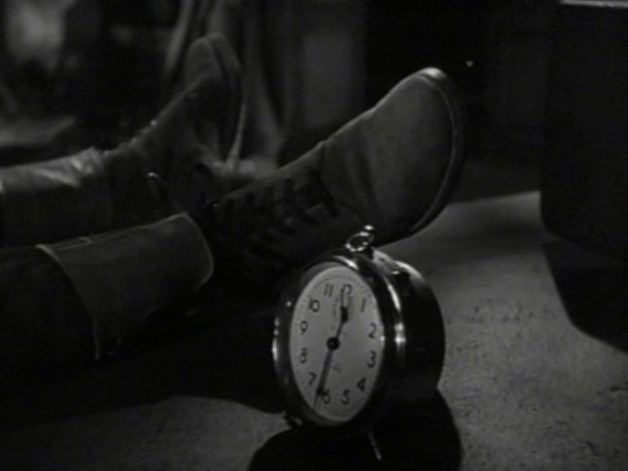
This movie marks the directorial debut of actor Dick Powell. His work here is strong, fast-paced, and solid. Note the alarm clock on the table in many scenes, reminding us that time is precious and slipping away from us. The script by William Bowers and Irving Wallace keeps the story moving briskly, with unexpected touches of macabre humor. This  keeps us and the characters on an even keel and brings us down to earth when our skin begins to crawl.

Keith Andes is a reporter assigned to cover the latest atom bomb test blast in the Nevada desert, but he gets taken off the story when a bigger one (if you’ve seen one atom bomb go off, you’ve seen them all) occurs. Murderer Stephen McNally and his partner Paul Kelly have broken out of prison and are on the loose.

Somewhere in the restricted test blast area.

Mr. Andes stops at a lonely desert diner and meets up with Jan Sterling, a night club dancer down on her luck, on her way to Reno. He comes up with the 50 cents for her pie and coffee. Yeah, we’ve seen this before. This part of the film, with the lone car driving on the dusty highway, the run-down diner, the gas pumps, looks like we’re about to enter a 1940s film noir nightmare. All the usual suspects start to show up.

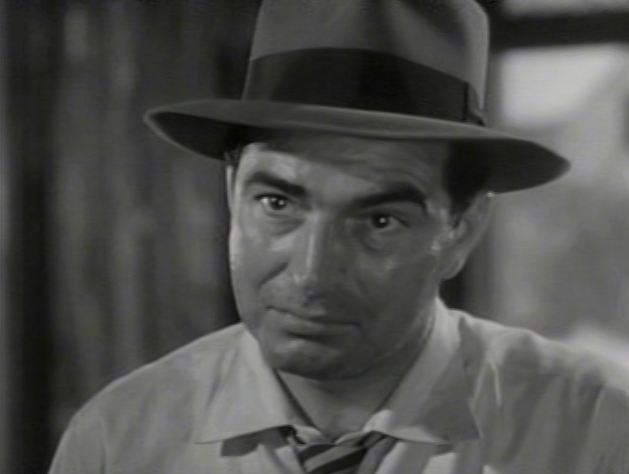
McNally, one of the very best bad men in movies, whose handsome, rugged charm and wry, funny delivery to his lines, is offset by his suddenly volatile personality. We don't dare take our eyes off him.  He's exciting.

Paul Kelly is his older sidekick, and he’s been shot in the stomach. McNally won’t ditch his friend. They meet up with a pal called Dummy played by Frank DeKova. Frank doesn’t say much, but he reads comic books constantly, and the subject matter -- atomic super heroes, is our first clue that we’re about to enter a weird new world.

Alexis Smith and Robert Paige drive up to the gas pump. She’s in the driver’s seat. For now. It will be the last time she has control in this movie. Her fur stole is over the back of the seat between them. He’s not her husband.

Alexis, who we lamented in this recent post about not getting very good roles during her contract with Warner Bros., gets a good role here. She’s the restless, well-to-do wife of a doctor back in California. She’s run off with family friend Mr. Paige, who sells insurance.

Which, forgive me insurance brokers, cracks me up. Funny how insurance salesmen always end up being the fall guy in the old movies. Think of poor sap Fred MacMurray in our favorite insurance movie, “Double Indemnity” (1944) which we covered here.

Mr. Paige is likewise behind the 8-ball because of some very bad choices and a very bad dame.


Eventually, all seven unlikely travelers end up packed together in Mr. Andes’ big woody station wagon with the leaky radiator, driving through the desert like a Bizzaro World field trip. Mr. McNally, smart enough to work an ace up his sleeve, calls Alexis’ doctor husband, played by Richard Egan. McNally threatens to kill Alexis unless Mr. Egan comes to their hideout and takes the bullet out of his pal Paul Kelly.

Their hideout, until they can hook up with the rest of the gang, is an abandoned saloon in a ghost town.

In the atom bomb test range.

We’ve been well warned that the bomb will go off at dawn, so the alarm clock is ticking. Stephen McNally, with the bravado of a psychopath, is willing to play “chicken” with the bomb, until his friend gets medical help. The ensemble cast suffers agonies -- over the bomb, over their own past and present mistakes, and must submit to the brutality of their captor.

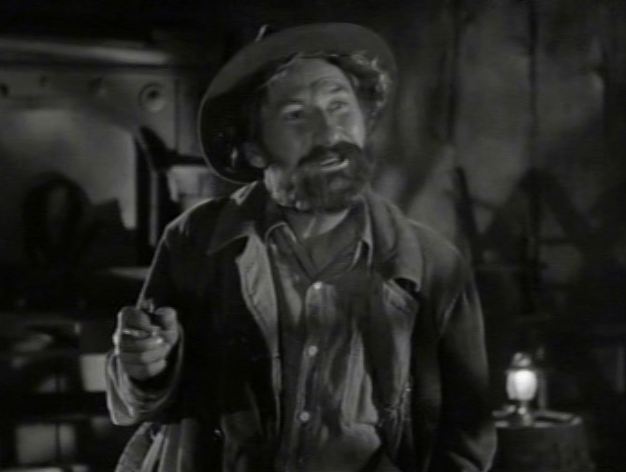
They are joined suddenly by Arthur Hunnicutt, who plays a folksy lone prospector on his way out of town. Mr. Hunnicutt, full of long-winded tall tales, brings humor to the script in his ability to annoy the others, but he’s also a safety value in his own homespun way. He’s a hoot.

They are a collection of interesting contrasts. Andes, the reporter, is not your typical cynical tough guy with rapid fire speech. He is quiet, easy going, charming, but passive. He’s willing to watch and bide his time.

Jan Sterling has some of the best lines, which she delivers with her blasé pout. Her character does not grow or change much, but she is a tough cookie with a heart and a conscience. When the doc shows up, she’s the one who helps with the operation.

At one point, McNally orders her to the kitchen of this old saloon “with that other dame to fix us something to eat.”

Being women, Alexis and Jan are naturally in charge of meals though they have nothing to cook. I am likewise, by virtue of my gender, able to put together a four-course meal with nothing but a can of beans, two soda crackers (Crown Pilots, ayah) and a teaspoon of Crisco. It’s a gift. Any woman can do it.


We never do get to see what they’ve had for supper, but afterwards they all settle down to listen to the portable radio and smoke. Just a relaxing evening at home.

The soft dance music and melodious ballads are interrupted by the radio announcer gleefully telling them, “We’ll try to give you ample warning so that you can get to your roofs and watch the flash from the explosion.”

Were we ever so innocent? I recall some comment singer/actress Kitty Carlisle made in her autobiography about watching a bomb blast from a hotel terrace, I think, in Las Vegas, a momentary distraction from a party. Like Alexis Smith in this movie, dressed to the nines.

These are strange days. McNally jokes about DeKova’s comic book, “In the next chapter, the Martians invade.”

The old prospector is fascinated by the bomb. A veteran of World War I, he marvels, “Just think what we could have done with a couple of them things at the Marne.”

Jan Sterling quips about their predicament, “Quite a spot. Between the devil and the bright red bomb.”

They are waiting for Richard Egan to show up, driving all the way from California into the restricted area here in Nevada. I’m not sure how he makes it through security checkpoints, but he’s Richard Egan. We trust him to do the job.

Alexis doubts he will come, knows that a cheating wife need not expect such devotion.

“He wouldn’t cross the street for me, much less risk his life.”

She tries to hedge her bets by urging her Insurance Man lover to do something.  Still, she is a little fascinated by the brute with the gun. Her Insurance Man looks less dashing in this dim light.  He is careful, perhaps regretting taking this trip, but when a leering McNally orders Alexis to go with him to the kitchen, Mr. Paige challenges McNally to a fight.

Mr. McNally, with a coolness that belies his own anxieties this evening, calmly shoots him dead. And drags Alexis off to the kitchen.

With a tear-streaked face she begs him not to kill her, but then the penny drops and she realizes he’s got another use for her just now. Hedging her bets again, she lets him kiss her. She’s not being clever or calculating, she’s just in a dead panic, like a drowning person ready to cling to anything floating by. If he wants a woman, by gorry, she’ll be his woman with everything she’s got.

Here’s where the subtlety of many classic films in addressing scenes of extreme violence or sexual situations is intriguing. We are taken back to the main room where the others sit and wait or sleep, or talk in whispered conversations. We get a tale from Jan Sterling about her miserable childhood and rotten parents. Time passes, but we don’t know how much time. Our attention is diverted to what is happening in the main room.

But we keep thinking about the sexual assault in the kitchen.

A funny paradox.  An explicit scene of violence that hammers the message home tends to make us draw back.  Here instead, lured into imaging the worst, we are drawn ever closer emotionally to the assault precisely because we have the safety of being voyeurs in our imaginations.

Alexis is eventually released from the kitchen like a skittish heifer after being branded -- self-conscious, shaky, nervously swiping her hair from her eyes. Jan Sterling sidles up to her, not to comfort, but to ask for a drink from Alexis’ hip flask and get the dirt.

Alexis, tense as a cat, fumbles with yet another cigarette, and masks degredation with another application lipstick, “Why don’t you just ask me what you want to know?”

“Do I have to?” Jan fires back, with a sarcastic smile. No, she doesn’t, and neither do we.

Richard Egan finally shows up to dig the bullet out of Paul Kelly. McNally needles Mr. Egan about his wife. “She decided not to depend on you entirely.” Alexis slinks away. The evening for her is a string of bad choices, panic, and humiliation. For everyone, a night of confidences, threats, secrets, and compromises.

McNally has had Alexis, so now he pursues Jan, who is smarter and better at pretending. She can handle McNally. She’s known men like him before.

Alexis, meanwhile, is baffled at Egan’s heroism.

“Are you still in love with me?” It's a fine moment; she's genuinely struggling to understand, perhaps even hoping that he does still love her.  She does not know, and even before this night is over, will never learn unselfishness and compassion. Her life has been ruled by her immediate desires, and she assumes that is everyone’s motive.

Mr. Egan is the stalwart, dependable man, a disappointed husband who’s been hurt enough and is more than willing to cut Alexis loose, (similar to his role in “A Summer Place” - 1959) but he’s genetically programmed to do the right thing and sticks his neck out for her, the room full of strangers, and his patient.

When the operation begins, Paul Kelly gets religion and wants a verse read from the Bible. The prospector has one in his gunny sack, right next to his gun.

His gun? Why he did not reveal to his fellow captives when he first arrived that he had a gun is a mystery and can only be chalked up to his maddeningly independent personality. He gets around to things when he gets around to them.

Nice, ironic scene where McNally reads to his pal in a flat voice, “Blessed are the meek for they shall inherit the earth” as the Sodium Pentothal is being injected.

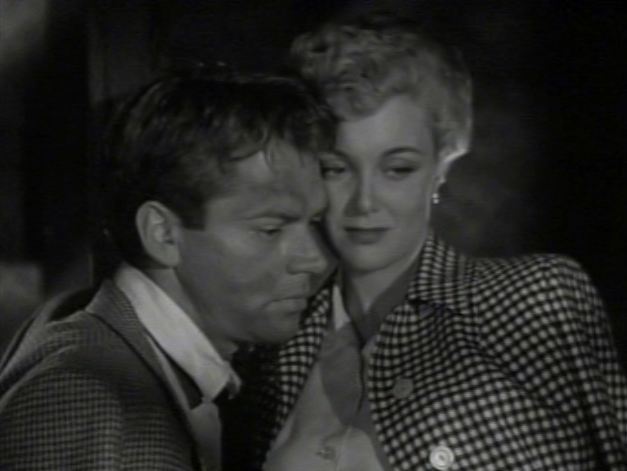
But the gun comes out during the operation when Mr. Andes makes a play for it. McNally beats him to a pulp, and even slaps around Jan Sterling for trying to interfere. This cements the bond between Andes and Miss Sterling, and in a cozy moment when they become resigned to the fact that they are probably going to die, he jokes, “Sooner or later one of us has got to learn to fight.”

“We’ll take up judo in the next world,” she replies. If there was more time there would be a romance, but touching their sore heads together is the best they can do now.

Now the morning dawns, and McNally gets ready to make tracks. Alexis hangs on to him, begging him to take her with him, but he responds, “You’re a real bad dame…nobody can count on you for ten seconds.” He is sickened by her. She has fallen so low that a murderer won’t dirty his hands with her.

We get taken from the ghost town for a moment to some government file footage on preparation for the test in the command bunker. A voice announces, “At 30 seconds the master robot will take over.”

I think that’s the scariest line in the movie. We are no longer able to make choices for ourselves, not once we’ve gone past a certain point. Then we are all slaves of the Master Robot.

Spoilers coming up, so head to the fallout shelter if you don’t want to know.

Last minute fisticuffs, last minute choices, and only two of the cons get away, with Alexis, who practically dives into the passenger’s seat. They drive in the wrong direction.

“The bomb!”

She needs to be with them because otherwise we wouldn’t care if they drove off into the bomb blast. As flawed a person as she is, she is still the most interesting character there (except for McNally, but we already have him figured out) -- I think mainly because of the complex and layered way she plays it rather than the way it’s written. We really don’t know which way she’s going to go, because neither does she.

In one of his last-minute confounding ruminations, the prospector announces there is an abandoned mine nearby where they can shield themselves from the atomic blast.

Now, why in the name of Aunt Mary’s knickers did he not say that before? That would have given everybody another interesting choice to mull over. Do they tell the bad guys? Or, do they play God and keep the cave for themselves? They already played God with poor DeKova, who gets knocked out and left to die. They could have dragged him to the mine with them. They just leave him there with the corpse of the insurance man.

What if Alexis, fairly crazed by the end of the movie, was given the chance to hide in the mine? What if McNally had gone through with plugging Paul Kelly with a bullet when Kelly betrayed him at the last minute?

“The master robot is now taking over” is the next announcement as McNally’s car spins its tires in the desert sand, and the other captives rush for the abandoned mine. All our choices are gone.

The blast, with its white light and nuclear wind demolishing the ghost town is similar to declassified test bomb blast footage you may have seen.

“Let’s take a look at the world of tomorrow,” Richard Egan grimly says as the survivors crawl from the mine. In 10 years they will probably all get cancer, but that’s another story. For today, it’s a flatter, whiter desert, and a giant mushroom cloud in the distance with the words “The End” written in script over it.

No monsters. Nothing is ever scarier than a bad reality.  Especially when we've caused it ourselves.