Showing posts with label Bing Crosby. Show all posts

Thursday, April 17, 2014

Ann Blyth - Profession of Faith


On February 20, 1955, Ann Blyth was given the Star of David Award at a charity ball in Los Angeles for her work in support of the Jewish Home for the Aged.  This was only one occasion of many when she had been noted for the charitable work she'd been involved in since she came to Hollywood, including both religious and civic organizations.  On another occasion, she was awarded an honorary Doctor of Humane Letters degree from St. Joseph’s College in Emmitsburg, Maryland, for her years of participation in these activities. 
Charity and civic work played a large part of her private life, but since this series is focused on her career, we’ll cover in this post those professional gigs that combined her acting career with her personal commitment to her faith.
She found herself part of a small colony of Roman Catholic actors in Hollywood, some of whom belonged to the Catholic Actors Guild, founded 1914.  Its first president was Jerry Cohan, George M.’s father.  Other members included Claudette Colbert, Pat O’Brien, Irene Dunne, Wallace Ford, Rosalind Russell, Ruth Hussey, Raymond Massey, Helen Hayes, and Jane Wyatt.
From time to time, some of these folks, Ann especially, appeared in a long-running radio program called Family Theater, which presented literary classics like A Tale of Two Cities, mixed with family dramas and gentle comedy.  The host, usually a guest actor, would remind the audience that praying together as a family would help lead to world peace.  Founded by Fr. Patrick Peyton, who established the Holy Cross Family Ministries, the program featured such other Hollywood luminaries as James Stewart, Bob Hope, and Barbara Stanwyck.  Fr. Peyton, you might recall, coined the phrase: "The family that prays together, stays together."
Ann’s first appearance on the show was in August 1947, and she appeared several times in the show’s run, which ended in 1957.  The Triumphant Hour was a kind of kin to this show, and she appeared on this radio program, and The Joyful Hour in December 1949, playing Mary to MacDonald Carey’s Joseph in The Nativity.  Bing Crosby and Dennis Day were part of a large cast.
In the late 1950s and 1960s, television broadcast The Christophers, where Ann appeared as a guest in a kind of talk show or panel discussion on such topics as: “Gear Yourself to a Fast Changing World” (1963), “Careers That Count” (1958), “You Can Change the World” (1951), “Give Children Good Reading Habits” (1960), and “Teen Agers: Today and Tomorrow” (1965).  “You Can Change the World” is no longer up at YouTube, but it featured a large cast including Irene Dunne, Loretta Young, Ann Blyth, Jack Benny, all in discussion with Fr. James Keller.  Though Jack Benny was along for comedy relief, it was William Holden’s concerned face being among the earnestly staged discussion that just sort of made me smile.
Here is a clip from a Family Theater short in celebration of Easter, with Ann Blyth singing “Come Holy Ghost.”  The clip demonstrates her rich, surprisingly powerful soprano voice, and I particularly like how relaxed she appears while singing, the leisurely pace of the song and her vocal technique itself creating drama.  It's a fine display of both her artistry, and her contentment in singing and in her faith.
A Happy Easter to those who celebrate it.


For those of you in the mood for a little Easter OTR (Old Time Radio), have a listen to Ann in "The Arbutus Bonnet," a dramatic episode of Hallmark Playhouse, hosted by author James Hilton, in a script adapted by Jean Holloway (one of my favorite radio and TV writers).  It was broadcast April 6, 1950.  Scroll down to "50-04-06" and download or listen.
Come back next Thursday when we discuss the delightful comedy Sally and Saint Anne, a coming-of-age story where small-town girl Ann Blyth suffers vast growing pains amid a daffy family in a circus of a home.  She has the help of her best buddy, Saint Anne.

 
*************************

Pittsburgh Press,May 8, 1964; also article by Carl Apone, July 28, 1968, p. 13.

*************************

THANK YOU....to the following folks whose aid in gathering material for this series has been invaluable:  EBH; Kevin Deany of Kevin's Movie Corner; Gerry Szymski of Westmont Movie Classics, Westmont, Illinois; and Ivan G. Shreve, Jr. of Thrilling Days of Yesteryear.

**************************

HELP!!!!!!!!!!

Now that I've got your attention: I'm still on the lookout for a movie called Katie Did It (1951) for this year-long series on the career of Ann Blyth.  It seems to be a rare one.  Please contact me on this blog or at my email: JacquelineTLynch@gmail.com if you know where I can lay my hands on this film.  Am willing to buy or trade, or wash windows in exchange.  Maybe not the windows part.  But you know what I mean.

Also, if anybody has any of Ann's TV appearances, there's a few I'm missing from, Switch, The Name of the Game, The Dick Powell show, the Dennis Day Show (TV), the DuPont Show with June Allyson, This is Your Life, Lux Video Theatre.  Also any video clips of her Oscar appearances.  Release the hounds.  And let me know, please.

***************************************
In response to the number of kind people who've requested print copies of my eBook Classic Films and the American Conscience, which is a collection of essays from this blog -- I still can't print that book because you wouldn't be able to lift it, and I couldn't afford to print it.  BUT, I'm putting out a new, smaller, collection of essays, some old, some new, from this blog titled Movies in Our Time: Hollywood Mimics and Mirrors the 20th Century.   It will be issued in eBook as well as print, and I'll let you know more about it down the road.  I hope to have it published sometime in May.


Thursday, March 13, 2014

Top 'O the Morning - 1949


“Top ‘O the Morning” (1949) is yet another example of how much the Irish love to parody themselves, or more specifically as in the case of this Hollywood-made movie, how much Irish Americans love to parody the Irish.  Only the real Irish in Ireland know the truth behind the silliness, and are usually quite forgiving of the Irish American cousins for believing their own fantasies about Ireland.  I suppose it’s too hard-hearted slap down someone who idolizes you so much.
This is our tribute to upcoming St. Patrick’s Day and Ann Blyth’s affinity for her Irish ancestry.
The movie is a comedy, a mystery, and a love story, but a partnership not always so much between leads Bing Crosby and Ann Blyth, as between Bing Crosby and Barry Fitzgerald, and a love between the Irish Americans with Ireland. 
The story is a cute idea.  The famed Blarney Stone in Blarney Castle has been stolen, and Bing Crosby, an American insurance investigator—nothing like the hard-edged Edward G. Robinson in Double Indemnity (1944)—is on the case.  However, like, Fred MacMurray in that same movie, Bing does take to relating his impressions into a Dictaphone.  More of our (okay, MY) fascination with recording devices in movies in this previous post.
 
Barry Fitzgerald plays the village constable.  His re-match with Bing Crosby, a partnership that first brought success to both of them in Going My Way (1945), is the focus of the film.  Mr. Fitzgerald is a crusty, pompous codger, has no idea how truly innocent he is, and holds the reigns of authority in this village only in his own mind.  The villagers, even his own daughter, acknowledge that he is not taken seriously and that solving the crime of the stolen Blarney Stone might finally get him the respect he craves. 
Hume Cronyn is his assistant, delightfully played with  excitable hero-worship of his superior, but as the plot progresses, we see that Mr. Cronyn has more going on under the surface.  “All the excitement!  It’s a pity Ireland doesn’t have more to steal.”
Eileen Crowe, who, like, Barry Fitzgerald was a product of Dublin’s famed Abbey Theatre, plays Biddy, a village crone with great wit and wisdom.  She’s the go-to gal for legends, premonitions, and curses.  I love her observation: “It does little good to put a curse on Americans.  They don’t seem to know the difference.”
It’s odd to think the actress playing the old woman is actually only 51 years old in real life.
John McIntire has a small role as the district police superior to Barry Fitzgerald, a much smarter, no-nonsense guy to who works with Bing Crosby to solve the crime.  Mr. McIntire will come back to us next month when we cover Sally and St. Anne(1952) in a wonderfully comic role, quite different from his normal fare of tough guy supporting players.  We’ll meet him again a few times later this year in other Ann Blyth films, and especially next week when we join Ann for a ride on McIntire’s Wagon Train.
Look for Mary Field as a chambermaid, who gets to sing a line or two with Bing.  We last saw her here as the hilarious saleslady selling bikinis to William Powell in Mr. Peabody and the Mermaid (1948).
 
Ann Blyth plays the daughter of Barry Fitzgerald.  She keeps house, feeds Da porridge for breakfast, and keeps track of how many times she has been kissed in her life.  She longs for her true romance, and falls for Bing Crosby, but though certainly none of Crosby’s movie romances were terribly romantic—he tends to coast through these roles without much fire, she gives us the perfect dream-image of a lovely and spirited Irish lass. 

She gets to sing a duet with Bing, but apart from that and a line in the crowd number, the foot-stomping “The Donovans,” that’s all we get to hear.  Bing gets most of the songs.  It was Bing’s production company that made the film, distributed through Paramount.
Reportedly, his first choice for the female lead was Deanna Durbin, but she turned down the offer, planning her final escape from Hollywood and a life of happy retirement.  There were several career connections or coincidences between Deanna Durbin and Ann Blyth.  Ann was discovered while touring in Watch on the Rhine, discussed in this intro post, by Universal director Henry Koster, who made several films with Deanna Durbin and may have seen something in Ann to remind him of her.  Ironically, despite having brought her to Universal, he never directed a film with Ann Blyth.
There may have been, in the beginning of Ann’s film career, a tendency to regard her as “the other” Deanna Durbin.  A syndicated article by Harold Cohen when she was signed to Universal in December 1942 noted, "Pretty little Ann Blyth of Watch on the Rhine may be Universal's new Deanna Durbin...although she doesn't sing in the play, she has a lovely voice..."  Because of her first four light musicals, she may have been groomed to be a second-string Deanna Durbin (even as, when she arrived at MGM, Ann may have been considered a second-string Kathryn Grayson).  If, indeed, in both cases she was regarded as a spare soprano, it may explain in part why Ann had such difficulty getting the prime musical roles she desired.  We'll talk about her MGM musicals down the road.
 
I find it odd that, since she was so adept at drama, but was also a trained singer, the studios for which she worked did not find a way to slip in a song or two in more of her non-musical films.  For instance, in something like I’ll Never Forget You (1951), which we discussed here (and will discuss again later in the year), it would seem like a natural fit to have this actress with her trained singing voice at a pianoforte performing an air from the historical period of this time-travel piece.  Anytime you see a dramatization of, say, a Jane Austen novel, there’s always going to be a woman banging out a tune on a pianoforte and singing.
I would compare Ann to Irene Dunne, who was also adept at drama and comedy.  But Miss Dunne sang often in her films, even those not considered musicals.  Consider Love Affair (1939), which we discussed here.
Irene gets that wonderful moment where she plays and sings “Plasir d’Amour.”  Life with Father (1947), discussed here, gives us the lovely duet with William Powell on “Sweet Marie”. 
You can better believe that if Irene Dunne were in a movie that was staged entirely in a broom closet, they’d find some way of stuffing a piano in there too.
But though Ann Blyth’s versatility as an actress was celebrated in the press in these early years of her career, her singing talent seemed under-utilized.  She should have gotten more singing time in Top 'O the Morning.  She should have gotten more singing time in lots of movies.
Bing is a nice guy in this movie; he’s always a nice guy, which makes his first song “When Irish Eyes are Smiling”, sung to a little girl when he’s getting his passport photo taken for the trip to Ireland, slow and unnecessary.  We already know his character.  It’s the one he usually plays.  It is a wasted opportunity for him not to be singing it to, or with, Ann Blyth, as he does in this clip here.


This clip, performed on the set of Top ‘O the Morning was actually filmed for Family Theater, a Catholic media production as a program promotion.  It’s a shame the duet doesn’t appear in the movie, but it’s nice that it was preserved on film anyway.  She’d get to sing "Toora Loora" on TV’s Ford Startime with Art Linkletter in a variety episode called “The Secret World of Kids”, broadcast October 27, 1959.
In September of this year, 1949, (a month after Top ‘O the Morningwas released) Ann would appear with Bing on the Lux Radio Theater in “The Emperor Waltz”, but here, too, he gets the lion’s share of the songs as the happy-go-lucky phonograph salesman pitching his wares to Ann’s stuffy duchess in turn-of-the century middle Europe.
Top ‘O the Morning is a sweet, pleasant movie, but critics’ chief complaint seemed to be the ersatz feel of Paramount soundstage  rather than the rustic Irish landscapes, and vigorous if equally-self parodying dialogue, we would be treated to later in John Ford’s The Quiet Man (1952).  To be sure, we do have a requisite shot of Blarney Castle slipped in, but for the most part, it’s a Hollywood version of Ireland.
Barry Fitzgerald’s humble cottage, when we visit for a party, suddenly seems as large as a Costco inside to accommodate all the dancers.  Ann gets to jig a wee bit, and in “The Donovans” number, young Jimmy Hart, a boy who figures prominently in the plot, starts to sing a verse with what we may presume to be a Guinness in his hand when he is promptly slapped in the head by Barry Fitzgerald.  A favorite moment of mine, as a little slapstick is suitable to almost any occasion.
Another cute scene where Ann, trying to find clues to verify an old legend with which Bing is unaware he has a major role, keeps sneaking peeks into the different pockets of his coat while they are dancing.  He gives her a “what a weirdo” look, and wonders if she’s a closet pickpocket.
 
The climax of the film, quite unexpectedly, has a more serious, even sinister tone, as the mystery is solved and the real thief of the Blarney Stone is discovered, the thief also having committed murder.  For some critics, this was too drastic a change in mood from lighthearted to sinister, but I like it.  A little Celtic noir.  A little slapstick.  A little romance.  A little porridge.  Did not G.K. Chesterton make the mercurial Celtic nature most plain when he wrote:

For the great Gaels of Ireland
Are the men that God made mad,
For all their wars are merry,
And all their songs are sad.

There is a happy ending—especially for the insurance company.  Now they won’t have to pay out.
Ann Blyth’s Irish accent in this film, we may presume, came without much difficulty.  As mentioned in our intro post here, Ann’s mother was originally from Dublin (a Lynch girl, which automatically makes her swell), and Ann grew up hearing the accent at home, as well from the aunts and uncles who emigrated along with her mother to the US, including the aunt and uncle with whom she made her home after the death of her mother.  According to one reporter for The Milwaukee Journal, that aunt, Mrs. Catherine Tobin, “…has a brogue so thick that she is sometimes difficult to understand.”
This movie is embroidered with a lingo of enthusiastic superlatives: “I tracked him gallantly.”  “That’s a gigantic reply."
That autumn of 1949, Ann was planning her first trip to Ireland with her aunt and uncle, hoping for a break in her film schedule the following year.
 
Ann Blyth strongly identified with her Irish ancestry and her mother’s birth country.  She had several aunts, uncles, and cousins still living there, and it must have been a deeply emotional moment when she visited her late mother’s hometown of Dublin for the first time.
St. Patrick’s Day 1950 kicked off her Irish year when The Ancient Order of Hibernians in Los Angeles named her the year’s outstanding Irish screen or radio performer, presenting her with a statuette at their St. Patrick’s Day Ball.
Columnist Sheilah Graham noted after Ann’s return from the Auld Sod, “Ann Blyth is dreamy-eyed when she talks of meeting a ‘Hundred of my relatives in Ireland.  I had my own claque when I appeared at the Royal Theater in Dublin.’"
Louella Parsons wrote, “She had a wonderful summer there with her aunt and uncle and all their many friends...“‘Ireland is even nicer than I ever dreamed it could be,’ Ann said…‘And how willing they are to go out of their way to make you happy.  And those people are so contented with so little.’”
Top ‘O the Morning got the Lux Radio Theater treatment on St. Patrick’s Day, March 17, 1952, with Barry Fitzgerald and Ann Blyth reprising their roles.  You can have a listen here, scroll down to the episode.  In Bing Crosby’s shoes this time is singer/comedian and Jack Benny sidekick, Dennis Day.  Mr. Day would figure prominently in Ann’s future.  His younger brother, James McNulty, would become Ann’s husband the following year in 1953.  Both she and her husband would make cameo appearances on Dennis Day’s TV show in the 1950s, and Ann would join her brother-in-law in concert in distant future.  More on that later.
Ann celebrated another St. Patrick’s Day, in 1959, with her husband at the White House where President Dwight D. Eisenhower invited her to sing for the visiting President of Ireland, Sean O’Kelly.

Have a look at Laura's take on Top O' the Morning here at Laura's Miscellaneous Musings.
Happy St. Patrick’s Day to those who celebrate it.  Beannachtaí na Féile Pádraig oraibh.
May the road rise with you,
May the wind be always at your back,
May the sun shine warm upon your face,
And the rain fall soft upon your fields.
And until we meet again,
   may God hold you
   in the palm of His hand.
Here's "The Donovans" number currently playing on YouTube:

 
Come back next Thursday when we join Ann as an ornery saloon gal, Dick York as stumblebum bank robber, John McIntire as the unluckiest wagon master in the west, and a little boy with an ugly disposition in a comic episode of TV’s Wagon Train  from 1961 called "The Clementine Jones Story."  It's part of the Big Stars on the Small Screen Blogathon hosted by Aurora over at How Sweet It Was.

*************************
Milwaukee Journal, November 2, 1949, p. 1.
Milwaukee Sentinel, syndicated article by Louella Parsons, March 13, 1959, part 2, p. 2.
Paley Center for the Media website.
The Pittsburgh Post-Gazette, December 3, 1942, syndicated article by Harold V. Cohen, p. 22.
Spokane Daily Chronicle, March 10, 1950, p. 20
The Spokesman-Review, syndicated article by Sheilah Graham, August 20, 1951, p. 5
St. Joseph (Missouri) News-Press, syndicated article by Louella Parsons, December 16, 1951, p. 4D.

************************

HELP!!!!!!!!!!

Now that I've got your attention: I'm still on the lookout for a movie called Katie Did It (1951) for this year-long series on the career of Ann Blyth.  It seems to be a rare one.  Please contact me on this blog or at my email: JacquelineTLynch@gmail.com if you know where I can lay my hands on this film.  Am willing to buy or trade, or wash windows in exchange.  Maybe not the windows part.  But you know what I mean.

Also, if anybody has any of Ann's TV appearances, there's a few I'm missing from Burke's Law, Switch, The Name of the Game, The Dick Powell show, the Dennis Day Show (TV), the DuPont Show with June Allyson, This is Your Life, Lux Video Theatre.  Also any video clips of her Oscar appearances.  Release the hounds.  And let me know, please. 

**************************

Oh, and while I still have you on the line, here's one more thing.  In response to the number of kind people who've requested print copies of my eBook Classic Films and the American Conscience, which is a collection of essays from this blog -- I still can't print that book because you wouldn't be able to lift it, and I couldn't afford to print it.  BUT, I'm putting out a new, smaller, collection of essays, some old, some new, from this blog titled Movies in Our Time: Hollywood Mimics and Mirrors the 20th Century.   It will be issued in eBook as well as print, and I'll let you know more about it down the road.  I hope to have it published sometime in May.

Monday, April 23, 2012

Answers to More Typists

Some great guesses for these movie typists.  The answers are:

1.  Allen Jenkins ponders his next sentence as Errol Flynn's secretary/chauffeur in "Footsteps in the Dark".

2. Burt Lancaster in "Mister 880".

3. Bing Crosby in "Here Comes the Groom".

4. Jean Arthur in "A Foreign Affair".

5.  Kim Novak in "Middle of the Night."

6.  Jean Arthur, again, in "More Than a Secretary" - Jean seems to be giving Barbara Stanwyck a run for her money as Hollywood's most prolific typist.

7.  Bing Crosby and Jane Wyman in "Here Comes the Groom" about to tap out a chorus on the typewriter.

Thanks for playing along.  No post this Thursday, but I'll see you next Monday

Thursday, December 15, 2011

World Without Blow Dryers - Answers

The answers to our screen caps in Monday’s post “In a World Without Blow Dryers” -

1. - That’s Cary Grant toweling Rita Hayworth’s tresses in “Only Angels Have Wings” (1939), which we discussed here.

2. That’s Bing Crosby toweling Alexis Smith’s tresses in “Here Comes the Groom” (1951), which we discussed here.

3. That’s Ruth Donnelly (the perennial wisecracking best pal) toweling Jean Arthur’s tresses in “More Than a Secretary” (1936), which I hope to cover sometime in the new year.

4. That Jessica “Jessie” Grayson scrubbing Teresa Wright’s scalp in “The Little Foxes” (1941). I always loved this scene. She does such a mercilessly thorough job. It’s fun to watch. Miss Wright may have been half drowned by the end of it, but she had very clean hair.  For the rest of her life, probably.

Thursday, October 13, 2011

Alexis Smith


Alexis Smith had a rare opportunity to stretch her acting muscles in “The Constant Nymph” (1943), discussed here in Monday’s post. She remains for me a mystery, a particularly interesting actress both for her ability, which I suspect was far greater than she was usually allowed to demonstrate; and especially for that very fact that she wasn’t allowed to demonstrate it very often.

Odd, when you consider she was plucked out of college to be fashioned into “The Dynamite Girl” by Warner Bros., subjected to the usual flurry of sexy publicity photos, and was soon paired with greats such as Humphrey Bogart, Errol Flynn, Cary Grant, Charles Boyer, Clark Gable, and Fredric March. (We’ve covered “Conflict” -1945 here, and “Any Number Can Play” - 1949, here.)

Both 5'9", Charles Boyer and Alexis Smith see eye-to-eye in "The Constant Nymph" even if their characters do not.

Despite easily being able, whether the material was good or not, to shine in her roles, sometimes steal scenes outright just by the force of her own splendid magnetism, she was often relegated to parts where she played little more than a type: a clothes horse, an ice princess, an elegant but haughty love interest.

In the 1950s, when her contract at Warners ended, she had fewer roles if a bit more variety in them. Also, time was catching up and she endured a series of those older repressed woman roles, the typical leavings of that era for aging actresses of Hollywood’s Golden Age. Aging? She was only in her 30s at the time.

But, despite sometimes having very little to work with, she made the most of them. In “The Young Philadelphians” (1959), she plays the lonely, stifled trophy wife of an elderly man. Paul Newman is his young assistant. From the moment they meet, Alexis and Mr. Newman are intrigued by each other, leading to, but not quite reaching, a love affair. Though Paul Newman is quite good in this movie, (actually so is Robert Vaughn in a minor role), much of the drama is pretty flat. Alexis Smith stole the film, what few minutes she had in it, and would have been a far more exciting partner for Newman than the rather predictable debutante played by Barbara Rush.

So, what seems strange about her career is not so much missed opportunities of roles she never got, but that she was chronically under-used.  The characters she played never went far enough or deep enough.  It takes a special kind of actress to enhance what is not on the page.

One of my favorite roles of hers is in “Here Comes the Groom” (1951), discussed here, where, as a second lead, she plays the awkward, lovelorn goof, too gangly and socially inept to get out of her own way. It’s as if she’s making fun of her earlier ice maiden roles. Bing Crosby teaches her how to be a hot tomato.

At one point he asks her why she wears ugly, sensible shoes.

“Because I’m too tall, if you must know!” she blurts out with building hysteria, which is endearing, as if it is her most embarrassing secret.

It seems too simple, but I can’t help wondering if that was it all along. In a 1980 interview with the Los Angeles Times, she noted that, "At the time, only cute little girls did musicals…It doesn't work out so badly now, but when you're 5 feet 9 in high school, you'd give anything to be a cute little girl."

Did her height set her off as patrician and aloof, and austere?  Did her striking appearance make her a square peg?

In the 1946 “Night and Day”, which attempted, sort of, to present the life of Broadway composer Cole Porter, a cast including Eve Arden, Mary Martin, Jane Wyman, and Ginny Simms belted out a smashing array of Cole Porter hits. Alexis Smith played Mrs. Porter. Everybody with a studio tour pass that day got to sing and perform in this movie. Including Monty Woolley, gosh-all-hemlock. Not Alexis. She spent the entire movie smiling encouragingly at Cary Grant from the audience while he avoided her for his work.

What a waste.

Now the calendar pages flip furiously and we jump a few decades into the future. Have a look here at this cover from Time Magazine, May 3, 1971. Go ahead, I’ll wait.

(Wipes her glasses on her shirt tail. Hums the first two acts of the score of “Rigoletto”. Sharpens a couple of pencils.)

Back? Good. You have to pull that screen door or it won’t shut.

Now then…

That’s Alexis, at 50 years old, svelte, sexy, and doing a chorus girl’s high kick in the Broadway show “Follies” at the Winter Garden.   Resurrecting a wobbly career that had died and given up the ghost.  So people thought.

The cover of Time.

It’s been called the biggest career comeback ever. (Here’s the lead the article by Peter De Vries.)

“Follies”, music and lyrics by Stephen Sondheim, directed by Hal Prince and Michael Bennett, was a remarkable production for many reasons. Since I’m not sure how many theatre buffs read this blog, I’ll just say it was a groundbreaker and leave it at that. It is a complex show, where several aging “Follies” stars must revisit the aspirations, and mistakes, of their former selves (which are moving about the stage like ghosts). Alexis, similarly, may have been working out a lot of demons about her real former film career while on this gig.

This gig, for which Alexis Smith won the Tony Award for Best Lead Actress in a Musical.

Best actress in a musical. Hear that, Jack Warner?

Author Ted Chapin, who wrote “Everything Was Possible - The Birth of the Musical ‘Follies’” (Alfred A. Knopf, NY, 2003), mentions Alexis Smith being overheard during rehearsal after reading another publicity article where she was inevitably and tiresomely pronounced “tall and striking”.

“She remarked: ‘I wish I could someday play someone short and fat.’” (pp. 56-57)

And here she is below, the tall girl, doing her big, flashy number from “Follies” in her now iconic red dress. Just having a clip, any clip, from a Broadway show is a treasure because it’s so rare, especially in those days when people didn't have cell phones and tiny video recorders to sneak into the mezzanine and secretly tape stuff.

Michael Bennett’s choreography from this show is fantastic (of course it was, it was by Michael Bennett), and you get a hint of it here, the inventive placement of male chorus dancers with their backs to the audience, navigating a multilevel raked set. It’s not the best quality video or audio, but heaven bless the person who cleaned it up and shared it. Note how the tempo picks up as the song moves along. By the end of the song, the pace is frenetic. Alexis doesn’t miss a beat.

She’s 50 years old. She’s hustling like a 20-year-old theatre gypsy.

Humphrey Bogart, Clark Gable, and Errol Flynn are dead. Cary Grant’s retired.

Did not do her own singing in "San Antonio". 

She’s not being dubbed with someone else’s voice, like she was in “San Antonio” (1945).

She is not wearing a body mic.

The director/producer was looking for old movie queen has-beens (Yvonne De Carlo also had a memorable minor role in the show) to push the drama and the pathos, and the angst of aging. What better people to illustrate faded dreams than by using performers whose careers were long behind them and never did live up to their potential?

The tall girl shoved it all down their throats.

Remember to scroll down to the bottom of the page and mute the music so you can hear the video.


After many script changes in the out of town tryouts, she was given this new number to learn at the 11th hour.  Again, here from Ted Chapin’s book: “Alexis Smith was quietly working away. No one was aware of it, but she was working harder and pushing herself further than anyone else.” (p.63)

When given the football, she surprised everyone.

“…For the cold, regal woman who spit out acid remarks all night long to emerge in red fringe, revealing a terrific pair of legs, and dance up a storm -- well, that was revelatory. And it had turned out that Alexis was also a really good actress, well able to get laughs, be hard-edged when called upon…when it came to pure showbiz, it was the sexy movie lady in the red dress who won the day -- and stole the show.” (p.283).

Here’s another clip, a song from that same show, but performed 14 years later in 1985 as part of the “Best of Broadway” TV special from the PBS “Great Performances” series. She was 63 years old here, still spitting her character’s protective sarcasm borne of years of hurtful neglect. I expect she knew something about that, professionally speaking. There is a live studio audience, but since this is set up specifically for TV, she must obviously play to the cameras as well. Look how pointedly she hits her marks. That’s a movie star.


And a Broadway star. She did some other shows. In 1979, the year after studio head Jack Warner died, she won another Tony nomination for her role in the musical “Platinum.”

With the passing years she seemed to grow into that patrician elegance that the Warner Bros. studio decided she should have had at 20. It came more naturally to her now. She had fun with it sometimes, in regional theater, a few more films and TV guest spots. She was nominated for an Emmy for a guest role in 1990 on the NBC series “Cheers”. She was 69 years old.

Then her natural evolution into a grand dame, in a small role in “The Age of Innocence” (1993). A graceful and dignified curtain call for her, it was released to theaters a few months after her death. She left behind her husband of 49 years, fellow actor Craig Stevens, best remembered for his “Peter Gunn” TV series, and with whom she sometimes appeared in stock.

She was said to be well-liked by movie crews back in the day, was a hard worker, and fanatically took lessons on various subjects most of her life, a disciplined, intelligent woman who followed her curiosity with passion. In middle age, she was still taking singing and dancing lessons.

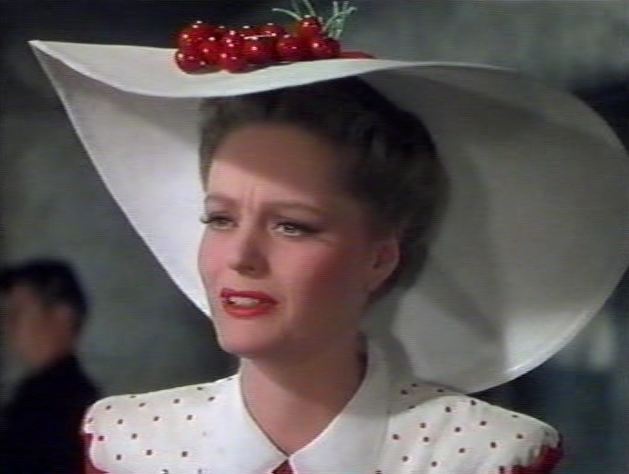
Probably was also not responsible for this hat with the bobbing cherries on top from "San Antonio".

She once famously remarked that she never watched her movies on TV because they weren’t that good when they were made and probably would not have improved with time.  Still, she made her characters as interesting as she could from whatever lofty perspective she had on life at 22, at 30, at 39, at 69…

At 5-foot-9.

The Time Magazine article from 1971 mentioned above noted that she had, “unbeatable, unbeatable cool.”

I suspect she always had; but we were allowed only glimpses -- if someone passed her the football.

Monday, July 4, 2011

Happy Independence Day


Happy Independence Day.  Have a look at this link for the scene in "Holiday Inn" (1942) which features the above Bing Crosby in a musical salute to the day.   Below, have a look at a 1942 rendition of "The Star Spangled Banner" by Fred Waring and his Pennsylvanians.  Don't forget to stand.

(And don't forget to scroll to the bottom of the page and pause the music so you can hear the video.)