Showing posts with label Cary Grant. Show all posts

Monday, May 14, 2012

North by Northwest - 1959


“North by Northwest” (1959), a forerunner of James Bond-type spy action flicks, a witty who-done-it-and-where-is-he, is also, at times, a comedy with style, elegance, sexual innuendo, and trains, sometimes all at once.

It’s the train we’re going to discuss today, now that I’m in withdrawal from my favorite holiday - National Train Day.

And we’ll also talk about the sex. Never have the two been so closely linked.

Today’s post is our contribution to the For the Love of Film: The Film Preservation Blogathon III. This year, the intrepid host trio of Farran Smith Nehme of Self-Styled Siren, Marilyn Ferdinand of Ferdy on Films, and Roderick Heath of This Island Rod are raising funds for the National Film Preservation Foundation's project, The White Shadow, directed by Graham Cutts -- which was “written, assistant-directed, and just generally meddled with in a number of different ways by the one and only Alfred Hitchcock”.


Please visit the three blogs of our hosts for lists of other blogathon participants and contribute if you can to the National Film Preservation Foundation.

In “North by Northwest”, Cary Grant is an advertising executive caught in a web of cold war intrigue and murder when he is mistaken for somebody else. His wit and his charm make for easy transitions to the moments of the film that are by turns elegant, mysterious, and even quite funny. Director Hitchcock and writer Ernest Lehman skillfully blend all these elements in a delightful way.

There is of course another element, one of suspense, of danger if not outright terror to Grant’s character, who through the course of the film is kidnapped, nearly killed several times, chased by the police as a suspected murderer himself, and dance partner to a homicidal crop duster.

The terror, I think, would be stronger if someone like James Stewart were in the role. Mr. Stewart had the ability, greater than Grant’s, I believe, to convey panic and psychological torment. If Stewart had been the man on the run, we’d worry more about him. Cary Grant, however, has that panache, that confidence in himself that makes us have confidence in him. We somehow know all along he’ll be fine.

He is, however, more fitting for the erotic train sequence than Mr. Stewart, whose vulnerability was part of his own particular charm. Grant shuttles us into the sexy 1960s.  He's more swinger than victim.

In “North by Northwest” the train, though often a place of mystery and even terror in Hitchcock films, instead becomes a safe haven, a place of romance, and at the end of the film is revisited for a happy ending.

Mr. Grant, on the run, and on his way to Chicago, slips aboard the 20th Century Limited in New York. Have a look at our previous trip aboard this famous train in “Twentieth Century” (1934).


The stowaway bumps into Eva Marie Saint in a corridor, where she smoothly diverts the cops who are chasing him. We might wonder why, since they are strangers and she seems not to care that he is wanted by the police. We soon learn she is not all she seems to be. For now, her mystery, like a delicate perfume, fills the train car and that is enough. We are in no great hurry, and neither is she.

Grant encounters her again in the dining car, where their ordering of brook trout invariably invokes for me the scene of Claude Rains’ petulant ordering of brook trout in “Deception” (1946) discussed here.

When you’re in a train dining car today, you still get the tablecloth, the bud vase with the flowers, but if you want a chance encounter with someone like Cary Grant, you’ll have to arrange that beforehand.

Which, it seems, is what Eva Marie Saint and her cohorts did.

Thorough planning is the sure way to a more pleasurable trip.

Though Cary Grant’s patented suaveness leads us to expect a tryst with the lady, it is really Miss Saint who controls the scene with such leisurely, and serene, seduction.

“It’s going to be a long night…and I don’t particularly like the book I’ve started…You know what I mean?”

“Tell me, what do you do besides lure men to their doom on the 20th Century Limited?”

She cups his hand when he lights her cigarette, drawing his fingers close to her lips so she can blow out the match.

We cut to her compartment where he is stuffed into the closed upper berth, hiding while the cops inspect her room. They spend the night together, without us. She will hide him a third time the next morning when she disguises him as a redcap carrying her luggage.

We are always aware of the threat against Grant, racing from the cops, racing against time, but the mystery and the threat is diminished on the train because we are distracted -- by Eva Marie Saint, and by the scenery, some of it quite lovely, passing outside the train. The looming Hudson River following us, the industrial backyards of steel and soot, and the blinding red sunset into which we are flying. Rather than leaving behind the outside world, it comes along for the ride.

Other locations in the movie, the mansion, the hotel rooms, the United Nations Building, even the Mt. Rushmore National Memorial are interesting and evocative -- but they are all mostly sets, and rear screen, and stagy looking. The train, with its controlled closed environment and rear screen scenery, is oddly natural looking, the only part of the film where we find dependable reality. However, here the familiar and ordinary is made exotic with the introduction of sex.

So powerful is the train in this movie that later in the film, when Grant and Saint are clinging to the rocky cliffs in South Dakota, about to plunge to their deaths, he says, “If we ever get out of this alive, let’s go back to New York on the train together…”

“Is that a proposition?” she replies.

Oh, yeah. Trains and romance. It’s the best kind of proposition.

Our final scene, he pulls her up to their awaiting upper berth, once more in the safety, but irresistible intrigue of the train.

“This is silly,” she says.

“I know. I’m sentimental.”

The last shot has the train entering a tunnel. Yes…well. Obvious and sophomoric perhaps, but at least symbolic and not graphic. Hitchcock may lead us around by the nose, but he still expects us to have an imagination.

Have a look at the other blogs participating in this worthy event, and please make your donation below to the National Film Preservation Foundation.


Thursday, December 15, 2011

World Without Blow Dryers - Answers

The answers to our screen caps in Monday’s post “In a World Without Blow Dryers” -

1. - That’s Cary Grant toweling Rita Hayworth’s tresses in “Only Angels Have Wings” (1939), which we discussed here.

2. That’s Bing Crosby toweling Alexis Smith’s tresses in “Here Comes the Groom” (1951), which we discussed here.

3. That’s Ruth Donnelly (the perennial wisecracking best pal) toweling Jean Arthur’s tresses in “More Than a Secretary” (1936), which I hope to cover sometime in the new year.

4. That Jessica “Jessie” Grayson scrubbing Teresa Wright’s scalp in “The Little Foxes” (1941). I always loved this scene. She does such a mercilessly thorough job. It’s fun to watch. Miss Wright may have been half drowned by the end of it, but she had very clean hair.  For the rest of her life, probably.

Thursday, October 13, 2011

Alexis Smith


Alexis Smith had a rare opportunity to stretch her acting muscles in “The Constant Nymph” (1943), discussed here in Monday’s post. She remains for me a mystery, a particularly interesting actress both for her ability, which I suspect was far greater than she was usually allowed to demonstrate; and especially for that very fact that she wasn’t allowed to demonstrate it very often.

Odd, when you consider she was plucked out of college to be fashioned into “The Dynamite Girl” by Warner Bros., subjected to the usual flurry of sexy publicity photos, and was soon paired with greats such as Humphrey Bogart, Errol Flynn, Cary Grant, Charles Boyer, Clark Gable, and Fredric March. (We’ve covered “Conflict” -1945 here, and “Any Number Can Play” - 1949, here.)

Both 5'9", Charles Boyer and Alexis Smith see eye-to-eye in "The Constant Nymph" even if their characters do not.

Despite easily being able, whether the material was good or not, to shine in her roles, sometimes steal scenes outright just by the force of her own splendid magnetism, she was often relegated to parts where she played little more than a type: a clothes horse, an ice princess, an elegant but haughty love interest.

In the 1950s, when her contract at Warners ended, she had fewer roles if a bit more variety in them. Also, time was catching up and she endured a series of those older repressed woman roles, the typical leavings of that era for aging actresses of Hollywood’s Golden Age. Aging? She was only in her 30s at the time.

But, despite sometimes having very little to work with, she made the most of them. In “The Young Philadelphians” (1959), she plays the lonely, stifled trophy wife of an elderly man. Paul Newman is his young assistant. From the moment they meet, Alexis and Mr. Newman are intrigued by each other, leading to, but not quite reaching, a love affair. Though Paul Newman is quite good in this movie, (actually so is Robert Vaughn in a minor role), much of the drama is pretty flat. Alexis Smith stole the film, what few minutes she had in it, and would have been a far more exciting partner for Newman than the rather predictable debutante played by Barbara Rush.

So, what seems strange about her career is not so much missed opportunities of roles she never got, but that she was chronically under-used.  The characters she played never went far enough or deep enough.  It takes a special kind of actress to enhance what is not on the page.

One of my favorite roles of hers is in “Here Comes the Groom” (1951), discussed here, where, as a second lead, she plays the awkward, lovelorn goof, too gangly and socially inept to get out of her own way. It’s as if she’s making fun of her earlier ice maiden roles. Bing Crosby teaches her how to be a hot tomato.

At one point he asks her why she wears ugly, sensible shoes.

“Because I’m too tall, if you must know!” she blurts out with building hysteria, which is endearing, as if it is her most embarrassing secret.

It seems too simple, but I can’t help wondering if that was it all along. In a 1980 interview with the Los Angeles Times, she noted that, "At the time, only cute little girls did musicals…It doesn't work out so badly now, but when you're 5 feet 9 in high school, you'd give anything to be a cute little girl."

Did her height set her off as patrician and aloof, and austere?  Did her striking appearance make her a square peg?

In the 1946 “Night and Day”, which attempted, sort of, to present the life of Broadway composer Cole Porter, a cast including Eve Arden, Mary Martin, Jane Wyman, and Ginny Simms belted out a smashing array of Cole Porter hits. Alexis Smith played Mrs. Porter. Everybody with a studio tour pass that day got to sing and perform in this movie. Including Monty Woolley, gosh-all-hemlock. Not Alexis. She spent the entire movie smiling encouragingly at Cary Grant from the audience while he avoided her for his work.

What a waste.

Now the calendar pages flip furiously and we jump a few decades into the future. Have a look here at this cover from Time Magazine, May 3, 1971. Go ahead, I’ll wait.

(Wipes her glasses on her shirt tail. Hums the first two acts of the score of “Rigoletto”. Sharpens a couple of pencils.)

Back? Good. You have to pull that screen door or it won’t shut.

Now then…

That’s Alexis, at 50 years old, svelte, sexy, and doing a chorus girl’s high kick in the Broadway show “Follies” at the Winter Garden.   Resurrecting a wobbly career that had died and given up the ghost.  So people thought.

The cover of Time.

It’s been called the biggest career comeback ever. (Here’s the lead the article by Peter De Vries.)

“Follies”, music and lyrics by Stephen Sondheim, directed by Hal Prince and Michael Bennett, was a remarkable production for many reasons. Since I’m not sure how many theatre buffs read this blog, I’ll just say it was a groundbreaker and leave it at that. It is a complex show, where several aging “Follies” stars must revisit the aspirations, and mistakes, of their former selves (which are moving about the stage like ghosts). Alexis, similarly, may have been working out a lot of demons about her real former film career while on this gig.

This gig, for which Alexis Smith won the Tony Award for Best Lead Actress in a Musical.

Best actress in a musical. Hear that, Jack Warner?

Author Ted Chapin, who wrote “Everything Was Possible - The Birth of the Musical ‘Follies’” (Alfred A. Knopf, NY, 2003), mentions Alexis Smith being overheard during rehearsal after reading another publicity article where she was inevitably and tiresomely pronounced “tall and striking”.

“She remarked: ‘I wish I could someday play someone short and fat.’” (pp. 56-57)

And here she is below, the tall girl, doing her big, flashy number from “Follies” in her now iconic red dress. Just having a clip, any clip, from a Broadway show is a treasure because it’s so rare, especially in those days when people didn't have cell phones and tiny video recorders to sneak into the mezzanine and secretly tape stuff.

Michael Bennett’s choreography from this show is fantastic (of course it was, it was by Michael Bennett), and you get a hint of it here, the inventive placement of male chorus dancers with their backs to the audience, navigating a multilevel raked set. It’s not the best quality video or audio, but heaven bless the person who cleaned it up and shared it. Note how the tempo picks up as the song moves along. By the end of the song, the pace is frenetic. Alexis doesn’t miss a beat.

She’s 50 years old. She’s hustling like a 20-year-old theatre gypsy.

Humphrey Bogart, Clark Gable, and Errol Flynn are dead. Cary Grant’s retired.

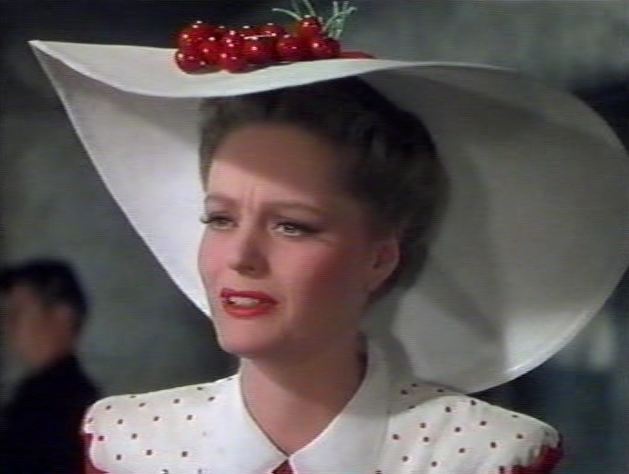
Did not do her own singing in "San Antonio". 

She’s not being dubbed with someone else’s voice, like she was in “San Antonio” (1945).

She is not wearing a body mic.

The director/producer was looking for old movie queen has-beens (Yvonne De Carlo also had a memorable minor role in the show) to push the drama and the pathos, and the angst of aging. What better people to illustrate faded dreams than by using performers whose careers were long behind them and never did live up to their potential?

The tall girl shoved it all down their throats.

Remember to scroll down to the bottom of the page and mute the music so you can hear the video.


After many script changes in the out of town tryouts, she was given this new number to learn at the 11th hour.  Again, here from Ted Chapin’s book: “Alexis Smith was quietly working away. No one was aware of it, but she was working harder and pushing herself further than anyone else.” (p.63)

When given the football, she surprised everyone.

“…For the cold, regal woman who spit out acid remarks all night long to emerge in red fringe, revealing a terrific pair of legs, and dance up a storm -- well, that was revelatory. And it had turned out that Alexis was also a really good actress, well able to get laughs, be hard-edged when called upon…when it came to pure showbiz, it was the sexy movie lady in the red dress who won the day -- and stole the show.” (p.283).

Here’s another clip, a song from that same show, but performed 14 years later in 1985 as part of the “Best of Broadway” TV special from the PBS “Great Performances” series. She was 63 years old here, still spitting her character’s protective sarcasm borne of years of hurtful neglect. I expect she knew something about that, professionally speaking. There is a live studio audience, but since this is set up specifically for TV, she must obviously play to the cameras as well. Look how pointedly she hits her marks. That’s a movie star.


And a Broadway star. She did some other shows. In 1979, the year after studio head Jack Warner died, she won another Tony nomination for her role in the musical “Platinum.”

With the passing years she seemed to grow into that patrician elegance that the Warner Bros. studio decided she should have had at 20. It came more naturally to her now. She had fun with it sometimes, in regional theater, a few more films and TV guest spots. She was nominated for an Emmy for a guest role in 1990 on the NBC series “Cheers”. She was 69 years old.

Then her natural evolution into a grand dame, in a small role in “The Age of Innocence” (1993). A graceful and dignified curtain call for her, it was released to theaters a few months after her death. She left behind her husband of 49 years, fellow actor Craig Stevens, best remembered for his “Peter Gunn” TV series, and with whom she sometimes appeared in stock.

She was said to be well-liked by movie crews back in the day, was a hard worker, and fanatically took lessons on various subjects most of her life, a disciplined, intelligent woman who followed her curiosity with passion. In middle age, she was still taking singing and dancing lessons.

Probably was also not responsible for this hat with the bobbing cherries on top from "San Antonio".

She once famously remarked that she never watched her movies on TV because they weren’t that good when they were made and probably would not have improved with time.  Still, she made her characters as interesting as she could from whatever lofty perspective she had on life at 22, at 30, at 39, at 69…

At 5-foot-9.

The Time Magazine article from 1971 mentioned above noted that she had, “unbeatable, unbeatable cool.”

I suspect she always had; but we were allowed only glimpses -- if someone passed her the football.

Thursday, September 8, 2011

The Toast of New York - 1937


“The Toast of New York” (1937) turns character actor Edward Arnold into a romantic lead. This alone makes this uneven movie a delight.

Based on the true life and financial skullduggery of 19th century entrepreneur James Fisk, Jr., Edward Arnold plays Fisk the Robber Baron with the aplomb of a swashbuckler. In tow are Cary Grant and Jack Oakie as his junior partners. They follow his lead from scheme to scheme like courtiers to a king.

Both, interestingly, play their roles in a subdued, understated manner. To some extent, their parts as written are subordinate to Edward Arnold’s bombastic Jim Fisk, but one expects more broad playing from Oakie in his stooge-like character. He is unusually restrained.

Cary Grant even more so. He is deferential to Mr. Arnold in business matters, and carefully avoids confrontation in a personal matter -- Mr. Arnold’s new friend, lovely Frances Farmer. She is the showgirl, Josie Mansfield (who, incidentally had died only a few years before this movie was made), who Mr. Arnold takes on as his protégé, and probably, love interest. Their romantic involvement, with barely a suggestion of intimacy, is really left for us to assume. It’s not just the Production Code that prevents the movie from being more explicit about their relationship. Jim Fisk is so in love with money there’s little room for anything else in his life (though in real life he found time for both).

Josie Mansfield thinks so, too, but is so grateful to Mr. Arnold for the jewelry and the publicity for her career, that she takes great pains to ignore her attraction for Mr. Grant. Cary Grant, meanwhile, brushes her off with coldness bordering on anger, but it is just to mask his own attraction for her. He does not want to hurt his boss by running off with his boss’s showgirl.

Donald Meek has a great role as Jim Fisk’s fellow Robber Baron, Daniel Drew, the scripture-quoting cheapskate who wants to snatch the Erie Railroad from Cornelius Vanderbilt so bad he can taste it, and so enters into a partnership with the devil, Jim Fisk. Mr. Meek and Mr. Arnold are a study in contrasting temperaments (one reticent and cautious, one bold and risk-taking), physical types (one small and weak-appearing, and one large, appearing bolder still in uniforms the like of which might be worn by a vain dictator), and voices (the wizened whine of Meek, and the booming, barrel-chested baritone of Arnold). They are a little like the Laurel and Hardy of Wall Street.

Billy Gilbert has a minor role, too, as a frustrated photographer.

The movie begins at the outbreak of the Civil War, as Messrs. Arnold, Grant, and Oakie are playing a peddlar’s con game in the south. They are “outed” as Yankees, and make a mad dash for the Mason-Dixon line -- just over that bridge -- to escape certain death by vigilantes and the townspeople they cheated. Then Arnold decides smuggling cotton to the north, defying the Union blockade, would be a better racket. It is one of many speculative ventures that lead the trio from ruin to wealth, to ruin, to wealth.

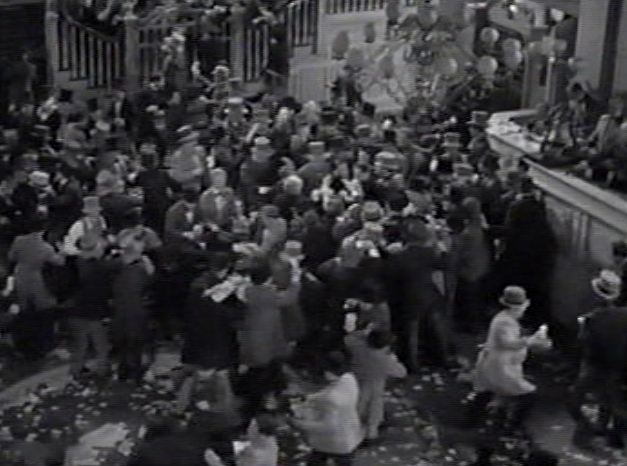
The climatic scenes of the movie are the most dramatic, and involve Jim Fisk’s attempt to corner the gold market, sending Wall Street into a tizzy. His rivals are frantic on the floor, while Edward Arnold sneers over the merciless ticker tape. The price of gold rises and rises, and Wall Street shudders, storming over to Mr. Arnold’s place to kill the gold-eating monster. They don’t have to bother; President Grant (not seen in the movie) releases gold reserves and saves the day. (He should see the price of gold today.)

The montage of piling coins and falling stocks, with a ticker tape run wild are images not unfamiliar to the generation that watched this movie in theaters. It had been only some eight years since the Crash of ’29 brought their worlds down upon them, so what we might view as a quaint and possibly over-dramatic representation of the financial panic of 1869 was to them a personal reminder of human frailty and financial Armageddon.

But this is perhaps nothing in comparison to the mind blowing image of Edward Arnold as a romantic rival to Cary Grant. It’s Mr. Arnold’s movie, right down to the melodramatic ending, and one can’t help feeling glad he’s got the spotlight.