Monday, October 24, 2011

The Unknown - 1927


Obsession. Sadism. Phobia. Panic. We’re going to slide into Halloween this week with some monsters. With all due respect to fans of movies about zombies, vampires, and werewolves, those creatures aren’t real. (The Easter Bunny is real. So is the Tooth Fairy. And leprechauns, they’re real.)

When the ancient Celts marked the Samhain, it was as a kind of Twilight Zone portal into the Other World. How it got to be about gory movies and snack-size Snickers bars these days is a matter for someone else to tackle.  I’m more interested in that portal, psychologically speaking, and the two films we cover this week are rife with human beings on the edge of madness. Being human is what causes their madness. This is what is most terrifying about it.

Today we have “The Unknown” (1927), a silent Lon Chaney masterpiece where “The Man of a Thousand Faces” uses only his own magnificent, weathered, sensitive face to show us the very picture of a man morphed into a monster by his obsession.

On Thursday, the portal to another world leads us into desert ghost town, a killer terrorizing his unlucky captives, while an atomic bomb is about to be tested just outside the tumbleweed-strewn main street in “Split Second” (1953).

Both scenarios are every bit as weird and grotesque as a “monster” movie, but what distinguishes them is that humanity (even more than the lack of it) is the focus, yet these films have the funhouse mirror effect of distorted reality. The acting, writing, and directing is superior.

“The Unknown”, directed by Tod Browning, takes us to a Gypsy circus in Spain. They are outcasts from the start, by virtue of their being Gypsies and by being circus performers. Some, however, are more outcast than others.

Lon Chaney is Alonzo the Armless. Director Browning would later explore sideshow performers in his famous “Freaks” (1932). Here, Chaney and his assistant played by John George, a little person who appeared in many films, represent the physical freaks in the circus. Mr. Chaney has a knife-throwing act. He clutches the knives in his bare toes and flings them at the target.

Joan Crawford is his target. She is the circus owner’s daughter. Only 22 years old, Miss Crawford had already made a slew of silent films in the previous two years and was well on her way to stardom. She later credited her work with Lon Chaney in this film for teaching her a lot about acting.

Lon Chaney was undoubtedly a great example for young actors in silent film. He is mesmerizing in this role, not merely what he does physically -- which as always is remarkable, but what he conveys with his facial expressions is so riveting. He is compelling, heartbreaking, and frightening.

Lon is in love with Joan, is obsessed by her. She is drawn to him because of his passivity and gentleness, represented for her by his having no arms. She is afraid of other men, and being in the position of the beautiful young Gypsy girl, has the unfortunate problem of always getting pawed over by them. She cuddles up to Lon, comfortable in the knowledge he cannot grab her. It’s an interesting way to illustrate she is afraid of sex and he is okay because he is sexless.

Though part of his act is to undress her every performance by shooting her clothes off with a gun.

Norman Kerry, who plays the circus strongman, is also in love with Joan, but he lacks the gentleness and moreover, the cleverness of Chaney to get very far with her. Besides, he has these two strong hands that are always reaching for her, which creeps her out.

In a brutal scene, Joan’s circus owner father beats up Lon, because he wants his daughter to get over her phobia and stop hanging around with circus freaks. He doesn’t want Lon encouraging her friendship. Lon cannot fight back. Norman Kerry comes to his rescue. Lon’s duplicitous expression here, smiling through gritted teeth, is really something. He hates Kerry, his romantic rival, with a passion, but acts the humble, grateful, helpless victim.

Norman Kerry is one of the most handsome men in silents. My gosh, that smile.

When the others have left, Lon’s helper Mr. George undresses him. With Lon’s back to the camera, we see…

Oh, by the way, there’s spoilers coming up. Go outside and sit in the car if you don’t want to know. But don’t play with the radio. It’s right at the station I want.

Now then, with Lon’s back to the camera, his shirt lifted, we see he is wearing an enormous leather corset. John George begins to unlace it. When the cumbersome cocoon is pulled away, we see two, white, snake-like appendages emerge, writhing, from Chaney’s torso.

Oh, lord, they’re arms.

He’s not armless. Only Lon Chaney could make something as completely normal as having arms look grotesque and sickening.

After the initial surprise, this begs the question, why does he hide his arms? It’s a bit much to go through for a circus act gimmick. But, there is more to Lon than the passive, pitiful deformed man. He is not passive, but a manipulative schemer. He is a thief, who hides in the circus that travels from town to town. The police are not searching for a man with no arms.

But Lon is not without a physical deformity. On his left hand, he has a double thumb. Taking his revenge on the mean circus owner, and to clear his way to get Joan for himself, Lon strangles her father. She sees the figure of a man with two thumbs on his left hand committing the horrid act, but she never gets to see Lon’s face.

Now the police are looking for a killer with two thumbs. More than ever, Lon needs to continue his armless act.

Norman Kerry is becoming more amorous, and Joan is clinging to Lon as a safe haven. It is Mr. George who warns Lon that he must never let Joan get close to him, for she eventually will, in the intimacy he hopes for, discover his arms, his thumbs, and who he really is.

Lon is crushed, and struggles with this problem. A terrific scene where he sits smoking a cigarette held in his toes, even though his arms are free. John George kids him about being so accustomed to using his feet that he sometimes forgets he has arms.

How much of Chaney’s work in this film grasping objects, wiping his face with a handkerchief -- all done with his feet is done by his own ability to contort his body and how much is done with the help of a stunt double I’m not sure. A double was indeed used to help, but I don’t know in which scenes that occurs.

Then the solution comes to Lon, and we see in his expressive dark eyes the obsession has turned to madness.

He blackmails a disreputable doctor to amputate his arms.

While he is away having this little bit of cosmetic surgery, Norman Kerry has learned that patience is a virtue. His respectful, not to say hands-off, treatment of Joan has won her heart. She is over her fear of men, and they welcome Lon back to the circus with the good news that they are going to be married. Kerry’s arms are wrapped around Joan. She holds one of his hands against her chest and kisses it.

This is the scene you want to see. Lon’s frozen-faced reaction, his ghastly forced grin, his tearing eyes, and a gasping, howling (yeah, I know it’s silent) descent into psychological hell. It’s as fine a few minutes of pantomime as ever was filmed.

But, wait, there’s more.

Mr. Kerry has a new act where he shows his strongman stuff pulling two horses made to run in opposite directions. He shows Lon how it works in rehearsal. Lon plans to rig it so that Norman Kerry’s arms get ripped off. Will it work? Here’s a link to the movie, now in public domain, on YouTube (in five parts). Go watch this creepy portal into the Other World where cherished dreams are entrapped by filthy nightmares. Very human stuff.

Come back Thursday for “Split Second” and a terrific ensemble cast of brutal killers, unlucky misfits, adulterous schemers, a dame down on her luck, and a reporter looking for the story of the century all trapped in a portal to Armageddon one evil night.

Thursday, October 20, 2011

John Huston - Biography by Jeffrey Meyers


“John Huston - Courage and Art” is a new biography of the larger-than-life Hollywood director (and writer, and sometimes actor) by Jeffrey Meyers.

The director of “The Maltese Falcon” (1941), “Key Largo” (1948), “The Asphalt Jungle” (1950), “The African Queen” (1951), “The Treasure of Sierra Madre” (1948) and “The Misfits” (1961), these titles alone would ensure him a place among the finest directors in classic films, along with his two Oscars, but he was also as famous for his bold, freewheeling lust for life, adventure, and women.

Mr. Meyers is no stranger either to biography or the Hollywood or literary greats. His numerous books include works on Humphrey Bogart and Ernest Hemingway, who the author notes figure prominently in John Huston’s life and work. To some extent this new book and his previous biographies dovetail in themes and certainly in research. The book is fast-paced, very readable, although sometimes repetitious. It is a good introduction into the psyche of John Huston, but the catalogue of his passions, which were many, and his attention span, which was brief, don’t leave as much room for a detailed analysis of his films, which is what appeals most to film buffs.

John Huston, son of the famous stage and film actor Walter Huston, was estranged from his parents in childhood, and also suffered from poor health such that he was made to understand he would die young. From that point, he lived a live as full and daring as anyone possibly could, which left him at the end of his (actually) long life with a string of accomplishments, and with a line of wives and lovers, and children with whom he could or would not connect emotionally.

Nevertheless, they, as others did, found him a charismatic man whose bravest act of all was perhaps just daring to tell stories no one else told in a spare, artist’s manner no one else tried.

“John Huston - Courage and Art” by Jeffrey Meyers is published by Crown Archetype.

NOTE: A free copy of “John Huston - Courage and Art” by Jeffrey Meyers was provided to me by the publisher for review purposes.

Monday, October 17, 2011

Jean Arthur

This is the 111th anniversary of the birth of Jean Arthur. The clips below might help to illustrate her unique quality of preoccupied self knowledge, comic pathos, and that ability, elusive-to-description, to be Everywoman and at the same time like nobody you ever knew. She brought depth and empathy to screwball comedy. She brought sly silliness to sober drama. Humanity was something she understood and conveyed easily, but crowds unnerved her and she preferred the silence of her own contemplation.

Remember to scroll down to the bottom of the page and mute the music so you can hear the videos.


In 1942, she visited Fred Allen’s radio show for a couple of comic skits, and this unabashed duet of “In My Merry Oldsmobile”.


Here in “A Lady Takes a Chance” (1943) she tried to cozy up to a resisting John Wayne. He should have done more comedy. Look at his antsy reaction to her having beer foam on her lip. It drives him nuts. She blithely prattles on, unaware how clownish she looks. She never played the clown. She played the social faux pas and the recovery from embarrassment. That was her spin. Notice at the end how she’s floundering in an agony of jealousy and frustration, and shouts “More beer!” to retaliate for his ignoring her.


She understood so much, instinctively, and yet explained very little. It required a light touch, and that was her genius.

Thursday, October 13, 2011

Alexis Smith


Alexis Smith had a rare opportunity to stretch her acting muscles in “The Constant Nymph” (1943), discussed here in Monday’s post. She remains for me a mystery, a particularly interesting actress both for her ability, which I suspect was far greater than she was usually allowed to demonstrate; and especially for that very fact that she wasn’t allowed to demonstrate it very often.

Odd, when you consider she was plucked out of college to be fashioned into “The Dynamite Girl” by Warner Bros., subjected to the usual flurry of sexy publicity photos, and was soon paired with greats such as Humphrey Bogart, Errol Flynn, Cary Grant, Charles Boyer, Clark Gable, and Fredric March. (We’ve covered “Conflict” -1945 here, and “Any Number Can Play” - 1949, here.)

Both 5'9", Charles Boyer and Alexis Smith see eye-to-eye in "The Constant Nymph" even if their characters do not.

Despite easily being able, whether the material was good or not, to shine in her roles, sometimes steal scenes outright just by the force of her own splendid magnetism, she was often relegated to parts where she played little more than a type: a clothes horse, an ice princess, an elegant but haughty love interest.

In the 1950s, when her contract at Warners ended, she had fewer roles if a bit more variety in them. Also, time was catching up and she endured a series of those older repressed woman roles, the typical leavings of that era for aging actresses of Hollywood’s Golden Age. Aging? She was only in her 30s at the time.

But, despite sometimes having very little to work with, she made the most of them. In “The Young Philadelphians” (1959), she plays the lonely, stifled trophy wife of an elderly man. Paul Newman is his young assistant. From the moment they meet, Alexis and Mr. Newman are intrigued by each other, leading to, but not quite reaching, a love affair. Though Paul Newman is quite good in this movie, (actually so is Robert Vaughn in a minor role), much of the drama is pretty flat. Alexis Smith stole the film, what few minutes she had in it, and would have been a far more exciting partner for Newman than the rather predictable debutante played by Barbara Rush.

So, what seems strange about her career is not so much missed opportunities of roles she never got, but that she was chronically under-used.  The characters she played never went far enough or deep enough.  It takes a special kind of actress to enhance what is not on the page.

One of my favorite roles of hers is in “Here Comes the Groom” (1951), discussed here, where, as a second lead, she plays the awkward, lovelorn goof, too gangly and socially inept to get out of her own way. It’s as if she’s making fun of her earlier ice maiden roles. Bing Crosby teaches her how to be a hot tomato.

At one point he asks her why she wears ugly, sensible shoes.

“Because I’m too tall, if you must know!” she blurts out with building hysteria, which is endearing, as if it is her most embarrassing secret.

It seems too simple, but I can’t help wondering if that was it all along. In a 1980 interview with the Los Angeles Times, she noted that, "At the time, only cute little girls did musicals…It doesn't work out so badly now, but when you're 5 feet 9 in high school, you'd give anything to be a cute little girl."

Did her height set her off as patrician and aloof, and austere?  Did her striking appearance make her a square peg?

In the 1946 “Night and Day”, which attempted, sort of, to present the life of Broadway composer Cole Porter, a cast including Eve Arden, Mary Martin, Jane Wyman, and Ginny Simms belted out a smashing array of Cole Porter hits. Alexis Smith played Mrs. Porter. Everybody with a studio tour pass that day got to sing and perform in this movie. Including Monty Woolley, gosh-all-hemlock. Not Alexis. She spent the entire movie smiling encouragingly at Cary Grant from the audience while he avoided her for his work.

What a waste.

Now the calendar pages flip furiously and we jump a few decades into the future. Have a look here at this cover from Time Magazine, May 3, 1971. Go ahead, I’ll wait.

(Wipes her glasses on her shirt tail. Hums the first two acts of the score of “Rigoletto”. Sharpens a couple of pencils.)

Back? Good. You have to pull that screen door or it won’t shut.

Now then…

That’s Alexis, at 50 years old, svelte, sexy, and doing a chorus girl’s high kick in the Broadway show “Follies” at the Winter Garden.   Resurrecting a wobbly career that had died and given up the ghost.  So people thought.

The cover of Time.

It’s been called the biggest career comeback ever. (Here’s the lead the article by Peter De Vries.)

“Follies”, music and lyrics by Stephen Sondheim, directed by Hal Prince and Michael Bennett, was a remarkable production for many reasons. Since I’m not sure how many theatre buffs read this blog, I’ll just say it was a groundbreaker and leave it at that. It is a complex show, where several aging “Follies” stars must revisit the aspirations, and mistakes, of their former selves (which are moving about the stage like ghosts). Alexis, similarly, may have been working out a lot of demons about her real former film career while on this gig.

This gig, for which Alexis Smith won the Tony Award for Best Lead Actress in a Musical.

Best actress in a musical. Hear that, Jack Warner?

Author Ted Chapin, who wrote “Everything Was Possible - The Birth of the Musical ‘Follies’” (Alfred A. Knopf, NY, 2003), mentions Alexis Smith being overheard during rehearsal after reading another publicity article where she was inevitably and tiresomely pronounced “tall and striking”.

“She remarked: ‘I wish I could someday play someone short and fat.’” (pp. 56-57)

And here she is below, the tall girl, doing her big, flashy number from “Follies” in her now iconic red dress. Just having a clip, any clip, from a Broadway show is a treasure because it’s so rare, especially in those days when people didn't have cell phones and tiny video recorders to sneak into the mezzanine and secretly tape stuff.

Michael Bennett’s choreography from this show is fantastic (of course it was, it was by Michael Bennett), and you get a hint of it here, the inventive placement of male chorus dancers with their backs to the audience, navigating a multilevel raked set. It’s not the best quality video or audio, but heaven bless the person who cleaned it up and shared it. Note how the tempo picks up as the song moves along. By the end of the song, the pace is frenetic. Alexis doesn’t miss a beat.

She’s 50 years old. She’s hustling like a 20-year-old theatre gypsy.

Humphrey Bogart, Clark Gable, and Errol Flynn are dead. Cary Grant’s retired.

Did not do her own singing in "San Antonio". 

She’s not being dubbed with someone else’s voice, like she was in “San Antonio” (1945).

She is not wearing a body mic.

The director/producer was looking for old movie queen has-beens (Yvonne De Carlo also had a memorable minor role in the show) to push the drama and the pathos, and the angst of aging. What better people to illustrate faded dreams than by using performers whose careers were long behind them and never did live up to their potential?

The tall girl shoved it all down their throats.

Remember to scroll down to the bottom of the page and mute the music so you can hear the video.


After many script changes in the out of town tryouts, she was given this new number to learn at the 11th hour.  Again, here from Ted Chapin’s book: “Alexis Smith was quietly working away. No one was aware of it, but she was working harder and pushing herself further than anyone else.” (p.63)

When given the football, she surprised everyone.

“…For the cold, regal woman who spit out acid remarks all night long to emerge in red fringe, revealing a terrific pair of legs, and dance up a storm -- well, that was revelatory. And it had turned out that Alexis was also a really good actress, well able to get laughs, be hard-edged when called upon…when it came to pure showbiz, it was the sexy movie lady in the red dress who won the day -- and stole the show.” (p.283).

Here’s another clip, a song from that same show, but performed 14 years later in 1985 as part of the “Best of Broadway” TV special from the PBS “Great Performances” series. She was 63 years old here, still spitting her character’s protective sarcasm borne of years of hurtful neglect. I expect she knew something about that, professionally speaking. There is a live studio audience, but since this is set up specifically for TV, she must obviously play to the cameras as well. Look how pointedly she hits her marks. That’s a movie star.


And a Broadway star. She did some other shows. In 1979, the year after studio head Jack Warner died, she won another Tony nomination for her role in the musical “Platinum.”

With the passing years she seemed to grow into that patrician elegance that the Warner Bros. studio decided she should have had at 20. It came more naturally to her now. She had fun with it sometimes, in regional theater, a few more films and TV guest spots. She was nominated for an Emmy for a guest role in 1990 on the NBC series “Cheers”. She was 69 years old.

Then her natural evolution into a grand dame, in a small role in “The Age of Innocence” (1993). A graceful and dignified curtain call for her, it was released to theaters a few months after her death. She left behind her husband of 49 years, fellow actor Craig Stevens, best remembered for his “Peter Gunn” TV series, and with whom she sometimes appeared in stock.

She was said to be well-liked by movie crews back in the day, was a hard worker, and fanatically took lessons on various subjects most of her life, a disciplined, intelligent woman who followed her curiosity with passion. In middle age, she was still taking singing and dancing lessons.

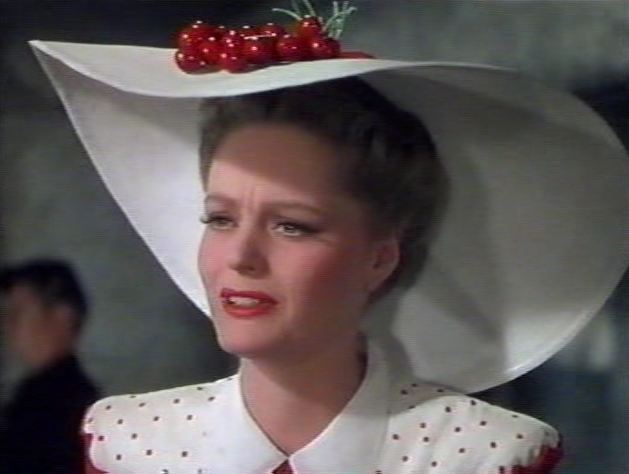
Probably was also not responsible for this hat with the bobbing cherries on top from "San Antonio".

She once famously remarked that she never watched her movies on TV because they weren’t that good when they were made and probably would not have improved with time.  Still, she made her characters as interesting as she could from whatever lofty perspective she had on life at 22, at 30, at 39, at 69…

At 5-foot-9.

The Time Magazine article from 1971 mentioned above noted that she had, “unbeatable, unbeatable cool.”

I suspect she always had; but we were allowed only glimpses -- if someone passed her the football.

Monday, October 10, 2011

The Constant Nymph - 1943


“The Constant Nymph” (1943) recently premiered on TCM. It would be interesting to get TV ratings data for that night. A film so long tangled up in legal limbo, it’s a rare gem for classic film buffs, probably all of whom with access to TCM were watching or recording it or both.

“Legal limbo” has an otherworldly sound to it. It’s not really a place. It’s an imaginary existence -- or lack of one -- that suggests a challenge yet to be resolved. Those of us on the outside of this struggle, with little understanding of it, merely accept that there is such a plane of existence.

Accepting without understanding can be a kind of safety valve. At other times, it can be a gift we give to those whose feelings or actions are beyond our comprehension. “The Constant Nymph” shows us a musically creative family who need a great deal of understanding, but whose peculiar “insanity” is “of the most enchanting kind.”

This, according to Charles Boyer, friend of the family and not a little insane himself.


The art of illusion plays a big role in this film, gently directed by Edmund Goulding. The dilapidated chalet in the Swiss alps, whose foothills hover just on the back cyclorama, are straight out of “Heidi”. A storybook illusion. The mosses and ferns, and disparate branches and grasses on the furry mounds just beyond the house wave in the light breeze created by the unseen wind machine, and lift the errant strands of hair escaping from Joan Fontaine’s tight, untidy braids.

Joan Fontaine is the biggest illusion in this film. She plays a teenager here, natural and unaffected, completely innocent yet possessed of wisdom beyond her years. She runs with a round-shouldered burst of exuberance, and throws her opinions around like any know-it-all kid. She is funny, and elfin, and tragic. I think it’s one of the best performances I’ve ever seen from any film of that era. She was something like 25 years old at the time. Her skinny, awkward body is the least of the illusion; most of it comes from that hyperactive energy, the clear face with its constantly changing expressions. She is quite remarkably moving.

The way Boyer rustles his hand through her hair roughly and puts a gentle hammerlock on her, tucking her head under his arm. He doesn’t quite get that she’s in love with him, but the film avoids the sexual escapades of the book by putting her love and his misunderstanding of it on a higher plane.

Like legal limbo, I suppose.

Boyer’s main trauma comes from not living up to his potential as a composer. “If he’d only cry,” Joan Fontaine’s dissolute composer papa, played by Montagu Love, declares. M. Boyer recoils from sentiment and tenderness, or maybe just hard work, preferring a lazy joke, or a romantic diversion, which here is played by Alexis Smith.

Alexis Smith, for once in her life, has a role she can sink her teeth into. She is the wealthy, upper class society debutante who is summoned to the storybook chalet to take charge of the girls after the death of Montagu Love (who actually did die a month before this film was released). She is the maternal cousin of Joan Fontaine. Her father, played with typical comic crankiness by Charles Coburn, is the brother of Fontaine’s long-deceased mother.

Rounding out the family we have a few more sisters and half-sisters, one of which is played by Brenda Marshall, who is pursued with middle-European angst by Peter Lorre.

Joyce Reynolds is charming as Fontaine’s closest sister, who shares in her troubles and hijinks. Fontaine dumps Miss Reynolds from her bed onto the floor in our introduction to her character. In a sweet, melancholy scene, Reynolds comforts Joan Fontaine, who has fainted. Noticing a bruise and smudge of dirt on Joan’s upper arm from when she fell like a sack of wet cement in the dirt, she licks the corner of the bedspread and daubs it lovingly on Joan’s skin.

Joan took a dive when she heard that Boyer has suddenly proposed marriage to Alexis Smith. Afterward, whenever Smith and Boyer are around, Joyce Reynolds keeps a close watch on her sensitive sister. On another occasion we see her dark eyes dart from the happy couple to Joan, helpless to prevent the cold slap of reality that she’s just a kid and Boyer is a grown man with a grown man’s appetites.

But soon, it’s Alexis Smith who needs comforting. She has perceived no warning from Joyce Reynold’s alert glances. Miss Smith begins to sense, on her own, a bond between Boyer and Fontaine. She’s almost sick with jealousy. It’s a very good performance, and even at her most harsh and shrill we have to sympathize with an insecure woman who knows she’s losing her handsome husband to a skinny little poor orphan with fainting spells.

“You’re so real, so definite,” Boyer says to Alexis, by way of a compliment, but he has no real interest in reality. It’s much more fun to play in an ethereal existence. Not that he hasn’t the ability to fit in wherever he goes. In a ballroom scene, he meets Dame May Whitty, more cranky than her pal Charles Coburn, and charms her to pieces. How they click immediately is irresistible.

I was a bit thrown by “Danny Boy” being played in the background. Not something I would expect in an upper class British ballroom.

But, Boyer chafes under his bride’s social set, does not want to perform for them, and Alexis deals smoothly with his tantrums and fretfulness. It’s Joan Fontaine that gets under her skin. Still, Alexis has agreed to become the girls’ guardian, save them from poverty, and this may be her chief value to Boyer, though he has the tact not to say it. She even has looked into and learns the name of Joan’s mysterious heart condition that gives her palpitations and fainting spells; Boyer shrugs it off as a bothersome detail, like school enrollment, which is also left to her.

It is the reality of his new everyday existence that perhaps irks Boyer most, with the girls sent to boarding school and Alexis so in love with him she shows him off to all and sundry, when she is not sending him to his studio to work. He needs a little illusion, or at least some self delusion, to buffer against the responsibilities of the everyday.

I think my favorite illusion in the film is the fact that in real life, Alexis Smith was nearly four years younger than Joan Fontaine.

Her height and elegance conveys that she’s the grown up and Fontaine is the kid. Fontaine’s school uniform helps, and the delightfully floppy way she carries herself completes the picture.

The film has a leisurely feel to it, and lightness, and gentleness that compliments the ethereal nature of the story. It takes a different tone from the book -- and has to, to pass muster of the Code, but this is part of the movie’s charm. It could be such a heavy soap opera, and it’s not. Think of other films like “All This and Heaven, Too” (1940) or “Now, Voyager” (1942), which hammer us with the illicitness of the love story. This fable, like Joan Fontaine’s character, is beautifully natural and tenderly developed.

The tension builds with Alexis Smith’s devotion to honesty, which is even stronger than her devotion to Boyer. The truth may set us free, but honesty is often the most callous and brutal road to freedom. Both Smith and Fontaine suffer this, and courageously face honest self appraisals of their shared reality. The two characters change the most, almost in tandem, through the film.

At the end, we have a conversion of sorts, when Alexis Smith, enraptured this time and no longer haunted by this embarrassing romantic triangle, experiences the same thrill of Boyer’s music as Fontaine does, and at the same time. The music here is by Erich Wolfgang Korngold, which launches Fontaine into a dream sequence. It is one of the most imaginative scenes in the film where snippets of previous dialogue are strung together to create a kind of fractured memory effect -- the illusion that the words are familiar and yet completely new. An eerie déjà vu.

Smith is not part of Fontaine’s dream sequence; we do not get to see her epiphany. We only see the ironic twist that Fontaine is roused from her reverie by the fear of death in the reprise of lines she earlier recited with an innocent lack of understanding of what they meant.

I like movies that give me something to think about after they end. What if we had been allowed inside Alexis Smith’s head when she changed her mind about the love between Joan Fontaine and Charles Boyer? Her astonishing turnabout, her offer to release him is done without self-pity or bitterness, but with a heart full of love, a sense of excitement in accepting a situation that exists without understanding it. What went on in that theater box for her to do a 180 on wanting to boot Fontaine out of her house?

What if the ending was different? (I’m going to avoid a spoiler here, but you several million who watched the TCM premiere know what I’m talking about.) Would there still be a romantic triangle tinged with the rumor of pedophilia? Would Boyer ever find his muse without losing it first?

What happens if he is without both his muse and his wife? Is he still going to compose, the new darling of the moneyed set, or just find some other storybook soundstage to lose himself -- that other elusive plane of existence that enchants and entangles, and inevitably leads to sorrow?

Like legal limbo.

Thursday, October 6, 2011

My Man Godfrey - 1936


“My Man Godfrey” (1936) pegs the era in such a precise way. It’s duality is its greatest charm --a light and airy foolishness above a message of grim reality that makes it a timeless foray into a specific Depression-era genre: the screwball comedy. Carole Lombard reigned as screwball’s quintessential high priestess. We celebrate the Carole Lombard blogathon today, sponsored by Carole & Company. Have a look for other participating blogs here.

Screwball comedy in the 1930s often doubled as social commentary, that was how it worked best. It threw darts, but lacked pretension. It called a spade a spade with honest and earthy directness, but without being cynical. There was still a luminescent idealism. It told its audiences of the day the way things were, and left an unmistakable footprint for future generations to vicariously experience the 1930s.

The film, directed by Gregory La Cava, begins famously with those credits stylized as neon signs over a cityscape, panning slowly until we pass the glitter and end up at the town dump. A “Hooverville” exists here. As frothy as the café society nightlife is depicted in this movie, the dump set is remarkably gritty and realistic. And big. A lot of work on the detail of that dump set.


Carole Lombard is a ditzy Young Thing on the town. She is on a scavenger hunt, one of the fads of the 1930s, that is organized by the party she is attending at the Waldorf-Ritz. Her older sister, played by Gail Patrick, is also in the competition, and Miss Patrick reaches the dump first for the next item on their list. A “forgotten man”. This was the euphemism in the day for a hobo or bum, or street person. Forgotten man sounds almost politically correct, doesn’t it? President Franklin Delano Roosevelt used the term (though he did not invent it) in referring to the folks who needed relief, and the phrase took off.

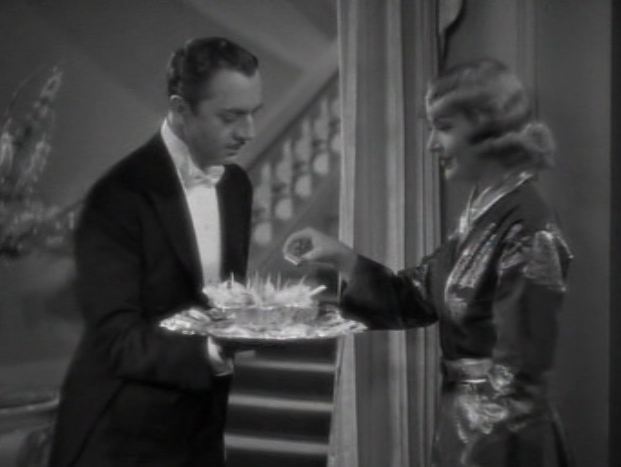
The Forgotten Man of the piece is William Powell. Powell is excellent here, a man intelligence and dignity, whose bitterness at living among the ash heaps in the dump is barely contained. Yet there is a careful reserve about him, a latent philosopher, and a wonderful unshaven virility that attracts the audience, and soon, Carole Lombard. He was never more sexy than in this movie.

She is first awed by him, and smitten, especially when he backs Gail Patrick into a pile of ashes. Gail is a haughty, arrogant rich brat who irritates Powell with the condescending offer of $5 to Powell if he will accompany her back to the Waldorf to be inspected by the prize committee as a genuine bum. Uh, forgotten man.

There is no love lost between the sisters. Carole’s delight at seeing her sister humiliated, as well as her more sensitive and shy request that Powell be her forgotten man, makes Mr. Powell allow her the privilege of capturing him.

At the party he sees the wealthy class in an orgy of junk collecting to win a prize.  He finds himself put on display, a little like a slave at a slave market when Franklin Pangborn strokes his cheek to see if the whiskers are real. Powell calls them “empty-headed nitwits” and Carole’s simple conscience, when it exists, realizes he has been humiliated. She feels guilty, and decides to bring him to her parents’ mansion to give him a job as their butler.

Of such simple stuff is excellent screwball comedy made.

Alice Brady, no sensible earth mother as we last saw her in “In Old Chicago” here, plays a society woman ten times ditzier than Carole Lombard.

Mischa Auer, in the “mad Russian” role he patented, plays a social parasite Alice Brady takes into their home as her protégé. He is a musician when he is not eating, or doing gorilla impersonations.

Eugene Pallette, he of the lordly, imposing girth and the foghorn vocal chords, plays the husband and father, and keeper of the keys to this nuthouse. The 1930s longsuffering rich guy, out of step in a world undisciplined and nutty. He is left paying the check.

Jean Dixon, longsuffering herself, plays their maid with that typical 1930s wisecracking sensibility that keeps us all levelheaded. I love the scene where she lovingly sews a button on Powell’s jacket, and Lombard strokes the sleeve. “It’s his, isn’t it?” Powell is unaware of the harem he has made of the household females.

Our beloved Grady Sutton (see this previous post), has a brief role as the bewildered fellow Carole Lombard takes as a fiancé for spite when William Powell exhibits no interest in her.

William Powell, it is disclosed to us, but not his employers, is not really a servant. He is from an upper class Boston family. He ran away after a failed romance, intending to kill himself. When he stumbled upon the destitute in the Hooverville, he instead learned a less about life and the grit and nobility of survival. He takes the butler’s job as part of his own self-rehabilitation -- part therapy and part penance, and he applies himself with diligence to his job. He is a very good butler.

We might remark that the rich people in this movie are child-like and foolish, and irresponsible and we may wonder if the audiences of the 1930s were disgusted or ridiculing of the upper class because of it. How could people like this be running the show? On the other hand, we have their neighbors in the lower class section of town, the Sycamore family of “You Can’t Take It With You” in their own self-imposed fantasy world of foolishness. Mischa Auer, you’ll remember, shows up as the perennial guest for dinner in that one, too.

I wonder if “Ochi Chornya” (pick your favorite spelling) or “Dark Eyes” could be considered a minor anthem of the 1930s? We hear it in so many movies of the day, including repeated bursts from music boxes in “The Shop Around the Corner” (1940) here.

Another musical reference we may note is Alice Brady’s musing that nobody knows the words to “The Star Spangled Banner”. It had become officially our national anthem only in 1931, five years before this movie was made.

Perhaps my most favorite topical reference from this movie, because it turns to be just as relevant today, is when Powell responds to his business partner’s question, “When do you start paying dividends?”

He replies, “Well, we’re giving food and shelter to 50 people in the winter and giving them employment in the summer. What do you want in the way of dividends?”


And the Art Deco nightclub they build over the old landfill is called The Dump.

The lines are fast and furious, and funny, and subplots include Mr. Powell’s plan to rehabilitate the dump just as he has rehabilitated himself and get his homeless friends there jobs. Meanwhile, the evil sister, Gail Patrick, plots to have him arrested for stealing her pearl necklace, which she plants in his room.

It is refreshing, in an odd way, to see two sisters really dislike each other and be shown as truly incompatible. “Yah! Yah! Yah!” as Miss Lombard would shout. Her incorrigible sweetness mixed with a cloying immaturity is a tough balance to maintain, but Carole Lombard does it well and probably better than anyone else could. William Powell knew this, and so when this project came up, he pushed for Lombard to get the part. That they were divorced in real life clearly made no problems in their chemistry for this movie.

Powell has chemistry with everybody in this movie, including the nasty Gail Patrick, and even poor Jean Dixon is so lovesick for him by the end of the movie, she and Lombard sob in each other arms over his leaving.

But it is Gail Patrick’s character I find more interesting. For all her meanness, the spark of attraction she feels for Powell is intriguing. Her encounters with him in the drawing room, and at the bar where she intrudes upon his meeting with a friend from the old days are snide but sexy jousts. She knows he has a secret and wants to ferret it out, ostensibly to humiliate him, to take revenge for his backing her onto her bum in the ash pile at the beginning of the movie.

She bullies him, she threatens him, she insults him. She uses her womanly wiles against him. He is impervious, and, in a superior and classy way tells her off, and this drives her nuts and makes him more attractive to her. In the end, another subplot reveals that Powell, through his own private scheme to raise money, has also saved her father from bankruptcy and a possible jail sentence.

Miss Patrick’s steel butterfly persona melts under the realization that Powell is their savior. Gratitude, contrition, and humility wash over her, and that is what really saves her as a human being. We wonder what kind of person she will turn out to be now that she has undergone a conversion. With Lombard’s character, we may assume both her unflappable charm and her childish tantrums will continue without change.

If we weren’t talking about the great Carole Lombard, I would say I preferred Patrick to end up with Powell at the end. But, it’s sweet, ditzy Carol that captures, truly this time, William Powell and leads him into wedlock before he knows what’s happening. In time she may end up being a carbon copy of her mother and Powell a copy of her longsuffering father.

That infectious, almost maniacal giggle bursts forth from her at the very end of the movie when Powell is ten seconds away from saying “I do”. Lombard makes this childish ditz lovable, so it is no wonder she gets away with it. And unlike Gail Patrick, who leads men around on a leash, Lombard needs someone to look after her. Naughty girl that she is.

Don't forget to check out the rest of the great blogs participating in the Carole Lombard blogathon.

Monday, October 3, 2011

Carole Lombard Blogathon and Other Stuff


This is a brief reminder of the Carole Lombard blogathon sponsored by Carole & Company, which begins this Thursday.  My contribution will be a look at "My Man Godfrey".  Have a look here for the list of participants.

And a couple of other notes:   Last summer I wrote about an exhibit of Norman Rockwell's work involving Hollywood subjects called "Rockwell and the Movies", here.  I managed to get to the Norman Rockwell Museum in Stockbridge, Massachusetts this weekend (actually for another exhibit), and sneaked a peak at the enormous painting of Jennifer Jones from "The Song of Bernadette" (1943).  The image depicts her character in contemplative awe at the moment of seeing her vision of the Virgin Mary.  One is always struck by the detail of Rockwell's photographic-style of illustration, and his likeness of Jennifer Jones is the best I've ever seen.  What made the painting more remarkable is that he adds that slightly subjective drama to the expression on her face and the stillness of her body that makes image go beyond merely photographic.  It enhances the image and enraptures the viewer.  His simulation of her simulation of seeing a heavenly vision is deeply moving.

Close by was the excellent depiction of Tyrone Power from "A Razor's Edge". 

Art is inevitably subjective.  In another gallery, an exhibit of animation from the Blue Sky studio contained a video presentation of some short cartoons made from the late 1980s to the present.  An elderly couple sat down in empty chairs in front of the small screen, I think simply to rest.  During a series of cartoons about a hapless squirrell whose fast-moving, slapstick adventures left him in constant danger while trying to protect his supply of acorns, this elderly couple bust a gut laughing.  I never expected them to enjoy this rapid-fire lunacy.

I was more amazed by the little girl who wandered in to watch, probably about 7 years old.  She remained stone-faced during the entire set of cartoons, occasionally sneaking glances at the elderly couple and smiling a little at them as one does in antipation at another person's laughter, and then bringing her eyes back, dubiously, at the screen as if wondering what was so funny.  Eventually, she became bored, and slipped on the earphones, and listened to her iPod, lost in a world she preferred and did not have to share.

Something tells me this child is never going to enjoy screwball comedy like Carole Lombard.  But I hope life will treat her gently and she may discover, as the elderly couple have, the delight of such simplistic irony and the utterly human joy of laughing at ourselves.  That's the secret, little one.  We're not really laughing at the squirrel, we're laughing at ourselves because we know how he feels.  We've been there on really bad days.

If the couple were her grandparents, I think they could take her in hand and show her in time by their glorious example.  But they were strangers to her, and she will never see them again.  In a moment, her father came in, a man likely in his middle 30s but dressed like a boy, the kind of person who bolts through museum exhibits like a man checking off an obligatory grocery list.  There.  I've got that done.  Now let's get out of here.

One more thing, my short story "Constancy", available as an ebook from Amazon, Barnes & Noble, Smashwords, Sony, etc., was recently reviewed on the book review blog Red Adept Reviews, accompanied by an interview, here.

See you Thursday for "My Man Godfrey".